Showing posts with label reading. Show all posts

30 April, 2026

Two large books!

I don't read paper books very often these days. Ebooks from the library are definitely more within my budget! They have other advantages too: like being able to read in bed without a light (works for camping brilliantly!) and being able to read without physically holding the book (works for reading while eating).

But somehow I've ended up reading these two large physical books at the same time. The total number of pages between them is more than 1,000! I don't have big hands and they're definitely both a handful.

Dominion is much more of a mental "handful" than Homecoming, though. For starters, the font is, I think 9! Which puts it at "dictionary" or "Bible" level. It's small. But the topic is what makes it a real mental challenge. It's covering around 2000 years of history in its 500 or so pages. 

"The book is a broad history of the influence of Christianity on the world, focusing on its impact on morality – from its beginnings to the modern day. According to the author, the book 'isn’t a history of Christianity' but 'a history of what's been revolutionary and transformative about Christianity: about how Christianity has transformed not just the West, but the entire world.'" (Wikipedia)

It moves fast and the Zoom lens following events shifts in and out rapidly. The author uses big words and assumes you know a fair bit of history already. I've had to try to read quickly, which sounds counterintuitive, but by reading quickly I can catch his drift without getting bogged down by the details and lose track of where he's going with his meta narrative. I've heard this book referenced numerous times in the podcast I like: "Undeceptions". When David found it at a bookstore in Australia last year when I was "redeeming" a book voucher, it seemed like a good challenge to set myself for 2026.

Homecoming is a family saga set mostly in Australia (the font is larger, 12, I think). I think this book was given to me by a friend who was packing up to leave Japan for a time. I'm enjoying it and moving through it at quite a good pace, I might even tackle another one of this author's books in the future. 

Dominion is more of a "it'll take at least six months" kinda book. Because my work involves a lot of reading and editing, I am pretty picky about the quality of the things and the genres I read in my spare time, but also prefer easy-to-digest reading. Reading Dominion is hard work and I don't always have the mental capacity to digest it after all the reading I've done at work.

I read a lot. I fell in love with books at an early age. They are my go-to for relaxation. Sometimes people ask me when I fit it in. I read if I'm eating alone (which is during weekdays most days), I read to go to sleep. I read during the night if I can't go back to sleep. I read in waiting rooms and on trains—another good reason to use ebooks, because I can access the library app on my phone as well as my Kindle, I don't have to carry a heavy book or extra device around with me. Basically, I read when I have spare time, but also mental capacity—I do play (logic, word, and puzzle) games on my phone too.

What have you been reading this month?

25 September, 2025

Not tying my significance to my busyness

Yesterday I got to ride to my favourite large park. I don't think I've been there since April! It was my first ride there after the worst of the summer heat had abated. Just like last year, for weeks I've found myself longing for this.

It wasn't just a 16 km ride, I stopped in the park for a picnic and read (mostly non-fiction) for over three hours. Like a mini retreat, really. Also, riding a bike gives you time to think! And I think better when I'm doing something physical.

I was surprised when two main books I spent time reading yesterday intersected in some of their themes, as they are authors from very different worlds. The first one I mentioned a couple of weeks ago: Life Interrupted by a friend, Susan Chapman, it was published three years ago during the pandemic. It's short and jam packed with things to think about how we live our lives, our expectations, how to continue to grow, and take care of ourselves at the same time. Susan is a missionary with our organisation and I've known her since before we came to Japan. She, like me, has lived her life in Australia and East Asia and grew up in a similar part of Australia to me. Her book was born out of a major interruption that she and her husband experienced during Covid. It's a text that you could use for a retreat or a small group, because there's plenty of questions and avenues to explore.

The Cosmo field: I alway stop here
and take photos at this time of the year.
They were almost the only flowers in the
whole park yesterday.

One quote that stood out to me was, "To say no appropriately, we need to stand against any cultural expectation that our busyness is linked to our significance. Author BrenĂ© Brown sums it up well—'if we want to live a wholehearted life, we have to become intentional about cultivating sleep and play, and about letting go of exhaustion as a status symbol and productivity as self-worth.'"

The second book is The Road to Daybreak, and is the first book I've read by Henri J.M. Nouwen. I've seen him mentioned by authors like Tim Keller and Philip Yancey, but haven't picked up one of Nouwen's works myself. Henri was a Dutch Catholic priest who worked for much of his life in north America; he was an intellectual as well as a priest, a speaker and mentor as well as dipping his toe in the waters of missionary work in South America. This book was extracted from a diary he wrote during a year when God led him away from the intellectual world of Harvard into a very different life. He was serving as the priest at a L'Arche home in France. (L'Arche ("The Ark") is an international federation of non-profit organisations working to create networks of community where people with and without intellectual disabilities live and work together–Wikipedia.) 

I've only just begun this latter book, but am finding it fascinating. He was in his early 50s and was searching for God's leading.  He writes: "I feel a tension within me. I have only a limited number of years left for active ministry. Why not use them well?...Time given to inner renewal is never wasted. God is not in a hurry."

So here the two books coincide. I struggle with needing to link my output to my significance. Nouwen was discovering that these people he was living with (and indeed himself also) were significant despite having limited output and limited potential for the future as far as the world understood it. I know this all in my head, but I so often fall short when I try to link that to my thoughts about my own worth and value. I want, so often, to prove my value to others through what I do and how busy I am, I get depressed when work is a little slow and my thoughts turn to all my deficits and then start condemning me as "pretty useless really".

I saw a lot of red dragonflies. This one is
called the "Spotted darter".


So with these authors speaking to me, I felt very much at peace reading in the park yesterday. It was a rare "perfect" day in Tokyo: neither hot nor cold, not windy or wet or grey. This side of heaven I will never get my thoughts and feelings perfectly aligned with how God sees me, but maybe, incrementally, I can grow more Christ-like and less tied to my faulty thinking.


The sky was gorgeous!


15 November, 2024

It's still messy, but I think I am growing


I took time out of the house yesterday, mostly with the intention of making more progress in reading the book Awe and intentionally following up on thinking about some of things I wrote about in this blog post in September "It's messier than I like to admit". In that post I wrote that I was planning a followup...I've not managed that till now (and I'm just pondering where the last seven weeks have gone!).
Autumn colours in the park

I've been trying to come to terms with a less busy life. A life without boys at home is less busy. Both the ministry roles I've returned to this year are less intense now. A lot of what I've done in the past has been spread out amongst others, which is a good thing, but leaves me with wondering how to best use my time. But I'm also aware that, though I am not "old" yet, I am "less young" than I was 25 years ago when I started having the responsibility of children, and the reality of that is that I have less energy and take longer to recover.

So yesterday I rode to my favourite large park, but was very distracted by how chilly it was (around 18C). I'd neglected to put on appropriately warm clothing as the day before had been quite warm (25C inside). The weather and the seasons are messing with me! Last Friday I had a conversation with some American friends and it became clear how messed up I was. 

This calendar year started with a Queensland summer. We accelerated our descent into winter by heading south in mid-March and our month (April) in Tasmania in an unheated motorhome was quite chilly. Then we drove back north to a more moderate Queensland winter! In July we accelerated into summer by flying north, going from around 2 degrees Celsius to 30 C in just one day. The next two months were full-on summer and since mid September we've gradually been descending into winter again. 

Add to that that we're just still figuring out how to weather the seasons in our new apartment, which has both more sunlight and more insulation than our previous abode. So we often have difficulty accurately judging how outside will feel before we get there. This is made worse by the structure of a Japanese home: in that, to properly go outside, you have to put shoes on, at which point the inside of the house (and clothing) is no longer accessible to you...unless you take your shoes off (or take other measures, that you might have seen illustrated in OMF Japan's social media post a few weeks back, if not, then I recommend checking it out here). 

But I digress. The problem with my conversation was that if I started using seasons to anchor my story, I was instantly in trouble. For example, "We came back [to Tokyo] in the summer, but will be heading back [to Australia] to a summer wedding in January." followed by "We're also planning to go back to Australia next summer (but it will be winter there)." Americans tend to call the middle of the year "the summer" as an overall term for "long school holidays", whereas Australias call our long summer holiday period "Christmas" or "Chrissy holidays" or "Christmas and New Year" or "End of the year." And so it's all a confused mess. So, in the conversation, I started using calendar anchors, rather than seasons!

Anyway, back to trying to read my book in the park: I spent ages trying to make up my mind about what I'd do about feeling too cold. I ended up eating lunch and riding to a coffee shop in a familiar shopping centre on my way back home. It wasn't ideal as it was much noisier than the park, but at least it wasn't home where there are so many other distractions.

I tend to process things better when I write (or talk), but I didn't take my computer or any people with me. Only the book, my phone, and a pencil and notebook. So I'm going to do some processing here.

The book is full of thought provoking stuff. It's key point is that human beings are hardwired for "awe". The problem is we were created to be in awe of God, but because of sin find it impossible, and the awe of God is very quickly replaced by awe of self. He's saying that "awe lies at the bottom of a whole range of human struggles". Nothing else satisfies our awe-wired existence, and thus we end up angry, lonely, disappointed, addicted, bitter, etc. We are self-centred, feel entitled, or experience relational dysfunction, seek to control people, live in fear or envy or drivenness or exhaustion. Tripp traces all these things back to our "awe problem".

In relation to the purpose of my ministry now that life is running at a slower pace, I was struck (in September) by: "Ministry is meant to be something bigger than completing a list of tasks" (p. 49. Ouch. He continues, "You have been called to the high position of making the invisible glory of God visible to people who quickly lose sight of God's glory and begin to look for glories elsewhere (Psalm 145:4).

In many ways he's writing to himself, but also to us all. All Christians are "in ministry" whether paid or not. We are all called to point others to God's glory. If we were all doing this for each other, we would be a more effective community.

It's easy to get very discouraged by all of this, because Tripp goes to great lengths to tell us that we can't help ourselves. On our own we can't fix this. However, God can.

Only when the awe of God rules your heart will you have joy even when people disappoint you and life gets hard. Awe means your heart will be filled more with a sense of blessing than with a sense of want. . . remember that he [God] is so rich in grace that he will never turn a deaf ear to your cries (p 105-106).

We all question God's character, and, despite the theology that we say we believe, we struggle to live that way "at street level". We wonder if God is good, if he is in control, does he have the power to help us, does he even care? Yep, I have these thoughts too (witness it in this blog post from this time last year). Therefore it was reassuring to read this:

God alone will never leave you...he never sends you without going with you. He is your protector, guide, defender, teacher, savior, and healer. He never mocks your weakness but gives you strength...His care is so awesome and so complete that nothing in your life's experience in any way compares." p 105

None of this is new to me. But I keep forgetting, so it is good to be reading a book that reminds me (and of course the Bible is riddled with such reassurances). Not remembering these things leads to discontent and complaints. And it's so easy for complaints to slip into our thoughts and conversation.

You can't do that work of awe reclamation on your own. You desperately need grace—but you and I are called to treasure that work and to pursue and participate in it any way we can. And we are called to humbly admit our need and again and again run to the grace that stands as our only hope of personal growth and change. (p. 129)

So I guess yesterday was partly about me running back to my saviour and admitting my need for his help. Help to grow, to know how to walk with him in this new season, and to fix eyes on him so that my awe is directed towards him again, instead of my own "kingdom of one".

God sent me to Japan again in July. He came with me and he has a purpose for me here in this new season, with all my weaknesses and foibles. I need to trust him . . . still and again! Possibly I'll look back at some time in the future and know what that purpose is (though I suspect it won't be one simple thing). Right now my job is to do my best each day, with God's grace, to point others towards his glory, however that looks in my life and with the strengths and skills that he gave me.

I hope this makes sense to you. I am not sure I can make it any better at this time! I am planning to finish the last three chapters of the book before the end of the year. Maybe I'll write again after I read those, maybe I won't. Perhaps you'll see the outworking of God in my life and writing without me consciously trying to pry it out of my head?


13 June, 2024

Books I've read recently

I wrote back in October that our schedule was less busy than we were used to, that has continued. While we came back to Australia with some big audacious goals (the main one being getting our sons settled into living independently here, especially our middle son who has extra challenges), achieving those goals hasn't been a full 40-hr a week job each week. On top of that, for various reasons we've had fewer church and other groups to visit. We've also not been tied to school drop-offs and pick ups. And then our sons moved out in February and we discovered that we had even more time available to us (meal prep and clean-up took less time, for example). And then, obviously, we had two months of leave! It's been a really different home assignment.

So I've had to figure out how to use my time meaningfully when it's not full of the daily deadlines that were the reality of my work in the last several years in publishing. And with all of the above changes, there has been many a day when I've woken up wondering just what I was going to do to fill my time that day.

A few possibilities for how to use my time were taking on further study or volunteering more of my time to our church or another organisation. None of these were ideal because of the lack of consistency I could offer. Particularly with two months of long service leave thrown in there. We haven't been at our church every week because we have had to speak at other churches some Sundays. We've also only got one car, and some weeks it's been pretty busy as David helped each of our sons get the necessary driving hours to qualify to take a driving test, or been helping them with other tasks.

So in the end I haven't volunteered much anywhere. One thing I have done, however, is read. I have read more non-fiction than I usually do, as an attempt at personal growth. Some of the non-fiction books I've read during our HA include:

  • Trusting God by Jerry Bridges
  • The Bible Jesus Read by Philip Yancey
  • A Praying Life: Connecting with God in a Distracting World by Paul E. Miller
  • Writely or Wrongly: An unstuffy guide to language by Joanne Anderson
  • How Writing Works: a field guide to effective writing by Roslyn Petelin
  • First You Write a Sentence: The Elements of Reading, Writing . . . and Life by Joe Moran
  • The Man Time Forgot: A Tale of Genius, Betrayal, and the Creation of Time Magazine by Isaiah Wilner
  • My Dream Time: A Memoir of Tennis and Teamwork by Ash Barty
  • The Container Victory Garden: A Beginner's Guide to Growing Your Own Groceries by Maggie Stuckey
  • Australian History in Seven Questions by John Hirst

It's turned out to be a great way to use my time on those days that I have extra hours to fill. The three I have read most recently are pictured here (not in the list) and they've all been very good.

Bullies and Saints was an excellent overview of the history of the church from the perspective of the good and not-so-good things that people who call themselves Christians have done over the centuries. I love history and really appreciated the perspective that the author, John Dickson, was able to provide. It definitely provided perspective on our current cultural climate, and the place of Christianity in it. His podcast Undeceptions is also excellent and I recommend it for thoughtful, well-researched content that addresses many things aside from history, including really difficult contemporary topics.

David and I read the Keller book on marriage together after dinner for a few weeks. It's also given us a better perspective on marriage in several areas. I definitely recommend it to any married person along with singles, pretty much any adult, but particularly those interested in a Christian perspective on marriage.


I'm not quite finished the Carson book on A Call to Spiritual Reformation: Priorities from Paul and His Prayers. It isn't the easiest book, but it's really good. For years I've used Paul's prayers in various Biblical letters to help me when, on our prayer schedule, I am allocated the task to pray for people who I barely know or haven't been in recent touch with. So this book about Paul's prayers has given me new insight and new encouragement to pray for people prayers that have more depth. For example, rather than  to  say "Please bless Sue", to pray that God would give her power to know his love deeper and to grow in her knowledge of God and love for others. 

To keep myself ploughing through the above book (and others before it), I've tried to set aside specific reading times. For example, a daily reading time over coffee mid afternoon out on my deck. Top tip: over the years I've found it easier to get things that aren't top of my priorities/joys done (like house cleaning and reading more difficult books) if they are tied to a schedule or some other marker.

Reading has many, many benefits. It's a great way to help you with conversation too: the number of times that I've brought up things in a book I've recently read could not be counted! A book like the one by Ash Barty is a great potential conversation starter in a variety of situations.

I'm grateful for the quieter weeks we've had this year, and the opportunity to invest in reading in a way that I haven't had a chance to do for nearly 25 years!


03 November, 2023

Rowboat, sentences, and driver's licence

This has been an interesting week, and not as quiet as my written schedule might lead you to believe. I think I'd been settling just a little into a "quieter" life. Time to read, to go a bit slower than usual. But this week has been a little different. For starters, I've picked up my editing pen again. OMF Australia has given me a spot as a guest editor for one of their publications. It's been good to brush up those skills a little.

A local park, a place that's helping
us stay a bit grounded here.

I wrote our monthly prayer letter on Monday and sent it Tuesday. A pretty usual end-of-month activity, but one that always involves a little reflecting on the month gone and looking at what the month ahead holds. It definitely showed that October was considerably quieter than the several months that had gone before it, and I guess that has shown up in my musings on this blog.

Over the last few weeks, on quieter days, I've been trying to invest more in reading about writing, as well as taking up a few small opportunities to write. I've spent many Tuesdays mornings at our local library writing. I haven't had a huge output or a big project that I'm working on, but just setting aside time on a set day to write in a different environment has been helpful. 

This week I finished a book about sentences: First you write a sentence by Joe Moran. It wasn't the easiest book to read, but that kind of helped it to feel like I was doing "work" i.e. professional development, not just reading for pleasure! Here's one helpful quote:

‘It’s necessary to write as if your sentences will be orphaned, because they will be.’ (Evelyn Kinkenborg)…Once our sentences are written and sent out into the world to be read, they are on their own. Most of us cling to a residual belief that we will still be there, hovering over the reader as she reads, to explain, when she stumbles over our words, what we really meant. We won’t…Writing a sentence is …hard because you have to arrange them in such a way that they can be deciphered in your absence” (p. 24–25 First you write a sentence, Joe Moran, 2018).

Later he qualified that statement about orphans by saying that sentences really need to be read in context, that "the sentence you are reading needs the already read and still unread sentences around it" (p. 161).

Another gem from the book: "Reading a sentence should never be a grim duty. . . Most paragraphs are longer than they need to be, likewise most chapters. Most books go on for fifty pages longer than they should. We forget all this because it is less effort to speak than to listen . .  at some point, sooner than we think, we should stop. no one is ever as interested as we are in what we have to say. They need to eat, or catch a train, or go to bed because they have work in the morning. The courteous actor says his lines and leaves the stage with no encore." (p.199)

Unfortunately the author didn't really take his own advice. This book could have been considerably shorter! What kept me reading, though, was the gems like I've quoted. One of the reviewers on Goodreads said "About 96% twaddle. Which is annoying because the 4% has some really good ideas and observations." Ironically, a good developmental editor would have been a big help!

Aside from reading interesting books, and writing and editing, we've been walking alongside our sons as they continue to settle into life in Australia. This week that's meant:

  • helping our middle son finally get his learners licence again (he had a Japanese learners, but that journey was interrupted by a seizure nearly two years ago)
  • helping facilitate communication to allow our sons and one other missionary kid to apply to take over a lease from four other young men (two of whom at least are missionary kids themselves) 
Both the above are part of long complex journeys, and it was satisfying to complete a clear step in each one this week. Two more tangible steps towards our twin goals of them living independently as adults and us returning on our own to Japan to continue work there.

A strange thing, but I also did two things that I've been postponing. I bought three new t-shirts (as we approached downsizing and moving to Australia, I pretty much stopped buying anything that wasn't consumable or an immediate desperate need, so it's been a long time since I bought a t-shirt). I also made an appointment with a physio for a problem that's been bothering me for many months (years?). These seem like small things, but they felt big, like I was settled enough to do them?

We've also had car trouble, which has meant the first driving lesson got cut short yesterday. And more money will be paid than we want to. The car is at the mechanic and we've had to borrow a car this weekend to fulfil our ministry commitments.

This week we also started talking to our families about Christmas plans . . . this is something we only do a couple of times a decade! And noted that it's getting gradually more complex as our kids get older. Our families live a whole day's drive apart, so it is always a bit complicated to factor in everyone's needs, desires, plus the sheer practicalities of travel. On top of that we have other people (long-term friends and supporters) wondering if they can catch up with us during the Christmas holidays (roughly Dec–Jan), but we can't set dates until we've settled on dates with our families. 

Yesterday evening I felt like I was a little row boat that had had a number of ripples pass underneath me: unsettled and rocked, not by any one thing, but by the various life things going on, some of which I've mentioned above. When this happens I can be quite harsh on myself, wondering where my faith in God my rock is. After all this is what King David wrote:
Yes, my soul, find rest in God;
    my hope comes from him.
Truly he is my rock and my salvation;
    he is my fortress, I will not be shaken.
My salvation and my honour depend on God;
    he is my mighty rock, my refuge.
Trust in him at all times, you people;
    pour out your hearts to him,
    for God is our refuge. (Ps. 62:5–8)

I will not be shaken? I'm not sure exactly of the meaning here. I know that houses in Japan are built so that they can be shaken by an earthquake, but still remain standing and undamaged. Perhaps that's it?

So, a rowboat, sentences, and a driver's licence, and a myriad of other things that have made up this week, including a really hot, but dry day of around 37C, and a much cooler, yet more humid day today (around 26C). Tomorrow we put on our "missionary" hats again and, all things going well, we will present at an OMF meeting and then have lunch with friends from uni days.

30 December, 2021

Looking back at 2021

 The last two years I've used some interesting and challenging questions to write this last post of the year, so I'm going to do it again.

David and me enjoying a pre-Christmas
date.

1. What makes this year unforgettable?

  • Second year of the pandemic, what can I say...
  • Personally we've had tragedy, ill-health, injury, despair, close encounters with suicide, exhaustion, a creative ending to a high school career, lack of clarity about the future, etc. Some, but not much of that was related to the pandemic. Altogether it's made for a very challenging year personally. I'm thankful for a fulfilling job that meant that even when I had no answers for the personal pain we faced, I found joy and purpose in my work, and of course God gave me hope.

2. What did I enjoy doing this year?

  • Editing fiction in my spare time. I spent a couple of months early in the year editing a book by a friend of mine. First time to edit a book-length manuscript, first time to edit fiction. It was challenging in a good way and I hope I get another opportunity to do it again in the future (though it would be great if I could devote work-time, rather than spare-tie to such a project).
  • Baking and reading: my two passions I've continued to love.
  • Camping: we only made it out to two camping trips this year and one of those was shortened due to a typhoon. The pandemic made it difficult to book campsites across prefectural borders and we complicated things by trying to gather a larger group to do it.
  • Walking after dinner: this has become one of my favourite things too, most of the time I love catching up with my husband during our 4–5 km walk, and I miss it when weather or work or other events mean we can't do it for a few days.
  • Weekly video calls with our eldest son have been really great too. Often one or both of his brothers join and we usually end up playing online board/card games.

3. What/who is one thing/person you're grateful for?

  • I'm grateful for a solid marriage, for a husband who is calm and committed to his family, and we've walked through a very hard year shoulder-to-shoulder. Many people don't have that. I'm ever so grateful I do.
  • I'm also grateful to my friends. My daily-trio of friends as well as some other women who have emerged as even more precious than they were before.

4. What did you read/watch/listen to that made the most impact this year?

  • Mmm. Hard question as usual. Looking at the books I've read (post on Dec 13), I would suggest the Bogel book about overthinking was probably the most impactful. I also have enjoyed listening sporadically to a podcast call Undeceptions, for example the episode about a same-sex-attracted Christian was eye opening and ultimately very encouraging, another episode I posted about here on Friendship was also excellent.

5. What did you worry about most and how did it turn out?

  • This is something I can't share here due to protecting the privacy of my family. My worst fear didn't eventuate, but it still might, only God knows.

6. What's my biggest regret?

  • Not being able to see my eldest son this year (it's been 2 ½ yrs now).
  • I regret not being able to see any Olympics or Paralympics in person, despite living in the city where they were held.
  • Not having the emotional energy to do some things that I used to do.

7. What's something that has changed about me?

  • I think I've become a little less less zoned in on "what's next" for our boys. I've had a lot of my expectations for them stripped away (expectations I mostly didn't realise I held).
  • I did more teaching this year than I've ever done (mostly in the first quarter of the year). I still don't think it's really my wheelhouse, but it was good to have the opportunity to help other adults learn new things.
  • I've become even more discerning about who I bare my heart to.

8. What surprised you most this year?

  • How many people are rejecting immunisation. Also I've been saddened by Australia's isolationist policy during this pandemic. There are times that it felt like us expats weren't welcome in our home country. And no, I don't wish to have a discussion about this here or on social media. I have steered clear of writing about these things on social media.
  • I've also been happily surprised by some of the ways that I've seen my boys grow and change this year. As I wrote in this blog post, it's harder to anticipate when and what milestones older teens and young adults will achieve, but it's just as satisfying (or more) as when they  were learning to walk and talk.
  • I was also surprised at how difficult it was to get used to being back in-person after many months of online meeting.
I'm going to add two more questions here: 

9. What Bible truths impacted you this year?
  • "Be still and know that I am God" (Ps 46: 10) has been an ongoing theme since mid-2018. But I also spent several hours on an "accidental" retreat considering the whole of Psalm 46.
  • Also I've returned again and again to Hebrews 12:1-3 and Isaiah 40. Both are worth looking up and pondering deeply.
10. What meta-themes have you thought about this year? (in no particular order)
  • Efficiency isn't necessarily God's way or the best way.
  • Letting go of control.
  • Walking alongside older teens and young adults as a parent (of course all these first three are related!)
  • Lily pads (see here)
  • I got to ponder a wide variety topics courtesy of my work for example: pop culture in Japan, technology in ministry, history of the Japanese church, men in the church, the best uses of social media for mobilisation, rest, good editing practices, and macrons and other questions of the romanisation of Japanese (look it up, it'll either fascinate you or bore you).

Highlights:

  • Two camping trips, including camping in a new prefecture.
  • Several opportunities to spend time with family friends in-person for the day or evening.
  • Immunisation against COVID-19 (yes, a highlight)
  • Seeing the social media team that I lead continue to forge ahead producing excellent content.
  • Editing a fiction book (as mentioned above)
  • The new building and sports field at school. I've rarely been there and actually haven't set foot on the oval ("field" for Americans), but it's great to hear about how it's being used.

Lowlights:

  • Aforementioned tragedy and ill-health
  • Missed opportunities for good fellowship during online meetings, sometimes due to a lack of thinking-outside-the box by event organisers.
  • Shortened winter holiday due to an unexpected and dramatic medical event
  • Seeing my boys struggle
  • Too many online meetings and not enough people-time some weeks.
  • Church being online for most of the year.
  • Not being able to get to Australia (which meant some thinking outside the box for a few items I'd rather buy in person there).
Other thoughts

Writing: I did plan to write a blog post every month based on a book called Come Closer by Jane Rubietta. I did it for four months, but then failed to finish the rest of the year. In fact this year I've only published 43 blog posts, that's an all time low (my highest output was in 2011 at 369). It's been a busy and stressful year and I've often been tired. I have written two or three articles for each of the four magazines we've published, plus various social media posts and a a couple of online articles for OMF. But really, my writing output has been very low, an indication of how the year has gone, really. There's lots been going on, but much that I can't share with a wider audience and a lack of energy to invest in writing as well. Contrary to that I've done a lot of editing and continue to enjoy working with other people and their writing.

Goals: these were my stated goals for 2021 (in my first blog post this year) and I think I've done okay at these. How we worked towards #1 looked surprising at times to some outside our household, but there were good reasons for what we did. Of course these aren't "SMART" goals, in that they aren't Measurable, but then I think that there is much that needs to be achieved in life that can't be measured easily and isn't short-term.
    1. Looking after myself and my household as best I can
    2. Taking care to look out for others who are within my circle of influence—keeping my eyes open for opportunities to serve them and others further afield, and
    3. Working to the best of my ability in all the tasks that are mine to do.
I have pondered this blog post long enough and it's just getting longer the more I look at it, so it's time to release it into the wild. If you take up the challenge of answering these questions, I'd love to hear your thoughts (privately, if you wish).

13 December, 2021

Top books I read in 2021

I mentioned last week in my blog post that I'd passed 100 books read during the year. A friend asked me for my top reads. This is really hard for me to judge, but I'll see if I can pull some out. As I said to her, much of my reading is for relaxation and I relax best with fiction, especially mystery/thriller/crime, but that isn't all I've read. I periodically have a work-related book that I read during some of my lunchtimes (given that I work from home and usually eat lunch on my own).

I keep track of my reading using an app called Goodreads.com, it's really helpful when you read a lot and don't like to re-read books, to have a record of what you've read so you don't accidentally pick up a book twice. It also makes it easier to find new books to read—you can easily look up authors, series, etc. When I've finished a book, I give it a star rating out of five. I've also created a "didn't finish" shelf in Goodreads, this year. Some of the books on that shelf I ditched after reading as many as 100 pages! All the books mentioned below I gave a five out of five rating. Most of these books I read on my Kindle and from a library. My reading is thus limited by what ebooks the library holds.

Here's a sample of the best of what I saw. I'll readily admit I am picky (I am an editor after all)—I discarded nearly two dozen books that I started. Part of that is because the elibrary app that I use unfortunately doesn't allow you to read sample portions of a book. Sometimes the author just couldn't make me care about the character or the plot, at other times they were poorly written, or a different genre than I was interested in.

Some of the books I've read that I gave a five star
rating to.

Fiction

I tend to read "by author" or "by series". So here are some authors I've enjoyed this year (though not all all books by all these authors, some found their way into my "books I didn't finish" list). Many of these are in my favourite genre:

J. A Jance. Joanna Brady series. I read up to #17 of this series. About half of that was 2021. This is about a sheriff who has real-life problems that make her very relatable. It's been great to read, not just about the murders and other mysteries she solves, but how she deals with the challenges in her daily life. Her J.P Beaumont series is also enjoyable.

Dee Henderson. At times this year I've felt delicate and exhausted emotionally. Dee Henderson writes about characters that make you feel safe. It's also been a year I've struggled with being isolated from others. Henderson's stories somehow helped to relieve some of that. I reread the O'Malley series as well as others including Full Disclosure, Traces of Guilt, and Undetected.

Lee Child. One of my sons like to talk about Jack Reacher, the main character in many of Child's books. I can't take too many of them in a short period, but they are a good, action-packed read.

Sue Grafton, the Kinsey Millhone series. I'd read more of these if they were in my elibrary. Alas I'm still waiting.

Fiona McIntosh. I've enjoyed a couple of her books, eg. Bye Bye Baby and Beautiful Death, both part of the Jack Hawksworth series. Many of her books are too romantic for me, though. I don't mind a little bit of realistic romance, but not as the main plot.

Christine Dillon and her Grace series. #6 is coming out this month, and I'm looking forward to it.

A couple of Australian authors I've enjoyed discovering: Sarah Bailey and Jane Harper.

Other authors I enjoyed: David Baldacci, James Patterson, Michael Connelly, Jonathan Kellerman, Jeffery Deaver, Mary Higgins Clark, and Elizabeth Breck.

A Most Clever Girl by Stephanie Thornton is a fictionalised story about a famous American spy during WW2.

Non-fiction

Anne Bogel, Don't Overthink it: Make Easier Decisions, Stop Second-Guessing, and Bring More Joy to Your Life. This easy-to-read book gave me plenty of food for thought.

Khaled Hosseini, A Thousand Splendid Suns. Splendid book that shows the plight of Afghani women. Author of The Kite Runner. [This actually qualifies as creative non-fiction, the characters and situations are fiction, but it's all based on what real like is like in Afghanistan.]

Melissa Fleming, A Hope More Powerful Than the Sea: One Refugee's Incredible Story of Love, Loss, and Survival. Wonderful true story that, like the one above, opens one's eyes to the issues that face refugees.

Carol Fisher Salter, The Subversive Copy Editor. Obviously related to my work, but I think that I'll get around to writing a whole blog post on it, because she has a lot of good advice for people who don't even think of themselves as editors.

Roger Lowther, Aroma of Beauty. A short book about the 2011 disaster in Japan. Moving and profound.


I hope that these are helpful thoughts for someone out there!

09 September, 2021

Weariness

Anyone else feeling tired? I feel like I'm doing a reasonable job of looking after myself, but I still feel like I'm weary.

Yesterday, when I began this post, I was feeling particularly exhausted. Is it the strain of the pandemic catching up to me? Is it the strain of our personal family struggles from the last year? Or perhaps it's just hormones? Or maybe it's a combination of all of the above? Last month I was putting it down to the struggle to sleep at night when the temps and humidity were so high, but that has eased in the last week. Maybe I just need to catch up?

Just remembering our August camping trip, which already
seems so long ago!
Sigh. 

So yesterday, when I was feeling particularly fatigued, I did two things, no three.  I started this blog post! I took a novel and lay down for a while. And I took a wander through the Bible looking for the word "strength". This is one of my favourite ways to search the Bible for a perspective on something I'm struggling with. I didn't spend long on it, but it was illuminating.

First, strength is something that God is described as having and giving. And second, it is something that humans struggle to have, something that people in the Bible go to God to ask for.

1 Chron. 16:11, 27, 28 (context, David singing after bringing the ark of the covenant to Jerusalem):
Seek the Lord and his strength;
seek his presence continually! . . .
Splendor and majesty are before him;
strength and joy are in his place.
Ascribe to the Lord, O families of the peoples,
ascribe to the Lord glory and strength!

Then a verse came up that was very precious to me the first time one of my kids was admitted to a Japanese hospital. Yes, I clearly remember being at the end of my strength that time, and that God helped me through.

Ps 46:1:
God is our refuge and strength, a very present help in trouble.

David wrote quite a lot about strength: God's strength, his own need of strengthening, and that God was his source and refuge: 

Ps 59:16: But I will sing of your strength; I will sing aloud of your steadfast love in the morning. For you have been to me a fortress and a refuge in the day of my distress. 

Ps 105:4: Seek the Lord and his strength; seek his presence continually!

God also is quoted many times as saying: don't be afraid, I'm with you.

Isaiah 41:10: 
Fear not, for I am with you; be not dismayed, for I am your God; I will strengthen you, I will help you, I will uphold you with my righteous right hand.

And a common benediction, that we don't necessarily pay attention to at the end of worship services:
Romans: 16:25: 
Now to him who is able to strengthen you

And the first, famous passage that came to my mind before I searched for anything: 

Isaiah 40: 28-31
Have you not known? Have you not heard?
The Lord is the everlasting God,
    the Creator of the ends of the earth.
He does not faint or grow weary; 
 his understanding is unsearchable.

29 

He gives power to the faint,
    and to him who has no might he increases strength.
30 
Even youths shall faint and be weary,
    and young men shall fall exhausted;
31 
but they who wait for the Lord shall renew their strength;
    they shall mount up with wings like eagles;
they shall run and not be weary;
    they shall walk and not faint.

And then a key verse for us personally as we serve in mission:

1 Peter 4:11: Whoever serves, as one who serves by the strength that God supplies—in order that in everything God may be glorified through Jesus Christ. 

So my conclusion: I need to continue to do my best to take care of things like resting and having appropriate boundaries, but I also need to keep asking God for strength and relying on him to give that at the right times. No magic cure, but it was a good moment to stop and refocus. 

Oh, and we're also planning another lily pad: a camping trip next month!

23 July, 2021

Summer holidays 2021

Well, we've been back nearly a week now and it's time to do some reminiscing and show you some "slides" from our time away. I didn't feel the slightest bit like writing while I was gone (though I didn't have a keyboard with me, so that was a significant deterrent for sure!). 

My days were spent in rotating between reading and eating, walking and sleeping, watching movies and doing puzzles, playing games and picking up cross-stitch again. It's truly amazing how much time can be spent on relaxing, non-work activities. 

We came back to Tokyo last weekend feeling very relaxed. I'm the only one properly back at work (David has one toe in the door, checking email and doing the odd task).

It was a great time to decompress. I thought I was doing okay before we left, except that my body was starting to tell me, in various ways, that it was time to take a break. It was hard to walk away, but so needed. We've had a rough year. It was especially great to take time away from making decisions. We'd deliberately set aside some pressing concerns until "after holidays" and we're seeing positive results from that now. Intentionally not talking about some things has given the space to think and process and make decisions that were too hard when we were stressed.

We definitely view ourselves as marathon runners in this work in Japan (and not particularly fast runners at that). If we're going to last the distance, we need to pace ourselves, and regular time away from work is an important part of that.

I'm glad to say that our "summer" isn't over yet. Not that I'm totally enjoying the heat (Tokyo's summer is oppressive and our house has poor insulation), but that the summer vibe in the house prevails, despite me spending office hours at my desk. Last night we went out for dinner and a movie (Black Widow). In a couple of weeks we're going camping for three nights. No school schedule is really nice! But I'm a bit sad that I'm not getting so much time to read . . . I read 11 books while we were away and it was awesome!

Anyway, here are a few tastes of the great outdoors from our holidays:

The front "gate". Yep, after Tokyo, it's very green.

Tiny "false" strawberry in the wild.


This is the mountain whose slopes we were situated on. We rarely saw it, though, it was cloudy 
much of the time. These fields, though, we feasted our eyes on all day long.

We were there in the middle of the rainy season, so there were lots of fun mushroom to find.


Putting my phone close to the ground, with the lens at the bottom,
I was able to see up under the mushrooms.

One day we drove 30 min north to Karuizawa, a popular summer retreat for the rich in Japan.
We almost always visit this outlet mall. It's a sprawling, luxurious place, with it's own lake and 
lawns. We caught it on a foggy day. Our purpose was finding sneakers in a larger size than you
can usually find in a Japanese store (for our tall teenager).

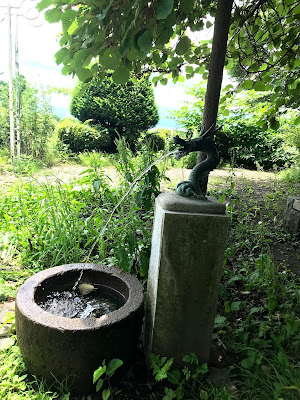
We happened upon this overgrown lookout while walking one day.
It wasn't well cared for, but had this interesting, and functional, water feature.

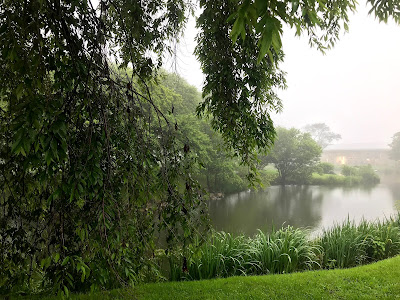
Venturing up the mountain, we walked this quiet, but well-maintained road.
It was blissfully quiet.

And yes, our usual haunt: the local park, with its park golf course. We spent three sessions here.

Another mushroom!

Green rice fields are beautiful (green being my favourite colour). We don't often get
close to them on foot, so when we walked past this one, I stopped for some photos.

In the cool of the mountains, the hydrangeas were still blooming, even as our Tokyo
ones were wilting in the heat.

Oh, and you can't have too many mushroom photos, can you?