Showing posts with label books. Show all posts

11 June, 2026

Pondering our uncommon "walking around life"

Before we went on home assignment in 2023 I was reading a book called Uncommon Ground, a collection of essays brought together by Tim Keller and John Inazu with perspectives from people thinking deeply and working daily to live with these times. Here are some of my reflections on that in light of our upcoming time in Australia:
Home assignment means meeting
up with people for various reasons.
On Saturday we met up with a 
member of our church in Tokyo,
someone we'd never met before.
We got to walk for the first time on
this cool bridge across the Brisbane
river.

In the case of a missionary on home assignment, we have to "translate" overseas mission and Japan to Australians. In general people we encounter there don't clearly understand what we do or where we do it. If you've followed my blog for a long time, you'll know that our work in Australia is composed of answering a lot of questions.

Much patience and diligence is required in translation. Much attention to detail as well as sensitivity to the wider picture. My work as an editor is also translation to some degree. I have to ensure that the writer's intent is accurately and appealingly translated into words that the audience will understand and not stumble over. And of course, as a writer who writes about cross-cultural life, I am translating my experience, life in Japan, and missionary life, into words so that others can understand. Pretty similar, in a way, to what we do on HA, except that as a writer and editor, I can hide behind my screen, rather than have to engage people face to face, or stand up in front of an audience with no time to edit my answers. (from here)

In the midst of another home assignment, one that is far more fast paced, the thoughts about still resonates with me. I'd definitely rather be working behind the scenes, but alas, God has given us this thing to do and we're getting on with doing it.

These last few weeks, when I have some free time and energy, I've been gradually making my way through A Long Obedience in the Same Direction by Eugene H. Peterson, the author of the Bible paraphrase: The Message. A Long Obedience. It is a book that I heard about early in our time in Japan but have only now gotten my hands on a copy. I didn't realise that it was a book on discipleship based on the Songs of Ascent, Psalms 120–134. It's a good read!

The chapter I read on Tuesday was based on Psalm 123 and in it Peterson connects it with Romans 12:1–2:

So here’s what I want you to do, God helping you: Take your everyday, ordinary life—your sleeping, eating, going-to-work, and walking-around life—and place it before God as an offering. Embracing what God does for you is the best thing you can do for him. Don’t become so well-adjusted to your culture that you fit into it without even thinking. Instead, fix your attention on God. You’ll be changed from the inside out. Readily recognize what he wants from you, and quickly respond to it. Unlike the culture around you, always dragging you down to its level of immaturity, God brings the best out of you, develops well-formed maturity in you. (The Message)

Below is how I more commonly recognise this passage: 

Therefore, I urge you, brothers and sisters, in view of God’s mercy, to offer your bodies as a living sacrifice, holy and pleasing to God – this is your true and proper worship. Do not conform to the pattern of this world, but be transformed by the renewing of your mind. Then you will be able to test and approve what God’s will is – his good, pleasing and perfect will. (Romans 12:1-2 NIV).

The Message version of the passage stands out to me because the intro that I'm giving to our formal presentations includes a series of statements about what our ordinary lives in Japan looks like. Our "walking around life". We tend to think of service to God as the extraordinary stuff, not the stuff of ordinary life. As we talk from the front of churches and other gatherings I'm deliberately framing our stories as being from the place where God has set us down. (From the quote that Alistair Begg uses from his mentor Eric Alexander: "There's no ideal place to serve God, except the place he sets you down.")

And of course the other thing that stands out is the observation about culture. As we move between our two "home" cultures, we see things that people who are immersed in them don't necessarily see so clearly. It doesn't make us experts in either culture, but it does give us a unique perspective. Perhaps not fitting so well into either culture is an advantage, helping us to focus our attention on God as Paul instructs us to do?

I'll continue to ponder this and other thoughts in this book while I go about my "walking around life", which, this afternoon includes the joy of hanging out in an Australian library :-) and even borrowing some physical books!

30 April, 2026

Two large books!

I don't read paper books very often these days. Ebooks from the library are definitely more within my budget! They have other advantages too: like being able to read in bed without a light (works for camping brilliantly!) and being able to read without physically holding the book (works for reading while eating).

But somehow I've ended up reading these two large physical books at the same time. The total number of pages between them is more than 1,000! I don't have big hands and they're definitely both a handful.

Dominion is much more of a mental "handful" than Homecoming, though. For starters, the font is, I think 9! Which puts it at "dictionary" or "Bible" level. It's small. But the topic is what makes it a real mental challenge. It's covering around 2000 years of history in its 500 or so pages. 

"The book is a broad history of the influence of Christianity on the world, focusing on its impact on morality – from its beginnings to the modern day. According to the author, the book 'isn’t a history of Christianity' but 'a history of what's been revolutionary and transformative about Christianity: about how Christianity has transformed not just the West, but the entire world.'" (Wikipedia)

It moves fast and the Zoom lens following events shifts in and out rapidly. The author uses big words and assumes you know a fair bit of history already. I've had to try to read quickly, which sounds counterintuitive, but by reading quickly I can catch his drift without getting bogged down by the details and lose track of where he's going with his meta narrative. I've heard this book referenced numerous times in the podcast I like: "Undeceptions". When David found it at a bookstore in Australia last year when I was "redeeming" a book voucher, it seemed like a good challenge to set myself for 2026.

Homecoming is a family saga set mostly in Australia (the font is larger, 12, I think). I think this book was given to me by a friend who was packing up to leave Japan for a time. I'm enjoying it and moving through it at quite a good pace, I might even tackle another one of this author's books in the future. 

Dominion is more of a "it'll take at least six months" kinda book. Because my work involves a lot of reading and editing, I am pretty picky about the quality of the things and the genres I read in my spare time, but also prefer easy-to-digest reading. Reading Dominion is hard work and I don't always have the mental capacity to digest it after all the reading I've done at work.

I read a lot. I fell in love with books at an early age. They are my go-to for relaxation. Sometimes people ask me when I fit it in. I read if I'm eating alone (which is during weekdays most days), I read to go to sleep. I read during the night if I can't go back to sleep. I read in waiting rooms and on trains—another good reason to use ebooks, because I can access the library app on my phone as well as my Kindle, I don't have to carry a heavy book or extra device around with me. Basically, I read when I have spare time, but also mental capacity—I do play (logic, word, and puzzle) games on my phone too.

What have you been reading this month?

12 September, 2025

Lots to think about

Life has settled down again to a discernible rhythm. It's a bit of a relief, actually—I work better like this. I find it hard to concentrate and make decisions when my day-to-day routine is less stable and predictable. So when I do things like try to work and travel, even though most of my work is done remotely, it gets tricky and I don't do as good a job. But I also get bored if life is too same-same. So I'm glad for a job that always includes new challenges and has a fair amount of variety in it, even if, like last week, I sometimes get overwhelmed by it all.

Magazine matters

I'm glad that the Autumn issue of the magazine I manage has gone to the printer and we get to mail it out next week! I've been working fairly solidly on this since we got back to Tokyo in early August. 

I've been working on this magazine for around 15 years, and I can tell you that some "issues" are harder than others. There are all sorts of reasons for that. It can be team challenges, a difficult issue-theme, unexpected random obstacles, author difficulties, or at times when my own transitions or travel interfere with my ability to concentrate on the work needed. 

This issue was particularly difficult for some of these reasons, and has required "above and beyond" over the last few months. I hope that it was all worth it, and pray that God will take it and use it for his purposes.

This month is our magazine "annual meeting" month. Because our remote team works across several different time zones it's hard to hold meetings. I've never been a fan of meetings, they can easily be a waste of time! I'm in a position to have been able to shape my work in so many ways, both with the magazine and with the social media work, and I've tended towards setting up processes that mean we don't have to meet often, though I have been called out on that!

Our magazine team gets together once a year to talk about team and magazine stuff, to pray, to have fun, and to plan. In the last few years that has been achieved with four 1½ hr meetings. I really enjoy this team. We have fun when we get together, even online. They are passionate about the mission of this magazine and that makes them easy to lead. And the four shorter meetings are actually a lot easier to manage than a single one-day event, like we used to have. (I've written about this meeting/ these meetings before, here's one back in 2016 when it was an in-person meeting: https://mmuser.blogspot.com/2016/08/energising-meeting.html)

What have I been thinking about recently?

Well, if you know me, you know that there's usually a lot going on in my brain! This week I've had time to listen to some podcasts and I've been trying to be disciplined about continuing to gradually (usually a short portion over coffee in the afternoon) work my way through non-fiction books that are on my to-read list.

I listened to John Dickson's Undeceptions (my usual go-to for lunchtime listening), an episode about the boy Jesus. It gave some interesting historical background to the life Jesus lived.

I came across an OMF US podcast interview with a new worker I met last week. She was effusive last week about the social media work I do and how that had been a pivotal part of her coming to Japan, so I was curious about her larger story (if you ever get into the position to ask, find out a missionary's "call story" they are usually fascinating and never the same as any other missionary's). The 45 minute interview was well done and I loved the bit where God led her to look at Instagram, just after she'd surrendered her desire to go to Japan...and she saw a post from OMF Japan!

I also listened to a podcast from Moore Bible College about Neurodiversity and the Christian Life (part 1 of 3). I wasn't so impressed with their format, it's a bit academic, although there were some redeeming interview clips. Yet it's a topic that is close to our hearts, so I'll go back later and hear what they have to say in the next two parts.

I've just finished one non-fiction book (after several months) and have started another. The first I've read before, and will probably read again. Gentle and Lowly is deep and full of many things that will take a lifetime for my heart to absorb. It's about the heart of Christ for us and what small amount I can grasp, even though I've been a Christian since I was a child, it still breathtaking.

The new book I've just picked up, Life interrupted, by Susan Chapman, an OMF colleague, starts out on a similar line: understanding that we are loved by God. It's something that is easy to say, but hard to live. I'm only just starting this short book, but am already challenged by what she says next: "we need to be totally content in being finite". She goes on to quote Ruth Hayley Barton who says:

Living graciously within the boundaries of our life as it has been entrusted to us gives our life substance. Oddly enough, something of the will of God is contained in the very limits that we often try to sidestep or ignore. Living within limits is not in any way an acquiescence that is despairing, passive or fatalistic. Rather it honours the deepest realities of the life God has given us. Life in this body at this age and stage. Life in my family at its age and stage. Life in this personality. Life with this community. Life in the midst of this calling. (Strengthening the Soul of Your Leadership: Seeking God in the Crucible of Ministry), p12 in Life Interrupted

It's this that I need to continue to learn as I settle into this phase of my life. What does "life in this body at this stage and age, with the gifts and calling that God's given me?" look like. And how can I be content in that? I think it's something all of us probably need to think about at various ages and stages!

22 August, 2025

Library, lamington, and love

Raspberry lamington that
one of the library assistants
gave me for helping them this week.
The school has an Aussie chef
in their cafeteria and he regularly
makes his own lamingtons for the students.
Yum!
For those who don't know: these
are Australian, in fact from
Queensland (though origin stories
differ as is common with food). They are
sponge cake chunks covered
on all sides with icing and coconut.
This week school started. It's a marker in our lives, even though I am not employed there and have no kids there, and David's already been back at work for nearly two weeks. I've enjoyed seeing CAJ-related friends over the last week. On Friday we had the staff-and-families dinner at school. On Monday I had lunch with a US friend who lived in Brisbane for a number of years. And then I went to school two days for an hour or so to help with shelving books in the library. They are understaffed at present (no librarian-teacher), so some help was appreciated. I always love spending time in a library and this one has been a special place for 20 years now! The social interaction was also fun. I love working at home, but sometimes it gets a little lonely.

At my desk I've been working with text and authors to get the next Japan Harvest magazine into the "Design phase". Sometimes this is easier than others. This time there have been some tough challenges that I'm still trying to find my way through.

As usual, I'm juggling the magazine work with the social media team work and in the background have other projects that are waiting on my finding some spare time and brain space.

My office is a great space, except in the midst of the worst of summer—it has no air conditioning or ceiling fan. When the days have been over 35 C for the last week or so, I've been able to funnel the air con from the main area down the hall to my office using a couple of standing fans. Yesterday I didn't start doing that until I got back from school at lunchtime and my office stubbornly remained over 30C until we had a fierce storm that cooled things off. I'm a Queenslander and don't mind low-30s too much if I'm just relaxing, but trying to get my brain to work on complex editing and writing matters when the room is stifling is hard. It's amazing how much clearer my head is at 28/29 C!

One of the exciting things this week has been to get some big details sorted for another social media team retreat. Venue and dates have been up for debate for a few months, but we've finally nailed that down and I can get to work on the finer details prior to our end-of-October retreat.

It's no surprise to you that I spend a lot of time reading. I read for pleasure and I read for work, if I'm on my own I read while I'm eating and while I'm relaxing. My work is in the space of mission and Japan, and my reading reflects those spaces. I also read to grow in my spiritual life. This week I saw a blog post called "More than enough" published by Thrive, a largely online ministry to Christian women working cross culturally. You can see it here: https://thriveministry.org/connection/devotional/more-than-enough2

One of the things I've struggled with in Japan is comparison. Actually I think it's a universal problem that women experience, but somehow doing what we do and where we do it, cross cultural workers end up with very high expectations of ourselves which we inevitably fail at. 

It's something that maybe I've gotten better at—I'm more comfortable in my skin now than I was 25 years ago...but still every now and then those cursed comparison thoughts shoot through my head and I feel useless and unlovely. So this little article was a good reminder. The author writes:

I stumbled upon John 15:9, that says, “As the Father has loved me, so have I loved you. Now remain in my love.” The lightbulb clicked on. Jesus loves me the way the Father loved Him. I am loved completely, without surprise, without reservation, and without disappointment. I had no business comparing myself to anyone but Jesus. I would never measure up to the fake standards I could put on myself. But since God loves me, I could throw those standards away and rest in His love. 

"I have no business comparing myself to anyone but Jesus" and those standards I have set up are fake. I don't know who needs to be reminded of this today, but I did. And I need to go forward into the rest of the day resting in God's love!

15 November, 2024

It's still messy, but I think I am growing


I took time out of the house yesterday, mostly with the intention of making more progress in reading the book Awe and intentionally following up on thinking about some of things I wrote about in this blog post in September "It's messier than I like to admit". In that post I wrote that I was planning a followup...I've not managed that till now (and I'm just pondering where the last seven weeks have gone!).
Autumn colours in the park

I've been trying to come to terms with a less busy life. A life without boys at home is less busy. Both the ministry roles I've returned to this year are less intense now. A lot of what I've done in the past has been spread out amongst others, which is a good thing, but leaves me with wondering how to best use my time. But I'm also aware that, though I am not "old" yet, I am "less young" than I was 25 years ago when I started having the responsibility of children, and the reality of that is that I have less energy and take longer to recover.

So yesterday I rode to my favourite large park, but was very distracted by how chilly it was (around 18C). I'd neglected to put on appropriately warm clothing as the day before had been quite warm (25C inside). The weather and the seasons are messing with me! Last Friday I had a conversation with some American friends and it became clear how messed up I was. 

This calendar year started with a Queensland summer. We accelerated our descent into winter by heading south in mid-March and our month (April) in Tasmania in an unheated motorhome was quite chilly. Then we drove back north to a more moderate Queensland winter! In July we accelerated into summer by flying north, going from around 2 degrees Celsius to 30 C in just one day. The next two months were full-on summer and since mid September we've gradually been descending into winter again. 

Add to that that we're just still figuring out how to weather the seasons in our new apartment, which has both more sunlight and more insulation than our previous abode. So we often have difficulty accurately judging how outside will feel before we get there. This is made worse by the structure of a Japanese home: in that, to properly go outside, you have to put shoes on, at which point the inside of the house (and clothing) is no longer accessible to you...unless you take your shoes off (or take other measures, that you might have seen illustrated in OMF Japan's social media post a few weeks back, if not, then I recommend checking it out here). 

But I digress. The problem with my conversation was that if I started using seasons to anchor my story, I was instantly in trouble. For example, "We came back [to Tokyo] in the summer, but will be heading back [to Australia] to a summer wedding in January." followed by "We're also planning to go back to Australia next summer (but it will be winter there)." Americans tend to call the middle of the year "the summer" as an overall term for "long school holidays", whereas Australias call our long summer holiday period "Christmas" or "Chrissy holidays" or "Christmas and New Year" or "End of the year." And so it's all a confused mess. So, in the conversation, I started using calendar anchors, rather than seasons!

Anyway, back to trying to read my book in the park: I spent ages trying to make up my mind about what I'd do about feeling too cold. I ended up eating lunch and riding to a coffee shop in a familiar shopping centre on my way back home. It wasn't ideal as it was much noisier than the park, but at least it wasn't home where there are so many other distractions.

I tend to process things better when I write (or talk), but I didn't take my computer or any people with me. Only the book, my phone, and a pencil and notebook. So I'm going to do some processing here.

The book is full of thought provoking stuff. It's key point is that human beings are hardwired for "awe". The problem is we were created to be in awe of God, but because of sin find it impossible, and the awe of God is very quickly replaced by awe of self. He's saying that "awe lies at the bottom of a whole range of human struggles". Nothing else satisfies our awe-wired existence, and thus we end up angry, lonely, disappointed, addicted, bitter, etc. We are self-centred, feel entitled, or experience relational dysfunction, seek to control people, live in fear or envy or drivenness or exhaustion. Tripp traces all these things back to our "awe problem".

In relation to the purpose of my ministry now that life is running at a slower pace, I was struck (in September) by: "Ministry is meant to be something bigger than completing a list of tasks" (p. 49. Ouch. He continues, "You have been called to the high position of making the invisible glory of God visible to people who quickly lose sight of God's glory and begin to look for glories elsewhere (Psalm 145:4).

In many ways he's writing to himself, but also to us all. All Christians are "in ministry" whether paid or not. We are all called to point others to God's glory. If we were all doing this for each other, we would be a more effective community.

It's easy to get very discouraged by all of this, because Tripp goes to great lengths to tell us that we can't help ourselves. On our own we can't fix this. However, God can.

Only when the awe of God rules your heart will you have joy even when people disappoint you and life gets hard. Awe means your heart will be filled more with a sense of blessing than with a sense of want. . . remember that he [God] is so rich in grace that he will never turn a deaf ear to your cries (p 105-106).

We all question God's character, and, despite the theology that we say we believe, we struggle to live that way "at street level". We wonder if God is good, if he is in control, does he have the power to help us, does he even care? Yep, I have these thoughts too (witness it in this blog post from this time last year). Therefore it was reassuring to read this:

God alone will never leave you...he never sends you without going with you. He is your protector, guide, defender, teacher, savior, and healer. He never mocks your weakness but gives you strength...His care is so awesome and so complete that nothing in your life's experience in any way compares." p 105

None of this is new to me. But I keep forgetting, so it is good to be reading a book that reminds me (and of course the Bible is riddled with such reassurances). Not remembering these things leads to discontent and complaints. And it's so easy for complaints to slip into our thoughts and conversation.

You can't do that work of awe reclamation on your own. You desperately need grace—but you and I are called to treasure that work and to pursue and participate in it any way we can. And we are called to humbly admit our need and again and again run to the grace that stands as our only hope of personal growth and change. (p. 129)

So I guess yesterday was partly about me running back to my saviour and admitting my need for his help. Help to grow, to know how to walk with him in this new season, and to fix eyes on him so that my awe is directed towards him again, instead of my own "kingdom of one".

God sent me to Japan again in July. He came with me and he has a purpose for me here in this new season, with all my weaknesses and foibles. I need to trust him . . . still and again! Possibly I'll look back at some time in the future and know what that purpose is (though I suspect it won't be one simple thing). Right now my job is to do my best each day, with God's grace, to point others towards his glory, however that looks in my life and with the strengths and skills that he gave me.

I hope this makes sense to you. I am not sure I can make it any better at this time! I am planning to finish the last three chapters of the book before the end of the year. Maybe I'll write again after I read those, maybe I won't. Perhaps you'll see the outworking of God in my life and writing without me consciously trying to pry it out of my head?


13 June, 2024

Books I've read recently

I wrote back in October that our schedule was less busy than we were used to, that has continued. While we came back to Australia with some big audacious goals (the main one being getting our sons settled into living independently here, especially our middle son who has extra challenges), achieving those goals hasn't been a full 40-hr a week job each week. On top of that, for various reasons we've had fewer church and other groups to visit. We've also not been tied to school drop-offs and pick ups. And then our sons moved out in February and we discovered that we had even more time available to us (meal prep and clean-up took less time, for example). And then, obviously, we had two months of leave! It's been a really different home assignment.

So I've had to figure out how to use my time meaningfully when it's not full of the daily deadlines that were the reality of my work in the last several years in publishing. And with all of the above changes, there has been many a day when I've woken up wondering just what I was going to do to fill my time that day.

A few possibilities for how to use my time were taking on further study or volunteering more of my time to our church or another organisation. None of these were ideal because of the lack of consistency I could offer. Particularly with two months of long service leave thrown in there. We haven't been at our church every week because we have had to speak at other churches some Sundays. We've also only got one car, and some weeks it's been pretty busy as David helped each of our sons get the necessary driving hours to qualify to take a driving test, or been helping them with other tasks.

So in the end I haven't volunteered much anywhere. One thing I have done, however, is read. I have read more non-fiction than I usually do, as an attempt at personal growth. Some of the non-fiction books I've read during our HA include:

  • Trusting God by Jerry Bridges
  • The Bible Jesus Read by Philip Yancey
  • A Praying Life: Connecting with God in a Distracting World by Paul E. Miller
  • Writely or Wrongly: An unstuffy guide to language by Joanne Anderson
  • How Writing Works: a field guide to effective writing by Roslyn Petelin
  • First You Write a Sentence: The Elements of Reading, Writing . . . and Life by Joe Moran
  • The Man Time Forgot: A Tale of Genius, Betrayal, and the Creation of Time Magazine by Isaiah Wilner
  • My Dream Time: A Memoir of Tennis and Teamwork by Ash Barty
  • The Container Victory Garden: A Beginner's Guide to Growing Your Own Groceries by Maggie Stuckey
  • Australian History in Seven Questions by John Hirst

It's turned out to be a great way to use my time on those days that I have extra hours to fill. The three I have read most recently are pictured here (not in the list) and they've all been very good.

Bullies and Saints was an excellent overview of the history of the church from the perspective of the good and not-so-good things that people who call themselves Christians have done over the centuries. I love history and really appreciated the perspective that the author, John Dickson, was able to provide. It definitely provided perspective on our current cultural climate, and the place of Christianity in it. His podcast Undeceptions is also excellent and I recommend it for thoughtful, well-researched content that addresses many things aside from history, including really difficult contemporary topics.

David and I read the Keller book on marriage together after dinner for a few weeks. It's also given us a better perspective on marriage in several areas. I definitely recommend it to any married person along with singles, pretty much any adult, but particularly those interested in a Christian perspective on marriage.


I'm not quite finished the Carson book on A Call to Spiritual Reformation: Priorities from Paul and His Prayers. It isn't the easiest book, but it's really good. For years I've used Paul's prayers in various Biblical letters to help me when, on our prayer schedule, I am allocated the task to pray for people who I barely know or haven't been in recent touch with. So this book about Paul's prayers has given me new insight and new encouragement to pray for people prayers that have more depth. For example, rather than  to  say "Please bless Sue", to pray that God would give her power to know his love deeper and to grow in her knowledge of God and love for others. 

To keep myself ploughing through the above book (and others before it), I've tried to set aside specific reading times. For example, a daily reading time over coffee mid afternoon out on my deck. Top tip: over the years I've found it easier to get things that aren't top of my priorities/joys done (like house cleaning and reading more difficult books) if they are tied to a schedule or some other marker.

Reading has many, many benefits. It's a great way to help you with conversation too: the number of times that I've brought up things in a book I've recently read could not be counted! A book like the one by Ash Barty is a great potential conversation starter in a variety of situations.

I'm grateful for the quieter weeks we've had this year, and the opportunity to invest in reading in a way that I haven't had a chance to do for nearly 25 years!


21 November, 2023

A couple of admissions

I've had lots of space for thinking recently. Sometimes it feels like too much space.

We enjoyed the simple pleasure of catching
up with "old" friends on Saturday.

A shocking truth: not trusting God. Yep, that's me.

After we moved here in July, I re-joined our home church's Friday morning Ladies Bible study. They had been studying Trusting God by Jerry Bridges. Of course, coming in more than halfway through the year was a disadvantage. (For my northern hemisphere readers: Much of Australian life runs on a calendar year. Many things, including school, start in mid or late January after the long Christmas/summer holidays and finish in November or December. So arriving in July or August often means you've missed half a year of something.) 

One of the ladies gave me a copy of the book they were studying, one that I have actually owned since I was a uni student, but I think it's in storage in Japan. It's a long time since I read it, so I've gone back to read from the start of the book. 

It really is basic stuff that I know, but stuff that I keep forgetting, or maybe "forgetting" is too strong a word, possibly "lose sight of" could be better? I am still not really good at applying truths I know in my head to my emotions. Emotions grab hold of me and before I know it my body is showing signs of stress. When I take a step back and think about what’s going on, more often than not I realise it's because I've stopped trusting that "God's providence is his constant care for and his absolute rule over all his creation for his own glory and the good of his people" (Trusting God, p. 13).

So, I was encouraged to read Bridges write (about his own pilgrimage of seeking to come to a place of trusting God at all times), "I am still far from the end of the journey." It is good to remember that it is a journey, and one that won’t be finished until we’re in heaven.

Entitled thinking 

Additionally I've been thinking about how easy it is for missionaries to slip into entitled thinking. A few weeks ago a close friend caught me thinking that way—my guard was down because she is such a good friend, and I was shocked to hear what came out of my mouth. I still feel ashamed as I see how easy it is to slip into thinking that because I'm a missionary I deserve certain things and deserve better things. And then complaining when I don't get them! And then I saw this quote: 

"You cannot possibly have a sense of entitlement—thinking you deserve only good and beautiful things–when you truly realize that you don't deserve anything good if not for God's grace, extended from his throne."—Mel Caparrow, Enough is Enough

Ouch!

I think "truly realize" is one thing, but always remembering it is another. The dictionary.com definition of "realize" is to "become fully aware of (something) as a fact; understand clearly". I really do understand these truths pretty clearly, but, as I wrote about earlier, applying them to my heart is another matter.

Need to be careful where I put my focus

I need to be more thankful, and more repentant when I notice thoughts like this entering my head. I'm thankful my friend caught me in this. She didn't rebuke me directly, but what she said made me stop and think about what I'd just said.

In the end I think many of the issues that we deal with (anxiety, entitled thinking, anger, fear, discontent etc.) stem back to not trusting God. And this reminds me of a favourite book of mine (that’s also in storage in Tokyo), Awe by Paul Tripp that traces the things we struggle with back to our lack of awe of God, our forgetting how amazing and completely capable and loving he is. I wrote about another book by Jerry Bridges a few years back (here), which also traces what he calls “hidden sins” back to a lack of trust in God’s character:

“The importance of a firm belief in the sovereignty, wisdom, and goodness of God in all the circumstances of our lives. Whether those circumstances are short-term or long-term, our ability to respond to them in a God-honoring and God-pleasing manner depends on our ability and willingness to bring these truths to bear on them. And we must do this by faith; that is, we must believe that the Bible's teaching about these attributes really is true and that God has brought or allowed these difficult circumstances in our lives for his glory and our ultimate good” (Hidden Sins, Bridges, p. 76).

“When I refocus, I take my eyes off my problems, and shift them onto the Lord — and I choose to trust him. Trust him even when my situation looks black. Trust him that he is working for my good. Trust him that he knows what is best.” (From here.)

Remembering this is so important: "No good thing does he withhold from those who walk uprightly" (Psalm 84:11). 

In the last two weeks we received disappointing news on two fronts. Not devastating news, just what felt like setbacks to our plans. But obviously our plans weren’t God’s plans and we need to continue to trust he’ll guide us as we seek to work our way through settling our younger two sons in Australia so that we can return to Japan next July. So I return to one of my favourite passages from the Bible:

Therefore, since we are surrounded by such a great cloud of witnesses, let us throw off everything that hinders and the sin that so easily entangles. And let us run with perseverance the race marked out for us, fixing our eyes on Jesus, the pioneer and perfecter of faith. For the joy set before him he endured the cross, scorning its shame, and sat down at the right hand of the throne of God. Consider him who endured such opposition from sinners, so that you will not grow weary and lose heart" (Heb. 12:1–3, NIV).

Ah, it is so easy to lose heart. I'm feeling flat today and I think it's partly a losing-heart symptom. Life is hard. God didn't promise us anything else. So the only option is to keep our eyes focused on him.

I've rambled on long enough, it's time to publish this now (I've been writing it for a couple of weeks as I tried to process the rollercoaster of emotions I've been riding).

03 November, 2023

Rowboat, sentences, and driver's licence

This has been an interesting week, and not as quiet as my written schedule might lead you to believe. I think I'd been settling just a little into a "quieter" life. Time to read, to go a bit slower than usual. But this week has been a little different. For starters, I've picked up my editing pen again. OMF Australia has given me a spot as a guest editor for one of their publications. It's been good to brush up those skills a little.

A local park, a place that's helping
us stay a bit grounded here.

I wrote our monthly prayer letter on Monday and sent it Tuesday. A pretty usual end-of-month activity, but one that always involves a little reflecting on the month gone and looking at what the month ahead holds. It definitely showed that October was considerably quieter than the several months that had gone before it, and I guess that has shown up in my musings on this blog.

Over the last few weeks, on quieter days, I've been trying to invest more in reading about writing, as well as taking up a few small opportunities to write. I've spent many Tuesdays mornings at our local library writing. I haven't had a huge output or a big project that I'm working on, but just setting aside time on a set day to write in a different environment has been helpful. 

This week I finished a book about sentences: First you write a sentence by Joe Moran. It wasn't the easiest book to read, but that kind of helped it to feel like I was doing "work" i.e. professional development, not just reading for pleasure! Here's one helpful quote:

‘It’s necessary to write as if your sentences will be orphaned, because they will be.’ (Evelyn Kinkenborg)…Once our sentences are written and sent out into the world to be read, they are on their own. Most of us cling to a residual belief that we will still be there, hovering over the reader as she reads, to explain, when she stumbles over our words, what we really meant. We won’t…Writing a sentence is …hard because you have to arrange them in such a way that they can be deciphered in your absence” (p. 24–25 First you write a sentence, Joe Moran, 2018).

Later he qualified that statement about orphans by saying that sentences really need to be read in context, that "the sentence you are reading needs the already read and still unread sentences around it" (p. 161).

Another gem from the book: "Reading a sentence should never be a grim duty. . . Most paragraphs are longer than they need to be, likewise most chapters. Most books go on for fifty pages longer than they should. We forget all this because it is less effort to speak than to listen . .  at some point, sooner than we think, we should stop. no one is ever as interested as we are in what we have to say. They need to eat, or catch a train, or go to bed because they have work in the morning. The courteous actor says his lines and leaves the stage with no encore." (p.199)

Unfortunately the author didn't really take his own advice. This book could have been considerably shorter! What kept me reading, though, was the gems like I've quoted. One of the reviewers on Goodreads said "About 96% twaddle. Which is annoying because the 4% has some really good ideas and observations." Ironically, a good developmental editor would have been a big help!

Aside from reading interesting books, and writing and editing, we've been walking alongside our sons as they continue to settle into life in Australia. This week that's meant:

  • helping our middle son finally get his learners licence again (he had a Japanese learners, but that journey was interrupted by a seizure nearly two years ago)
  • helping facilitate communication to allow our sons and one other missionary kid to apply to take over a lease from four other young men (two of whom at least are missionary kids themselves) 
Both the above are part of long complex journeys, and it was satisfying to complete a clear step in each one this week. Two more tangible steps towards our twin goals of them living independently as adults and us returning on our own to Japan to continue work there.

A strange thing, but I also did two things that I've been postponing. I bought three new t-shirts (as we approached downsizing and moving to Australia, I pretty much stopped buying anything that wasn't consumable or an immediate desperate need, so it's been a long time since I bought a t-shirt). I also made an appointment with a physio for a problem that's been bothering me for many months (years?). These seem like small things, but they felt big, like I was settled enough to do them?

We've also had car trouble, which has meant the first driving lesson got cut short yesterday. And more money will be paid than we want to. The car is at the mechanic and we've had to borrow a car this weekend to fulfil our ministry commitments.

This week we also started talking to our families about Christmas plans . . . this is something we only do a couple of times a decade! And noted that it's getting gradually more complex as our kids get older. Our families live a whole day's drive apart, so it is always a bit complicated to factor in everyone's needs, desires, plus the sheer practicalities of travel. On top of that we have other people (long-term friends and supporters) wondering if they can catch up with us during the Christmas holidays (roughly Dec–Jan), but we can't set dates until we've settled on dates with our families. 

Yesterday evening I felt like I was a little row boat that had had a number of ripples pass underneath me: unsettled and rocked, not by any one thing, but by the various life things going on, some of which I've mentioned above. When this happens I can be quite harsh on myself, wondering where my faith in God my rock is. After all this is what King David wrote:
Yes, my soul, find rest in God;
    my hope comes from him.
Truly he is my rock and my salvation;
    he is my fortress, I will not be shaken.
My salvation and my honour depend on God;
    he is my mighty rock, my refuge.
Trust in him at all times, you people;
    pour out your hearts to him,
    for God is our refuge. (Ps. 62:5–8)

I will not be shaken? I'm not sure exactly of the meaning here. I know that houses in Japan are built so that they can be shaken by an earthquake, but still remain standing and undamaged. Perhaps that's it?

So, a rowboat, sentences, and a driver's licence, and a myriad of other things that have made up this week, including a really hot, but dry day of around 37C, and a much cooler, yet more humid day today (around 26C). Tomorrow we put on our "missionary" hats again and, all things going well, we will present at an OMF meeting and then have lunch with friends from uni days.

24 March, 2023

Exciting and scary

I think I'm pleased to report that we booked more plane tickets on Saturday. I have to say that after our journeys last year, I wasn't keen, but I'm also glad that it's done. At least this time there are no passport or visa dramas, and no Covid regulations either! I've also booked accommodation in three different locations (one in Japan and two in Australia) that will help us have places to lay our heads between July 10 and August 2. After that, only God knows!

This transition represents the next stage in our journey: the start of our 5th (!) home assignment. It's also a significant journey as we take our sons back to Australia for good. As I keep saying, we're not bringing them back to Japan next year.

I'm also pleased to say that this week I was able to submit the 4,500-word project I'd been working on since November last year. That felt both very good, but also nerve-racking even though it was something that I'd been commissioned to write. I'm glad to have gotten it to this point and to shove it into someone else's hands for the time being. I think all editors should periodically take a turn at being writers whose work is submitted to editors, I think it would help us all to have a good deal of insight into what writers feel.

Then on Wednesday, I found enough free space in my schedule to ride to the park—my usual haunt—to spend time with the blooming sakura (alongside hundreds of others). Last Friday we sent the latest magazine to the printer, and this week I only had one meeting on my calendar and no out-of-the-office responsibilities during work hours. So, from several years of experience, I knew that this week I'd have a little extra time and that a ride to the park was viable. It was a shock to realise I haven't done that in five months! It was definitely time and yesterday everything lined up: time to spare, beautiful weather, and sakura blooming. Ah, it was a blessed couple of hours. I relaxed enough to even lie down and read a book under one of the pink trees!

This week it's been delightful to have more time to think about home assignment preparation . . . though I need to stop writing now! I've probably already got sufficient "story modules" written for our rounds of speaking. Noting that we're often only given 10 minutes between us to talk about Japan and our ministry over the last 4 ½ years, and we rarely speak to the same audience, it's not too hard. Because I love to write and "stories" are my hobby horse, it's the easier part of HA preparation for me. The hard work of upending our lives and moving will be much worse.

So, now, I think, a story is warranted. Smile! Writing for publication can be a scary thing, but it's also an exciting thing. For the same reason: you never know where your words are going to end up. Editing and publishing are the same. I feel a little like a midwife, sometimes, in the various publishing that I'm involved in. 

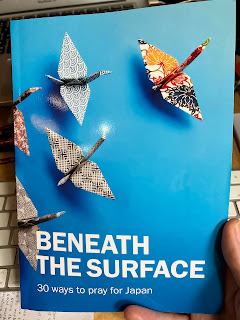
A couple of weeks ago at the women's retreat I went to I saw one of my "babies" on a table. I think it was for sale. "Beneath the Surface" is a prayer guide I spent several months working on in 2019 and 2020. I wasn't a writer, but I laboured over the editing! Oh, I did write the initial draft of the "From the editors" at the beginning, but it was heavily worked over in one of the most intense "team editing" sessions I've ever been part of.

I've just done some intense searching, and I can't believe that I never wrote here about this big "baby". It was a huge project (that involved a lot of collaboration across organisations) to undertake on top of the other day-to-day responsibilities I have at work. Probably one reason that I never wrote here about it was that it happened in the middle of the pandemic, at least the end part did. We had planned a post-publication party for the three of us editors who conceived and worked together on the project, but we never ended up being able to do anything. In the end, in November 2020, the only thing that marked this going out into the world was an online launch party for the contributors. 

In any case, I'm still very happy with this amazing booklet and feel a little possessive whenever I see it around somewhere. I'm unsure how many copies have been sold around the world, but it's many thousand. And it's been translated into a few other languages as well. The Japanese version is currently being worked on.

I think the unique thing about the booklet is not only that it is not about the work of any one mission, but also that it delves into some really deep and difficult topics, but makes them accessible to many people because as much as we could we tried to utilise stories. Oh, and you can buy it here.

But that actually wasn't the story I was planning to tell you. I've got another one. I received an email early in March from someone in the UK. He's a Christian student worker (IFES), and specifically, he works with music students. One of the authors in the Winter issue of the magazine that I manage Japan Harvest happened to be in the UK and gave a copy of the magazine to this man. (This issue was themed "Arts in Ministry.") This man in the UK read the whole thing and wrote: 

"I found [it] fascinating—I've known for quite a while that using the arts in mission is something that is done to particularly good effect in Japan, and so it was eye-opening, encouraging, and inspiring to read so many articles documenting the thought and practice of so many missionaries in Japan."
He was particularly taken by one of the articles and wanted to reprint it on this website. https://musicnetwork.uk/.

The website is the "chief online resource for equipping music students here in the UK to live for Christ in the world of music. We are always trying to give them deep theological foundations for their musical practice, as well as actively trying to encourage them to think globally and missionally, and the article certainly did both of those things I feel."

You can check out the article that's now been republished here.

I was so encouraged by this little exchange. The magazine is primarily for people ministering to Japanese people, so to think that this went halfway around the world into the hands of someone working with quite a different audience is pretty cool.

I like my job. It is indeed both scary and exciting. Who knows what God's going to do with my words or the words I help into publication?

I'm also excited because we've got a camping trip planned for next week! So my next blog post might be a camping one!

04 October, 2022

Sacred pathways spiritual temperaments

I've just finished reading a book called Sacred Pathways by Gary L. Thomas. It's about different "spiritual temperaments". That is, about various ways that people find it more natural to worship God. This is fascinating to me, and consolidates things that I've contemplated over the years as I work and live in an interdenominational environment.

I've found the book helpful for a number of reasons:

This helps with the tendency to be judgemental of people who do things differently to you. I work with a lot of different people from a wide range of backgrounds. It's good to have a better understanding of their perspective when it comes to worship and connecting with God, and to move away from that tendency that "only my 'tribe' does it right".

It's taught me about my Christian background and how that plays into the way I think about worship. I come from a tradition that strongly values intellectualism. I see that in how much emphasis they put on the words of songs, and on concentrating carefully on a complex, often theologically rich sermon. 

The big revelation that I had as I recognised this was the struggle I have every week with worshipping in Japanese. I only grasp small portions of sermons and most Japanese worship songs mean little to me. However, I love singing with my Japanese brothers and sisters. That's not an intellectual activity for me, it's a sense-filled one that I appreciate. Sermons often turn into intellectual activities as I work really hard to understand what's being said, and look up various words, but I don't feel particularly close to God doing this. It's a language learning exercise that wears me out every week.

The book has helped me see that there are other ways to worship. This is really helpful because my background, and also the unspoken emphasis of my organisation, is that "words" are all important. As a writer, I have to agree . . . to some extent. But here's the interesting thing: being at church is important to me. When services were only online during the pandemic, I could barely bring myself to listen to a Japanese worship service from my home. However, I appreciate going to a worship service in person. I can only account for that as being I appreciate the atmosphere, the music and the beauty of the building, I appreciate being in the same space as others who are worshipping, and even the comfort that comes from the familiar rhythm of the elements of a worship service.

The book has taught me other things about me. I would never have called myself an "activist" (in fact I tend to run from confrontation), however the book showed me that a deep passion and involvement in mission work, like I have, is a form of activism. I also wouldn't have picked myself to be an "enthusiast" either, but in mission work we take risks and get to see God work in supernatural ways (like people giving money for the last 21 years for us to serve in Japan). Apparently both these things are characteristics of enthusiasts.

And I was surprised at how strongly I had affinity to caregiving, for example offering rides to people, cooking for them, and helping with needs when I can. I love caring for my own family by providing meals for them, and making sure they have a reasonably clean and tidy house to go about their daily lives in (though I don't take that too far, I get bored too easily with housekeeping).

I also didn't realise how much time in nature and appreciating God's creation was also a way I love to worship God. Though I should have known that, given how I love camping and going to parks, taking care of pot plants, and getting out of the city. Having my work desk in a place where I can see outside, especially seeing green, is also important to me.

Probably this isn't a book for Christians who are new to the faith, or who have a shallow faith. But for someone who has been around a while and has a reasonable grounding in basic truths of the gospel, it's a helpful read. I'm already feeling less guilty about not being the best Japanese student, and more appreciative of those who feel that liturgy or incense or fasting or  drawing is a really good way for them to connect with God.

It's always good to remember that the God of the Bible is a big, humungous God. One that we can't put into boxes. It makes perfect sense that just as he's made so many humans, each one different, that he's able to connect deeply with each one, and never in exactly the same way.

[And a very cool thing: I discovered this book through editing an article by a colleague/friend of mine, then found the ebook in my local Australian public library (Ipswich)!] 

21 April, 2022

Top ten tips for editors on working with writers

I've just discovered this blog post: it was in my draft folder, almost completely finished, but never published. I wrote it over a year ago. It think it's time to let it out into the wild. Of course most of you aren't editors, which is probably why I didn't end up publishing it. But, I've been reminded that many of us have to edit our words or other people's words, whether we identify as an editor or not. In the last year I've read The Subversive Copy Editor by Carol Fisher Saller. She says, 

"In the routines of almost any office job, a worker is likely to be responsible for a chunk of writing, and in any chunk of writing there is likely to be a problem. Solving problems with writers is what copyediting is."(p 3)
I like that: lots of us are editors, whether we think of that as part of our skill-set or not. I also like the idea that editors are problem solvers. That's what I love to do: solve problems!

By the way, it's an excellent book. I've underlined many passages in it. For example:
Editing "matters because inaccuracies and inconsistencies undermine a writer's authority, distract and confuse the reader, and reflect poorly on the company...Discriminating readers look for reasons to trust a writer and reasons not to . . . [We] help the writer forge a connection with the reader based on trust—trust that the writer is intelligent and responsible, and that her work is a reliable source." (p 10)

This book is about doing a good job as an editor (tonnes of practical hints about how to organise your work etc.) and but also also how to build a good relationship with writers. It's one of those books I'd love to have read before I started work as an editor—I had to learn so much by trial and error! 

Editors also need to build trust with their writers and that's not easy to do when you don't have a face-to-face relationship with them. I look back now and realise that most of the difficulties I had early on was that writers didn't trust me. And quite possibly I needed to do more to gain their trust than I did.

The three key words she emphases in her book are carefulness, transparency, and flexibility. 

I could go on and on about this book, but anyway, if editing is part of your job, I recommend you grab this book and read it. It'll be worth your while. You can skip past bits that don't apply to you, but a lot of it is very relevant if editing in some form and working with others with their words is part of what you do. Oh, and there's a chapter just for writers too!

Here is what I wrote in March last year:


Last week I taught a short session at a non-fiction book-writing workshop. Online, of course! I first talked about working with editors and, obviously, gave advice about how writers could work well with editors. At the end of that I asked for "bad experiences" with editors. I was shocked. My advice to editors, is the same as what I gave the writers (in this blog post): be professional and treat this work as a team event.

The best quote I've seen about editing was in an acknowledgement of a book I picked up recently. The author noted that the editor "was both an enthusiastic supporter of the author and a faithful advocate for the reader." This succinctly explains the careful tension that an editor must work under in order to do good work. I don't believe the best editor is one who has the best understanding of English. I think the best editor is one who can keep these two elements in mind while working.
"The relationship between writer and editor can be as complex as any marriage. The common perception seems to be that the editor holds all the power. [Magazine editor talking to writer] 'Do it my way, or forget about the assignment!' he bellows, 'And forget about ever working here—or anywhere else—ever again!'  (The Layers of Magazine Editing, Michael Robert Evans, p. 123-125)
In reality, the relationship is, or should be, much more balanced than that. Yes, the editor can block the publication of an article...[but] the last thing an editor wants to do is leave a good writer feeling abused, mistreated, neglected, or otherwise."
"Editors don't hold all the power. And they know that. So they work to keep their writers happy." (or they should!)

It is the "tension between nurturing and pressuring that makes the writer-editor relationship so delicate and challenging."

My philosophy is to remember whose name will be on this work at the end of the day. If it is the writer's name, then they hold more power than I do, though hopefully we've build a respect for one another that they at least hear my opinion and take advice. The caveat with that is that there might be other considerations, especially if this writing represents a group larger than the writer. For example, the magazine I edit is published by an organisation, and I can't let writing that violates their name go into the magazine. I work in social media for my mission organisation and can't let writing go out under that name, or on the website, that goes against its principles. 

What I do is somewhat different to book editing, in that I have fairly strict deadlines and word-limitations to keep to. So, sometimes I have to choose not to publish something, or seriously shorten something because of these limitations. I also have a team of people who help me with this publishing work, I have occasionally rejected an article because I deemed it unfair to demand my team do the excess amount of work that would be required to publish that author's work.

So here are my tips for any out there who edit other people's work:
  1. This is not your work, it is the author's and will have their name on it, don't ever lose sight of that. Your goal is to make their writing shine. (The caveat to that from The Subversive Copy Editor, is that "it's not the author's right to offend or confuse the reader, defy the rules of standard English, fail to identify sources, or lower the standards of your institution.")
  2. Be kind, but not dishonest. Writers, especially new or inexperienced writers can take changes to their work personally. It's a good policy to seek ways that you can legitimately encourage the writer.
  3. If you think big changes are needed (eg. removing large amounts of content, changing structure, significant change in tone or audience or main focus, rewording larger segments), go back to the author and see if they can make the changes themselves. Explain your reasons. The best editors do as little rewriting as possible.
  4. If rewriting is necessary, be willing to go back and forth on it with the author, giving clear direction as to what you're expected.
  5. Editing is not black and white. A number of the changes you will want to make are instinct or opinion. There is usually more than one way to express something. So be willing to revise your decisions if a writer is adamant.
  6. Good communication with writers is vital. Try to keep your communication succinct: not long-winded, but also not multiple emails/phone calls.
  7. Be clear about what you want. For example, word length, audience, main emphasis, due date, tone, even how they format the article before sending it to you. This might chafe some writers, but it is better to have these things clear and avoid wasting the writer's time and then having to waste more time afterwards with major rewriting or worse. For this reason with Japan Harvest magazine, I ask for proposals before people write, so I have a chance to direct them in their writing before they've invested valuable time into writing.
  8. Keep your readers in the forefront of your mind. Your goal is to help the writer communicate clearly with them.
  9. Make sure you check your changes with the writer before you publish.
  10. And again: be professional. That means be respectful, don't take things personally, do what you say you will do, and don't be unreasonable.
As a Christian I do my best to build a gracious relationship with writers. After all, as a Christian I am called to have a character full of these: "But the fruit of the Spirit is love, joy, peace, forbearance, kindness, goodness, faithfulness, gentleness and self-control" (Gal. 5:22–23 NIVUK).