Showing posts with label words. Show all posts

24 March, 2023

Exciting and scary

I think I'm pleased to report that we booked more plane tickets on Saturday. I have to say that after our journeys last year, I wasn't keen, but I'm also glad that it's done. At least this time there are no passport or visa dramas, and no Covid regulations either! I've also booked accommodation in three different locations (one in Japan and two in Australia) that will help us have places to lay our heads between July 10 and August 2. After that, only God knows!

This transition represents the next stage in our journey: the start of our 5th (!) home assignment. It's also a significant journey as we take our sons back to Australia for good. As I keep saying, we're not bringing them back to Japan next year.

I'm also pleased to say that this week I was able to submit the 4,500-word project I'd been working on since November last year. That felt both very good, but also nerve-racking even though it was something that I'd been commissioned to write. I'm glad to have gotten it to this point and to shove it into someone else's hands for the time being. I think all editors should periodically take a turn at being writers whose work is submitted to editors, I think it would help us all to have a good deal of insight into what writers feel.

Then on Wednesday, I found enough free space in my schedule to ride to the park—my usual haunt—to spend time with the blooming sakura (alongside hundreds of others). Last Friday we sent the latest magazine to the printer, and this week I only had one meeting on my calendar and no out-of-the-office responsibilities during work hours. So, from several years of experience, I knew that this week I'd have a little extra time and that a ride to the park was viable. It was a shock to realise I haven't done that in five months! It was definitely time and yesterday everything lined up: time to spare, beautiful weather, and sakura blooming. Ah, it was a blessed couple of hours. I relaxed enough to even lie down and read a book under one of the pink trees!

This week it's been delightful to have more time to think about home assignment preparation . . . though I need to stop writing now! I've probably already got sufficient "story modules" written for our rounds of speaking. Noting that we're often only given 10 minutes between us to talk about Japan and our ministry over the last 4 ½ years, and we rarely speak to the same audience, it's not too hard. Because I love to write and "stories" are my hobby horse, it's the easier part of HA preparation for me. The hard work of upending our lives and moving will be much worse.

So, now, I think, a story is warranted. Smile! Writing for publication can be a scary thing, but it's also an exciting thing. For the same reason: you never know where your words are going to end up. Editing and publishing are the same. I feel a little like a midwife, sometimes, in the various publishing that I'm involved in. 
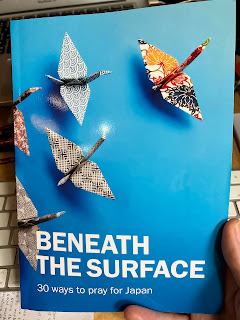
A couple of weeks ago at the women's retreat I went to I saw one of my "babies" on a table. I think it was for sale. "Beneath the Surface" is a prayer guide I spent several months working on in 2019 and 2020. I wasn't a writer, but I laboured over the editing! Oh, I did write the initial draft of the "From the editors" at the beginning, but it was heavily worked over in one of the most intense "team editing" sessions I've ever been part of.

I've just done some intense searching, and I can't believe that I never wrote here about this big "baby". It was a huge project (that involved a lot of collaboration across organisations) to undertake on top of the other day-to-day responsibilities I have at work. Probably one reason that I never wrote here about it was that it happened in the middle of the pandemic, at least the end part did. We had planned a post-publication party for the three of us editors who conceived and worked together on the project, but we never ended up being able to do anything. In the end, in November 2020, the only thing that marked this going out into the world was an online launch party for the contributors. 

In any case, I'm still very happy with this amazing booklet and feel a little possessive whenever I see it around somewhere. I'm unsure how many copies have been sold around the world, but it's many thousand. And it's been translated into a few other languages as well. The Japanese version is currently being worked on.

I think the unique thing about the booklet is not only that it is not about the work of any one mission, but also that it delves into some really deep and difficult topics, but makes them accessible to many people because as much as we could we tried to utilise stories. Oh, and you can buy it here.

But that actually wasn't the story I was planning to tell you. I've got another one. I received an email early in March from someone in the UK. He's a Christian student worker (IFES), and specifically, he works with music students. One of the authors in the Winter issue of the magazine that I manage Japan Harvest happened to be in the UK and gave a copy of the magazine to this man. (This issue was themed "Arts in Ministry.") This man in the UK read the whole thing and wrote: 

"I found [it] fascinating—I've known for quite a while that using the arts in mission is something that is done to particularly good effect in Japan, and so it was eye-opening, encouraging, and inspiring to read so many articles documenting the thought and practice of so many missionaries in Japan."
He was particularly taken by one of the articles and wanted to reprint it on this website. https://musicnetwork.uk/.

The website is the "chief online resource for equipping music students here in the UK to live for Christ in the world of music. We are always trying to give them deep theological foundations for their musical practice, as well as actively trying to encourage them to think globally and missionally, and the article certainly did both of those things I feel."

You can check out the article that's now been republished here.

I was so encouraged by this little exchange. The magazine is primarily for people ministering to Japanese people, so to think that this went halfway around the world into the hands of someone working with quite a different audience is pretty cool.

I like my job. It is indeed both scary and exciting. Who knows what God's going to do with my words or the words I help into publication?

I'm also excited because we've got a camping trip planned for next week! So my next blog post might be a camping one!

21 April, 2022

Top ten tips for editors on working with writers

I've just discovered this blog post: it was in my draft folder, almost completely finished, but never published. I wrote it over a year ago. It think it's time to let it out into the wild. Of course most of you aren't editors, which is probably why I didn't end up publishing it. But, I've been reminded that many of us have to edit our words or other people's words, whether we identify as an editor or not. In the last year I've read The Subversive Copy Editor by Carol Fisher Saller. She says, 

"In the routines of almost any office job, a worker is likely to be responsible for a chunk of writing, and in any chunk of writing there is likely to be a problem. Solving problems with writers is what copyediting is."(p 3)
I like that: lots of us are editors, whether we think of that as part of our skill-set or not. I also like the idea that editors are problem solvers. That's what I love to do: solve problems!

By the way, it's an excellent book. I've underlined many passages in it. For example:
Editing "matters because inaccuracies and inconsistencies undermine a writer's authority, distract and confuse the reader, and reflect poorly on the company...Discriminating readers look for reasons to trust a writer and reasons not to . . . [We] help the writer forge a connection with the reader based on trust—trust that the writer is intelligent and responsible, and that her work is a reliable source." (p 10)

This book is about doing a good job as an editor (tonnes of practical hints about how to organise your work etc.) and but also also how to build a good relationship with writers. It's one of those books I'd love to have read before I started work as an editor—I had to learn so much by trial and error! 

Editors also need to build trust with their writers and that's not easy to do when you don't have a face-to-face relationship with them. I look back now and realise that most of the difficulties I had early on was that writers didn't trust me. And quite possibly I needed to do more to gain their trust than I did.

The three key words she emphases in her book are carefulness, transparency, and flexibility. 

I could go on and on about this book, but anyway, if editing is part of your job, I recommend you grab this book and read it. It'll be worth your while. You can skip past bits that don't apply to you, but a lot of it is very relevant if editing in some form and working with others with their words is part of what you do. Oh, and there's a chapter just for writers too!

Here is what I wrote in March last year:


Last week I taught a short session at a non-fiction book-writing workshop. Online, of course! I first talked about working with editors and, obviously, gave advice about how writers could work well with editors. At the end of that I asked for "bad experiences" with editors. I was shocked. My advice to editors, is the same as what I gave the writers (in this blog post): be professional and treat this work as a team event.

The best quote I've seen about editing was in an acknowledgement of a book I picked up recently. The author noted that the editor "was both an enthusiastic supporter of the author and a faithful advocate for the reader." This succinctly explains the careful tension that an editor must work under in order to do good work. I don't believe the best editor is one who has the best understanding of English. I think the best editor is one who can keep these two elements in mind while working.
"The relationship between writer and editor can be as complex as any marriage. The common perception seems to be that the editor holds all the power. [Magazine editor talking to writer] 'Do it my way, or forget about the assignment!' he bellows, 'And forget about ever working here—or anywhere else—ever again!'  (The Layers of Magazine Editing, Michael Robert Evans, p. 123-125)
In reality, the relationship is, or should be, much more balanced than that. Yes, the editor can block the publication of an article...[but] the last thing an editor wants to do is leave a good writer feeling abused, mistreated, neglected, or otherwise."
"Editors don't hold all the power. And they know that. So they work to keep their writers happy." (or they should!)

It is the "tension between nurturing and pressuring that makes the writer-editor relationship so delicate and challenging."

My philosophy is to remember whose name will be on this work at the end of the day. If it is the writer's name, then they hold more power than I do, though hopefully we've build a respect for one another that they at least hear my opinion and take advice. The caveat with that is that there might be other considerations, especially if this writing represents a group larger than the writer. For example, the magazine I edit is published by an organisation, and I can't let writing that violates their name go into the magazine. I work in social media for my mission organisation and can't let writing go out under that name, or on the website, that goes against its principles. 

What I do is somewhat different to book editing, in that I have fairly strict deadlines and word-limitations to keep to. So, sometimes I have to choose not to publish something, or seriously shorten something because of these limitations. I also have a team of people who help me with this publishing work, I have occasionally rejected an article because I deemed it unfair to demand my team do the excess amount of work that would be required to publish that author's work.

So here are my tips for any out there who edit other people's work:
  1. This is not your work, it is the author's and will have their name on it, don't ever lose sight of that. Your goal is to make their writing shine. (The caveat to that from The Subversive Copy Editor, is that "it's not the author's right to offend or confuse the reader, defy the rules of standard English, fail to identify sources, or lower the standards of your institution.")
  2. Be kind, but not dishonest. Writers, especially new or inexperienced writers can take changes to their work personally. It's a good policy to seek ways that you can legitimately encourage the writer.
  3. If you think big changes are needed (eg. removing large amounts of content, changing structure, significant change in tone or audience or main focus, rewording larger segments), go back to the author and see if they can make the changes themselves. Explain your reasons. The best editors do as little rewriting as possible.
  4. If rewriting is necessary, be willing to go back and forth on it with the author, giving clear direction as to what you're expected.
  5. Editing is not black and white. A number of the changes you will want to make are instinct or opinion. There is usually more than one way to express something. So be willing to revise your decisions if a writer is adamant.
  6. Good communication with writers is vital. Try to keep your communication succinct: not long-winded, but also not multiple emails/phone calls.
  7. Be clear about what you want. For example, word length, audience, main emphasis, due date, tone, even how they format the article before sending it to you. This might chafe some writers, but it is better to have these things clear and avoid wasting the writer's time and then having to waste more time afterwards with major rewriting or worse. For this reason with Japan Harvest magazine, I ask for proposals before people write, so I have a chance to direct them in their writing before they've invested valuable time into writing.
  8. Keep your readers in the forefront of your mind. Your goal is to help the writer communicate clearly with them.
  9. Make sure you check your changes with the writer before you publish.
  10. And again: be professional. That means be respectful, don't take things personally, do what you say you will do, and don't be unreasonable.
As a Christian I do my best to build a gracious relationship with writers. After all, as a Christian I am called to have a character full of these: "But the fruit of the Spirit is love, joy, peace, forbearance, kindness, goodness, faithfulness, gentleness and self-control" (Gal. 5:22–23 NIVUK).

16 August, 2017

Wednesday Words

I've been having fun since early May by putting up a once-a-week Facebook status I've called Wednesday Words. 

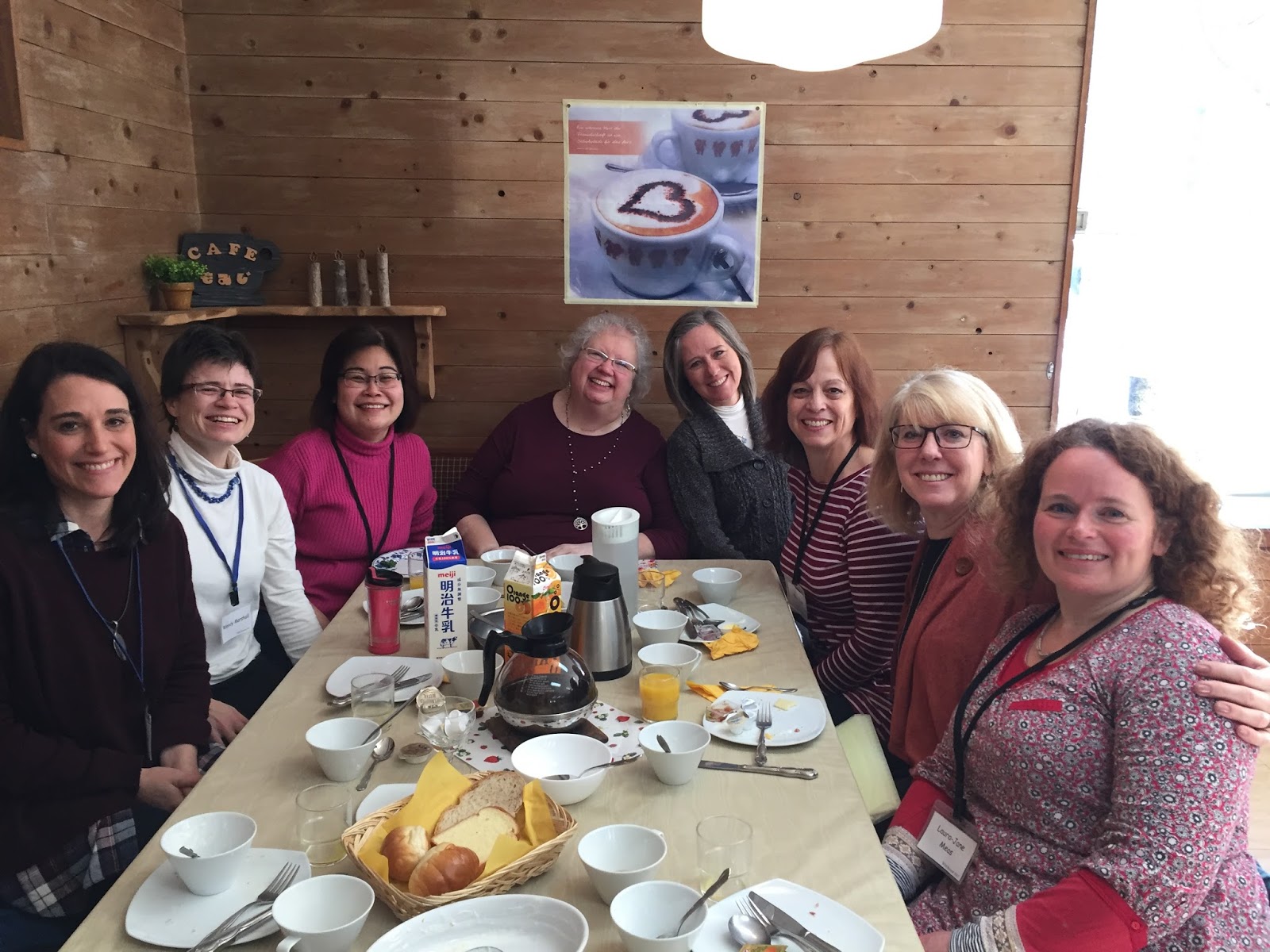
This photo was taken at the women's retreat I went to in
March. It's an illustration of the international environment
I work in. Here we have people from Germany, Singapore,
Ireland, US, Canada, and Australia. And I'm pretty sure at
least one of these ladies wasn't born in the country that they
are a citizen of. Two of them are also married to men from
other countries (Japan and Cambodia).
Under that title, I've been asking people to comment with words from their English background, specifying a certain category each week. I started out quite broad, with topics like food, clothes, nouns, verbs, and prepositions. But recently have gotten more specific like real estate words, abbreviations, occupations. I've had a great time doing it and regularly get upwards of 70 comments on a post.

It's been great to have a safe place to exchange these without exchanging blows.

Here are just a few things I've learned:

  • snow peas (Aust) = Mange tout (UK)
  • My team is winning (US) = My team are winning (Commonwealth)
  • Clean your teeth twice a day (Commonwealth) = Brush your teeth twice a day (US)
  • He's in hospital (Commonwealth) = He's in the hospital (US) [Though this is a bit complex, I might say the latter if there were only one hospital.]
  • Crossing guard (US) = Lollypop lady (Commonwealth) = Scholar Patrol (South Africa)
  • Hospitalist (US for a doctor who specialises in the care of patients in hospital)
  • General Practitioner or GP (Commonwealth) = Primary Care Physician or PCP (US)
  • Professor (Australia) = Department Chair (US). [This one is also a bit complicated, in Australia a professor is a higher title than in the US.]
  • I'm free on Wednesday (Commonwealth) = I'm free Wednesday (US)
  • Meeting one-on-one (US/Aust) = Meeting on-to-one (British)
  • Outwith (Scottish?) = Outside of (every other form of English?)
  • Take a shower (US) = Have a shower (Australian)
  • I'm working 9 while 5 (Northern UK) = I'm working 9 till 5 or 9 to 5 (other English)
  • One step on (Commonwealth) = One step beyond (US)
There's quite a lot there, and some I'm still not that clear on. Many of the things that come up in these discussions I'm familiar with, but it's great to learn more of the subtle variations. I've also got friends from the UK and Northern Ireland who bring up a whole variety of very regional-specific vocabulary and usage points.

This is a good learning opportunity for me, as I regularly edit the written work of people from a variety of English backgrounds. Our editing policy is that we try to edit to the English background that the author comes from. So, for example, an Australian would not have to change their spelling to US spelling. However, we do try to use vocabulary that the majority of our international audience will know, so we don't allow a word such as "sparkie" (Australian slang for electrician).

I've been a little surprised at how much attention this particular Facebook status has received. I've had people tell me they go looking for this post on Wednesdays. Others who've suggested topics or brought it up in conversation. It works on my FB feed because I have friends from a variety of countries, though I haven't received many comments from Canadians, Singaporeans, New Zealanders or other English-background speakers. Mostly just US, UK, and Australians.

I'm happy to receive suggestions for topics for the future!

This week's Wednesday Word topic is children and parenting. For example, the other day I commented about a US/Japanese friend's new "pram". She was a little bit surprised, as no one had yet called it that, though she understood what I meant. "Stroller" I think, was her word, though other words you could use are "baby car", "buggy", "carriage", "pushchair", depending on what your local English preference is.

01 April, 2017

Interesting English

As usual I'm on the look out for unusual sights and word-usage while I'm out and about. I found a few recently and snapped photos of them.

I'm wondering what version of English a "dust port" comes from. Otherwise known as a rubbish bin or trash can. In Japan usually known as a gomi bako, how did they get "Dust port"? 

This motorised scooter was parked next to my bike at my local supermarket. I'm wondering what the invitation is: "Let's4" seems an odd thing to put in that particular place, not to mention that I need a noun.

This is not a Japanese app, but the language seemed a little odd to me. "Ponding on the road" and "Breathing is very good in your area". How would they know the state of my lungs? I guess they're talking about pollution?

I spotted the next sight as I drove along a local road. Someone got all excited about putting up warning posters at their local rubbish-collection station. I think it is just English and Japanese.

To finish off, I was reading in an orthodontist's waiting room this morning and found this sentence: "Another hallway was perpendicular to the staircase." This gave me vertigo! Which angle of the staircase did the author mean? That the hallway angled upwards towards the ceiling? Because this is a Kindle book I can look up this word usage in the book and I'm not too surprised to find that this author uses this slightly unusual word three times in the book. She must like it!


14 January, 2014

Word of the day: Lassitude?

Our family loves words. At present our computer's screen saver is "Word of the Day" which consists of a number of words, usually fairly unusual words, floating across the screen, and all the boys love it. Every now and then one of the words of the day are defined on screen. It's led to some very interesting conversations. My eldest was almost late for school today because he paused to see what the next word's definition would be! David and I have played Scrabble games continuously for most of our marriage (made easier these days by electronic versions).

And of course I'm a writer, so I like to say what I mean. I'm feeling a little out of sorts today. It's hard to describe, but like I'm lacking my usual mental vigour. I went looking for an unusual word to use, how about: 
Lassitude
weariness of body or mind from strain, oppressive climate, etc.; lack of energy; listlessness; languor.
The word doesn't completely cut it, though. It is also a post-excitement let down: we had such a full and exciting day on Saturday. 
The five Marshalls watching wrestling on Saturday.

Then yesterday for me was also full: a social meeting over coffee for the magazine (ah, the things I do for "work"), followed by a stimulating prayer meeting, and a loong bring-and-share lunch with some other parents from 9th grade. The evening was defined by the usual struggles over homework and instrument practise, but overshadowing all of that was a huge blow-up between two of our sons at dinner time, that took some time to recover from (it had a really good resolution, though).

I remember feeling like this last year (I went back and read this post: Discombobulated). At least I haven't yet signed any emails "Donald", or at least I don't think I have... 

But as I was back there, I found this post, a favourite of mine:
Still recovering from wrestling, I read a blog post by another mum also struggling with the exhaustion that comes from watching your kids compete in sports. Great post, but even better was this comment that came afterwards, I really relate, to this, even though we don't yet have a high school wrestler who has such long meets:
I just read your post after a very long day in a high school gym with a bunch of sweaty, stinky boys. My son was wrestling and that is not for the faint of heart. Every Saturday from mid Dec until 3rd week in Feb is spent at an all day tournament. They start at 8 am and go until 7 pm or later! We are exhausted at the end of the day. Wrestling is so INTENSE! In fact, our school t-shirts say “my son is killing me 6 minutes at a time.” That is so true. They wrestle with all their heart and effort for 6 minutes and I swear that I lose a few years every weekend. On a Saturday, my son may wrestle up to 5 times in the day and it’s crazy! But I wouldn’t miss a match for anything. He is amazing to watch and when the hard work pays off, what a great feeling.
This totally resonates with me!

Well now I've got all those words out of my system, I'd better knuckle down and get back to the other things I'm supposed to be doing today!

18 September, 2013

Words, racism, trivia, and a difficult choice

There was an interesting discussion on my Facebook page the other day when I posted this:
Here's another US word I've never heard before:
pratfall
n.
1. a fall on the buttocks, often regarded as comical or humiliating.
2. a humiliating blunder or defeat.
Turns out it isn't an American word after all. Some Americans had heard of it, others not. Some British had heard of it too! I shouldn't have been surprised when I accidentally came across the word (or a form of it) again today in this post.


Then there are other unusual words I've come across recently. Do you know these (all from From Billabong to London, by Mary Grant Bruce, 1915)?

assegais
kraal
aigrette
Kaffirs

This last term used to be a neutral term for black people in South Africa, but is now a racial slur. Indeed this chapter has been a challenge for me to read to the boys. The attitudes of these Australians to encountering black South Africans in Durban has been shocking. I guess it is true to the times, but still. I've had trouble reading without editing and editorialising. But the truth is that we really shouldn't avoid this kind of literature. It should be read and explained. If I try to bury my head and my kids' heads in the sand about racism in literature, I'm not helping us learn and grow.

Disclaimer: this is a random photo
of a runner, not our son. I don't post
photos of our children on this blog.
I was very surprised to find that my 14 y.o. knew what an assegais was (a special type of African weapon). He also knew something of the historical context of it, including the warrior-leader called Chaka who is also mentioned in the book.

This kid of mine is a trivia king! He's had a decision to make in the last week. It looks like he might make the CAJ cross country team that's going to an invitation meet in Guam next month, but it clashes with the high school Brain Bowl competition here in Tokyo (see an explanation of what that is here). Which to chose? For most people that would be a no-brainer, but for our sporty, yet smart son it wasn't that simple!

His cross country coach was mildly amused at the dilemma. Oh, did I mention that his Brain Bowl coach is David? So David had to decide too: whether to give permission for this expensive sporting excursion that would take away one of his pretty reasonable Brain Bowl competitors. Ah, the fun! No chance of our son becoming a stereotypical jock.

Ah, but I must get back to my wordy job. More editing and writing. That's what's on my agenda this afternoon.

15 February, 2013

Concessions Stands

Concession n. 1. the act of conceding or yielding, as a right or privilege , or as a point or fact in an argument. 2. the thing or point yielded. 3. something conceded by a government or a controlling authority, as a grant of land, a privilege, or a franchise.

When we first came to CAJ we were confronted with a whole swag of new vocabulary. Freshman, Sophomore, Varsity, Brain Bowl, Agenda (when referring to a homework notebook), etc.

Concessions Stand or "Concessions" for short was another. It seems a strange name for a place to buy food and snacks at events, but Wikipedia has just enlightened me. They say:
concession stand (American English), snack kiosk or snack bar (British EnglishIrish English) is the term used to refer to a place where patrons can purchase snacks or food at a cinemafairstadium, or other entertainment venue. Some events or venues contract out the right to sell food to third parties. Those contracts are often referred to as a concession — hence the name for a stand where food is sold. Usually prices for goods at concession stands are greater than elsewhere for the convenience of being close to an attraction.

At wordorigins.org someone writes:
At many venues, the owner grants concessions to individual vendors allowing them to sell refreshments and other articles on the premises. Hence the term. 
This is the CAJ Concessions Stand. It is run by
seniors to raise funds for their Senior Ministry
Trip to Thailand in March. They usually run it at
sporting events, but also various cultural events
too. There is a lot of snack/junk food (some of
which is American and not widely available in Japan).
But they also serve basic main meals like hot dogs,
Japanese curry rice, chilli dogs, etc.
Concessions happens in the gym lobby if the sports are
gym-based sports. That's good when we're talking winter
sports, it's often below 5 C at night.
This was not a crowded night, but we enjoy going down to
school on some of these nights, eating their food for dinner, thereby
supporting the seniors in their fundraising, and also catching
some of the games. Though we usually have to leave before
the end in order to get kids in bed and homework completed.

We relied on other schools' Concession Stands a bit at Wrestling events, we usually take a swag of food with us, including sandwiches, but sometimes something hot is nice.

Another small piece of American culture and language for you!

21 September, 2012

Autumn vs Fall

The weather is changing seasons finally. Last night we slept without a fan for only the second time since we came back (not including camping). Today I don't even feel very sticky. I love it!

One of the funny things I find here in Japan is that everything starts to be pumpkin-shaded. I think that happens in America too. The marketing/decorating etc. becomes orange-themed. It is strange to me, coming from Queensland, Australia, where our seasons are much less marked; Halloween isn't a big deal (or haven't been in the past — I believe that that is changing a little), and Thanksgiving doesn't happen at all.

Gum trees, which are everywhere
in Australia, lose their leaves at
any time of year.
That brings me to a short discussion about the term for the season: autumn vs fall. I live and work in a somewhat American environment (of course the Japanese call it aki), so the word "fall" is used a lot, possibly almost exclusively for the season. In fact I've been working on the "Fall issue" of Japan Harvest recently. This term has apparently has been used with the magazine since it was founded in 1950 and is evidence that missions here have had a strong American influence.

It isn't a natural word for me to use at all. Even though it is English, it isn't my native English and I think most Australians regard it as an American term and one that we just don't use at all.

Yesterday I was surprised to find that the word has wider and older origins than America. That it isn't an American invention, but rather it fell out of use in England in the 18th Century when the French-origin "autumn" came into popular use.

I was also surprised to find that some Americans do use "autumn". It doesn't seem to be as foreign to them as "fall" is to us.

Here is where I found out some of that surprising information.

28 June, 2012

Excitement building

Today we're finalising things. Tidying up the house more than usual due to having house-sitters coming on Sunday. It is actually a blessing because we've cleaned up many of those little piles that just sit around waiting for someone to make a decision about. We've dusted (or will dust) in places that usually get ignored, and done a general house clean.

My suitcase is partway packed. I believe the boys are pretty packed. (David supervised them, yah for a great packer for a husband!) Our turtle-sitter just came to pick up Tiny for his summer "vacation". After lunch vacuumed the dining-kitchen-entrance area and mopped. Next I'll clean both toilets. Just bits and pieces.

The excitement is building, no one, not even our teenager, slept in this morning (I did a little, but that was because I couldn't switch off mentally last night and it got late). We had to take the boys for a ride this morning, because they were getting too loud with pent-up energy.

Last night around the dinner table the energy was getting too much, so I pulled out a book to fill in some time while everyone finished their meal. I happened upon a book I pulled out of a free-box from the school library. Rhyming Dictionary. Now you wouldn't expect that to be a very interesting read, would you? But the guys took turns in asking me to look up words and we had some unexpected results. The most memorable is the list that reads:

beanie
genie
meany
teeny
wienie (which is a homonym to weeny, as in tiny)
bikini
Houdini (who couldn't get out of the teeny, wienie bikini!)

Oh boy, we had trouble regaining control after that lot.

But we were in for some surprises. Some lists reminded us that this was an American dictionary (though with all the different accents in America, I'm sure that all Americans wouldn't agree on all the lists either). For example, these words purportedly rhyme:

Aussie
bossy
glossy
mossy
posse
saucy

For all those out there who don't understand the problem. Aussie is pronounced correctly as Ozzie. Rhyming with mozzie (except you probably don't know our abbreviation for mosquito).

And these:

con
dawn
don
drawn
fawn
gone
John
on
pawn
baton
coupon
python
pecan
Yvonne
Genghis Khan

According to this dictionary, "reservoir" rhymes with salad bar as well as dinosaur. So I guess that is a sign that there are different pronounciations within the states. We have ourselves a son who's studied French for two years and tells us that the way (most) Australians say it is the French way, as in, rhymes with star.

Oh well, away from linguistics and back to packing and cleaning. I'm hoping to be done by 8.30 so that David and I can watch the next episode of Grey's Anatomy (we have the second series on DVD). We watched the first of a two part-er last night, finishing with the main character having her hand on a live bomb which was inside the body cavity of a patient! No, don't tell me what happens!

As for now, a coffee, then back to the cleaning.