Showing posts with label English. Show all posts

01 November, 2024

Why did the chicken cross the road? and other linguistic challenges

Why did the chicken cross the road is a classic joke, but we recently found out that it's very much an English-speaking-culture joke. We had dinner last week with two colleagues, one Australian and one German. After dinner we served our Australian guest tea in a mug that had a version of the chicken-road joke. It was a "Far Side" comic. She loved it, but confusion took over as we tried to explain to our German guest the meaning of the joke. She's fluent in English, but didn't understand why that version (or the original) made us smile. (The joke turns out to have quite a history, check it out here.) Humour is so much more about culture than it is about language.

We continued talking about humour and I brought up the example of Mr Bean. I'd thought he was pretty clever with his non-verbal humour that seems to be appreciated across cultures, but our friend tells us that in Germany, Mr Bean is seen as "British humour"!

Most of our colleagues and friends are not Australia, many are not native English speakers either. Sometimes people in Australia notice that our English isn't quite as Australian as it used to be and it's because we've spent nearly 24 years living and working outside of Australia in multicultural environments. It means some of our word choices are different, for example, I tend to say "bathroom" more often than "toilet" these days, simply because it's less likely to cause confusion or offence. I used "rush hour" just this morning and found out that "peak hour" is more often used in Australia. Probably "gas station" comes out more often than "petrol station". I tend not to use colloquial words like "arvo" or "footy" and geographically-tied words like "ute" (pickup truck) and "regional" (yes, this word is used differently in Australia to other parts of the world). Our accent has become more "international" and we probably don't lengthen our vowels as much as many Aussies do.

My work as an editor and writer means that words are on my mind a lot. Almost all I write is for an international audience. Both my jobs are with international teams who speak different kinds of English, or have English as their second, or third language. Linguistic challenges are often on the table for discussion, hence my apparently well-known "Wednesday Words" Facebook statuses. The other day I tried to set up an online meeting with a British colleague and American colleague. Communication went a little bit awry with what I suspect was a hastily written email by our British colleague that confused my American colleague. Each of us had a slightly different understanding of what had been written. No big deal, as far as I know. But it could easily have been.

Working in an environment like this can make you think more carefully about the words you use and how you say them. A good communicator thinks more about their audience than they might have in their own country. For example, if I'm talking to an American, I would tend to say "ketchup" not "tomato sauce" or "candy" not "lolly". If I'm talking to a friend who speaks English as their third language I might choose simpler words and sentences than I would when speaking to my Australian or British colleagues, not because my friend is unintelligent, but as a way of respecting them by speaking in a way they understand.

It might be a surprise to you, but the differences between our English go way beyond spelling, word usage is a big difference, and not simple biscuit vs cookie vs scone. Will I stand at the back of the room, or in back? Is it good or bad news if I hear "you lucked out"? Is the chicken walking in the road or on the road? But I think it's time I hopped on my bike and rode on the road to the grocery store.


27 September, 2019

Missionary code words—do you have them sorted out?

I read an amusing article a while back about "code words" in missionary prayer letters, but I'd say some of them are employed by plenty of other people, for example, in annual Christmas letters. 

For example, the article gives this one: "it's been a year of transitions". If I were to guess what that meant, I could suggest it might include: "it was a year when we packed a lot of bags and endured many stressful moments in airports, or, we had to say a lot of goodbyes and work hard at getting to know new people."

So I went hunting in our own prayer letter for some "code words". I don't think there are too many, but perhaps you can suggest some more. Here are some I found:

[Regarding summer holidays] "These were much needed and much appreciated breaks away." Meant: we were desperate for a holiday and had been for some time. 

"Pray for patience with one another as we adjust to everyone being based at home for 10 weeks." Well, I'm guessing that that probably isn't so coded. Use your imagination! Especially when thinking about the extra hot days where only three rooms in our house are airconditioned and we spent most of our days there together (including me trying to work). 

The word "farewells" appeared several times in recent letters. That means that we'd said goodbye to quite a number of people, yet again, for the 19th year in a row (in our case). Some were close, others not so much. It's relentless, even if we ourselves don't move.

"Continue to pray that God would provide us with new financial support." Yep, you might know that we nearly didn't get back to Japan in January because of this exact issue. It's just some words on the paper until you're living it, then it is a real challenge to trust God for all you need.

"Praise God for the various people who helped us to quickly pack up and leave Australia and also to settle back into Japan." This means that people did stuff for us like, take school uniforms and offer to sell them to other parents, cleaned our house, housed us when we were exhausted and in the deep throes of transition. People who stocked our fridge in Japan and found blankets for our beds for when we arrived close to midnight on our first day back in Japan and picked us up from the bus from the airport. And many more, I listed some here at the time. We wouldn't have made the move anywhere near so gracefully without all this help (and I don't know how graceful it was, even with their help...).

In our last two prayer letters I've used the word "challenging". It was in relation to the life of one of our sons. This meant everything from: "we lost sleep over him" to "he spent hours with David each day working on an online subject just to meet the deadlines". And plenty more that I can't share, which, of course, is why sometimes we resort to "code words". We can't share everything and rely on perceptive praying people to read between the lines.

What code words have you seen in prayer letters? Do you know what they mean? We use code words in polite conversation too, sometimes they help smooth the way when you don't have much time, or you don't know how committed someone is to hearing all the details, or you simply can't tell the details because you are protecting someone. Which code words do you find the most difficult to decipher?

26 February, 2019

English encounters in Tokyo

It's been too long since I've been here. I've had several people-intense days and no time or energy for writing. But today the writing "force" is strong and hard to resist. I know when I've been away too long when I can't decide on one single thing to write about...there's a lot buzzing around in my head.

But I'm already running out of time to get traction on my large to-do list, so here's a small offering.

Yesterday I had to print a A3-sized poster. The place to do that here is at a convenience store. It's been many years since I done this, but with no good reason to chicken out, I forged ahead, not knowing how this would go. (I have a dislike of using such machines in Japan, because it's so easy to make a mistake when you're language isn't super.) After all the worst that could happen would be that I'd have to swallow my pride and ask for help!

It turned out that I didn't need help at all. Good thing I speak "American English" though (wink). This was the touch screen that greeted me when I hit the "Language" button. Quite an impressive array of choices.

In English I had no problem negotiating my way through the screens. Then I got some entertainment (sorry for the poor photos, Japanese shops are seriously over-lit!). This screen appeared while I was waiting for my printout. There were three of these that rotated through while I waited. So cute, so Japanese!


I have to note that this machine was located in a convenience store within a stone's thrown of several universities and I suspect there are more foreigners frequenting this area of Tokyo than in many places in Japan. So I can't say that this would be so easy a task in a more rural area! But I am grateful whenever I find English in this country, especially good English.

I had no trouble sorting my rubbish at a local supermarket today. There are certain things that you can put in recycle bins at some supermarkets, but can't "recycle" them from home, that includes milk and juice cartons and polystyrene trays. We usually save them up and I take them every few weeks or so. But I was a little amused by the English on this poster. It seems that the synonyms "trash" and "garbage" have been allocated different meanings. "Garbage" meaning "food rubbish" and "trash" meaning "things that aren't supposed to go in this bin". Very subtle difference!

01 April, 2018

Ugly is okay?

There were two Australians and an American at a missionary conference in Japan. The American had been in Japan many less years than either Australian.


In a casual conversation, one Australian mentioned their son in passing, using the word "ugly" as a descriptor.

The North American was shocked and said so.

The other Australian pointed out that the comment was a beautiful example of contextualisation: that a Japanese person would naturally say such a thing about their child.

There was a pause in conversation as they considered that.
_______________

Of course the Australian was, perhaps, not being as Japanese in their comment as their colleague suggested (although after a lengthy period of living in this country, the ways of this country do rub off on you). For in Australia such a comment is just a bit of lighthearted tomfoolery. In Japan, a parent might say something like this out of humility. And, well, for an American, it was all rather a shock.

It's easy make assumptions or mistakes when you're dealing with multiple cultures, even between native English speakers.

Please don't assume you know who is who in this scenario!

16 August, 2017

Wednesday Words

I've been having fun since early May by putting up a once-a-week Facebook status I've called Wednesday Words. 

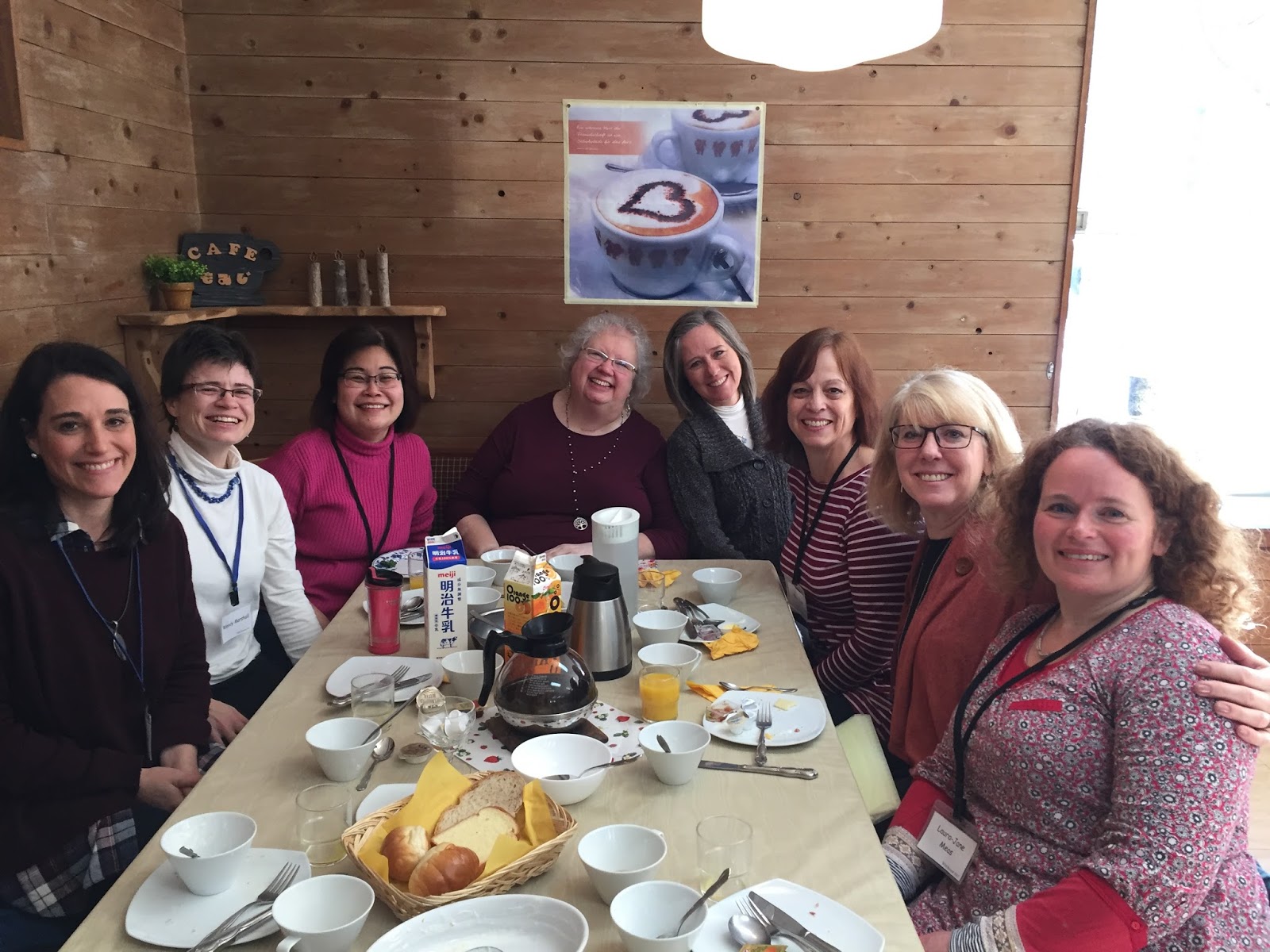
This photo was taken at the women's retreat I went to in
March. It's an illustration of the international environment
I work in. Here we have people from Germany, Singapore,
Ireland, US, Canada, and Australia. And I'm pretty sure at
least one of these ladies wasn't born in the country that they
are a citizen of. Two of them are also married to men from
other countries (Japan and Cambodia).
Under that title, I've been asking people to comment with words from their English background, specifying a certain category each week. I started out quite broad, with topics like food, clothes, nouns, verbs, and prepositions. But recently have gotten more specific like real estate words, abbreviations, occupations. I've had a great time doing it and regularly get upwards of 70 comments on a post.

It's been great to have a safe place to exchange these without exchanging blows.

Here are just a few things I've learned:

  • snow peas (Aust) = Mange tout (UK)
  • My team is winning (US) = My team are winning (Commonwealth)
  • Clean your teeth twice a day (Commonwealth) = Brush your teeth twice a day (US)
  • He's in hospital (Commonwealth) = He's in the hospital (US) [Though this is a bit complex, I might say the latter if there were only one hospital.]
  • Crossing guard (US) = Lollypop lady (Commonwealth) = Scholar Patrol (South Africa)
  • Hospitalist (US for a doctor who specialises in the care of patients in hospital)
  • General Practitioner or GP (Commonwealth) = Primary Care Physician or PCP (US)
  • Professor (Australia) = Department Chair (US). [This one is also a bit complicated, in Australia a professor is a higher title than in the US.]
  • I'm free on Wednesday (Commonwealth) = I'm free Wednesday (US)
  • Meeting one-on-one (US/Aust) = Meeting on-to-one (British)
  • Outwith (Scottish?) = Outside of (every other form of English?)
  • Take a shower (US) = Have a shower (Australian)
  • I'm working 9 while 5 (Northern UK) = I'm working 9 till 5 or 9 to 5 (other English)
  • One step on (Commonwealth) = One step beyond (US)
There's quite a lot there, and some I'm still not that clear on. Many of the things that come up in these discussions I'm familiar with, but it's great to learn more of the subtle variations. I've also got friends from the UK and Northern Ireland who bring up a whole variety of very regional-specific vocabulary and usage points.

This is a good learning opportunity for me, as I regularly edit the written work of people from a variety of English backgrounds. Our editing policy is that we try to edit to the English background that the author comes from. So, for example, an Australian would not have to change their spelling to US spelling. However, we do try to use vocabulary that the majority of our international audience will know, so we don't allow a word such as "sparkie" (Australian slang for electrician).

I've been a little surprised at how much attention this particular Facebook status has received. I've had people tell me they go looking for this post on Wednesdays. Others who've suggested topics or brought it up in conversation. It works on my FB feed because I have friends from a variety of countries, though I haven't received many comments from Canadians, Singaporeans, New Zealanders or other English-background speakers. Mostly just US, UK, and Australians.

I'm happy to receive suggestions for topics for the future!

This week's Wednesday Word topic is children and parenting. For example, the other day I commented about a US/Japanese friend's new "pram". She was a little bit surprised, as no one had yet called it that, though she understood what I meant. "Stroller" I think, was her word, though other words you could use are "baby car", "buggy", "carriage", "pushchair", depending on what your local English preference is.

09 April, 2017

Self-saucing pudding

I had fun this week by putting the word "pudding" up on my Facebook page and asking my friends, who hale from a variety of backgrounds, how they used this word. I had over 100 responses. This is a summary of what they said:

Americans: it is a smooth, gelatin-type creamy dessert of varying flavours, often based on Jello. Although a handful of exceptions came up: bread pudding, banana pudding, rice pudding, and cottage pudding. Edit: I knew I could get in trouble writing this. My American proofreading friend has said this is wrong. He suggested I put this: "It is a sweet, smooth, milk-based creamy dessert of varying flavours." Other feedback suggests that it is not necessarily made with gelatine or Jello.

Australians: many remember when they were growing up that the sweet course after mains at the evening meal was called "pudding" no matter what it was, but now call that course "dessert". 

British: were split. Some call anything sweet you eat after dinner pudding, some do a similar split to Australians. I believe it is something of a geographical split, but I don't have a clear reference for that. Some also had other things they called pudding, non-sweet things like Yorkshire pudding which goes with roast beef or a steak d kidney pudding.

I got no responses from other English-speaking countries like New Zealand, South Africa, or Singapore.

On Thursday I made chocolate self-saucing pudding (my recipe is here) to share with friends who invited us to dinner on Friday. I have a US friend who is curious about the creation of this dessert, so here are some pictures of the process:

First the cake-like batter went into the dish.

Then I mixed together cocoa and brown sugar.

And sprinkled this over the top of the cake-like batter.

After that I gently poured boiling water over the whole thing.

Finished, it looked like this and then went into the oven.

I neglected to take a photo of the end effort. Actually the dish I used for this was too small (because I'd doubled the recipe and calculated badly on the volume, a common problem for me that makes me a bad packer too). Because it was too small, the final product didn't look great as it had overflowed and baked onto the edge and outside of the dish. 

However it tasted great. On top it looks like a normal-ish cake-like dessert, but when you take out a serving, you find thick chocolate sauce has formed at the bottom (check the recipe I linked to above to see a photo of this). Magic!

28 February, 2017

Today's language mayhem

The person who came up with this translation "ship shortage",
might have been having a mayhem of a day too.  This was
the reason given for our flight back to Tokyo being
cancelled last June.
This morning I was head-down-tail-up trying to get all the articles for the next magazine issue finalised before going away again tomorrow.

Finalising an article means making sure every detail is taken care of before I hand the articles over to the designers: from the obvious mistakes the proofreader might pick up, to checking on communications with authors about details they are concerned about, to images I've received from authors or a myriad of other small matters that can become big matters if not dealt with at this point.

This is not my favourite part of editing. I prefer content editing where one is looking at bigger picture issues.

So in order to do this end of editing for the magazine I need to work myself into a certain focus. The sort of focus that doesn't allow me to quickly jump in and out.

This afternoon I had my semi-regular language exchange meeting. A time when I get together with two Japanese friends and we try to talk in Japanese and English, helping each other learn. 

Unfortunately I did not allow myself sufficient transition time. I jumped almost straight from editing onto the train and into chatting. My "Japanese brain" simply didn't snap into gear. Especially as they wanted to hear about our son's wrestling! And that is something that I almost never talk about in Japanese, so my vocab is pretty limited. Not to mention that they had a lot of questions about specifics that are challenging to explain, even in English.

So I went from thinking about a sentence like this:
US authors may object to “maths” being used in place of “math” in their writing, just as Commonwealth-background authors might protest about “cilantro” replacing “coriander” (the leaf, used in cooking) in something they’ve written. 
To trying to figure out how to explain "pinning" in Japanese (not knowing the word for shoulder blade and forgetting what verb I could use for "holding someone down").

Thankfully my language exchange partners are very forgiving and don't mind if we end up doing more English than Japanese. It is I who tends to beat myself up.

So we ended up talking about all sorts of things in a mixed-up way. Not the best for language exchange, but still fun.

Something that struck me later as I walked home, was the number of times I talked about "the feeling" of a word. Words like "seedy" and "balmy". Even talking about a "white elephant" and how it isn't just something that is useless, but it carries the feeling of an encumbrance.

The "feeling" of a word is very important. It's something that you only get when you are becoming familiar with a language. For example, when you put  the word I've used in the title of this blog post: "mayhem" into the thesaurus, you come up with words that are similar, but not necessarily quite the same. For example, "violence" and "destruction".

Similarly in Japanese. I only can think of poor examples, but I learned the word for energetic or lively: "nigiyaka" when I was at language school and applied it to my son, but was immediately corrected. "That is only used for events or situations, not people," I was told. The word "gambatte" is a Japanese word that isn't easily translated, but means something like "do your best" or "try as hard as you can". The feeling of the word is one of encouragement, with an edge of stoicism to it. Something you don't easily get with those English translations I've given.

So anyway, I've learned that I have good days and bad in Japanese. Probably I would have more good days if my job required me to work more often in Japanese. But I've learned to accept that sometimes I'll feel like I'm flying through and other times it is more like a less-than-graceful trek through a bog.


18 January, 2017

Music and prayer

Today, on my way to a missionary women's gathering for prayer and encouragement, I read an article by a missionary about music and prayer. It had only landed in my inbox this morning. 

I didn't have much time to read it, but skimming was enough. The author's style is not one I'm particularly drawn to, but she made a point that I suspect many missionaries can connect with: that most of the time we're worshipping and singing in a language that isn't our heart language. The words are foreign and often the melody too. It can make worship dry and our hearts grow fatigued. Then, when we do have the chance to sing in English, the emotions can come pouring out with tears. 

Many of you may not know what it is like to not sing in your heart language at church regularly. I nearly made it through the whole Christmas season last year without once singing an English Christmas carol in fellowship with others.
Our gathering this morning was permeated with song.
I see it in my friends who gather with us once a year for fellowship, blessing and restoration. They lift their arms to the sky, singing in English for the first time in months.
As we gather together, I hear in their voices a year’s worth of prayers held together with tape and glue, tattered through treacherous dangers, embedded – as we are often reminded – in spiritual battle. We let our worship do the praying for us. The words we’ve been missing for so long don’t dare hide the promises of Scripture, or the God who sees and loves sparrows and wildflowers as much as the hairs on our head. From here.
There were more than this present, but I didn't try hard to take a photo, rather
I luxuriated in being fully present with these friends, new and old.
It's fitting that I was headed where I was when I read this. Together with other, mostly foreign, women I worshipped in English this morning. I'm unusually blessed in this business as I get to do this most months at our mission gathering. But many do not. 

Still, gathered in an unhurried way with other English-speaking women, my tears still spilled over this morning. I couldn't even tell you what exactly the tears were for. But I suspect, as the author of the article above suggests, that this was an outpouring of prayer, of love, for my heavenly Father.

31 October, 2016

Cross cultural communication in English

On Saturday after the cross-country finals we had lunch in the restaurant on the US recreation "base". An American restaurant with American friends. I was surprised at how much "translation" was required.

Our waiter was a trainee and drew a little diagram on his notepad to help him remember who ordered what. One of the Americans suggested after the waiter left that we could all switch seats. I said, with feigned admiration, "You're wicked!" That was met with confusion! We had to explain it meant "a bit naughty".

This led into a discussion about Australian humour, and that teasing, being "mean", or "paying out" was a sign of friendship.

Then another parent came over to say hi. He's an Aussie. His son had gotten a medal earlier so I congratulated him saying, "Good onya." That also required explanation for our American friends: "Well done"! 

Chips or fries? In Australia those words a synonyms (except at Maccas)
When the Aussie finished talking to us he said, "Well, I'll leave you to it!" That one also needed interpretation, it means "I'll let you get on with what you're doing."

The menus required some translation the other way. Hoagie rolls and Kaiser rolls! I'm still not really sure what they are. The waiter also asked if I wanted fries or chips. I looked at my friends and said, "Fries are hot and chips are cold, right?" They looked confused for a moment!

David was asked whether he wanted bacon or ham with his burger, he said, "ham" and deftly slipped in, "American bacon is too chewy!" (Lucky they let him get away with that virtual slander!)

Language is a fascinating thing. Finding Americans untouched by our brand of English can also be fun. But I'm still not interested in going to America, I think communication might be harder than I want to try.

We also discovered that none of them have tried Vegemite. I'm thinking we might need to do some more educating!

08 March, 2016

Bath tissue

This was on the wall in my toilet cubicle at Costco this morning. In the company of north Americans I've grown accustomed to calling the "toilet" a "bathroom" even when there is no bathroom. Sometimes I'll use restroom, because bathroom just seems too weird.

But this is pushing it too far. All I can see when I read "bath tissue" is a bunch of tissues floating in bath water. Eeew!

Language is funny, because when words are a part of your regular vocabulary you don't even think about the literal meaning or an alternative literal meaning. For example "car park" sounds strange to American ears. To us it is merely a place that you park your car. But they think about parks and how weird it is to have a park full of cars!

What other phrases do you use that makes sense in your culture, but not to people from other cultures?

14 October, 2015

Fascinating chatter

On Saturday we went to another cross country meet, in fact my husband was the team bus driver, so I got to ride up front. As the students piled back into the bus to drive home I wrote this on Facebook:

It really is amazing to . . . listen to the runners chat. It's so bilingual. Most conversations include a mixture of both English and Japanese.

Most students at the school speak two or more languages. Students who don't are the exception. Even those who mostly only speak English frequently mix Japanese words into their chatter, especially when they're with their friends.

One of the surprises that Japanese parents get when they send their children to the school is that they change, they don't just gain another language, they change in the way they think too. Our children have been growing up in a fascinating context. I can't wait to see how this becomes a part of who they are as adults.

12 October, 2015

Why are Japanese people so bad at English?

It is a discussion we often have, in Japan and here. Japanese people seem convinced that English is too difficult for them. But there are other reasons beyond the fact that English is vastly different to Japanese.

Here are some reasons and language-learning ideas for those of us living in a land that doesn't speak our heart language: http://japaneseruleof7.com/why-are-japanese-so-bad-at-english-5-reasons/

12 August, 2014

The joy of number plates

Here's an example of the sort of reading challenge that we face
in Japan. Which one is sugar, which one is salt?
Yes, I know they are really "registration plates", but I've always called them "number plates". You know, the things on the backs and fronts of motorised vehicles with numbers and/or letters on them. They've become quite an conversation topic for our boys as we travel around. 


Queensland number plates are generally three numbers and three letters. The combination of letters can be particularly fun. For example, we can be driving along and suddenly from the back seat comes,

The car from which we're doing all this number-plate spotting.
"Oh look, there's QQQ on that yellow car beside us, wow!"

From another boy, "Coming up beside us is a blue DuCK." (DCK, being the actual letters).

Then David says, "Oh, there's a green C. That's an old number plate." (Current number plates are maroon.)

And the we might say to our personalised number plate expert, "I can see a a personalised number plate, reads, 'Mum10'. How much does three numbers and two letters cost?" (He's researched this and knows.)

This really is a small example of the joy our boys have in being able to read everything in Australia. Nothing is immune: signs, nutrition information on the sides of boxes, etc.

I revel with them. Being able to read and understand it all (or most of it) is an amazing thing, and not something to be taken for granted.