Showing posts with label work. Show all posts

29 August, 2025

Be strong and do it

This week has been full of many words, most of them written. I've done a lot of editing, at times I've really struggled with the editing work I had to do, which included a lot of reading and making decisions about author's wishes as what I thought readers could read and understand. When people think of editing they often first think about grammar and spelling, but the work I have done this week was at a much higher level than that. It was really hard work, work that sometimes had me wondering if I was any good as an editor at all, and people in my vicinity have heard me call myself a "bear of little brain". In any case, I'm glad for respectful, gracious authors who were patient with me as I tried my best to do the work.

Be strong and do the work

Mid-way through the week I was also reading the end of 1 Chronicles, where King David was preparing for the end of his life and handing over reign to his son Solomon. The big thing that he didn't get to do in his lifetime was build a temple in Jerusalem. He really wanted to, but God said no. However he did a lot of preparation. 

In chapter 28 he is talking to the leaders of Israel. He charged the leaders as well as Solomon with the task of continuing to follow the commands of the Lord. 

He particularly addresses Solomon with the charge to "acknowledge the God of your father, and serve him with wholehearted devotion and with a willing mind, for the Lord searches every heart and understands every desire and every thought. if you seek him, he will be found by you; but if you forsake him, he will reject you for ever" (v. 9 NIV). Then he moves onto the task of building the temple and then he says the words that have resonated in my head all week: "Be strong and do the work" (v. 10).

I think I'm going to have to start calling this
Maidenhair Fern 
"Lazarus" because once again
it has nearly died and it's coming back to life again!

After a whole lot of detail about the plans for the temple, he says again to Solomon, 

Be strong and courageous, and do the work. Do not be afraid or discouraged, for the Lord God, my God, is with you. He will not fail you or forsake you until all the work for the service of the temple of the Lord is finished. (v. 20, my emphasis)

The phrase "be strong" actually appears 33 times in the NIV version of the Bible, most of them are exhortations from God to his people. Often it's "be strong and courageous", but also "be strong and take heart" which is similar.

Now of course I am not doing anything like building a worship building for God, I am not taking on massive leadership challenges, and nor inheriting a reign over a people chosen by God. So the parallels are a little hazy, but I do feel like it's applicable to our lives as Christians. Often we struggle with motivation or distraction or other things. Sometimes it helps to be reminded "be strong"—because God is with you and has promised to give you strength—and "do the work"—just get on with doing the hard thing, the next thing because it's what God's given you to do this day.

I don't know what hard thing God's given you for today. I'm anticipating my mental load today will be less than it's been for the last couple of weeks, merely because I did the hard work and those particular tasks are done, and the ones I anticipate doing today are probably easier. But I better get on with "doing the work", trust that God will give me all the strength I need to do all he has for me today.

17 August, 2023

A typical week, not a chance!

No, no one has asked me yet what a typical week is on home assignment. I can't say we've had a typical week yet, and we probably won't ever get there these twelve months. We've now been in Australia for a month and our weeks have included:

  • collecting furniture
  • shopping
  • setting up home internet
  • sorting out stuff we've had stored for 4 ½ years
  • figuring out how to make a functional home and office from the stuff we own and the stuff we've been given
  • buying a car
  • sorting out red tape—including stuff related to driver's licences, applying for Blue cards (child safety clearance), changing addresses, insurance
  • debriefs of various sorts for our organisation
  • medical stuff—bi-annual checks for our organisation, hunting down referrals to specialists, skin checks, blood tests etc. (this has actually taken up a lot more time that you might imagine)
  • starting to get involved in mid-week events at our home church
  • university open day
  • social time—with our eldest son, with good friends
  • driving lessons
  • preparation for speaking events coming up
  • a prayer meeting
  • meeting with other members of our organisation to catch up
  • walking and orientating ourselves to the local community
    The hardest thing to set up was our dining 
    room/home office. Without an extra bedroom
    we've had to juggle our living area to accom-
    modate a working area too. It turns out that 
    this large table doubles quite nicely for work 
    (except for me, thankfully I am able to
    work at the shorter desk you can see in the 
    corner).

Phew! In between all that I've been trying to do my best to relax by having a coffee break on our deck with a book in the afternoon, when I'm home. Other things that have helped me feel more grounded have been household management things—meal planning, grocery shopping on a regular day, regular basic cleaning, and baking. 

"There’s a big difference between living and visiting." That phrase that popped into my mind recently. A lot of what we've been doing is related to living here. We're not on a brief visit or trip. We need to, as best we can, establish our lives here for the next 12 months. That's been hard work, and it doesn't feel like it's over yet, though perhaps the pace is slowing as we gradually tick off once-off things.

Two weeks tomorrow we're flying to the west coast for 18 days to visit churches and others over there for work. That deadline looms large. We'd like our sons to be as settled as they can be at this time so they can manage independently for the longest time we've ever been away from them. We also want to be as prepared as we can for the speaking work we'll be doing over there . . . alas we're still waiting on replies from several people, so it's more last minute than we're really happy with. 

Ah, God's got us on our toes. But I'm reminded that he's the God who goes before us (Deut. 31:8) and that his mercies are new every morning (Lam. 3:22–24, KJV, more modern versions say "compassion"). And these are the truths I need to be repeating to myself when I dream/drowse in the early hours of the morning and my thoughts get filled with anxious thoughts.


17 June, 2023

Finally the day has come…

Yesterday was the day we've been working towards: it's the day we decided months ago that we would finish our work (i.e. magazine editing, social media managing, and—for David—teaching). It seemed impossible at times, but alas (or much to my amazement) we actually managed it! The only portion of all that that I will retain is an overall management of the magazine team and general "hard question" consultant.

I'm thankful that I was running ahead of schedule last week. That relieved some stress as yesterday didn't go at all as expected—a simple get-medication medical appointment at a hospital (usually takes under an hour) turned into a four-hour ordeal. 

Being ahead of schedule also meant that I could volunteer several extra hours to help the admin team for the magazine with the manual labour of packing, and this month's mail-out had a wrinkle that's extended the time it's taking to packing all the magazines up several fold!

This week has held other unplanned things: 

  • Doing my first ever audio recording of a conversation with a colleague which will go with six articles I've written about home assignment preparation (looks like that recording and the articles will be published over the next couple of months, so I'll be sure to share them).
  • Doing some serious culling of files on my computer so that I can transition to my new work computer (yep, my computer lied about how much it held, and we ordered a new computer that was too small). Why this week?
  • Starting to hand off my plants to others! Just like with my work, I'm splitting my plants up between several people to care for while we're away. I’d planned to do it, but not as soon as this week!
  • A pile of mending has suddenly appeared! Really?
  • And various appointments that aren't related to us leaving: mostly medical, and dental, but I do need to remember to make a hair appointment.
  • I don't remember when I found out, but not long before Monday I discovered that I was invited to a staff-family dinner that night. First time since COVID (for me). And it was followed by square dancing, which is very closely related to the Australian bush dancing we did as kids and was super fun (even if I was very tired).
And expected things:
  • I'm starting to struggle with sleep: nightmares about clerical errors, waking up early with my brain whirring, etc.
  • Finishing work today, of course!
  • My last work meeting (aside from next week, which is basically a whole five days of meetings at our OMF conference).
After my long wait at the hospital on Thursday I was feeling quite off balance yesterday. I'm really glad that I planned ahead and handed things off early, it's really helped that that hard work of thinking things through to be done before this week!

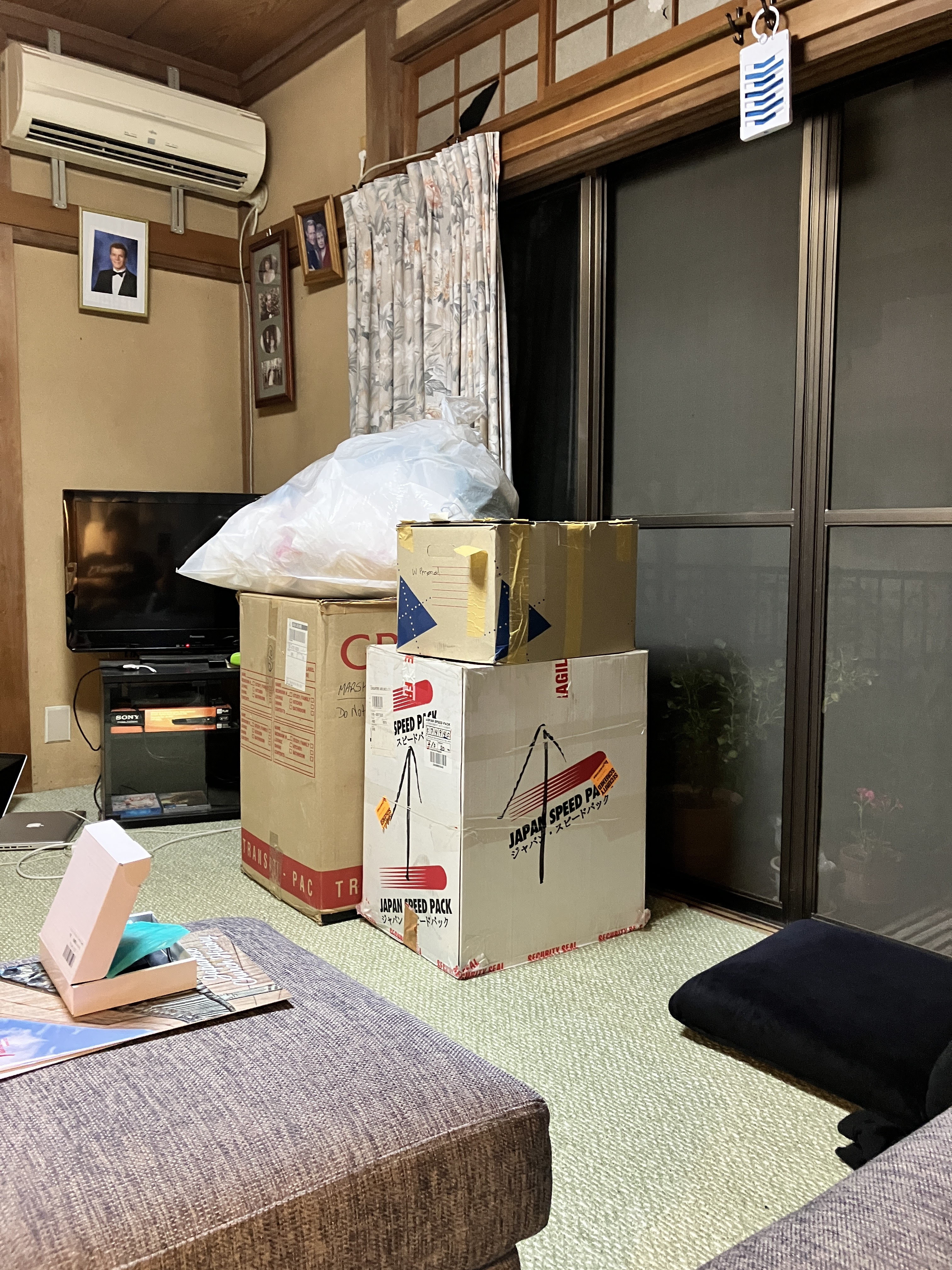
David also finished work yesterday, and last night he pulled out a whole lot of boxes that we haven’t used in 13 years. They’ve been living in our attic. Now our house looks like we’re moving, even if we haven’t actually put much into the boxes yet. But I’m feeling pretty restless about it all. Probably the best way to deal with that is to get off my chair (and this blog) and actually do some sorting myself. Here’s my secret: I leave the actual box-packing to David who is a magician when it comes to 3D puzzles like this.

Boxes full of packing material


On Monday we leave early to catch a couple of trains to catch a plane to Hokkaido for a five-day conference with OMF Japan. So we’ve also got to pack for that…and so, I’d better get going.

16 February, 2023

Pondering COVID's impact on life and ministry

One of my jobs with our mission's social media is to come up with media posts, especially the text-parts. That sounds easier than it sometimes is. Our goal is to raise awareness of the need of the gospel in Japan and getting people more involved, which is a bit different to how most of us use our personal social media accounts. I guess it's a close relative to "marketing".

We use a monthly theme to help fuel our creativity. Some themes are easier than others. Next month's theme is "How COVID has impacted life and ministry in Japan". That sounds like a good theme . . . but how did we find engaging content for that? 

Our team met early last week and brainstormed. One of my ideas was to do a short survey of our missionaries. But putting feet on that is harder than I thought. This afternoon I found some space to think about what I'd actually ask people. I shifted some ideas into a draft survey format, and then I have moved away to other things (like this). 

That is my usual way of operating with creative things: it's how I write, and edit, as well as work on tasks like this. Letting an idea drift around in my brain while I do other things is a brilliant way to find my way forward. I hate it when someone asks me to do "live editing" at a meeting. I prefer to read something and let it sit for a while before I do anything with it, and even when I do start to work on it, I want to do it without an audience, I want to play around with ideas in my head (and on the screen) before I decide anything. Actually, it's how I do shopping too. I hate shopping with (most) other people, I need space to think about options and decisions.

But anyway, what do I ask missionaries about how COVID has impacted their life and ministry?

My own ministry hasn't been majorly impacted by COVID. I worked from home and online for years before everyone else was doing it. The biggest impacts COVID had were more personal things like the inability to travel to see family in Australia (and them unable to come here) and watching my boys suffer as they lost opportunities and had to deal with online classes. 

Wearing masks hasn't been my favourite thing, but I've been able to avoid much of that as I work at home. 

Emotional distress probably rates fairly highly too. We've just passed the two-year anniversary since one of our young friends lost her battle with depression and died by suicide. We've had our own mental health battle in our own household during the pandemic and because I was isolated from good person-to-person contact with people for months at a time, I've found it difficult at times to find ways to interact with others and know how to talk about my own struggles. I wonder if I've gotten worse at "small talk".

Life is getting back close to normal now, though attendance in-person at our church is still lower than it was pre-pandemic. And we are still wearing masks indoors and in crowded public spaces in Japan. There is talk that next month the government recommendation for wearing masks will be lifted, but we wonder what that will look like. Life in Japan is very influenced by not causing discomfort for other people, and will not wearing masks create problems?

I can identify some positives that came about due to COVID: regular walking and talking with David. And the acquisition of a stand mixer (given it by a missionary who had to leave). Also, the increased tendency of people to have some meetings online and thus meaning less time is taken up with travel, even some opportunities to meet online with folk who we'd never otherwise have done so because we all live so far from one another.

But back to my question: What would you like to know about how COVID has impacted life and ministry for missionaries? If you are a missionary, what would you like others to know?

21 January, 2022

Dwelling in the land of spoken word

This week, instead of doing my usual work that involves a lot of written word, I've been dwelling in the world of spoken words. I've been helping facilitate an online workshop for 17 members of our organisation. That means 3 ½ to 4 hours a day on Zoom, not just as a participant, but as one of those who is responsible for how it goes. But I really did struggle, at times, to pay attention when the other facilitators were talking. And then, towards the end of the week, I also struggled to get my thoughts in order as I taught someone else's curriculum. I avoid meetings as much as I can in my daily work, so this week has been pretty overwhelming. 

One of the concepts I taught 
about this week. "Six ways" 
of mobilisation.
It's interesting to read what I wrote in my blog post about it the week after it was finished last year. But especially how it gave me an "adrenaline rush", because that's not how I remember it at all, in fact I was pretty terrified at times and certainly completely wiped out afterwards (and am feeling some of that this afternoon, it's become hard to think and to write!). But thankfully I've felt a little more confident and less terrified this week!

Now we have a week's break and then do it again from Jan 31, with the same people, but different content and more meeting time (maybe 5–6 hrs every day online?). I've got plenty of tasks from my usual responsibilities tugging at me, so it's going to be hard to stay focused and not over-work next week.

On top of that we've had news over the last 24 hrs that COVID is touching closer to home, with cases at the school, including a colleague of my husband's. So school is going online again all next week. It's challenging times we live in!

Coming back to these verses again:

Each of you should use whatever gift you have received to serve others, as faithful stewards of God’s grace in its various forms. If anyone speaks, they should do so as one who speaks the very words of God. If anyone serves, they should do so with the strength God provides, so that in all things God may be praised through Jesus Christ. To him be the glory and the power for ever and ever. Amen. (1 Peter 4:10-11, NIV)–my emphasis

18 August, 2021

On the edge of ordinary on the medical scene

Looking at July and August, all I've written about on this blog is holidays and camping! Anyone would think I've done nothing else. I actually only had 16 official days of holidays in those two months. Since we got back from holidays in mid July I've been at my desk most of each work day (aside from those two days of camping a couple of weeks back). It's always a challenging time of year to work, although as the boys grow older it's become much less of a problem. They are no longer running around the house during their holidays, demanding my attention at random times, so I've got a lot more headspace to devote to work.

David went back to work officially on Monday, so this week is looking more like business as usual, except that I've got two big boys sleeping away much of the day (yes, they are pretty nocturnal at the moment). When I say "officially", David's actually been in and out of school many days in the last fortnight. And he's been on his computer doing email and other admin things for a period most days, not to mention three Zoom meetings/training with OMF last week. Plus, he's been working on a project of digitalising a portion of his work that has existed on index cards that have been collected by dozens of teachers over the last few decades. So, I've not been alone in working at home here!

We do as much of our medical care as we
can in Japanese, but for some things we 
really need English service providers for.
We're thankful for the doctor near this
station who has been caring for one of our
sons over the last 2 ½ years.

In addition to that, we've been doing a few medical things. I wanted to write a bit about one of them—a visit to a dermatologist.

When you live in your home country you don't think about how the medical things that happen there are (sometimes) specific to your country. Of course you might think about how accessing medical care in another language is hard (and it is!), but I've got a different type of example you might not have thought about.

Skin cancer isn't common here

Australia has the highest rate of skin cancer in the world for men (not women, though we're close to the top of the list). Japan is not even in the top 20 countries in this list. But Japan is third on the list for stomach cancer and Australia doesn't feature in the top 20. (This data is from here.) 

These are interesting statistics, but the rubber hits the ground when you are not living in your home country. In Australia skin cancer is high on the list of things that your local GP will check if you ask them to (and in fact we've been told that the average Australian GP is better informed about skin cancer than the average dermatologist in Japan). Plus, there are many easily accessible skin cancer clinics that will give you a regular full body check. By contrast, in Japan, there aren't such clinics. And at annual government-funded medicals in Japan, they check for bowel and stomach cancer, but skin cancer isn't on the radar.

It just so happens that my husband has a family medical history (and now a personal history) of skin cancer, and so this is definitely on our radar as he gets older. I'm very grateful, therefore, that we live in one of the largest metropolises in the world. It's possible to find unusual services, like a doctor who has read up on skin cancer in Australia and is willing to "colour outside the lines" with foreign patients who have different skin and had different environment growing up to most of the Japanese population. It's not covered by our Japanese health insurance, but it's an awful lot cheaper and easier than going to Australia. It really is another example of how we live "on the edge of ordinary".

And life continues on...

Aside from all that, we're living pretty quiet lives here and trying not to be too stressed by the news of what's going on in the rest of the world. The pandemic is raging in Japan (between 15,000 and 20,000 new cases a day in the last few days, around 5,000 of those in Tokyo) and we're doing essentials, but otherwise at home. We're thankful that Japan is working hard to vaccinate—nearly 50% of the population has had one jab, that's 60 million people since they began in mid February. Maybe by summer next year Australia will welcome us back for a couple of months without requiring us to quarantine in a hotel at our own expense?

School (CAJ) starts the new school year for students from next Tuesday. I'm still coming to grips with the fact that we'll only have one at school this year. We're not sure what the year will look like for our middle son, but we're glad we have the means to be able to support him at this transition time of life, to give him a chance to figure things out.


02 July, 2021

Medley of thoughts before holidays

We're winding down here, on our way to family holidays. This weekend I'm walking away from my computer and email and other work messages for a couple of weeks. Oh, and daily language study too! A total break during which I can forget about what plate/ball I might have accidentally dropped. Ah, the bliss.

This is the park near where we'll be.


I've been working hard these last few weeks to clear my To Do list of urgent matters. It's quite a trick to managed when you are responsible for social media posts five days a week for your organisation, but I've got a good team and we've worked together to get the next month sorted ahead of time. I've also got a team working on magazine matters. Almost anything that arises in that realm can wait till I get back too.

And though I have generally felt okay recently, I think my body is sending me signals that it's time to take a break. It's been a very rough year for us personally, as you might have guessed (see this post about death and this one that includes a brief reference to the uncertainty we have faced over the last several months with one of our boys). 

On Monday we had our first COVID-19 vaccinations. So thankful! Japan is really getting a hurry on with these. Nearly 25% of the population has had their first injection, which three times what it was a month ago. The next day I had an unusual few hours of gastro upset. There were other factors involved, so it's impossible to say why, but I think it's time for a break.

We're headed to the same place we've had family (non-tenting) holidays twice a year in the last three years. I anticipate that our time away will be very similar to last year (see here). Which suits us just fine, especially the one who gets anxious about change.

We're also excited to have finally been able to book another camping trip for early August. We're staying pretty close to home, though, no new prefectures to add to our list, but still three nights in the mountains next to a stream sounds really good. It's cool today, but by then the stream will also sound really good (and they have showers too!).

When we come back the Olympics will be close to opening ceremony and it will be fascinating to watch that event unfold on Japanese TV. We no longer have our Olympic tickets; though we've still got two tickets for the Wheelchair Basketball and Paralympic Athletics in late August, in a couple of weeks we'll find out if we can still attend.

I've kind of dropped the ball on writing about "Come" (see my kind-of resolution from January), but I really don't think I have brain power to write anything on that today, so maybe later. Maybe I'll get an urge to write while we're on holidays, but I kinda doubt that. Usually holidays pass in a blur of reading, eating, sleeping, playing games, and watching movies with the boys. Generally taking a break from thinking about putting words together.

See you on the other side!


06 May, 2021

Thankful for my job

Have I told you recently that I love my job? I love the variety and challenge. I love the flexibility and the mixture of working with people as well as on my own. I also love that I've continued to grow in this skill that I've invested myself in learning—editing. And that the job offers endless challenge to continue to grow.

Editing, like most professions, requires a certain boldness in your own skills, knowledge, and opinions, even more so if you start out in it with little official training. But I've grown in confidence over the years and now, more than 10 years after I started in earnest in the editing business, I find that I'm relishing working in an area that I feel pretty comfortable in. I never got that far in my Occupational Therapy career. I moved onto motherhood and missionary work less than four years after starting work as an OT (and was employed in multiple jobs), so I never really gained the confidence that comes with experience. I can't say that I've gotten to that level of experience with many other things, so this is something to enjoy and be thankful for.

All that being said, I still have much to learn about editing, and indeed, if I didn't, I think I'd become bored and move onto something else! I'm currently enjoying dipping my toes in the world of editing a fiction novel in my spare time.

Mind you my current job involves a lot more than just editing words. I manage a magazine production team, which means managing schedules and the space in the actual magazine. I work with editors, fact checkers, a proofreader, and designer. I also work with a team producing social media content for our mission, which includes working with constantly changing technology, as well as visual and auditory content. I work with writers and people who don't consider themselves writers, but write nonetheless. My job involves a fair bit of writing too: from emails, to social media content and magazine articles. I'm also involved in mentoring editors as they learn and grow, and helping writers learn about improving their writing. 

One cool thing about editing is that you're constantly learning, not just because you intentionally go out to do that, but the content you edit teaches you as you go, and often you have to do research to do a good job at editing. For example, in recent weeks I've learned about Doraemon and NiziU, an anime character and recent Japanese pop group. I've watched videos about warfare in Afghanistan (for the novel I'm editing) and listened to a podcast about how Japan's exported its culture to the rest of the world. I had to look up the plurality principle and check references for the average size of a Japanese church. I love it how I get stretched by the different themes that we work with both in the magazine and in social media.

I this this is a great quote about the editing profession: (from the end of a book about magazine editing)

Editors will forever be burdened with the public perception that they are grammar nerds, cocktail-schmoozing glitterati, or tough-nosed autocrats.

Such is life.

But as you now know, editing is more than these things—and even more than these things put together.

Editors work with ideas, grappling with concepts that must prove themselves to be fascinating, enlightening, valuable, or necessary—or risk dismissal as the editor plows on in search of better ones.

Editors work with words, making them inform, making them amuse, making them sing.

But most of all, editors work with people. We work with readers, first and foremost. We work with writers a lot. We work with designers, publishers, circulations managers, and artists. We work with sources: presidents, janitors, movie stars, prostitutes, CEOs, victims, teachers, and everyone else we can find who will tell us great stories and make us feel something.

We spend too much time in the office, but we get out when we can: to parties, to conferences, to gatherings of people who might give us the next great story to tell...

Editing allows you to see things that other people don't get to see. But mainly editing allows you to think. You're paid to think and create and work with teams to build something new each month.

It's a great job. 

From The Layers of Magazine Editing, Michael Robert Evans, pp. 326-327. 

Personally things have been rough in recent months, for various reasons I can't go into here. I did start this week with a pretty heavy heart (but feel better today). But I have to say that it really helps that both David and I have jobs that we enjoy and that are meaningful. I am very thankful! 

Of course I'm also thankful that I can walk through each day remembering my rock, the unshakeable one:

He only is my rock and my salvation, my fortress; I shall not be shaken. (Psalm 62:6 ESV)


27 November, 2020

Managing my time

This is a lifelong challenge for most of us. I see my kids struggle with it, my friends and colleagues, and of course myself.

Coffee is one of my routines. I look
forward to coffee at about 9.30 and
3.30 each day. The other day I was
out at 3.30 and in a rush, so I bought
a coffee from a convenience store.
Not bad, either!


Last week a friend called me about our Saturday plans. She asked how I was and I told her I was in the midst of a crazy week where some bigger things had all landed on my desk at once. I had several Zoom meetings, for two of them I had to spend significant time preparing information to present. On top of that the prayer booklet that I've been working on was finally printed and there was a flurry of activity surrounding that, including a trip into town to sign thank you cards for contributors. In the same week we were doing final proofreading for the Winter issue of the magazine, something that only happens four times a year, but last week it collided with these other things.

My friend said, "Wow Wendy, that's quite a bit of juggling!"

I said, "I usually juggle quite a lot, and manage it fairly well, even enjoy it; but this week is a bit over the top." 

I have several job titles, including OMF Japan Social Media manager, Japan Harvest Managing Editor, and Website responder. Now added to that is Pre Home Assignment Workshop facilitator. Most of the time I love it. I love variety and hate boredom, this collection of jobs suits me well and most of time I can make them fit well with one another.

What do I use to keep me organised?

  • Asana.com (see my post about that here). This keeps me on track with deadlines in my publishing work (I usually have dozens of deadlines  in any given month).
  • A running list on my phone where I tick off (US=check off) the items as they're done through the day, this saves me when I remember I need to do something later and because I nearly always have my phone nearby, it's brilliant. I used to use PostIt notes, but they aren't nearly so convenient.
  • A calendar next to my computer and one in my handbag. Yes, I'm a physical calendar kind of girl. Not so good for keeping track of Zoom meeting links, but I haven't had many of those to deal with on a regular basis.
This next list is not so much tools for time management, but more helping with organising multiple bits in projects: when it comes to organising publishing work, I use a variety of other tools, including: 
  • Trello (a collaboration tool for organising projects, particularly useful for working in a remote team, we use it for social media planning)
  • Google docs: sheets is a particularly helpful way to lay out content such as a publishing schedule or a list of articles for a magazine, in a way that is easy to understand and for others to access.
  • Dropbox: I use this extensively when working with files that others need to access, such as other magazine team members.
  • Social media scheduling tools (yes there are such things, and I only use them for work, not my personal account): Buffer, Hootsuite, and just today I'm starting to try out a new one called "Later". But I'm still searching for the "perfect" one, any suggestions welcome!
Yes, it's complicated, but I wouldn't be able to do these jobs efficiently without these tools to help me stay on top of things. These tools also help me to relax when I'm not working: I know that I don't have to hold everything in my head, that I'm probably not going to forget important things, because they are recorded in a place that will remind me.

Routines also help me, though my weeks aren't tightly scheduled because I dislike being over-regulated.

What do you use to help you stay organised? Everyone has different responsibilities and a different style. Mine certainly has changed over the years as my boys have needed me less. Different people tolerate different levels of disorganisation and some thrive on being last-minute people. Others, like me, like a certain level of unpredictability, but don't enjoy being panicked.

07 November, 2020

Curve-ball kind of week

 After a slow week at work last week, the burners were turned up this week. (You can often tell by how many blog posts I’ve written...in a slow week I write more, busy week, I don’t often get to write at all).

My working week ended with a pretty
cool sunset. This was the best I could
get from my balcony.

Last weekend the first curve ball landed of my week landed when two siblings at school were diagnosed with COVID. None of our family had close contact with either student while not wearing a mask (the main thing they consider in Japan), however they did “shut down” the two grades those students were in for the week and that meant one of our boys was back to online schooling. As my husband is on the leadership team at school I also heard a few bits and pieces as the week went on, as various circles of contact were tested and eventually cleared (that’s right, no one at school caught the virus from these two students). I’m pretty impressed—Japanese contact testing is thorough and well organized.

I spent Monday on the other side of Tokyo with some of my Kanto OMF colleagues. David got to come too, which was a lovely treat (although we tried not to talk on the 2.5 hrs we spent on trains...that’s one of the COVID guidelines here). 

As usual, it was great to spend time with colleagues. We even got to stay an extra hour and play games. That was both challenging and fun. I ended up being drawn into a Japanese language game that’s a bit like Taboo and surprised myself by not doing too bad. Actually “guessing” is a big part of my survival strategy in Japanese language, so I suppose it shouldn’t be such a surprise that I did alright. But I still ended up the day with a bad headache, traveling on public transport and being with people all day while wearing masks is not as  easy as it used to be.

When I got back to my desk on Tuesday I found a pile of work bigger than I’d expected, that was the next cluster of curve-balls. We’re into the design-phase of the Winter issue of the magazine and I thought I’d finished the hard-lifting editing last Friday. However one article came back from an author with some major changes. I also had to do some fast writing to extend one article I’d written, to better fill the space we had available (we had less content than we’d needed to fill the 40-page magazine).

Managing a magazine has lots of behind-the-scenes stuff that I never imagined. The most surprising to me is how tricky it can be to get just the right amount of content. That involves juggling many things, from word count and images, to actually where articles are placed in the magazine, not to mention ads.

So Tuesday was a busy day at the office. 

On Wednesday the next curve ball arrived, and it was in the form of a request to create a PowerPoint presentation for the content I’d be helping present on Friday morning for an orientation for new missionaries. The pressure mounted as I’d already agreed to help out an expat friend all Wednesday afternoon, and Thursday was fully booked with parent-teacher conferences, at school and other errands that needed doing.

By Thursday morning I was feeling pretty exhausted. I ended up having to reschedule an appointment (not because I was tired), but that gave me some extra wriggle room for getting things done. After dinner on Thursday night David had to go back to school to see more parents for conferences and I nearly fell asleep at 7.30 in my chair!

Friday was more sane. We did the orientation session just before lunch and it seemed to go well, despite our lack of experience at delivering training via Zoom (they were all in one room, but my colleague and I were in our own homes). That gave me Friday afternoon to tidy up a lot of the loose ends from earlier in the week. I got to the end of yesterday feeling both exhausted and satisfied. And very thankful for a quiet weekend coming up and that no further curve balls arrived on Friday!

How was your week? I’m still learning to go with the flow—to enjoy the times when the demands of my job and time and energy available are about equal. The difficulty I have is to not get too stressed when the demands exceed the time and energy I have available and not to overthink when I’ve got more time and energy available than the job demands.


27 October, 2020

Fiddling at work

As a child I was overflowing with energy, ideas, and words. It drove my parents crazy at times. The energy has slowed over the years, but you can still see the restlessness in me if you look closely. I need to be physically comfortable and have a tendency to wriggle. I also fiddle. A lot. I do it in a way that most people don't notice: with a pencil, a seam on my clothes, a fold in a piece of paper. As I just re-read this paragraph, my left hand slipped off the keyboard and over to a nearby black pen and tried to balance it on its plastic clip.

My desk, with fiddle objects in plain sight.
I have never been one to tolerate long periods of sitting still, unless my attention is riveted on a book, the conversation, or the task that I'm doing, but even then I fiddle. I find it difficult to pay close attention to meetings that I don't have deep involvement in. I have been known to occasionally take cross-stitch to meetings.

On my desk are several things that I use for fiddling. Most are usual desk equipment, but one is a bit more unusual, my twelve-sided fidget toy. I've found it helpful this year during Zoom meetings when my fingers long to be busy and my attention is flagging. I believe it used to belong to one of my boys, who was given it during the "fidget spinner" craze a few years back.

I know I'm not the only one who fiddles. I am experienced at using small objects to help my boys in a quiet situation to settle or distract them from whatever is bothering them (yes, as teenagers). I carry a couple of small things in my handbag for just that purpose and have occasionally used them myself. There is even research out there about fiddling! In the process of writing this blog post I found a Youtube video rating various items people fiddle with in 2020 in the office.

Do you fiddle compulsively? What is your preferred go-to object?

21 April, 2020

Rabbit holes, land tax reform, and the angel Gabriel

Last Wednesday my work took me down a rabbit hole that started with the question "Why does Japan's school, church, and financial year start in April?" My journey took me to land tax reform in the 1800s in Japan, to international financial years, and then to British history, all the way to the angel Gabriel! When I got there I realised I'd probably gone too far and needed some help.
I'm very thankful for the internet. Without which I'd be much more
limited in my ability to research.


Early on in my journey into editing I heard someone say, "Editors need to be jacks of all trades". That is, they need to know a little about a lot of things. Our specialty is written communication and helping that to be the best it can be for whatever audience and medium we're working with. But the content we work on is often quite varied. I find I have to research all sorts of things, some fascinating, some very complex, others just plain confusing.

The result is that I often learn lots of interesting things, but also that I can feel out of my depth pretty easily. Take last week for example, I love history, so that was fine, but land tax reform is not exactly my area of expertise! Then part of the trail was in Japanese, which is definitely not my area of expertise. I'm thankful that very early on as a young professional in a rural hospital I learned to network and to ask for help.

Last week I also started writing a social media update myself about why it's hard for Japanese companies to transition to working at home. That also took me down intriguing trails, including statistics about the sizes of houses around the world (I was surprised to find that Japanese don't live in some of the tiniest places, and that Australians live in some of the largest places, on average). I'm waiting on more information from a colleague to finish writing that piece, it was harder to write than I'd imagined.

Sometimes we're fact checking when we editors (and writers) do this, or just checking terminology, at other times we're just trying to get a more complete understanding of the situation so that we can ensure clear, simple communication (usually I find out a lot more than needs to be communicated).

And so, you're wondering what Gabriel has to do with Japan's school year starting in April? Well it turns out that the tax reforms in the 1870s in Japan was partly influenced by Britain, a major global power at the time, starting their financial year in April. According to legend England and Ireland used to start their year on March 25, in commemoration of the angel Gabriel's announcement to the Virgin Mary that she would become the mother of Jesus (read about it here), and it gets more confusing as their financial year now starts on April 6! A bunch of fascinating facts, but much more than I needed to know to do my job last Wednesday.


14 April, 2020

It's hard to settle

I'm finding it hard to settle down to work today. Something that seems to be plaguing my days more often than usual. And I suspect I'm not the only person. 

This morning I had a message from a long-ago friend from the US saying she remembered something I'd written on here many years ago about how I'm both an extrovert and introvert (aka ambivert), in that I get both energised and exhausted by time with people. She's finding that, as an extrovert, she's struggling without non-family people contact at the moment, that it's leaving her drained and without the energy to do what she has to do.

As an ambivert who usually works from home, I'm doing fairly well. But probably I'm neither getting enough contact with different people (the men in my house cannot cope with the number of words I have) nor enough alone time (I miss having my house during school hours).

The "hard to settle" feeling may partly come from the above, but also probably a delayed stress and grief reaction to this ongoing season. Everyone feels it: this is dragging on much longer than we want it to. It stresses me that there is no definitive end in sight. 

Trying to stay healthy and engaged is hard. Unlike some people, my work has not changed much, which is both good and bad. It's good because I've not had big changes to adapt to. I've already got a well-organised, permanent work station with an ergonomic chair at home. I'm not grieving the loss of daily contact with workmates or the loss of the familiar routine of commuting. But it's bad because I've still got approximately the same amount of work to do regardless of how I feel or who is in my workspace (although I have, thankfully, struck a slightly slower patch in my work flow).
My work station, right next to the dining room table and a large
glass behind me out to our tiny backyard.


I'm very thankful that we have such a plethora of ways to easily and rather cheaply stay in contact with people; that is helping us a lot. That would have been very different if this had happened 20 years ago!

I'm also thankful for a bit more wriggle room to do some things that I ordinarily would have had to say no to. For example: joining a book club. I'm participating in a Facebook bookclub for a book that I had on my shelf, My Seventh Monsoon by Naomi Reed. It's not a fancy set up, so we're probably not getting as much out of it as we would if there were more connection and interaction between those involved. But it has been an interesting time of short reflection in my days. It's something to look forward to and has been a point of interaction with two other friends who are doing it also. And having something to look forward to each day is something that is definitely worthwhile building into your schedule if you can. Even if it is something silly or sounds rather simple, it can help.

And then there's the spontaneous connections with various people, like the friend I haven't seen for 12 years who contacted me this morning. Some of these connections wouldn't have happened in the pre-COVID-19 world when we were busier and more locally focused.

As I wrote in this blog post a couple of weeks ago, now is a time to get creative. How can we creatively help ourselves? And even more importantly, help one another? 


This is the snail mail I received with a gorgeous card and two recipes.
My postcards are very different, but I'd love to send you one.
A couple of weeks ago also I shared on Facebook that two creative colleagues in the US (they're on my magazine editing team) decided at this time to send snail mail to people who asked for it. They volunteered to send things such as a book recommendation, a recipe or two, a story, a poem, creative writing prompts, music playlist etc. I got a lovely letter in the mail with a couple of recipes to try. So I decided to do my own: send a postcard from Japan to anyone who wanted one. So far I've sent four. Would you like one? Let me know (email: wendy.marshall04 at gmail.com).

How are you? Is there something I can do for you? Maybe you've got a topic you'd like me to write about on this blog? Shoot it on over.

Meanwhile, I've got to get back to editing some articles about "men in Japan" and "ministry through education", oh, and there's that article I'm writing for OMF's social media about the current "work at home" difficulties that Japan is experiencing (if you have a personal story about the latter, I'd love to hear from you). So, plenty to do . . . must get back to work . . . but perhaps a coffee first!

02 April, 2020

Can we get creative at this time?

Last week I had a virtual coffee with one of my best friends in Australia. We love touching base and always come away feeling encouraged, and with things to think about.

One thing I came away with this time was a sense that people like us (we're both in full-time Christian ministry) have already learned some of the things that others are now faced with in the current global crisis. As is typical for me, this has been percolating and a blog post forming in my head. But my chief struggle has been: what angle to take? I can't write to you in a boastful way saying, "Ah, we've been learning these things for a long time. Have fun learning them now!"

Please forgive me in advance, I'm trying not to write with that tone. Though this situation is not a cake walk for us either, perhaps I can speak as one who has gone before in some ways and tell you some of the things (in random order) I've learned that are helping with the current situation. Perhaps that can help you process the many things going on and find some paths through.

Loneliness
I think this is one of the biggest things I've faced as I've lived overseas. It's been an ongoing challenge to find relationships and keep them. When you move out of your own culture you face challenges to having friendships on multiple levels. 

I felt like I left the "real Wendy" in Australia. In Japan I could no longer hug friends freely, as I preferred (I do still struggle with this at times). I couldn't speak freely in the new language I found myself surrounded by. Even those who spoke English didn't speak the same English as me. I needed to internationalise my language somewhat, just to communicate clearly.

I had to be more intentional about friendships. That included "seizing the day". If there was an opportunity to touch base with a friend, even if it was unexpected or creative (like an accidental pocket-call) then it was worth doing. Video calls and texting have made life a lot easier on this front in recent years, I'm so glad technology is where it is now, even ten years ago this would have been a more difficult experience.

If you need a hug, try a pillow or a soft toy! It's worked for me (even before I came to Japan). I know it's still warm in Australia, but cuddling under a blanket, or even a sheet wrapped firmly can help.

Get creative. Be impulsive. Think intentionally about how you most value as friends and seek a way to encourage them. Pray.

Cooking meals
From the start learning to make do with what you could get has been an integral part of us providing food for our family in Japan. That includes a lot of substituting in recipes. It can require creativity. But it also requires you to think about what you can do, rather than long for what you can't have.

Living in Japan has pushed me to learn new culinary skills, or extend the ones I had: like making bread, lasagne, and fruit mince pies and making other things from scratch, like chutney, lemon butter, and even puff pastry (never doing that again!) There are plenty of ideas online for substituting for ingredients you don't have, and videos to help you learn new skills.

Get creative. Be bold. Try new things. Think about what you can do, rather than what you can't.
Fruit mince pies

Spirituality
Moving to a country where you don't speak the language you have to learn how to self-feed. For many years it was about all I could do to get my family to church, let alone understand anything that was going on there. I've learned not to rely on a Sunday morning service to "feed" my soul. I've listened to sermons mid-week, read helpful books, pray and read the Bible very regularly, been honest with friends about how I'm doing, even formulating my thoughts enough to write them on my blog etc.

Get creative. Set a goal of doing one new thing to feed your soul this week. Think about what you've learned and share it with a good friend. Share honestly with one person about what you're struggling with spiritually.

Working from home
Home is my usual place of work, so that hasn't been a major change for me. The biggest change has been having my high schoolers and sometimes my husband join me at home, though I'm used to working here during their holidays. Some of the challenges of working at home have included a lack of private space, separating home and work, managing my time, and getting enough rest. 

Ways I've addressed these include setting "work hours" when I try to remain at my desk in our dining room most of the time, and not sitting at my desk at other times. Not looking at or answering emails or work messages outside of "work hours", including weekends. Taking the evenings off and sitting in my "relaxing chair" (admittedly, though, I'm still doing Japanese study there). Having a routine that includes watching a TV episode in the evening with my husband (something to look forward to as I work during the day). I've even got a red bandana that I put on my head if I particularly don't want to be interrupted (given that I don't have a door on my office). I don't use it often, but it has worked well when I do.

Get creative. Set up a rough schedule, including meals. Set aside time to work and time to relax. Find things to look forward to that you can slot into your day.

Grief
Yes, we're all suffering grief at this time. A loss of our plans, a loss of lifestyle, of freedom, even a fear of losing people we love. We've lost the ability to touch base with people easily in our day-to-day lives.

Yesterday I went into the office to pack the magazines we've been working on since Christmas. As I said goodbye to my two colleagues/friends at the end of the day, it was a bigger goodbye than usual. It kind-of felt like the goodbyes we do when we leave Australia or when friends leave Japan. An "I don't know when I'll get to see you again" goodbye. That hurts. I meandered my way home, not knowing when I would next get outside my own little neighbourhood. A lot like the internal processing that goes on in my last days in Australia: wandering through shops like a ghost, not knowing when I'll next be there, wondering if there's any last-minute things I should buy. It's a way of saying goodbye for now.

Get creative. There are different ways to grieve. But take your time. Think about, or even write or draw the things that you're missing. Look at photos. Talk with friends about what you're missing, or what you're looking forward to doing again. Plan what you might do next time you get the freedom to go to that favourite place or to shop freely again.

Being content in the now
One big lesson we've learnt that helps us stay afloat is finding ways to live in the present, to enjoy where we are. We've sought places and experiences that can only be done where we are. In Japan that has ranged from big things like going camping or visiting places we'd never get to if we weren't living here, to smaller things like enjoying local cuisine or appreciating the seasons in our local area.

Get creative. Are there things you can find that are unique about now that you can enjoy? Like living in your PJs all day? Or the many online experiences that are freely available? Or having time to sort through old photos? Or just having more time to connect with others who also have more time just now?

The first article I've linked to below finishes with an invitation to cross-cultural workers to join in the conversations that are circulating about confronting the challenge before us. I'm not quite sure what opportunities will present themselves to me, but I guess this blog post is a start.

The second article below mentions some other things that I've learned as a cross-cultural worker:

  • loss of control
  • our fragility
  • dealing with fear and learning to operate out of faith instead
  • our desperate need of God and compelling need to pray
  • helping us distill what's really important in life
  • what's our ultimate hope
I could write on all of these things also, but maybe another day.


Inspiration for this post also came from these two articles:
1. https://www.alifeoverseas.com/how-to-do-life-during-a-pandemic-cross-cultural-workers-can-add-to-the-discussion/
2. https://www.thegospelcoalition.org/article/things-coronavirus-teach-us/

I'd love to hear what you're inspired by in this post, or what creative things you're doing to help cope in the midst of the current season.

16 January, 2020

What do you do and how does that contribute to reaching Japan?

These are essentially the questions that many supporters want to know the answer to. Even more, they want a person such as my self, who works in support ministry, to answer this question for them. For in roles like mine the line between what we do and reaching Japan for Christ is not a clear, easy-to-discern path.

What do I do?

I am an editor, writer, and manager. I actually juggle a number of roles. I'll quickly outline them before I explain how that fits with reaching Japan for Christ.

Managing editor of Japan Harvest: this is a magazine by and for missionaries in Japan. I am involved throughout the process of putting the magazine together: from planning themes, to acquiring articles, editing, and the design/proofreading stage. I also manage the team that works together to produce the magazine.

Social media/website content manager for OMF Japan: I do a number of things in social media for OMF, including coordinating it. That includes acquiring, creating, and editing of content for OMF's Facebook and Instagram pages. I also edit and upload articles written by missionaries to the OMF website. (See below for why we're doing this.) I'm also the one who answers those who click "Contact us" on OMF Japan's website.

Editor: I've been involved as an editor in various publishing projects. The latest one is a prayer booklet for Japan that has 29 contributing authors.

Investing in others: I also seek to encourage others in their writing. This has taken various forms over the years, but this year includes facilitating a writer's retreat and teaching on written communication and social media at an OMF workshop for missionaries. 

Encouraging and helping others: It's not an official role, but I love to encourage and help others whenever I can. So when I can fit it into everything else I do, I get together with others. This happens at sports meets, volunteering at school events, at prayer meetings, at annual women's retreats, hospitality and driving, etc.

How does all that I do contribute to reaching Japan for Christ?

On our last home assignment David and I spent a lot of time explaining we support missionaries and (I in particular) mobilise for mission. I'll break that down according to the roles that I outlined above.

Managing editor: Japan Harvest magazine goes out to over 1,000 missionaries. It contributes to reaching Japan for Christ because it encourages missionaries, it inspires missionaries, and it equips them. 

Japan has a poor retention rate for missionaries. At 19 years of service David and I are well over the average length of stay for a missionary here. For many reasons it is hard to stay here for a long time in mission work. This magazine goes to many missionaries who are alone in their ministry, facing discouragement because they're not seeing results, or needing inspiration. 

It gives a venue for missionaries to share what they are doing and therefore to inspire others to try different things. It provides a place for people to encourage others in their work or to challenge them to keep their eyes focused on Jesus as they labour in this hard place. Through what people write, we learn insights about culture, language, and ways of working, we're challenged to use different methods or technology, or discover more resources (like books and websites) on relevant topics to ministry in Japan. So it is contributing to our professional development also.

Social media: this is plain mobilisation. Mobilising people to be more involved in mission—whatever that looks like for them. We're using these free platforms (Facebook and Instagram, plus our website) to tell people about what OMF is doing in Japan, to show what it's like to live here and what missionaries are like. We're helping people to know how to pray for this land and challenging them to consider serving here or to encourage others to come and serve here or to reach out to Japanese people where they are. Stories are powerful vehicles for our message and it is my joy to be able to get the stories of missionaries out to an audience of thousands! To places that it would be difficult, expensive, or even impossible to get a speaker to. (Can you tell I'm passionate about this?)

Editing: again mobilisation. Providing people with tools to help them pray or to help them help others to pray for this needy nation. By applying a high level of quality to OMF's publications and social media I am also raising the authenticity of OMF. Because we're producing good quality material, others see OMF as a mission worthy of their trust, interest, and involvement.

Investing in others: almost a decade ago God placed on my heart a desire to help missionaries get their stories out to more people. To help them help others see how God uses ordinary people to do his extraordinary work. I see that being played out across almost all of what I do now: editing people's work, helping people with their writing, and using people's stories in our social media. All of these are helping us in Japan tell others about what God is doing in Japan. I trust that God takes all of these things and uses them in ways I couldn't imagine to raise up prayer and workers for his work. Which in turn reaches Japan for Christ, but not in an easy-to-see way that evangelism and church planting does.

Encouraging and helping others: if my small contribution to someone else (be it a word of encouragement, hospitality, or some other way that I've helped them) means that they are encouraged to continue to serve, then I am contributing to reaching Japan for Christ. A number of missionaries I know are involved in church planting and evangelism and are gifted in these areas. Who knows, but perhaps a word or deed that I've done has made a small contribution to them being able to continue to work in Japan reaching Japanese people for Christ. A contribution that I would not have been able to make if I were based in Australia!

This is a bit of a rough piece of passionate writing. Do you hear my heart? I am not on the so-called "front line". I am not a soldier who is in combat. My gifting is not in evangelism or church planting. But I am passionate about supporting those who are. 

Just take a moment to think about what if everyone who was serving in Japan with OMF was a church planter or evangelist, what would that look like? Here are some ideas:
This is one of my colleagues who is also in support ministry. She processes
applicants to serve with OMF Japan as well as works in member care.
One of her previous ministries was running OMF's language school.
  • We'd have lots of church plants, but the workers would be frustrated because they couldn't devote all their time to the work. They would also be spending time educating their kids, plus hours working on filling out forms for the government related to their visas, taxes, insurance, banking, rental properties etc.
  • We'd have almost no prayer material, because no one would have any time to produce it, therefore we'd have almost no one praying for the work here.
  • People would stagnate in their work because there would be no training, no one would have time to think about upgrading their skills, or learning new ways of working. They would be discouraged.
  • There would be no one to process new applicants who wanted to come to Japan to work.
  • We would have no website telling people about what we're doing in Japan.
  • We wouldn't have a short-term program, or if we did it would be much smaller, and potentially cause a lot of frustration to missionaries as they took a lot of time out of their work to do the administration work necessary to get a short term worker to Japan.
  • We'd have no direction or goals as a mission because we would have no leaders. Or if we did have leaders, their attention would be very divided because they would be spending most of their time leading church plants. So our work would be very ad-hoc and lacking cohesion.
  • We wouldn't have a language program, people would be responsible for finding their own language teachers and program. Again, it would be ad-hoc and potentially ineffective.
Well, it's getting a bit negative. But you can see what happens when support ministries are taken away. There is a lot that needs to be done in order run a local church. The same (or more) in a mission. Of course many people come as independent missionaries or as tent makers, and people make good cases for this way of working. I'm not here to pit independent mission work vs being in a mission, except to say that I appreciate the support that OMF gives and I doubt that we would still be in Japan except for that.

Well, it's time to sign off. I hope that this is a helpful insight into my role and possibly a challenge to think more deeply about the sorts of roles missionaries can legitimately do as part of the greater missionary effort.