Showing posts with label learning. Show all posts

22 August, 2023

An aha moment

Every time we’ve come on home assignment (this is our fifth) I’ve made a photo album about our recent term of service to share with people. It’s been a very helpful tool when we meet informally with small groups, or over meals, or even when chatting with someone after a church service that we've spoken at. So now we have a collection of five photo albums summarising our last 22 1/2 years!

This year I wondered if I was going to get a photo album done before I left Japan (or at all). Back in February (see this blog post) there seemed like so much to do. Photo album was on the list, but it was way down below other priorities like "moving", "handing over our work to others", and "finding somewhere to live in Australia". But I found some time to do it in the last week before we headed to conference, after I'd handed most of my work on to others and before we started packing up our house.

The other day I pulled out the earliest photo album to show some ladies who know our eldest son . . . the first photo album shows his early days in Japan and they loved seeing that. The aha moment came later when I thought about how detailed the first couple of albums were, compared to the ones I’ve made the last couple of times. How did I have the time?

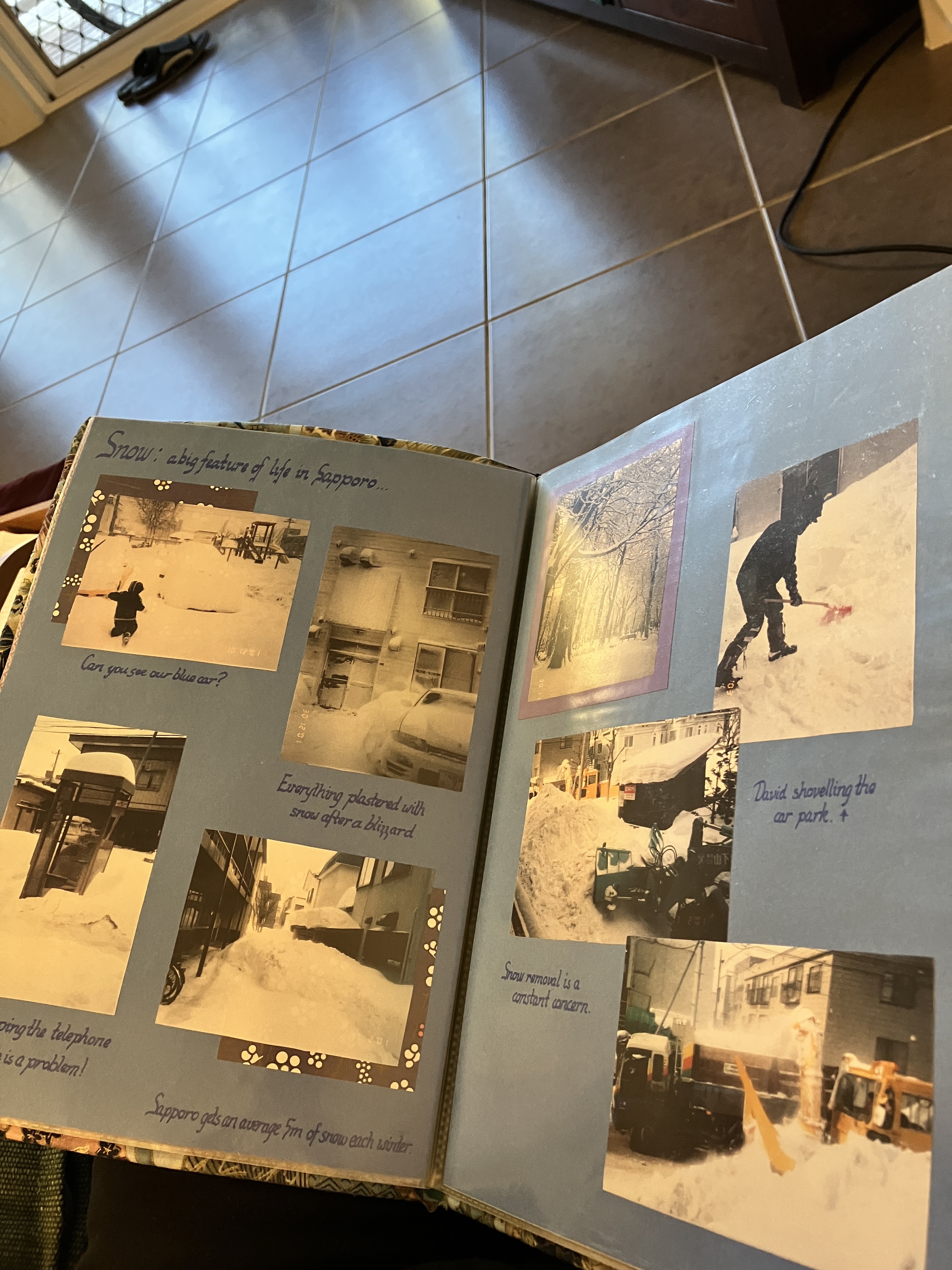
I realised that those first two albums were made when my role in Japan was mostly full-time stay at home mum. A role that was busy, but didn't completely satisfy my creative tendencies and also had many little moments that I could use for an extra project. The photo albums are evidence of that. They are also evidence that, as my kids have grown and become more independent and busy outside the home, I've also taken on more work that's focussed outside the home.

That realisation led to me further realising that I should never been afraid that I'm being too lazy. That, over the years, I've naturally filled my time with productive and creative things. And I appear to keep filling up my time until I reach my limit. Another place to see that is this blog. From 2009 when I started it, until late 2017 I wrote here most days. What happened in 2017? I took on new roles: OMF Japan's social media and website content.

That fear of laziness? I'm a conscientious soul, always have been, and I don't like the thought that I'm wasting my precious time on this earth. Because I work flexible hours at home on several different jobs it can be difficult to tell if I'm working at my capacity. Over the years I think it's become a little easier to read the signs that I'm overdoing it, however sometimes I still don't recognise that until I've stepped over the "too busy" line.

I knew that I'd be tired yesterday, because we had a run of high-octane days last week: several intense, but good times with friends and colleagues, the start of deputation meetings, and sorting through years of accumulated resources related to speaking about Japan here (unpacked it easily took over our dining room and office). Amidst all that, various other things continued to need our attention, including medical and bureaucratic matters. 

Thankfully yesterday we could just call a halt to the craziness and we focussed hard on "not doing", not opening the computer and not talking about work stuff. I'm feeling better today, but know that I need to be cautious. We're still recovering from this major transition and don't quite have the stamina we're used to when we're settled in Japan.

It's amazing to me that at 50 I'm still learning more about myself. This realisation about my internal drive to fill my days makes it easier to push though this very fuzzy year known as home assignment. We don't have anyone closely looking over our shoulder to tell us to work harder or to take it easier. No one assigns us a schedule or tells us what meetings we have to attend. We don't have to report to anyone the number of hours that we work and we don't have as many deadlines as I usually juggle. All in all, there's not much accountability for our day-to-day activities and it's easy to wonder if we're doing an okay job, or if we're wasting time.

But then there's the debrief we had earlier in the month with a psychologist. She recommended we take things a bit easier this year, even aim for boredom! (I usually avoid boredom pretty studiously.) 

We've carried a fair weight these last few years as parents of someone who isn't neurotypical (see this blog post from last year when I poured out something of what that has meant). I hesitate to call myself a "carer", as many others carry much heavier, full-time caring responsibilities, but it is similar. It's something that is hard to escape, but also something that is woven into the fabric of our lives in a way that has changed us and how we live. The psychologist challenged us, as we work towards the goal of all our boys living separately from us, to explore things and ways of living that we've just had to avoid in the past, in order to survive. It’s going to be an interesting adventure. 

But my big challenge now is trusting, moment-by-moment that we will eventually get there, that we will make it through this transition time. 

 I need to do what David did when he wrote Psalm 62, tell myself: “Yes, my soul, find rest in God; my hope comes from him. Truly he is my rock and my salvation; he is my fortress, I shall not be shaken. My salvation and my honour depend on God; he is my mighty rock, my refuge. Trust in him at all times, you people; pour out your hearts to him, for God is our refuge (vv 5–8 NIV)”.

27 August, 2021

Overthinking—more common than I thought

This is a review of a book I read last weekend. Yes, it's so well written that I managed to read it in just three days (granted my weekend was very quiet, being as we're not going out for anything beyond essentials).

I have caught myself recently dithering over purchases for several months (or years). I didn't categorise myself as an overthinker, but perhaps I am a little, especially about financial decisions, but through reading the book I realised I tend to overthink conversations, conflict, and other things too.

I felt like, at the start, the author was trying too hard and over-wrote the first few chapters. She spends a lot of time convincing the reader that you could change. However, once I got past that bit, it was a fantastic read, one that I got through very quickly.

Here are (quite a few) gems:

  • "Mental energy is not a limitless resource. We have only so much to spend each day, and how we choose to spend it matters." Overthinking is basically frittering away mental energy, that's not something I want my life characterised by.
  • Overthinking includes inefficiencies, like poor organisation (e.g. losing car keys because you don't put them in the same place every time).
  • We can develop processes that help us circumvent overthinking, e.g. not checking email when you don't have the time to reply (e.g. before bed).
  • Putting decisions off for later isn't always the best thing to do.
  • Doing too much research or looking at too many options isn't necessarily helpful, limiting your choices can be a huge time and mental energy saver.
  • Rejecting perfectionism: putting a cap on how much time you spend on something making it as good as you can, then acting.
  • Adapting a "try it and see what happens" approach can help.
  • Our values can drive our decisions. (See more about this lower down in this post)
  • I love this quote: "Being a responsible adult is the most underrated form of self-care. Yes I mean: live within your means, make dentist appointments, save money, plan meals, wash your face before bed, go for walks, cook for people, keep your house clean, go to bed at a decent hour, all that boring stuff. Routines make everything in your life better and this is absolutely the most overlooked and underestimated form of self-care"—Sarah Bessey, as quoted in the book.
  • "Clutter isn't great for mental function. . . By streamlining your spaces you can streamline your thought process, and your brain won't have to work so hard to tend to life's details."
  • Don't duplicate the work: this is where our camping list works brilliantly. We don't overthink preparing to camp because I know that if we get everything on the list, we'll be prepared for most things.
  • Take breaks and look after yourself: sometimes overthinking creeps in because we're overtired.
  • Sometimes we dither because we have to decide between two good choices, or between two bad choices. If that is the case it's best to just get on and choose one.
  • Notice when you're stuck in a negative cycle. Breaking that can be as simple as noticing things to be grateful for or distracting yourself.
  • Outsourcing is another strategy that helps. There are times when it is worth doing it yourself (especially if it lines up with your values), but other times it is far better to ask someone else to do something.
  • Don't think too long about splurging on an experience that you think will be good. Memories are invaluable.
  • Small treats to myself are okay and don't need to be overthought.
I liked it that she talked about life as a writer. I am a non-fiction editor and writer. That means that reading non-fiction tends not to help me feel refreshed—it's what I read for work. I also related to her work-cycle that has period of both "leisurely seasons of creative planning and preparation [which] alternate with busier seasons of execution." During the latter periods, it's okay to brush off decisions that fit more naturally into the creative planning and preparation periods.

Our values can drive our decisions
I realised that we do do this, and that is why we sometimes feel so different to many people we meet. But identifying your values makes a big difference to the decisions you make. For example, the decision about when we will come back to Australia for our next home assignment is informed by many factors, especially at the moment the education and well-being of our three sons has a big part to play in our decision on that matter.

Rituals
The author defines rituals in an interesting fashion, distinguishing them from routines by noting that rituals have a higher purpose in mind. Simply changing the name of something can give it deeper meaning. I realised that I've got more rituals in my life than I realised, and that they are helpful in keeping me afloat! Yes, even camping has become something of a ritual: it has a rhythm and routine to it, but there is a deeper meaning that makes its total value more than just us sleeping in tents and cooking outdoors.

Read it
Wow, that's a lot. I really do recommend reading the book, I hope I haven't put too many spoilers in. I got a lot more out of it than I expected and often thought of close friends who could also benefit from it.


02 April, 2020

Can we get creative at this time?

Last week I had a virtual coffee with one of my best friends in Australia. We love touching base and always come away feeling encouraged, and with things to think about.

One thing I came away with this time was a sense that people like us (we're both in full-time Christian ministry) have already learned some of the things that others are now faced with in the current global crisis. As is typical for me, this has been percolating and a blog post forming in my head. But my chief struggle has been: what angle to take? I can't write to you in a boastful way saying, "Ah, we've been learning these things for a long time. Have fun learning them now!"

Please forgive me in advance, I'm trying not to write with that tone. Though this situation is not a cake walk for us either, perhaps I can speak as one who has gone before in some ways and tell you some of the things (in random order) I've learned that are helping with the current situation. Perhaps that can help you process the many things going on and find some paths through.

Loneliness
I think this is one of the biggest things I've faced as I've lived overseas. It's been an ongoing challenge to find relationships and keep them. When you move out of your own culture you face challenges to having friendships on multiple levels. 

I felt like I left the "real Wendy" in Australia. In Japan I could no longer hug friends freely, as I preferred (I do still struggle with this at times). I couldn't speak freely in the new language I found myself surrounded by. Even those who spoke English didn't speak the same English as me. I needed to internationalise my language somewhat, just to communicate clearly.

I had to be more intentional about friendships. That included "seizing the day". If there was an opportunity to touch base with a friend, even if it was unexpected or creative (like an accidental pocket-call) then it was worth doing. Video calls and texting have made life a lot easier on this front in recent years, I'm so glad technology is where it is now, even ten years ago this would have been a more difficult experience.

If you need a hug, try a pillow or a soft toy! It's worked for me (even before I came to Japan). I know it's still warm in Australia, but cuddling under a blanket, or even a sheet wrapped firmly can help.

Get creative. Be impulsive. Think intentionally about how you most value as friends and seek a way to encourage them. Pray.

Cooking meals
From the start learning to make do with what you could get has been an integral part of us providing food for our family in Japan. That includes a lot of substituting in recipes. It can require creativity. But it also requires you to think about what you can do, rather than long for what you can't have.

Living in Japan has pushed me to learn new culinary skills, or extend the ones I had: like making bread, lasagne, and fruit mince pies and making other things from scratch, like chutney, lemon butter, and even puff pastry (never doing that again!) There are plenty of ideas online for substituting for ingredients you don't have, and videos to help you learn new skills.

Get creative. Be bold. Try new things. Think about what you can do, rather than what you can't.
Fruit mince pies

Spirituality
Moving to a country where you don't speak the language you have to learn how to self-feed. For many years it was about all I could do to get my family to church, let alone understand anything that was going on there. I've learned not to rely on a Sunday morning service to "feed" my soul. I've listened to sermons mid-week, read helpful books, pray and read the Bible very regularly, been honest with friends about how I'm doing, even formulating my thoughts enough to write them on my blog etc.

Get creative. Set a goal of doing one new thing to feed your soul this week. Think about what you've learned and share it with a good friend. Share honestly with one person about what you're struggling with spiritually.

Working from home
Home is my usual place of work, so that hasn't been a major change for me. The biggest change has been having my high schoolers and sometimes my husband join me at home, though I'm used to working here during their holidays. Some of the challenges of working at home have included a lack of private space, separating home and work, managing my time, and getting enough rest. 

Ways I've addressed these include setting "work hours" when I try to remain at my desk in our dining room most of the time, and not sitting at my desk at other times. Not looking at or answering emails or work messages outside of "work hours", including weekends. Taking the evenings off and sitting in my "relaxing chair" (admittedly, though, I'm still doing Japanese study there). Having a routine that includes watching a TV episode in the evening with my husband (something to look forward to as I work during the day). I've even got a red bandana that I put on my head if I particularly don't want to be interrupted (given that I don't have a door on my office). I don't use it often, but it has worked well when I do.

Get creative. Set up a rough schedule, including meals. Set aside time to work and time to relax. Find things to look forward to that you can slot into your day.

Grief
Yes, we're all suffering grief at this time. A loss of our plans, a loss of lifestyle, of freedom, even a fear of losing people we love. We've lost the ability to touch base with people easily in our day-to-day lives.

Yesterday I went into the office to pack the magazines we've been working on since Christmas. As I said goodbye to my two colleagues/friends at the end of the day, it was a bigger goodbye than usual. It kind-of felt like the goodbyes we do when we leave Australia or when friends leave Japan. An "I don't know when I'll get to see you again" goodbye. That hurts. I meandered my way home, not knowing when I would next get outside my own little neighbourhood. A lot like the internal processing that goes on in my last days in Australia: wandering through shops like a ghost, not knowing when I'll next be there, wondering if there's any last-minute things I should buy. It's a way of saying goodbye for now.

Get creative. There are different ways to grieve. But take your time. Think about, or even write or draw the things that you're missing. Look at photos. Talk with friends about what you're missing, or what you're looking forward to doing again. Plan what you might do next time you get the freedom to go to that favourite place or to shop freely again.

Being content in the now
One big lesson we've learnt that helps us stay afloat is finding ways to live in the present, to enjoy where we are. We've sought places and experiences that can only be done where we are. In Japan that has ranged from big things like going camping or visiting places we'd never get to if we weren't living here, to smaller things like enjoying local cuisine or appreciating the seasons in our local area.

Get creative. Are there things you can find that are unique about now that you can enjoy? Like living in your PJs all day? Or the many online experiences that are freely available? Or having time to sort through old photos? Or just having more time to connect with others who also have more time just now?

The first article I've linked to below finishes with an invitation to cross-cultural workers to join in the conversations that are circulating about confronting the challenge before us. I'm not quite sure what opportunities will present themselves to me, but I guess this blog post is a start.

The second article below mentions some other things that I've learned as a cross-cultural worker:

  • loss of control
  • our fragility
  • dealing with fear and learning to operate out of faith instead
  • our desperate need of God and compelling need to pray
  • helping us distill what's really important in life
  • what's our ultimate hope
I could write on all of these things also, but maybe another day.


Inspiration for this post also came from these two articles:
1. https://www.alifeoverseas.com/how-to-do-life-during-a-pandemic-cross-cultural-workers-can-add-to-the-discussion/
2. https://www.thegospelcoalition.org/article/things-coronavirus-teach-us/

I'd love to hear what you're inspired by in this post, or what creative things you're doing to help cope in the midst of the current season.

17 March, 2020

Professional development in cross-cultural ministry

“Professional Development” are words that I knew in my pre-missionary profession. My husband is in charge of this for the staff at the school he works at. But I don't hear these words often in mission circles. I wonder why? Maybe because we don’t think of what we do as a “profession”.

I had to essentially leave behind my former profession, Occupational Therapy—at least in terms of formal registration with a national registration board—when I started down the road of cross-cultural ministry. I couldn't keep up with the professional development  requirements, not to mention afford the costs involved in remaining a legit Allied Health professional in Australia.
So having left something that is fits a narrow definition of profession, I found it helpful to think about what I currently do using those familiar terms. 

What is a profession?
Dictionary.com has a very broad definition of profession:
a vocation requiring knowledge of some department of learning or science: the profession of teaching.
the body of persons engaged in an occupation or calling: to be respected by the medical profession.
My own professional development
Over the years I've gained a lot of knowledge about Japan, the culture and language, I've also gained knowledge about cross-cultural living—especially in Japan, and about many aspects of missionary life. So I guess I've been growing in the profession of missionary. Though I've never thought about it in those terms.

The time at the writer's retreat ten days ago also convinced me that I've grown into a third profession (or a fourth, if you count motherhood as my second profession): that of publishing. It's what I've spent a lot of time learning about and doing over the last decade. It amazed me that I could sit and talk with people about many varied aspects of writing and publishing. It shouldn't have! I've gathered a lot of information and expertise over this decade, none of it official with a certificate or degree, but certain not without merit.

And somehow I've had this mindset: always desiring to learn, and to grow.  Perhaps it is just my curious mind, although I don't discount the influence my university education and subsequent few years in the Occupational Therapy field had on me. 

The location of my first major professional development for
writing: Hong Kong.
Yes, it's not your usual Hong Kong image, is it?
Our mission helps with this by insisting on goal setting and regular reviews with supervisors. But what I do is a little outside the bounds of what many of the workers in our organisation do, so a certain amount of being a self-starter has been necessary. I don't actually know another missionary on any mission field who works as an editor (though I'm sure they exist, somewhere). And I'm doing this as a predominantly English speaker in a non-English speaking country, so there are less resources than if I were elsewhere. Therefore I've had to be creative.

Over the years my professional development in relation to publishing (there's more if you include cross-cultural living) has included:
  • Reading books about writing and editing (and buying them, something I don't do a lot for pleasure on a missionary budget, but when I come across a useful professional resource, I'm keen to lay my hands on it).
  • Reading many articles online.
  • Writing a lot. Over 3,000 articles on this blog and probably over 100 articles published in magazines and a couple of book contributions also.
  • Being a part of an online critique group and other online groups over the years has taught me so much.
  • Editing and being edited. Nothing like having to edit someone's work to make you think about what good writing is. Nothing like being called on a decision you've made when editing someone's work to make you think about why you do what you do. I've got a great production team with the magazine who don't let me get away with sloppy work.
  • Managing a magazine has been another level of learning and growing. Learning how to efficiently put together a quality product with a volunteer and long-distance team and also how to manage a team. Learning how to work with writers has been another, sometimes painful, journey. Much of this has been learning on the job, figuring things out as I went. Not only have I learnt about being a leader, but I've also learnt about how to be a good follower.
  • I've had to learn how to use various online tools, that was especially the case when I took on my current social media manager role for OMF Japan. But also tools that I use to help me with the magazine (see this post and this one).
  • Attending conferences, workshops, and retreats
    • OMF Writer's retreat/workshop in Hong Kong 2010
    • Magazine editing training Manilla 2009
    • Christian Writer's conference Victoria 2014
    • OMF Social media workshop Manilla 2017
    • International Christian Publishing conference (LittWorld) in Singapore 2018
    • Training with OMF about leading teams Bangkok 2016
    • Led six writer's workshops/retreats in Japan
    • Completed a couple of small online courses, and in the middle of another with Udemy.
    • Attended a hands-on photography course.
    • Attempted (and failed) to learn inDesign, the program that our magazine designer uses.
Well that's quite a lot when you write it out like that!

Last month I found this article and it is very helpful. It looks at what we do in cross-cultural ministry from the position of a profession and notes the vital importance of professional development, especially for those who stay a longer time.

When things get quiet here, I sometimes wonder about what the future holds for me with my current skills. I don't know. But I do know that I will not be content to become stagnant. I want to keep growing, keep taking on challenges, keep learning new things.

The writer's retreat I led 10 days ago didn't allow me to do much writing. But it did stretch me professionally. Having to answer questions about publishing and doing one-on-ones with people asking about publishing, writing, and editing issues was hard. This was especially so because there is much more time pressure when you are sitting with someone, if I encounter a difficult editing issue at work I can often walk away from it for a while and come back, or consult a resource or someone else. It was hard, but it was good for me.

What about you? Thinking outside the box, how has professional development looked for you in recent years? What are you looking forward to doing in the near future? What would you like to do, but haven't had the chance yet?

25 January, 2019

What transition has taught me

It’s good to read about other people’s transitions because in the midst of a major transition it’s easy to feel quite at sea and isolated. Without any regular contact with other people, with many goodbyes having been said, there are few people around to help give us some ballast.

A friend recently described to me her experience of transition as akin to being in a washing machine. And yes, it does throw you around, at times it’s hard to know which way is up and there’s not much predictable, not much to grasp ahold of in the midst of transition. I have felt more like it’s been a rollercoaster, with emotions and energy riding up and down unpredictably. That hasn’t been helped this time by arriving in the midst of term-time. School is in full tilt, church, and OMF also. It feels like we’ve been dropped into a rollercoaster that’s heading down a slope rather fast.

I saw this blog post several months ago and I’ve used it to springboard into my own post today.

A simple life?
The blog post author had hoped for a simple life, but found that a call to cross-cultural mission work means that life gets complicated. However, in the same breath, transition also strips you down. It helps you to see where you are putting your trust and that truly the only place to put your trust in in your Heavenly Father. Our only true, permanent identity is as a child of God.

I agree. Being regularly stripped of the trappings of life, of status, of a residence, of settled routines, makes you re-examine yourself. Moving often and, in our case, living in a smallish Japanese house, means that you tend to be faster to throw things out than you might have been if you hadn’t lived this life. Our lives are simpler in terms of materialistic goods, simply because multiple transitions helps you to see what’s not so important to hold onto.

Leading to growth
The author goes on to talk about spiritual growth. It really is an extension of what is mentioned above: that transition strips you and leaves you to lean on the only true Rock. The shake-up that happens with every major transition rips away those things that you were relying on and hopefully the result is growth.

Trusting God to provide
Yep, pretty much all missionaries have this challenge, some more than others. But there are points about God’s provision that are beyond monthly support figures. Because we don’t have a large budget we rely on others to help us with practical things like moving, finding accommodation, borrowing cars, finding furniture etc. This post I wrote in the middle of our move earlier this month highlighted the many “helps” we received.

Then there’s other things that you have even less control over, that God often provides, like a friend for your child, a sympathetic teacher who will help your child adjust to their new school, a friend who will stop and listen to you when you’re less than likeable, groceries or a meal provided, or help to complete a bureaucratic errand. God provides people and things like these in the midst of transition, at a time when you’re most in need of help.

Because we’ve seen God provide in these ways in the past it gives us more confidence to face the next transition. For all those people who look at us during transition and sigh, “I couldn’t do what you do,” it’s important to understand the context we’re operating under: we’ve done it before and know God’s great provision. It doesn’t mean that transition is a breeze, it definitely isn’t. But it does mean that we possibly do it a little easier than someone who never has and never could imagine doing it.

Holding onto God
The author mentioned God giving her a “word” to cling to during transition. I haven’t had that exact same experience, but I have known God’s special reassurance when returning to Japan. Except for this last time, every transition back to Japan, within a week or so of returning I’ve felt a deep sense that God has called me to this land and will continue to enable and provide. This last time I think that reassurance came several weeks earlier when we were seeking God’s leading in the midst of the financial questions thrown at us late in November.

Where is home?
Transition between cultures makes you question where home is. Another aspect of the experience of transition that makes you realise that our only true home is with God. That’s both an unsettling thought (I’ll never feel 100% “at home” here on earth), but also reassuring that there will eventually be somewhere I feel at home, even if I have to wait a while for it. And that home will last forever.

There are other things I’ve learned through transition, for example, to be an observer and inquirer about culture and “the air”. The latter is great Japanese euphemism for picking up the atmosphere, being perceptive to what’s going on that’s not necessarily being stated outright. After we returned to Australia I wrote a post about what I perceived as being “in the air” in Australia. Some was obvious as it was in newspaper headlines, but others I only picked up through conversations with various people, articles, and observations in the community.

There are other things I've learned too, but this is enough for today!

25 January, 2018

Counting isn't hard, is it?

As I mentioned on NYE, I've started studying Japanese again, more consistently and intensely. A friend introduced me to a website that I can access on my phone that consistently teaches and reviews vocab and kanji (complex Japanese characters that make up many words). My goal is to improve in my reading, which shouldn't be hard because my level is quite low. But I hope it also overflows into my daily conversation too. 

The system is compelling and almost like a game. I'm enjoying it (most of the time) and definitely making progress like I haven't seen for over a decade, partly because I'm doing this more than once a day, everyday, and when I get stuff wrong, I have to answer the question again, a bit later, no escape if I want to make progress up the 60 levels.

But of course no new method makes learning a new language easy (especially for someone like me who doesn't have a high aptitude for learning new languages). So there are frustrations along the way. One is counting.

Counting in Japanese is a bit of a pain. Truly. They have more than one word for some numbers eg. 4 is "yon" or "shi". And, even more challenging, depending on what you count, the suffix (called a counter) you use changes.

Here's an explanation of counters that I found:

What Are Japanese Counters?

Japanese counters are the words used to count objects, people, lengths of time, events and so forth. Counters are usually single-kanji characters that have a special reading just applicable to their function as a counter.
Let’s think about counting in English. To count in English we usually take a cardinal number (i.e. one, two, three, etc.) and add it to an object. If we are making a plural, then we stick on that object’s plural ending. One cat becomes two cats; one fox, two foxes; one mouse, two mice.
Counting just doesn’t work like that in Japanese. Remember—Japanese has no real plural/singular endings, so it’s not going to be the same as the English system anyway.
So how do you count objects in Japanese? Japanese uses special counting words, which come in different categories according to what you are counting. The way to count long, narrow, cylindrical objects is different from the way you’d count thin, flat ones, for example. And the words for counting small animals differ from the words used for counting humans, etc.
For example (the characters at the end are the kanji):

one = ichi  一
one person = hitori 一人
one machine = ichidai  一台
one pen = ippon  一本
one piece of paper = ichimai 一枚
one generation = ichidao 一台
one portion = ichibu 一部
one o'clock = ichiji 一時
first place or first or best = ichiban 一番

There are lots more counters than this. There are counters for small animals, lessons, volume, pages, day of the month, night, day, head of cattle and for objects that presumably don't fall under any special category like the more unusual ones for chopsticks, bowls of rice, tatami mats (traditional flooring we have in two of our rooms), single stem flower, and wheels.

Alas, I'm hopeful. Lots of practise will equal progress, right? I've invested money in this and  that is highly motivating for me. Not to mention the competitive side of me that wants to make progress in this game-like project.

21 November, 2017

Interesting map facts about Australia and Japan

I love maps and interesting statistics. This article has some fascinating statistics that relate to
our lives as Aussies in Japan. Here are the ones that catch my eye most:
  • Japan's a pretty green place, especially in comparison to Australia. Japan has 68.6% of its land forested, that's 17th highest in the world.
  • Japan has many more roads than Australia (1.21 million km vs 823,000 km), despite Australia being 20 times bigger than Japan. I guess it makes sense in some ways, because Japan has more than five and a half times Australia's population.
  • We've moved from one of the least crowded nations to one of the most crowded (well, we pretty much knew this already!).
  • Australian drink more alcohol than Japanese, in fact more than most countries do. I don't know if I'm surprised at this. I do know that alcohol is readily available in my local grocery store in Japan, though.
  • Japan is one of the highest risk nations for a natural disaster. Yep, pretty sure I knew this. That's why we have an emergency kit in our cupboard.
  • Australia and Japan are both listed on the high end of urbanisation. Difference is that there's a lot of places where no one lives in Australia. Driving through Japanese and Australian countryside is quite a different experience. The cities and towns are much further apart in Australia.
  • One of the hundreds of tunnels in Japan, this one is on
    the northern island on Hokkaido.
  • The two countries are similar in ranking for rail network, but I'm sure that that is totally skewed by the long distances trains have to cover to get to Perth and Darwin. Rail is the primary mode of transport in Tokyo. 40 million passengers use the trains each day! More than Australia's whole population. Tokyo alone has 882 stations and nearly 5,000 km of track!
Our house (blue roof) and road.
Go and have a peek at the maps, you might learn something about your country you don't know!

08 November, 2017

Personal seal

One of the first things we owned in Japan:
a family seal.
Did you know that we rarely sign things in Japan? In fact I usually have to practise my signature a couple of times when returning to Australia because I'm quite rusty. Part of the reason I don't use my signature much here is that I pay cash for pretty much everything on a day-to-day basis. I almost never pull out a card to pay for something unless I'm buying it online. The other reason is that signatures are a relatively new phenomenon in Japan. Most often official things are "signed" using a personal seal.
It says: Marshall (literally maasharu)
Last week our eldest son had to open a Japanese bank account for taxation purposes. He needed a personal seal to open the account. At first we thought that he needed his own, but it turns out that it was okay for him to use our family seal or inkan. It actually turns out that he probably didn't need a seal at all, a friend told me her Australian husband has never had one and he's employed in a firm here in Tokyo. He does it all, as he would in Australia, with a signature.
Come to think of it, now, when we take delivery of postal items, they usually ask for a signature, not a stamp. Ha, there's always things to learn when you're living in another country. It feels like you're forever playing catch-up.


We were pondering this "seal" culture when I was with my language exchange friends last week. It turns out that Japan isn't the only country that still uses them. To me it seems to be a throw-back to ancient times when important people sealed things with wax, but China, Taiwan, Korea, and Vietnam also still use seals to one degree or another (see here).

Anyway, I'd asked one of my language exchange friends about having an inkan made for our son as she owns a stationary store and customers can order inkans through them. She brought a catalogue to show us that you can see here. I had no idea there were so many choices, nor that most people own more than one. There are choices in size, style, and even the material they're made from (from cheap resin and box tree to expensive ivory). 
In the close-up picture below you can see differences in size and style (not sure why the abbreviation for millimetre is rendered m/m). The one on the right is for formal documents for something like a company and there is no up or down (which is important in the ones on the left).


There is a more informative article about this topic here.


25 October, 2017

New tricks?

Old dog new tricks? Yes, I'm in my mid 40s, but sometimes I do feel like an old dog when it comes to things like learning new things about technology and social media. As I've gotten more involved in OMF Japan's mobilisation drive, I've found my boundaries of what's comfortable pushed again and again.

First, about 12 months ago it was helping in the redesign of the OMF Japan website (and talking about that to our leaders when I really didn't know what I was talking about) and picking up an Instagram account. Then editing the whole website. After that came learning how to blog on wordpress.com (something I'd tried in the past and given up as too complicated). Setting up guidelines for a new blog was the easy part!

Then I went to the social media for mobilisation workshop in Manila last month and discovered a whole 'nother world. I've been doing social media for years, but now it has become a more integral part of my work. I'm doing it not just in my own name, but for OMF Japan.

I've been working with another much younger colleague, who lives way north of here, to coordinate our FB and Instagram pages, that's taken some figuring out too! Even today, trying to figure out why she couldn't see the photos I shared on the Google calendar that I started for coordinating content.

I'm also trying to figure out the best way to convert an inDesign file of our 31 Days of Prayer into a sharable electronic document. Looking at Blurb.com just before lunchtime today drove me to the edge of what my feeble brain could manage. I'll come back to it later.

How my job has changed over the last few months can be seen somewhat by peeking at my iPhone homescreen which now includes these apps:


The first, Workplace, is a Facebook app designed for use for in the workplace. It's been very useful for our remote team. I've found it wonderful to easily get advice (especially technical advice) from others who know a lot more about these things than I.

Flipboard is a fun app. A bit like an RSS feed, except that you don't add blogs or anything else to it, just the topics you're interested in and it scouts around for you, looking for articles on the topics you're interested in. Helpful for me as I administer the OMF Japan FB page and am on the lookout for Japan-related stories to add to the mix.

Repost is an app that allows me to repost Instagram posts. I haven't used it much and have found it a little cumbersome so far, but I'm assured it's the best app there is.

Canva is also fun and allows you to easily transform a photo by adding words or graphics to it, creating your own "meme". I've used this a lot in the last month in creating content for the OMF FB page.

I don't have Buffer.com there, but it's on my laptop and I'm using it to schedule FB posts for OMF Japan. Another new website to add to my rapidly growing collection.

Yep, it's all related to social media. The workshop I went to in Manila was incredibly useful, introducing me to these apps (plus a lot more).

Then this week I've been challenged as I figured out how to distribute a video created for OMF Japan via social media (thankfully with a lot of help from our remote team via Workplace). 

Yesterday I added subtitles to a video for the first time using amara.org. Then I had to use handbrake.fr to apply the subtitles to the video. Figuring out how to upload the video to our OMF FB account (including allowing cross-posting to other OMF pages) and then to our blog have all been new challenges. Then it was discovered that there were mistakes in the subtitles and it had to be edited twice, which isn't an easy task when you need to make a completely new file as well as re-apply the subtitles to the video each time (thankfully a more tech-savvy member of our mobilisation team did it for me). But then the question: what do you do when the "faulty" video you've shared has already gone to a lot of people and you've got a new, better one to replace it?

I figure a few of you might not be fazed by this, but it was a challenge that made me feel quite like a techno dinosaur.

I wonder when it will settle down, or whether it just won't! This field is constantly changing and I suspect for as long as I'm doing this, I'll be playing catch-up.

I've learnt a lot and most of the time I'm glad I'm being challenged and stretched. It keeps me fresh and not-bored (the prospect of avoiding boredom drives me often). But sometimes I feel overwhelmed!

I am reassured by this article that one of these new apps sent me recently (maybe it was Buffer?). The article had a lot of good information, but this helpful paragraph at the end is reassuring:
If you take nothing else away from these eight lessons and case studies, do take away this: Find a social media strategy that works and stick to it. Evoke it through well-designed visuals, intentionally-written copy, and informed decision making, and you’ll be on your way to a storm of likes, comments, shares and results. From 8 social media lessons you can learn from the pros


14 June, 2017

Summer holidays guidelines (2017 edition)

Last year around this time I posted about our family's "Summer Holiday Guidelines". It worked fairly well last year, so we're doing it again. Hopefully now they're one year older we'll see an even better response.

Here are our revised guidelines:


21 February, 2017

More detailed post about Far East Wrestling 2017

My view for three days. I'm thankful for my sheep-skin seat-cover.
I take it to all wrestling meets and it gives just a little cushion to these hard
bench-seats.
I've edited my summary post and taken out some of the details, putting them here for those who are interested. As I suggested, I'm also working on a more reflective email. Reflecting not just on this week, but on our journey over the last six years of our son's wrestling.

Wednesday
I always find leaving home for nights away hard. 
Have I remembered everything? Will the guys be okay in my absence? Is there one more thing I've forgotten to take care of?

It turned out that us travellers all left before our two youngest, who didn't start school until 9.30 last Wednesday. So I was getting texts on the train like, "Should I turn all the lights out?" (Yes, I had told him earlier that that was what I wanted!)

Travelling on peak hour trains is always stressful with luggage. But my travelling companion and I somehow seemed to avoid the sardine-squish of the worst trains. It's still a long way to the airport, though. Two hours.
We were warned that the pace would be slow, however
it turned out that there weren't really long periods
of boredom. I was my usual ADHD-wrestling-spectator
self, jumping up to go down and sit mat-side for most of
our team's bouts. However I did manage to pull out
some colouring-in. Even some cross-stitch on one day,
though the lighting where we could sit with a backrest
 was too poor for fine needlework. 

Our travel was smooth. Even the bus from the airport to the area near our hotel was good. Transport is cheap in Korea and this luxurious 1 ½ hr bus trip cost us just a bit more than 1,100 yen or AU$10. I slept for 40 minutes or so, which was just what I needed to get through the last little bit.

On the bus we encountered an interesting man who turned out to be the Stars and Stripes (military newspaper) reporter who was going to cover the wrestling tournament. It is always strange to meet people who know my son's name. This guy not only knew that, but knew that he was the favourite to win his weight category as he'd reported on earlier tournaments this season.

The hotel was not fancy, but entirely adequate. It's location was the best thing: five minute walk from the front gate of the base. It's also the hotel that many other base-related travellers stay in. We saw mostly foreign faces during our stay there, including the parents from St Mary's, the school that won both individual and duals in the larger schools category. They also had a breakfast buffet included in the deal that came with our hotel-travel deal (the whole trip was really a very good package deal).

There were four of us parents who travelled together. A married couple and two mums. Us mums shared a room, which was nice, but meant I got hardly any time on my own, except in the bathroom. The introvert part of me struggled with this, especially towards the end of our four-night trip.

Thursday
I woke early again this morning, typical for the start of a wrestling day. The biggest blip of the morning was discovering that I'd packed no spare underwear!

We had to meet our sponsor at the gate of the base at 8am to get through security, then we walked about 20 minutes to the gym, which was a nice start to the day. 
Something about having boys that I didn't realise. I love seeing their muscles.
Does that sound weird? It's akin to the pride in seeing them learn to walk
or learn to read. Watching a boy grow up has many facets.

This tournament was run more loosely than the tournaments we're used to in Tokyo. Though there were five mats out (it is a long, thin gym with two basketball courts end-to-end), rarely did we see action on all five mats at the same time. There was lots of down-time. The slower pace was necessary as the guys had to last three days (and some of them wrestled up eleven times in three days). However, they were given very little warm-up time before each bout. Knowing that they could be called up with a minute or so notice to wrestle again meant it was hard to relax.

We did get an hour for lunch, which was nice. Though I didn't have much of an appetite. The base's large food court was conveniently nearby and I found a nice chicken salad that wasn't too heavy. And finished off with my first (and only) coffee of the day, badly needed after a few days of poor sleep, plus tiring travel.

The wrestling was over between four and five and we did a little bit of shopping on the way back to the hotel. Including buying my first ever pair of underpants from a 7-11 to supplement my poor packing!

Dinner that night was at a sit-on-the-floor Korean restaurant where we cooked our own meat at the table. It came with a plethora of side dishes, some for dipping, others for eating as is. It seemed that the meat should be dipped in a sauce and then wrapped in a large leaf or some lettuce. It was delicious and affordable. A great way to finish the evening.
A quick selfie before eating on Friday night. One of the
challenges we faced was the difference in temperature
between inside and outside. About 25 degrees different,
which I found difficult to cope with and resulted in
multiple clothing additions and removals.

Except it wasn't finished. My roommate asked me to accompany her on a foray into the rabbit-warren of streets near the hotel. We bought a few things, including a bra, again to supplement my poor packing!

All in all we walked about nine kilometres on Thursday. It was a good day to be out, the weather was mild compared to the cold that followed. My legs were a bit sore the next day!

Friday
This started out with semifinals, then wrestle backs. It was not a simple knock-out competition. If you lost in the main bracket, you got another chance or two to get back into the running. If you lost the semi, you had another bout with someone who'd come up through the "loser bracket" to go for the final.

Even if you lost the final, you could have a second chance at it, if it was your first loss of the tournament, which basically amounted to a "best of three" wrestle-off for the gold.

So it shouldn't be a surprise that it took almost the whole day to get through the semis, and finals (including wrestle-offs for third to sixth places).

Like I wrote in my summary post, this was a hard day for me. Our son had a tough wrestle in the semi. He only won it by the skin of his teeth and it threw me.
This is the same area after dark. I loved the illuminated trees.

His opponent was wary, particularly in the first three-minute period and didn't engage well. Our son finished the first three minutes 2-0. But the second half was tighter, with our son behind for a good portion of the time. Our son was still behind with 12 seconds left. He scored a single point at 11.7 seconds (I've just gone back and looked at the video) with a push-out that levelled the score. Phew, it ties me up even to watch it now! He only won because his opponent had broken the rules by fleeing the mat during the bout and that broke the tie.
The back of the medal he was awarded on Saturday.

Four hours later the two of them went at it again, but the result was much clearer with his opponent scoring nothing on him and our son scoring 10. I felt like the hard work had been done earlier, and hence a little bit of a let-down.

After dreaming that my son may possibly have a chance at Far East Champion for a few years now, it was like a dream when it really happened. I'm still pinching myself. And a relief. (But I'll talk about that in my reflection post.)

Then the dual competition started. This is when whole teams line up against each other to wrestle off across all thirteen weight classes. The system works well when each team has all, or nearly all the thirteen weight classes filled, but it more challenging when there are several gaps. Our team was in the smaller schools' division, so most of the schools there had small teams. Our team of nine was one of the larger. 

The system is that the two teams work their way up from the smallest weight class (101lb or 49kg) up to the heavyweights (under 125kg). Coaches can choose to be strategic when their opponents have gaps, like we did. While wrestlers can't wrestle lower than their weight, they can wrestle up, so a 115lb wrestler can be promoted to 129, for example, if they know their opponents don't have a 129lb wrestler, and thereby earn their team the maximum five points for a forfeit. It isn't a fun way to do a wrestling dual, but is within the rules. 

As first seeds in this bracket, we got a bye for the first round and didn't wrestle any duals on Friday afternoon. It was 4.50 when we were told this, and that we had just ten minutes to vacate the gym. So we rushed away.

Friday night we caught a taxi to meet the team at another restaurant and ate Chicken Galbi, something like a chicken stir-fry in rice not noodles but it was cheesy. It was also cooked in front of us and was delicious, though also spicy.

Saturday
The hardest bouts were over for our son. His toughest competitors were in the large-schools division, so I slept better on Friday night. However, we still had to get up for a 6.30 breakfast.
The area we were located in wasn't pretty at all. This is from the hotel roof.

First up our team went up against another team, but as I explained above, coaches can legally wrangle things when there are gaps, so that though the other team barely wrestled us, they got more than 20 points because they put wrestlers into categories that we didn't have competitors in. We still won, overall, though.


The second team we met had only four certified wrestlers. So we won several bouts via forfeit. Their fifth team member had missed out on qualifying because of weight on the first day, but was 158lb and our son did an "exhibition" match with him that didn't count for points, but gave the other guy a bit of experience. It's a pity to come to a three-day meet without any wrestles at all!

The third team was the finals. This time the organisers vetoed lunch (but didn't tell us beforehand), so we were left with scrounging through our bags for whatever we could find. I think I ate a banana, an apple someone had spare, and a granola bar, plus the coffee I'd managed to snaffle mid-morning. I was famished by the time we were done at 3.45.

The final was agonising, as I wrote in my summary post. We knew that it would be close and that as many guys needed to pin as possible, while defending against being pinned themselves, because we started 20 points down by giving up four forfeits. 

Here was another twist brought on by the way points are scored. Different wins get scored differently. The best way to win, as always, is a pin. That scores five points for your team (and zero for them). Alas forfeits also score five points. If you get ten more points than your opponent, you score four points for your team. If you score ten more points than your opponent (called a technical fall), but they have points too (for example 14-4), they also get a point. If you win by getting more points over the six minutes, but not by ten or more points, you get 3 points for your team. If you get points and they don't, it's 3-0. If you both get points the winner gets 3 and the loser 1.

The twist is, that because you get more if you score by a pin than a technical fall, the ref asked the coach when a tech falls was achieved before the six-minute mark whether they wanted the match to continue to see if the wrestler could achieve a pin for that extra point. It was a risk, though, because that gave the other team another chance. The one who was winning could be pinned, for example. As a result there was a lot of pressure on the whole team, including the coach, who had to make some hard choices in the middle of bouts.

Our team fought hard. Because of the above twist, some of the matches went to more than 20 points. One guy scored 24 points on his opponent in six minutes another scored 18. That's a lot of work and our guys all wrestled to the end, though it was the third straight day and many were very tired. The intense strength conditioning that our team had been through in the previous three months really showed. They were up to the challenge.

They had 13 wrestlers to our 9 and we tied score with them, despite giving up 20 points with forfeits. Our guys were hands-down the best team, it's just that there wasn't enough of them. It hurt to watch, especially afterwards.

We offered around bananas soon after the defeat, knowing that they had skipped lunch, but almost no one was hungry. It wasn't until a while later that they came looking for food.
One individual gold, one team gold, and one team silver.

The coach of the opposing team came up to us parents afterwards and complimented us on our wrestlers, especially for their exemplary conduct. He called it "Christian conduct" and said it spoke loudly to the wrestling world represented in that gym. I never saw one of them lose their tempers or say a bad word to or about their opponents. Amazing, considering how intense this sport is. Their coach holds them to very high behavioural standards and they consistently meet that. He's a great coach, we love the influence he's had/having on our boys.

Then we had awards. A long affair, as they gave out medals to the top six wrestlers in each of the 13 categories, plus medals to all the team members of the top three teams in both the individual and dual competitions. 


And then lots of photos. This was it, the last wrestling meet of the season. Our son's last wrestling meet of his six-year school career. A moment to savour.

It's been a long road, one that I'll write about in my reflection post. But it's ended gloriously. I was concerned that with such high expectations from many people, he'd fail to meet them (it's happened often in the past at the end of the season) and it's great relief that he didn't. It's so exciting to see how a lot of hard work has paid off and also how he's matured as a person and a wrestler. This sport is as intense psychologically as it is physically. Being able to keep your head in the match right to the end of a long, tough meet (and season) is hard, but really important.

We went out with the team again this evening. This time to an all-you-can-eat cook-your-own-meat restaurant. The guys ate and ate and ate. No more weigh ins!

After we left there we did a bit of wandering in the cold in the small streets around the front of the base/hotel before collapsing into bed. We encountered other roving teams of wrestlers too. All looking relieved all the hard work was over.

Sunday
This little cultural centre in the airport proved to be a short diversion during
our wait for a flight home. We made paper-covered trays, listened to traditional
Korean music live, and bought a couple of souvenirs.
This was our travel day. But first, as I said in my summary post, we had lunch with two former CAJ mums and then onto the airport for a late-afternoon/evening flight. With all the intensity over, it was an exhausting day. I think I caught a nap on the plane, but I'm really not good at sleeping in a seat and only do it when I'm really tired.

It was great to finally sink into my own bed just before midnight, knowing the season was over. 

As I've said before, I love wrestling. I love watching my son wrestling. But it is exhausting: emotionally and physically. I've looked forward to this wrestling season since last February and it hasn't disappointed. I'm so glad I had the opportunity to actually go to Korea and be a part of the event, rather than hear about it via other people's reports. 

I'll treasure this memory for the rest of my life. I don't know where my son will go from here with wrestling (though he does intend to continue, be it in a less intense fashion, both here and in Australia), but he's had wonderful opportunities and success as a high schooler and that's been an integral part to his growth. I'm so glad he found his niche, something he was passionate about. It's helped him (and us) through some really rough times. The lessons he's learnt are bigger than how to pin an opponent . . . but now I'm morphing into my reflection post, so I'll finish up.