27 August, 2021

Overthinking—more common than I thought

This is a review of a book I read last weekend. Yes, it's so well written that I managed to read it in just three days (granted my weekend was very quiet, being as we're not going out for anything beyond essentials).

I have caught myself recently dithering over purchases for several months (or years). I didn't categorise myself as an overthinker, but perhaps I am a little, especially about financial decisions, but through reading the book I realised I tend to overthink conversations, conflict, and other things too.

I felt like, at the start, the author was trying too hard and over-wrote the first few chapters. She spends a lot of time convincing the reader that you could change. However, once I got past that bit, it was a fantastic read, one that I got through very quickly.

Here are (quite a few) gems:

  • "Mental energy is not a limitless resource. We have only so much to spend each day, and how we choose to spend it matters." Overthinking is basically frittering away mental energy, that's not something I want my life characterised by.
  • Overthinking includes inefficiencies, like poor organisation (e.g. losing car keys because you don't put them in the same place every time).
  • We can develop processes that help us circumvent overthinking, e.g. not checking email when you don't have the time to reply (e.g. before bed).
  • Putting decisions off for later isn't always the best thing to do.
  • Doing too much research or looking at too many options isn't necessarily helpful, limiting your choices can be a huge time and mental energy saver.
  • Rejecting perfectionism: putting a cap on how much time you spend on something making it as good as you can, then acting.
  • Adapting a "try it and see what happens" approach can help.
  • Our values can drive our decisions. (See more about this lower down in this post)
  • I love this quote: "Being a responsible adult is the most underrated form of self-care. Yes I mean: live within your means, make dentist appointments, save money, plan meals, wash your face before bed, go for walks, cook for people, keep your house clean, go to bed at a decent hour, all that boring stuff. Routines make everything in your life better and this is absolutely the most overlooked and underestimated form of self-care"—Sarah Bessey, as quoted in the book.
  • "Clutter isn't great for mental function. . . By streamlining your spaces you can streamline your thought process, and your brain won't have to work so hard to tend to life's details."
  • Don't duplicate the work: this is where our camping list works brilliantly. We don't overthink preparing to camp because I know that if we get everything on the list, we'll be prepared for most things.
  • Take breaks and look after yourself: sometimes overthinking creeps in because we're overtired.
  • Sometimes we dither because we have to decide between two good choices, or between two bad choices. If that is the case it's best to just get on and choose one.
  • Notice when you're stuck in a negative cycle. Breaking that can be as simple as noticing things to be grateful for or distracting yourself.
  • Outsourcing is another strategy that helps. There are times when it is worth doing it yourself (especially if it lines up with your values), but other times it is far better to ask someone else to do something.
  • Don't think too long about splurging on an experience that you think will be good. Memories are invaluable.
  • Small treats to myself are okay and don't need to be overthought.
I liked it that she talked about life as a writer. I am a non-fiction editor and writer. That means that reading non-fiction tends not to help me feel refreshed—it's what I read for work. I also related to her work-cycle that has period of both "leisurely seasons of creative planning and preparation [which] alternate with busier seasons of execution." During the latter periods, it's okay to brush off decisions that fit more naturally into the creative planning and preparation periods.

Our values can drive our decisions
I realised that we do do this, and that is why we sometimes feel so different to many people we meet. But identifying your values makes a big difference to the decisions you make. For example, the decision about when we will come back to Australia for our next home assignment is informed by many factors, especially at the moment the education and well-being of our three sons has a big part to play in our decision on that matter.

Rituals
The author defines rituals in an interesting fashion, distinguishing them from routines by noting that rituals have a higher purpose in mind. Simply changing the name of something can give it deeper meaning. I realised that I've got more rituals in my life than I realised, and that they are helpful in keeping me afloat! Yes, even camping has become something of a ritual: it has a rhythm and routine to it, but there is a deeper meaning that makes its total value more than just us sleeping in tents and cooking outdoors.

Read it
Wow, that's a lot. I really do recommend reading the book, I hope I haven't put too many spoilers in. I got a lot more out of it than I expected and often thought of close friends who could also benefit from it.


18 August, 2021

On the edge of ordinary on the medical scene

Looking at July and August, all I've written about on this blog is holidays and camping! Anyone would think I've done nothing else. I actually only had 16 official days of holidays in those two months. Since we got back from holidays in mid July I've been at my desk most of each work day (aside from those two days of camping a couple of weeks back). It's always a challenging time of year to work, although as the boys grow older it's become much less of a problem. They are no longer running around the house during their holidays, demanding my attention at random times, so I've got a lot more headspace to devote to work.

David went back to work officially on Monday, so this week is looking more like business as usual, except that I've got two big boys sleeping away much of the day (yes, they are pretty nocturnal at the moment). When I say "officially", David's actually been in and out of school many days in the last fortnight. And he's been on his computer doing email and other admin things for a period most days, not to mention three Zoom meetings/training with OMF last week. Plus, he's been working on a project of digitalising a portion of his work that has existed on index cards that have been collected by dozens of teachers over the last few decades. So, I've not been alone in working at home here!

We do as much of our medical care as we
can in Japanese, but for some things we 
really need English service providers for.
We're thankful for the doctor near this
station who has been caring for one of our
sons over the last 2 ½ years.

In addition to that, we've been doing a few medical things. I wanted to write a bit about one of them—a visit to a dermatologist.

When you live in your home country you don't think about how the medical things that happen there are (sometimes) specific to your country. Of course you might think about how accessing medical care in another language is hard (and it is!), but I've got a different type of example you might not have thought about.

Skin cancer isn't common here

Australia has the highest rate of skin cancer in the world for men (not women, though we're close to the top of the list). Japan is not even in the top 20 countries in this list. But Japan is third on the list for stomach cancer and Australia doesn't feature in the top 20. (This data is from here.) 

These are interesting statistics, but the rubber hits the ground when you are not living in your home country. In Australia skin cancer is high on the list of things that your local GP will check if you ask them to (and in fact we've been told that the average Australian GP is better informed about skin cancer than the average dermatologist in Japan). Plus, there are many easily accessible skin cancer clinics that will give you a regular full body check. By contrast, in Japan, there aren't such clinics. And at annual government-funded medicals in Japan, they check for bowel and stomach cancer, but skin cancer isn't on the radar.

It just so happens that my husband has a family medical history (and now a personal history) of skin cancer, and so this is definitely on our radar as he gets older. I'm very grateful, therefore, that we live in one of the largest metropolises in the world. It's possible to find unusual services, like a doctor who has read up on skin cancer in Australia and is willing to "colour outside the lines" with foreign patients who have different skin and had different environment growing up to most of the Japanese population. It's not covered by our Japanese health insurance, but it's an awful lot cheaper and easier than going to Australia. It really is another example of how we live "on the edge of ordinary".

And life continues on...

Aside from all that, we're living pretty quiet lives here and trying not to be too stressed by the news of what's going on in the rest of the world. The pandemic is raging in Japan (between 15,000 and 20,000 new cases a day in the last few days, around 5,000 of those in Tokyo) and we're doing essentials, but otherwise at home. We're thankful that Japan is working hard to vaccinate—nearly 50% of the population has had one jab, that's 60 million people since they began in mid February. Maybe by summer next year Australia will welcome us back for a couple of months without requiring us to quarantine in a hotel at our own expense?

School (CAJ) starts the new school year for students from next Tuesday. I'm still coming to grips with the fact that we'll only have one at school this year. We're not sure what the year will look like for our middle son, but we're glad we have the means to be able to support him at this transition time of life, to give him a chance to figure things out.


12 August, 2021

Summer 2021 camping trip

This time last week we'd just driven about 45km west-north-west to camp for the second time this year. And indeed the fifth time during this pandemic! I'm so thankful we've been able to continue doing this. It's such a life-giving activity for us. I read a short article recently about seven types of rest. The author listed physical, mental, sensory, creative, emotional, social, and spiritual. I think camping touches most of these areas for us. And it's been especially valuable to camp with the same friends each of these five times. That's given me a social opportunity that has been significantly lacking in these last 18 months. (If you're interested in the article, it's here.)

The campground's name, Seseragi, means small stream or babbling brook. Indeed, the campsite was centred around a gorgeous stream (called Iruma River), perfect for a summer camp. The water was clear, running over a rocky bed, and mostly shallow, indeed we walked several hundred metres in the stream both directions from where we were camped. The adults and kids had so much fun in it, ranging from sitting with our feet in it, to skimming rocks, building rock towers, and even jumping into places that were deeper.

Camping at this time of year can be really hot. So we worked hard to find somewhere close to water where we could cool off (and had showers). I was so relieved to find that our campsite was shaded most of the day too. So, though it was hot and humid, it was easy to cool off, and we had a great view. As you can see in the following photo, our three tents were facing the stream, and the fourth "structure" the common area/kitchen, also faced onto the stream. Gorgeous!

One small downside was this cute, but not easy-to-walk-on bridge. We had to park on the other side of the stream and carry all our gear across. We were thankful for the three strong teenage boys in our group!


Sunset from the first night. We were in a valley, as you usually are when you camp near a stream in the mountains of Japan. So we could only catch small glimpses.

The below photo was just a little downstream from our tents where I went to sit on a boulder on my own and read on Friday afternoon. You can vaguely see our tents on the left of the photo.

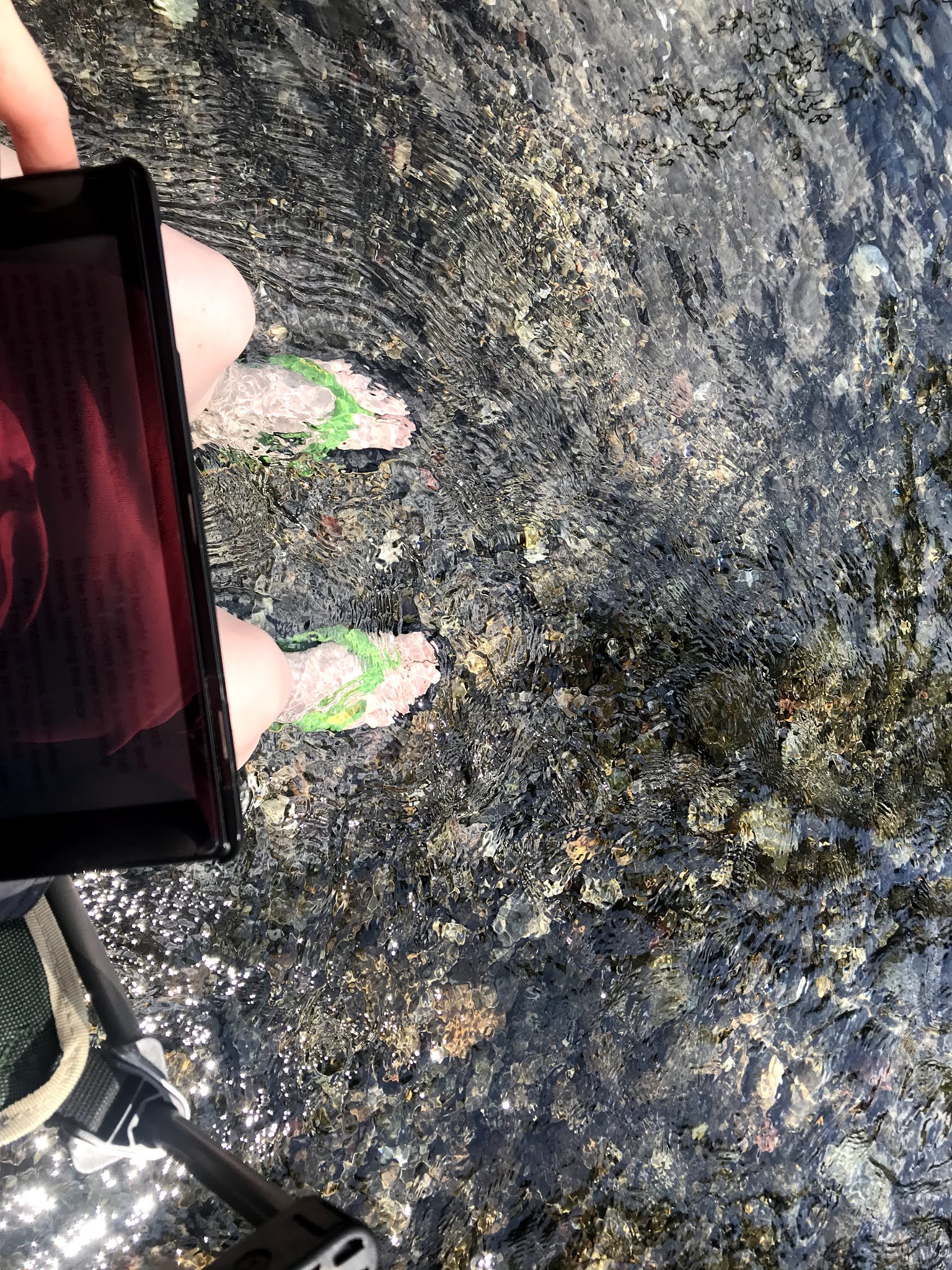
Earlier in the afternoon David brought a chair down into the stream for me (the bank between our tents and the stream was steep and a bit slippery). It was especially lovely to sit with my feet in running water. Which says a lot about the temperature and humidity. Most of the year in Tokyo I am trying to keep my feet warm!

My view of my feet while reading on my Kindle.

This solitary tree was across from our campsite. Lovely shape!

We knew a typhoon was forecast for Saturday night and that we might not be able to stay for our planned three nights (they hadn't let us pay for three nights when we arrived). So we packed a lot into Friday. It was definitely "seize the day" time. 

Mid afternoon we drove to a local dam (Arima Dam) that is often seen by the school's year 11 students when they do their "Wilderness Trek". It was so hot, though, so we didn't stay long. But long enough to take some photos from the dam wall. This is just such a typical "rural Japan" photo! Mountains occupy over 80% of this nation.

We were in for a surprise at the dam, courtesy of social media and a good friend. I'd posted a photo of our campsite on Facebook the day before, and unusually, had included the name of the campsite. Hazel, a Scottish friend (middle of photo below), saw it and as she was in the area visiting family she decided to see if she could seek us out. She arrived at the campsite just after we'd left for the dam, but it so happened that the lady who runs the campsite had seen us leaving and asked us where we were going (she has discount vouchers for a local hot spring and wanted to make sure we weren't going there without the vouchers). So when Hazel arrived, the campsite lady was able to tell Hazel where we'd gone. Amazing! 

I usually see Hazel several times a year at missionary women's gatherings, but that hasn't been happening in the last 18 months. The last time I saw her was in March in a Zoom meeting with about 70 other people. To see her in person was so special. She also knows Renee (left in the photo) and Mark, our camping buddies, from their first stint in Japan when they were stationed here with the US military. 
This is the other direction from the dam wall.

Mark brought two of his bikes to camp and he and one of the teenagers, who's also a biking fanatic, rode to and from the dam. Here we waited, on our way home, at a very long red light!


To give you an idea of our location, the campsite occupied this "triangle" of land. The parking area was where the green "pin" is at the top of the map and we camped about where the "a"of "Iruma" is. All the land was more than a metre above the river, with fairly steep banks, but obviously the forecast of a typhoon coming through was a concern. These typhoons can deliver large amounts of rain in a short period (it's not unusual to hear forecasts of 80-100mm an hr). So this wasn't a smart place to be if the typhoon did hit. Not to mention the possibility of tree branches breaking, nor the idea of packing up in heavy rain and carting everything over a slippery bridge. So, we negotiated a deal to stay till after lunch on Saturday and then went home 20 hrs early. 


Our "Plan B" kept the camping vibe going just a little longer. The BBQ we'd planned for that evening, we had at our friends' house and then we enjoyed a movie night (something we wouldn't have done camping). Then the two friends of our youngest, who'd been camping with us, slept the night at our house. 

It's only the second time we've been "evicted" from a campsite by a typhoon in ten years. Though we did leave another campsite very early after being dumped on by a storm at 3.30 a.m.. And only one camping plan has been cancelled in 10 years. That wasn't due to a typhoon, but merely cold, rainy weather in spring, plus it had been a bold, audacious plan with several families and lots of kids. That's not to say we haven't had rain at other times while camping, just not to the point of needing to abandon the trip.

Last week I wrote here about how this is 10 years of camping for us in Japan. I've just now looked at the map and determined we've now camped in 30 different campsites! Some of them more than once, so probably we've set up at a campsite about 40 times. Here's the map where I've been keeping track of the campsites. What an adventure! And it's not over yet. Clearly we've got some work to do in northern and western Honshu, not to mention Kyushu and Shikoku (the other two of Japan's four main islands).


04 August, 2021

Celebrating 10 years of camping in Japan

 I realised this afternoon that last week was the 10 year anniversary of our very first Japan camping trip (which was actually our first camping trip on our own). I wrote a blog post about that first camping trip: http://mmuser.blogspot.com/2011/07/our-camping-adventure.html

It’s fascinating to look back and remember the journey. Our boys were 6, 8, and 12 on that first trip and they loved it (though were thoroughly exhausted by it). Opinions have changed over the years and only two still enjoy camping.

Last year’s summer camp

Camping also looks a lot different with older teenagers. For starters, camping just with us is too boring, so for the last couple of years we’ve been including their friends, and that’s added another fun dimension.

For the first five years or so, we mostly just camped as a family, but since then we’ve camped a lot with others, particularly one family who lives close to us. It’s been fun to share the camping fun with them, and share the meal-preparation (and clean-up) side with them too. And camping with Americans also means S’mores!

This last 18 months of pandemic I’ve had very little opportunity to spend face-to-face time with people outside my family. Camping has been one way to stay connected to at least a couple of our friends.

In those ten years we’ve also done two camping tours. We toured Hokkaido and also the central part of Honshu (as far south/west as Kyoto and Wakayama Prefecture). Both times we camped continuously for about two weeks, but only staying in each campsite one to three nights. David and I loved those trips, the boys, not so much.

I probably should stop and count how many camping trips we’ve been on, but we’re in the midst of preparing for another one tomorrow, so I’ll leave that for another day. 

The main reason we began camping ten years ago was a realisation that we’d been in Japan for ten years already and seen very little of this beautiful country. It’s not easy to see Japan on a budget with a family, but camping was one way to do it. We’re also more small-town/country kids than we are big-city kids, and we’re not particularly into tourism or shopping, so exploring Japan’s countryside was appealing. 

You might think that we are great outdoorsy people. We are not. Both David and I burn easily and don’t particularly love hiking. I was pondering earlier this year why camping has been so appealing to us (besides being able to see different parts of Japan and to get out of the city) and I think it’s partly because both of us love problem solving. Camping is full of opportunities to problem solve and we enjoy the challenge. We’ve also found that camping so fully occupies your mind that just a few days away can feel like many more, so it’s actually a pretty efficient way to take a break.

Anyway, if you’ve followed my blog for any length of time you will know about our camping trips. We’re excited about embarking on another one tomorrow, but we’re hoping that it will be cooler at the campsite than it is here (the car’s thermometer read 35 degrees C when parked in the shade at 5pm this afternoon, and the humidity was something like 80%). We’re camping near a stream, so hopefully we’ll be able to cool off pretty easily.

23 July, 2021

Summer holidays 2021

Well, we've been back nearly a week now and it's time to do some reminiscing and show you some "slides" from our time away. I didn't feel the slightest bit like writing while I was gone (though I didn't have a keyboard with me, so that was a significant deterrent for sure!). 

My days were spent in rotating between reading and eating, walking and sleeping, watching movies and doing puzzles, playing games and picking up cross-stitch again. It's truly amazing how much time can be spent on relaxing, non-work activities. 

We came back to Tokyo last weekend feeling very relaxed. I'm the only one properly back at work (David has one toe in the door, checking email and doing the odd task).

It was a great time to decompress. I thought I was doing okay before we left, except that my body was starting to tell me, in various ways, that it was time to take a break. It was hard to walk away, but so needed. We've had a rough year. It was especially great to take time away from making decisions. We'd deliberately set aside some pressing concerns until "after holidays" and we're seeing positive results from that now. Intentionally not talking about some things has given the space to think and process and make decisions that were too hard when we were stressed.

We definitely view ourselves as marathon runners in this work in Japan (and not particularly fast runners at that). If we're going to last the distance, we need to pace ourselves, and regular time away from work is an important part of that.

I'm glad to say that our "summer" isn't over yet. Not that I'm totally enjoying the heat (Tokyo's summer is oppressive and our house has poor insulation), but that the summer vibe in the house prevails, despite me spending office hours at my desk. Last night we went out for dinner and a movie (Black Widow). In a couple of weeks we're going camping for three nights. No school schedule is really nice! But I'm a bit sad that I'm not getting so much time to read . . . I read 11 books while we were away and it was awesome!

Anyway, here are a few tastes of the great outdoors from our holidays:

The front "gate". Yep, after Tokyo, it's very green.

Tiny "false" strawberry in the wild.


This is the mountain whose slopes we were situated on. We rarely saw it, though, it was cloudy 
much of the time. These fields, though, we feasted our eyes on all day long.

We were there in the middle of the rainy season, so there were lots of fun mushroom to find.


Putting my phone close to the ground, with the lens at the bottom,
I was able to see up under the mushrooms.

One day we drove 30 min north to Karuizawa, a popular summer retreat for the rich in Japan.
We almost always visit this outlet mall. It's a sprawling, luxurious place, with it's own lake and 
lawns. We caught it on a foggy day. Our purpose was finding sneakers in a larger size than you
can usually find in a Japanese store (for our tall teenager).

We happened upon this overgrown lookout while walking one day.
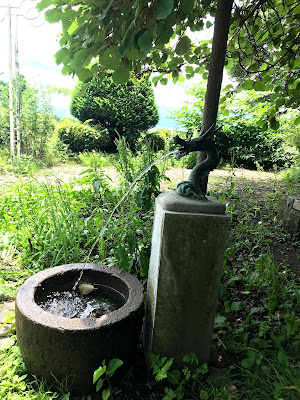
It wasn't well cared for, but had this interesting, and functional, water feature.

Venturing up the mountain, we walked this quiet, but well-maintained road.
It was blissfully quiet.

And yes, our usual haunt: the local park, with its park golf course. We spent three sessions here.

Another mushroom!

Green rice fields are beautiful (green being my favourite colour). We don't often get
close to them on foot, so when we walked past this one, I stopped for some photos.

In the cool of the mountains, the hydrangeas were still blooming, even as our Tokyo
ones were wilting in the heat.

Oh, and you can't have too many mushroom photos, can you?

02 July, 2021

Medley of thoughts before holidays

We're winding down here, on our way to family holidays. This weekend I'm walking away from my computer and email and other work messages for a couple of weeks. Oh, and daily language study too! A total break during which I can forget about what plate/ball I might have accidentally dropped. Ah, the bliss.

This is the park near where we'll be.


I've been working hard these last few weeks to clear my To Do list of urgent matters. It's quite a trick to managed when you are responsible for social media posts five days a week for your organisation, but I've got a good team and we've worked together to get the next month sorted ahead of time. I've also got a team working on magazine matters. Almost anything that arises in that realm can wait till I get back too.

And though I have generally felt okay recently, I think my body is sending me signals that it's time to take a break. It's been a very rough year for us personally, as you might have guessed (see this post about death and this one that includes a brief reference to the uncertainty we have faced over the last several months with one of our boys). 

On Monday we had our first COVID-19 vaccinations. So thankful! Japan is really getting a hurry on with these. Nearly 25% of the population has had their first injection, which three times what it was a month ago. The next day I had an unusual few hours of gastro upset. There were other factors involved, so it's impossible to say why, but I think it's time for a break.

We're headed to the same place we've had family (non-tenting) holidays twice a year in the last three years. I anticipate that our time away will be very similar to last year (see here). Which suits us just fine, especially the one who gets anxious about change.

We're also excited to have finally been able to book another camping trip for early August. We're staying pretty close to home, though, no new prefectures to add to our list, but still three nights in the mountains next to a stream sounds really good. It's cool today, but by then the stream will also sound really good (and they have showers too!).

When we come back the Olympics will be close to opening ceremony and it will be fascinating to watch that event unfold on Japanese TV. We no longer have our Olympic tickets; though we've still got two tickets for the Wheelchair Basketball and Paralympic Athletics in late August, in a couple of weeks we'll find out if we can still attend.

I've kind of dropped the ball on writing about "Come" (see my kind-of resolution from January), but I really don't think I have brain power to write anything on that today, so maybe later. Maybe I'll get an urge to write while we're on holidays, but I kinda doubt that. Usually holidays pass in a blur of reading, eating, sleeping, playing games, and watching movies with the boys. Generally taking a break from thinking about putting words together.

See you on the other side!


24 June, 2021

Let's review your life #10

I'd like to get back to this park soon, it's
a good place for reflecting! But the lead-
up to our family holidays the end of next
week continues to fill with new things to do!
I've written before about one way our organisation takes care of us: Two Year Reviews. Having published a blog like I've done, for several years, it's great to be able to look back at earlier things I've written. In 2013 I wrote about the Two Year Review (TYR) process here, giving some examples of questions we have to answer (and then talk about with a leader). I also shared in that blog post about why reviews like this are really important, as well as the things I struggle with about them.

I've added a few of the questions below (it took me a good couple of hours to answer everything, as well as do the goal setting that was required):

Do you have a day of rest each week?
What do you do to maintain your spiritual health?
In what ways has the Lord blessed you since your last two year review?
Here is a list of emotions. From this list choose the emotions that have characterised your life since your last review. Feel free to add any that aren't listed.
What subjects have you thought about or studied since your last review?
In what ways has your marriage been under stress since your last review?
What are your challenges and encouragements concerning your children's education?
What encouragements have you experienced in your relationships with your family at home (meaning your home country)?
Describe significant friendships in your life since your last review.

When I mildly complained this week about the process (mostly that my "head hurt" in trying to answer these broad questions about the last two years), a close friend quietly rebuked me and said that this was a privilege. She's right—most people don't get the opportunity to answer questions like these, let alone have a leader with time to sit down and go through them with you.

There's a few reasons why missions do (or should do) these kinds of reviews:
  • Missionaries often carry a load of extra stress, merely because of where they live and what they do.
  • They are often more vulnerable because when you live outside your home country your networks are often thin and it can be hard to access appropriate help.
  • Missionaries can be lone rangers and stubborn (the flip side of independent and persistent, two valuable character traits for serving overseas). These two factors can mean they don't ask for help till it's too late.
  • Missionaries are rare. There really aren't that many of them in the world, that makes them important human resources that make sense to retain in good working order, if possible. (Not to mention the importance Great Commission...)
  • And there's probably more...
This is maybe the 10th or 11th time we've done this, so we're a little savvy. Many of the questions I could have written several paragraphs, or even a blog post about. But no one has time to read all that, let alone talk about it. I also think we are being asked regularly enough "how are you really" for lots and lots of detail at this time to be unnecessary, i.e. our line manager is doing a good job of caring for us. This TYR is like a screening test to pick up areas that need closer attention.

I also tend to be a reflective person anyway, and also fairly self-driven, so possibly this process isn't as important for me as it might be for someone else. However, it's still a good process to have in place, even if I feel a bit grumpy about it at times.

I don't think I got any surprises as I went through the questions this time, although the question about "What subjects have you thought about in the last two years?" always flabbergasts me: no one really wants a detailed answer to that! And as for "What emotions characterise your last two years?" Yikes!

Can you think of a question that you wish someone would ask you, but they rarely ever do?