30 September, 2021

Should we value efficiency as highly as we do?

In April, more than a year after this pandemic began to change our stories, and when we really started to ask: how much longer? I came across an article by Susan Narjala about inefficiency. Susan has worked (still works?) as a missionary in India. She talks about how she used to live a very efficient life, but how that changed when she got to India.

Indeed, missionary life does feel very inefficient at times: even in Japan. When you think about it God's idea of mission does seem a bit odd at times. And many a church has failed to support missionaries because of that simple thought: that it looks far more efficient and (is often) cheaper to support a local, than to send in a foreigner to spread the word about God's good news.

Just yesterday I received a blog post in my editorial inbox by two of the thirteen missionaries we have in OMF Japan who are "on the field" but not in Japan, because the borders have been shut to people seeking new religious workers visas for much of the last 18 months. The missionaries write about how they'd sold their house and bought aeroplane tickets, but gotten stuck where they were. That is but one story of many during this pandemic of frustrated plans (missionary and non-missionary alike).

In the Western world we value things like busy schedules, productivity, and high income. We tend not to talk so much about those times when things don't match that: when people lose their jobs, when there's down-time in a work schedule, when illness prevents people from living up to their "potential", and failure to jump through society’s hoops on an acceptable schedule (e.g. education). Indeed, I wonder if that is why artists and other creatives are often undervalued: they don't look productive and indeed the creative process is often slow and seems inefficient. We complain when our plans are disrupted and feel like we've failed or are somehow less valuable.

In many ways I count the opportunity to live life as a missionary as a privilege. We are under no illusion that we're earning our own living, that we're independent islands (dependency on our prayer supporters), or that we are functioning as efficiently as we could in our home countries. All these things keep us leaning hard on God and prevent us (mostly) from believing in our own strength. Hopefully they all help us grow more Christlike!

If we read God's Word carefully, I think it shows us that the value we place in efficiency is often  misplaced. In the Bible we see inefficiencies everywhere. Examples aren't hard to find. Here's a few that come to mind: Why did Abraham and Sarah have to wait until they were elderly to have their one child? Israel had to wait a long time before God called 80-year-old Moses to free them. Jesus certainly didn't live a life that reeked of modern-day efficiency. His schedule wasn't full. Obviously God's ways are different to ours. The aforementioned article quotes John Piper: 

"God almost never takes the shortest route between point A and point B. The reason is that such efficiency—the efficiency of speed and directness—is not what he's about. His purpose is to sanctify the traveler, not speed him between A and B. Frustrating human efficiency is one of God's primary (I say primary, not secondary) means of sanctifying grace."
A local flower, that is a native to Eastern Australia! 


Susan poses a scary question: "Am I normally so entrenched in efficiency that I don't desperately need God?"

It's a good question for any of us to ask. Especially when we find ourselves wondering about the inefficiencies that are thrown our way. The pandemic has given us all many. Personally, our family has thrown some extras too. Let's face it: parenting isn't really a picture of efficiency.

Martin Luther has some wise words when we're feeling a bit at a loss, when we're wondering if we're really doing the best we can:

 "What you do in your house is worth as much as if you did it up in heaven for our Lord God. We should accustom ourselves to think of our position and work as sacred and well-pleasing to God, not on account of the position and work, but on account of the word and faith from which the obedience and the work flow."

And John Piper again: 

"By all means, make your list of to-dos for the day. By all means, get as good at that as you can get. . . . Go ahead and read a book about it. Then walk in the peace and freedom that, when it shatters on the rocks of reality (which it will most days), you’re not being measured by God by how much you get done. You’re being measured by whether you trust the goodness and the wisdom and the sovereignty of God to work this new mess of inefficiency for his glory and the good of everyone involved, even when you can’t see how." quoted in the article first mentioned above.

This blog post is a study in inefficiency in itself. It was begun in April with a confluence of several things, along with various circumstances at the time: I read Susan's article, but also had recently written a blog post that included a metaphor about jellyfish, and then discovered this verse on my desk calendar:

"Now thanks be to God who always leads us in triumph in Christ, and through us diffuses the fragrance of his knowledge in every place. For we are to God the fragrance of Christ among those who are being saved and among those who are perishing." 2 Cor. 2:14-15 NKJV
But alas the blog post was never completed, until now!

Do you feel judged by others about how much you get done? Are you judging yourself or others too harshly? What if we sit back and remember that God's sense of efficiency isn't the same as ours? And that through these challenges we face, that he's working in us for his purposes.

In our prayer time together, I often pray with my husband that God would help us to do the things that day that he'd "prepared beforehand" for us to do. It comes from Ephesians 2: 
For by grace you have been saved through faith. And this is not your own doing; it is the gift of God, not a result of works, so that no one may boast. For we are his workmanship, created in Christ Jesus for good works, which God prepared beforehand, that we should walk in them. (vs. 8–10 ESV). 
I often forget that I've prayed that, but I think that it's a good way to start the day, nonetheless. Maybe one day I'll be less forgetful!

25 September, 2021

Feeling a bit buffetted


I think it's been nearly four months since I rode to the big park to the south of us. I made it there on Wednesday for a solo picnic. I’ve had a lot of Zoom time in the second half of this month. So when it dawned on me on Wednesday morning that I had a small window where I could escape from the house (and work), I seized it. 

Even though we’ve had some hot days this week, the season is definitely early autumn. Nights have cooled down. In the park some of the leaves are starting to change. And though Wednesday was a warm day, it was a tad cool in the shade at times. 

As I always do before going on a longer ride, I'd checked the weather and there was no forecast of rain. But as I got closer to the park, the sky got greyer and the wind stronger. Had the forecasters made a mistake? When I arrived, I pulled up my trusty weather app and looked at the radar. There was a small thunderstorm headed my way! So I parked myself at a table near a small non-ornate gazebo and ate lunch.

Thankfully it never did rain, though it looked like it could for quite some time. The sky eventually cleared to the white puffy clouds we’d started the day with.

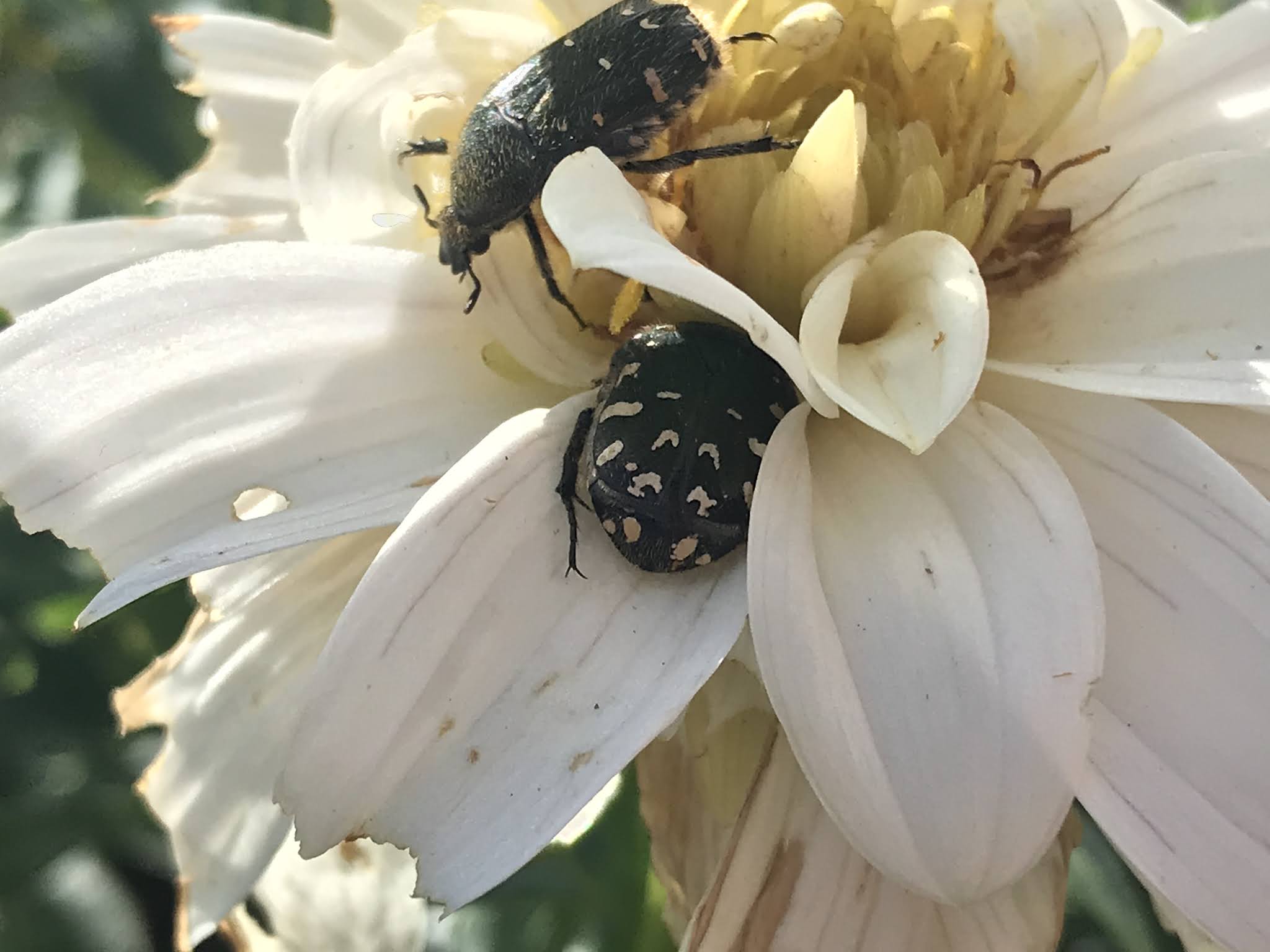
If I'd hung around longer, I might have gotten
better captures of these two bugs who were
very intent on harvesting the remains of this
past-its-prime flower. I think they are Middle-east 
flower scarabs.

After I ate I read for a while and then took some time searching for photos, having been inspired by a nature photography seminar I participated in the day before. The seminar encouraged us to take our time, to breathe, to be renewed as we looked for things to photograph. I have for some years now been on the lookout for things to capture, often small or unusual things or angles, but mostly opportunistic things. That is, as I’m out and about doing other things. It was good to take a few minutes to change focus a little bit, to feel like it’s more than okay to do that. In the midst of so many video calls and intense interaction, it was very good to be out in the fresh air, and away from buildings and people.

But this morning, as I sat in my relaxing chair in our lounge room, rotating between various activities: Scrabble, game on phone, Japanese vocab and kanji (character) review, I’ve been reflecting on the last couple of weeks and wondering why I’m feeling a bit buffetted. I think it’s not just the busyness of those days, but also the emotional highs and lows. And a list is good to help explain that, so in the last two weeks I’ve—

    Light was difficult for capturing this ant,
    but I tried.
  • Led nine hours of meetings with my magazine team over two days. This was an emotional high, but also a heavy responsibility that exhausts me.
  • Sat through two days of online field conference, during which we farewelled ten colleagues who are retiring in the coming year and brought tears.
  • Interacted in person, via text, and on video calls with a handful of friends and colleagues who wanted to know how I really was, and I got mixed responses. One of which really disappointed me and others that really lifted me up.
  • Had to share briefly in a small group of OMF colleagues about the challenges of the last 18 months. I know none of these people well, and wasn’t sure how much to share. It turns out my brief summary was enough to make them feel like they had nothing significant to share :-( So I felt that perhaps I did have reason to be feeling a bit overwhelmed and tired, if other people, who hadn't heard most of the details, are taken aback.
  • Made a small step forward in planning for the next few months for a member of our family. It was a small, but significant step that had me feeling elated.
  • Low-key celebrations of a birthday and our wedding anniversary.
  • Led a prayer meeting online for our mission. At night, which is a challenge for me.
  • Had an article published in the US that was quite personal (it’s here). It was great to have a writing opportunity, but also emotional to get my thoughts out there.
That’s probably enough! Yes, I think there are a few reasons there to feel like I’m a bit depleted. So in retrospect I see that the couple of hours I was able to spend in the park on Wednesday was a real gift from God. As is this quiet weekend. And no, I’m not going to be an overachiever today. I think sitting quietly is really okay, otherwise I’m probably going to end up saying something to someone that I really will regret (a classic sign of exhaustion for me).

So, here are a few photos from my God-given time out.
  • Summer cypress

    Balloon flower.

    Not exactly where I sat to eat and read, but close by. You get the idea that this park has
    some lovely tall trees, and more than a few.

    A dahlia, I think, reaching for the sky.


09 September, 2021

Weariness

Anyone else feeling tired? I feel like I'm doing a reasonable job of looking after myself, but I still feel like I'm weary.

Yesterday, when I began this post, I was feeling particularly exhausted. Is it the strain of the pandemic catching up to me? Is it the strain of our personal family struggles from the last year? Or perhaps it's just hormones? Or maybe it's a combination of all of the above? Last month I was putting it down to the struggle to sleep at night when the temps and humidity were so high, but that has eased in the last week. Maybe I just need to catch up?

Just remembering our August camping trip, which already
seems so long ago!
Sigh. 

So yesterday, when I was feeling particularly fatigued, I did two things, no three.  I started this blog post! I took a novel and lay down for a while. And I took a wander through the Bible looking for the word "strength". This is one of my favourite ways to search the Bible for a perspective on something I'm struggling with. I didn't spend long on it, but it was illuminating.

First, strength is something that God is described as having and giving. And second, it is something that humans struggle to have, something that people in the Bible go to God to ask for.

1 Chron. 16:11, 27, 28 (context, David singing after bringing the ark of the covenant to Jerusalem):
Seek the Lord and his strength;
seek his presence continually! . . .
Splendor and majesty are before him;
strength and joy are in his place.
Ascribe to the Lord, O families of the peoples,
ascribe to the Lord glory and strength!

Then a verse came up that was very precious to me the first time one of my kids was admitted to a Japanese hospital. Yes, I clearly remember being at the end of my strength that time, and that God helped me through.

Ps 46:1:
God is our refuge and strength, a very present help in trouble.

David wrote quite a lot about strength: God's strength, his own need of strengthening, and that God was his source and refuge: 

Ps 59:16: But I will sing of your strength; I will sing aloud of your steadfast love in the morning. For you have been to me a fortress and a refuge in the day of my distress. 

Ps 105:4: Seek the Lord and his strength; seek his presence continually!

God also is quoted many times as saying: don't be afraid, I'm with you.

Isaiah 41:10: 
Fear not, for I am with you; be not dismayed, for I am your God; I will strengthen you, I will help you, I will uphold you with my righteous right hand.

And a common benediction, that we don't necessarily pay attention to at the end of worship services:
Romans: 16:25: 
Now to him who is able to strengthen you

And the first, famous passage that came to my mind before I searched for anything: 

Isaiah 40: 28-31
Have you not known? Have you not heard?
The Lord is the everlasting God,
    the Creator of the ends of the earth.
He does not faint or grow weary; 
 his understanding is unsearchable.

29 

He gives power to the faint,
    and to him who has no might he increases strength.
30 
Even youths shall faint and be weary,
    and young men shall fall exhausted;
31 
but they who wait for the Lord shall renew their strength;
    they shall mount up with wings like eagles;
they shall run and not be weary;
    they shall walk and not faint.

And then a key verse for us personally as we serve in mission:

1 Peter 4:11: Whoever serves, as one who serves by the strength that God supplies—in order that in everything God may be glorified through Jesus Christ. 

So my conclusion: I need to continue to do my best to take care of things like resting and having appropriate boundaries, but I also need to keep asking God for strength and relying on him to give that at the right times. No magic cure, but it was a good moment to stop and refocus. 

Oh, and we're also planning another lily pad: a camping trip next month!

02 September, 2021

Tidbits from recent weeks

In the spirit of sharing "ordinary life," which is where this blog started out all those years ago! Here's a bit of what's been going on in our house recently (aside from camping):

School

New building and field (before it was completely finished)
School started last week for the students. David started work again full-time more than a week earlier than the kids, and had been working part-time since the start of the month. I'm trying to figure out when we last had just one boy at school—that would be when our eldest started Japanese kindergarten in April 2003, before the one who is now our only boy at school was even born.

Another exciting development at school is the new building that replaces the old cafeteria, but includes a band practise room and a multipurpose room. It overlooks a new full-sized soccer field that is covered in artificial turf. The school looks very different! The 'field" has been gravel for many decades, so this is a huge change.

COVID-19

We've also been touched by COVID-19. We had one case in the high school and that prompted online schooling for just two days at the start of this week while they assessed the situation. We're back to usual on campus classes again now.

As of yesterday all the Tokyo Marshalls are now fully vaccinated, which we're very happy about, especially considering that the country is in the midst of a spike of infections that is far bigger than we've had so far.

Weather

The weather has been in the forefront of our minds, as it usually is in a Tokyo August. Oddly, we had a cooler wet patch in the middle of the month, which we were thankful for. Alas the unbearable heat and humidity soon returned and we had challenges with sleeping and close proximity. Only three of our six rooms are air conditioned, so that made for interesting times with teens who value their privacy. 

On Tuesday this week another cool change came through which dropped temperatures into the low 20s, a shock to the system, but most welcome. We've slept deeply these last couple of nights. A cool change at this time of year is unlikely to turn back into the worst of summer, though we might have one or two 30C days still to come.

Olympics and Paralympics

We've enjoyed many an hour watching these amazing events in our lounge room. The range of English commentary available to us online has been impressive, and we've often played the "guess the commentator's accent" game! It was sad that we didn't get to use the tickets we had to four different events, but a relief in some ways, as spectating in the Tokyo heat would have been very tough.

Lily pads

With holidays behind us, I've struggled a little to find "lily pads" to look forward to. We have talked about a possible camping plan for October and have booked our usual pre-Christmas holiday. But I've also made some smaller plans, which includes pulling out my sewing machine and trialling a weekly out-of-the-house work date with myself.

My work

These last weeks I've been working on the final stages of our Autumn magazine issue about Men in the Japanese church. We finished that on Tuesday afternoon. I've also been communicating with authors who have/are writing for our Winter issue about Technology in Ministry. There's a lot that's been going on in that area and it's a very timely topic to cover, alas that also makes it a challenge to fit everything into the space available!

Our social media continues onwards also. In August we covered Sports, for obvious reasons. Not as much Olympic and Paralympic news as we would have had if we hadn't been in a pandemic, but still, we managed to find plenty to share. In September we have a more challenging topic: Japanese church history. So in recent days I've been reading and trying to write summaries of various topics and eras that make sense and work for social media while at the same time keeping in mind our purpose: mobilising people to be more involved in mission. Yeah, not the easiest of tasks.

I also picked up a small writing gig: writing an article about missionaries and loneliness for our OMF US folk who are tackling that topic in September. It's a topic I've written about many times here, so it was interesting to pick it up again and try to write something fresh.

I've also just written our monthly news and prayer letter. We also have the responsibility of running a prayer night for our fellow 120+ missionaries at our online field conference in a couple of weeks. Planning needs to be done!

I tend to be easily bored, so I'm thankful to have a job that means I'm kept on my toes and have lots of different places to turn my attention, even if it can be stressful at times.

But for today, it's time to pull the plug on work and move into dinner prep and a relaxing evening. How's your August been?

27 August, 2021

Overthinking—more common than I thought

This is a review of a book I read last weekend. Yes, it's so well written that I managed to read it in just three days (granted my weekend was very quiet, being as we're not going out for anything beyond essentials).

I have caught myself recently dithering over purchases for several months (or years). I didn't categorise myself as an overthinker, but perhaps I am a little, especially about financial decisions, but through reading the book I realised I tend to overthink conversations, conflict, and other things too.

I felt like, at the start, the author was trying too hard and over-wrote the first few chapters. She spends a lot of time convincing the reader that you could change. However, once I got past that bit, it was a fantastic read, one that I got through very quickly.

Here are (quite a few) gems:

  • "Mental energy is not a limitless resource. We have only so much to spend each day, and how we choose to spend it matters." Overthinking is basically frittering away mental energy, that's not something I want my life characterised by.
  • Overthinking includes inefficiencies, like poor organisation (e.g. losing car keys because you don't put them in the same place every time).
  • We can develop processes that help us circumvent overthinking, e.g. not checking email when you don't have the time to reply (e.g. before bed).
  • Putting decisions off for later isn't always the best thing to do.
  • Doing too much research or looking at too many options isn't necessarily helpful, limiting your choices can be a huge time and mental energy saver.
  • Rejecting perfectionism: putting a cap on how much time you spend on something making it as good as you can, then acting.
  • Adapting a "try it and see what happens" approach can help.
  • Our values can drive our decisions. (See more about this lower down in this post)
  • I love this quote: "Being a responsible adult is the most underrated form of self-care. Yes I mean: live within your means, make dentist appointments, save money, plan meals, wash your face before bed, go for walks, cook for people, keep your house clean, go to bed at a decent hour, all that boring stuff. Routines make everything in your life better and this is absolutely the most overlooked and underestimated form of self-care"—Sarah Bessey, as quoted in the book.
  • "Clutter isn't great for mental function. . . By streamlining your spaces you can streamline your thought process, and your brain won't have to work so hard to tend to life's details."
  • Don't duplicate the work: this is where our camping list works brilliantly. We don't overthink preparing to camp because I know that if we get everything on the list, we'll be prepared for most things.
  • Take breaks and look after yourself: sometimes overthinking creeps in because we're overtired.
  • Sometimes we dither because we have to decide between two good choices, or between two bad choices. If that is the case it's best to just get on and choose one.
  • Notice when you're stuck in a negative cycle. Breaking that can be as simple as noticing things to be grateful for or distracting yourself.
  • Outsourcing is another strategy that helps. There are times when it is worth doing it yourself (especially if it lines up with your values), but other times it is far better to ask someone else to do something.
  • Don't think too long about splurging on an experience that you think will be good. Memories are invaluable.
  • Small treats to myself are okay and don't need to be overthought.
I liked it that she talked about life as a writer. I am a non-fiction editor and writer. That means that reading non-fiction tends not to help me feel refreshed—it's what I read for work. I also related to her work-cycle that has period of both "leisurely seasons of creative planning and preparation [which] alternate with busier seasons of execution." During the latter periods, it's okay to brush off decisions that fit more naturally into the creative planning and preparation periods.

Our values can drive our decisions
I realised that we do do this, and that is why we sometimes feel so different to many people we meet. But identifying your values makes a big difference to the decisions you make. For example, the decision about when we will come back to Australia for our next home assignment is informed by many factors, especially at the moment the education and well-being of our three sons has a big part to play in our decision on that matter.

Rituals
The author defines rituals in an interesting fashion, distinguishing them from routines by noting that rituals have a higher purpose in mind. Simply changing the name of something can give it deeper meaning. I realised that I've got more rituals in my life than I realised, and that they are helpful in keeping me afloat! Yes, even camping has become something of a ritual: it has a rhythm and routine to it, but there is a deeper meaning that makes its total value more than just us sleeping in tents and cooking outdoors.

Read it
Wow, that's a lot. I really do recommend reading the book, I hope I haven't put too many spoilers in. I got a lot more out of it than I expected and often thought of close friends who could also benefit from it.


18 August, 2021

On the edge of ordinary on the medical scene

Looking at July and August, all I've written about on this blog is holidays and camping! Anyone would think I've done nothing else. I actually only had 16 official days of holidays in those two months. Since we got back from holidays in mid July I've been at my desk most of each work day (aside from those two days of camping a couple of weeks back). It's always a challenging time of year to work, although as the boys grow older it's become much less of a problem. They are no longer running around the house during their holidays, demanding my attention at random times, so I've got a lot more headspace to devote to work.

David went back to work officially on Monday, so this week is looking more like business as usual, except that I've got two big boys sleeping away much of the day (yes, they are pretty nocturnal at the moment). When I say "officially", David's actually been in and out of school many days in the last fortnight. And he's been on his computer doing email and other admin things for a period most days, not to mention three Zoom meetings/training with OMF last week. Plus, he's been working on a project of digitalising a portion of his work that has existed on index cards that have been collected by dozens of teachers over the last few decades. So, I've not been alone in working at home here!

We do as much of our medical care as we
can in Japanese, but for some things we 
really need English service providers for.
We're thankful for the doctor near this
station who has been caring for one of our
sons over the last 2 ½ years.

In addition to that, we've been doing a few medical things. I wanted to write a bit about one of them—a visit to a dermatologist.

When you live in your home country you don't think about how the medical things that happen there are (sometimes) specific to your country. Of course you might think about how accessing medical care in another language is hard (and it is!), but I've got a different type of example you might not have thought about.

Skin cancer isn't common here

Australia has the highest rate of skin cancer in the world for men (not women, though we're close to the top of the list). Japan is not even in the top 20 countries in this list. But Japan is third on the list for stomach cancer and Australia doesn't feature in the top 20. (This data is from here.) 

These are interesting statistics, but the rubber hits the ground when you are not living in your home country. In Australia skin cancer is high on the list of things that your local GP will check if you ask them to (and in fact we've been told that the average Australian GP is better informed about skin cancer than the average dermatologist in Japan). Plus, there are many easily accessible skin cancer clinics that will give you a regular full body check. By contrast, in Japan, there aren't such clinics. And at annual government-funded medicals in Japan, they check for bowel and stomach cancer, but skin cancer isn't on the radar.

It just so happens that my husband has a family medical history (and now a personal history) of skin cancer, and so this is definitely on our radar as he gets older. I'm very grateful, therefore, that we live in one of the largest metropolises in the world. It's possible to find unusual services, like a doctor who has read up on skin cancer in Australia and is willing to "colour outside the lines" with foreign patients who have different skin and had different environment growing up to most of the Japanese population. It's not covered by our Japanese health insurance, but it's an awful lot cheaper and easier than going to Australia. It really is another example of how we live "on the edge of ordinary".

And life continues on...

Aside from all that, we're living pretty quiet lives here and trying not to be too stressed by the news of what's going on in the rest of the world. The pandemic is raging in Japan (between 15,000 and 20,000 new cases a day in the last few days, around 5,000 of those in Tokyo) and we're doing essentials, but otherwise at home. We're thankful that Japan is working hard to vaccinate—nearly 50% of the population has had one jab, that's 60 million people since they began in mid February. Maybe by summer next year Australia will welcome us back for a couple of months without requiring us to quarantine in a hotel at our own expense?

School (CAJ) starts the new school year for students from next Tuesday. I'm still coming to grips with the fact that we'll only have one at school this year. We're not sure what the year will look like for our middle son, but we're glad we have the means to be able to support him at this transition time of life, to give him a chance to figure things out.


12 August, 2021

Summer 2021 camping trip

This time last week we'd just driven about 45km west-north-west to camp for the second time this year. And indeed the fifth time during this pandemic! I'm so thankful we've been able to continue doing this. It's such a life-giving activity for us. I read a short article recently about seven types of rest. The author listed physical, mental, sensory, creative, emotional, social, and spiritual. I think camping touches most of these areas for us. And it's been especially valuable to camp with the same friends each of these five times. That's given me a social opportunity that has been significantly lacking in these last 18 months. (If you're interested in the article, it's here.)

The campground's name, Seseragi, means small stream or babbling brook. Indeed, the campsite was centred around a gorgeous stream (called Iruma River), perfect for a summer camp. The water was clear, running over a rocky bed, and mostly shallow, indeed we walked several hundred metres in the stream both directions from where we were camped. The adults and kids had so much fun in it, ranging from sitting with our feet in it, to skimming rocks, building rock towers, and even jumping into places that were deeper.

Camping at this time of year can be really hot. So we worked hard to find somewhere close to water where we could cool off (and had showers). I was so relieved to find that our campsite was shaded most of the day too. So, though it was hot and humid, it was easy to cool off, and we had a great view. As you can see in the following photo, our three tents were facing the stream, and the fourth "structure" the common area/kitchen, also faced onto the stream. Gorgeous!

One small downside was this cute, but not easy-to-walk-on bridge. We had to park on the other side of the stream and carry all our gear across. We were thankful for the three strong teenage boys in our group!


Sunset from the first night. We were in a valley, as you usually are when you camp near a stream in the mountains of Japan. So we could only catch small glimpses.

The below photo was just a little downstream from our tents where I went to sit on a boulder on my own and read on Friday afternoon. You can vaguely see our tents on the left of the photo.

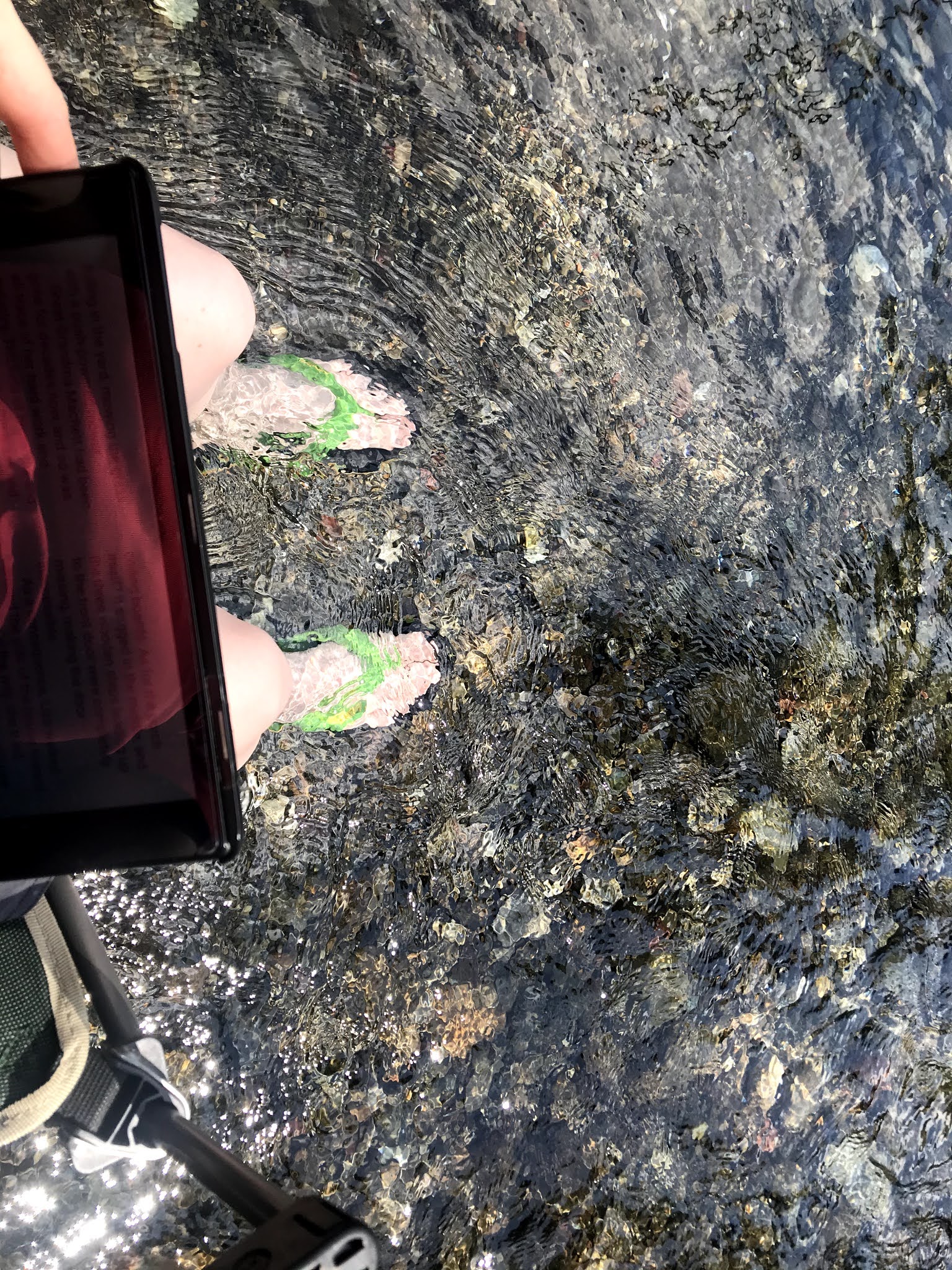
Earlier in the afternoon David brought a chair down into the stream for me (the bank between our tents and the stream was steep and a bit slippery). It was especially lovely to sit with my feet in running water. Which says a lot about the temperature and humidity. Most of the year in Tokyo I am trying to keep my feet warm!

My view of my feet while reading on my Kindle.

This solitary tree was across from our campsite. Lovely shape!

We knew a typhoon was forecast for Saturday night and that we might not be able to stay for our planned three nights (they hadn't let us pay for three nights when we arrived). So we packed a lot into Friday. It was definitely "seize the day" time. 

Mid afternoon we drove to a local dam (Arima Dam) that is often seen by the school's year 11 students when they do their "Wilderness Trek". It was so hot, though, so we didn't stay long. But long enough to take some photos from the dam wall. This is just such a typical "rural Japan" photo! Mountains occupy over 80% of this nation.

We were in for a surprise at the dam, courtesy of social media and a good friend. I'd posted a photo of our campsite on Facebook the day before, and unusually, had included the name of the campsite. Hazel, a Scottish friend (middle of photo below), saw it and as she was in the area visiting family she decided to see if she could seek us out. She arrived at the campsite just after we'd left for the dam, but it so happened that the lady who runs the campsite had seen us leaving and asked us where we were going (she has discount vouchers for a local hot spring and wanted to make sure we weren't going there without the vouchers). So when Hazel arrived, the campsite lady was able to tell Hazel where we'd gone. Amazing! 

I usually see Hazel several times a year at missionary women's gatherings, but that hasn't been happening in the last 18 months. The last time I saw her was in March in a Zoom meeting with about 70 other people. To see her in person was so special. She also knows Renee (left in the photo) and Mark, our camping buddies, from their first stint in Japan when they were stationed here with the US military. 
This is the other direction from the dam wall.

Mark brought two of his bikes to camp and he and one of the teenagers, who's also a biking fanatic, rode to and from the dam. Here we waited, on our way home, at a very long red light!


To give you an idea of our location, the campsite occupied this "triangle" of land. The parking area was where the green "pin" is at the top of the map and we camped about where the "a"of "Iruma" is. All the land was more than a metre above the river, with fairly steep banks, but obviously the forecast of a typhoon coming through was a concern. These typhoons can deliver large amounts of rain in a short period (it's not unusual to hear forecasts of 80-100mm an hr). So this wasn't a smart place to be if the typhoon did hit. Not to mention the possibility of tree branches breaking, nor the idea of packing up in heavy rain and carting everything over a slippery bridge. So, we negotiated a deal to stay till after lunch on Saturday and then went home 20 hrs early. 


Our "Plan B" kept the camping vibe going just a little longer. The BBQ we'd planned for that evening, we had at our friends' house and then we enjoyed a movie night (something we wouldn't have done camping). Then the two friends of our youngest, who'd been camping with us, slept the night at our house. 

It's only the second time we've been "evicted" from a campsite by a typhoon in ten years. Though we did leave another campsite very early after being dumped on by a storm at 3.30 a.m.. And only one camping plan has been cancelled in 10 years. That wasn't due to a typhoon, but merely cold, rainy weather in spring, plus it had been a bold, audacious plan with several families and lots of kids. That's not to say we haven't had rain at other times while camping, just not to the point of needing to abandon the trip.

Last week I wrote here about how this is 10 years of camping for us in Japan. I've just now looked at the map and determined we've now camped in 30 different campsites! Some of them more than once, so probably we've set up at a campsite about 40 times. Here's the map where I've been keeping track of the campsites. What an adventure! And it's not over yet. Clearly we've got some work to do in northern and western Honshu, not to mention Kyushu and Shikoku (the other two of Japan's four main islands).