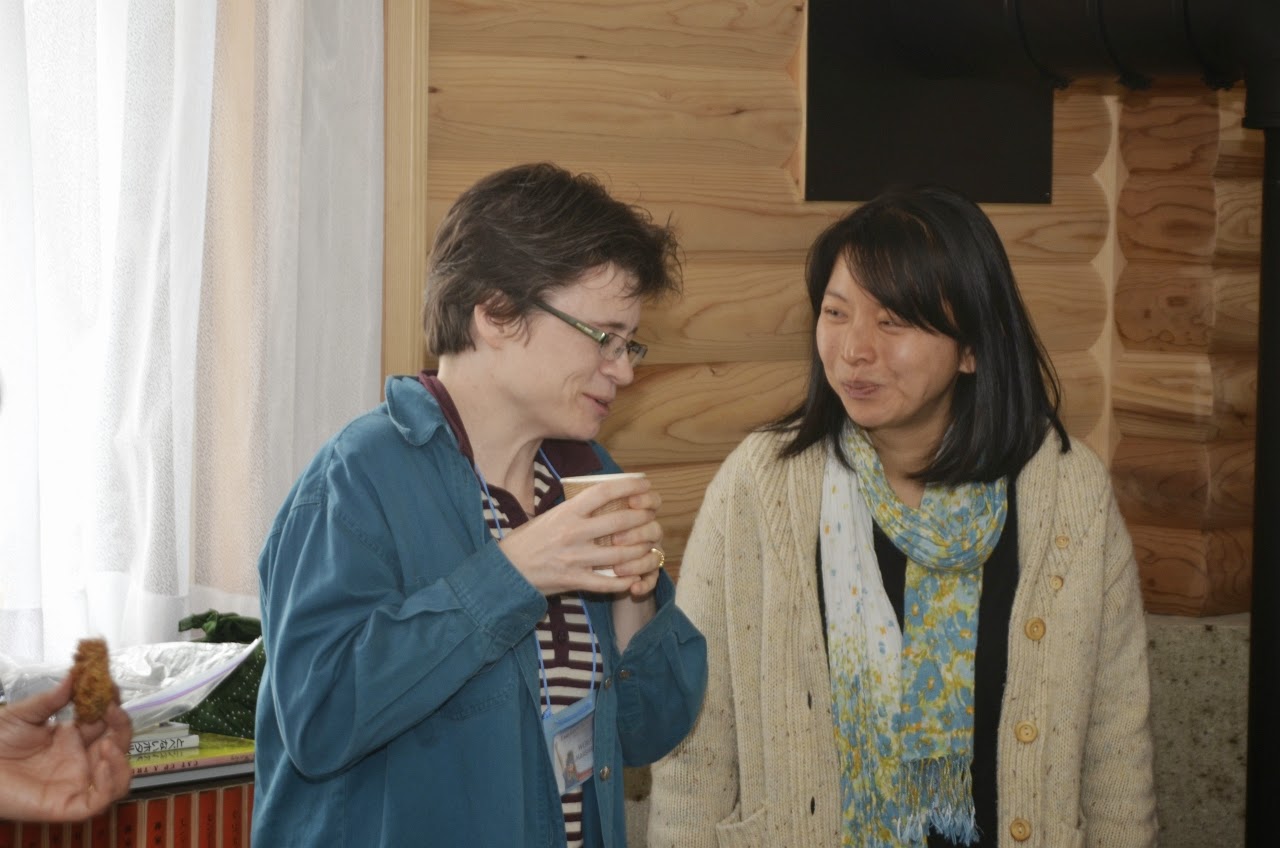
There were two Australians and an American at a missionary conference in Japan. The American had been in Japan many less years than either Australian.
In a casual conversation, one Australian mentioned their son in passing, using the word "ugly" as a descriptor.
The North American was shocked and said so.
The other Australian pointed out that the comment was a beautiful example of contextualisation: that a Japanese person would naturally say such a thing about their child.
There was a pause in conversation as they considered that.
_______________
Of course the Australian was, perhaps, not being as Japanese in their comment as their colleague suggested (although after a lengthy period of living in this country, the ways of this country do rub off on you). For in Australia such a comment is just a bit of lighthearted tomfoolery. In Japan, a parent might say something like this out of humility. And, well, for an American, it was all rather a shock.
It's easy make assumptions or mistakes when you're dealing with multiple cultures, even between native English speakers.
Please don't assume you know who is who in this scenario!
Showing posts with label American. Show all posts
01 April, 2018
25 September, 2017
Fascinating map of the future
This is a map on a wall at school. Marked are all the places that the seniors who graduated from the Christian Academy in Japan in June planned to be going after high school. You can see that most of them went to North America or stayed in Japan. Our son is definitely in the minority.

You can see on the school profile here, that the school has 29 nationalities amongst its students. It is interesting that even many of the non-US students go to North America for college.
Another point of note from a non-American perspective is that no degrees are mentioned here. It is yet another point of the American system that I don't understand. In Australia you aim for a degree, not necessarily a university. So I went straight into Bachelor of Occupational Therapy, and that is what I would tell people if I were asked what I was going to do (of course, I could only answer with certainty about a month before uni started, not months before I graduated, like many US-bound students). Ask an American year twelve student what they're doing after graduation and they'll say something like, "Going to Biola." Assuming, often, that you'll know where that is. They rarely mention what degree they're aiming for. That question confuses, instead the correct question seems to be, "What will you major in?"
I guess by the time we've been here a couple more decades I might understand better . . . but for the meantime, I'm happy to be in the minority and with a son heading into a tertiary system that I've got a better grasp on.
And I love this map!
Labels:
American,
Australia,
CAJ,
cross-cultural experience,
university
10 June, 2017
11 weeks of summer holidays?
Yesterday school finished for our younger two boys. Now we face 11 weeks of school holidays. Yes. America has a crazy system! CAJ is locked into a similar schedule that the other schools in our region have. If they want to give the students opportunities like interschool sport, music, drama, debating etc, they need to keep somewhat in-step.
What are we going to do? Aside from going away for 16 days in July, it's not a very exciting summer, at least for three of us.
CAJ has three weeks of various "summer school" classes starting a week from Monday. Our two remaining school students will do a couple of "classes" each (art, wrestling, algebra, and computer programming). And David's teaching the algebra class. These classes are only one or two hours a day.
Two of our boys are going away to summer camps. Our eldest is also a leader (or "counselor" as they're called by Americans) on three summer camps for elementary and middle school kids (including his brother).
Early August David and I are also going away for a couple of nights on our own as an early 20th anniversary celebration.
My various jobs continue, but the pace of life at home is less hectic. Plus a husband around during the day who organises things like lunch and helps out in many other ways. Minus school-related things I'm involved in like prayer meeting and going to sports events. And minus homework and assignments to be concerned about in the evenings. So the pace is slower and the mornings later. Nice.
It does mean, though, that I get less time on my own and have to work with people in my "office" (actually just a corner of the dining room). Which has its own stresses, especially when it's hot enough to put the air con on. We only have air con in the main living area (kitchen-lounge-dining). So that means little breathing space for anyone.
But it's way less stressful than when the boys were little. We still need to get them out, boot them out sometimes (tiny backyards aren't ideal with boys), but they're not as difficult to manage as when they were younger. I used to particularly hate this coming week, when the boys were home and David still at work. I'm aware I'm privileged to be married to a teacher because I really did find "single-parenting" all the boys when they were younger very stressful.
I'm going to try to enjoy this uneventful summer. Because it will be at least three years before I get another. Next year we'll be moving to Australia and the year after we'll be moving back. Stressful times. This summer is a cake walk compared to that.
What are we going to do? Aside from going away for 16 days in July, it's not a very exciting summer, at least for three of us.
CAJ has three weeks of various "summer school" classes starting a week from Monday. Our two remaining school students will do a couple of "classes" each (art, wrestling, algebra, and computer programming). And David's teaching the algebra class. These classes are only one or two hours a day.
Two of our boys are going away to summer camps. Our eldest is also a leader (or "counselor" as they're called by Americans) on three summer camps for elementary and middle school kids (including his brother).
Early August David and I are also going away for a couple of nights on our own as an early 20th anniversary celebration.
My various jobs continue, but the pace of life at home is less hectic. Plus a husband around during the day who organises things like lunch and helps out in many other ways. Minus school-related things I'm involved in like prayer meeting and going to sports events. And minus homework and assignments to be concerned about in the evenings. So the pace is slower and the mornings later. Nice.
It does mean, though, that I get less time on my own and have to work with people in my "office" (actually just a corner of the dining room). Which has its own stresses, especially when it's hot enough to put the air con on. We only have air con in the main living area (kitchen-lounge-dining). So that means little breathing space for anyone.
But it's way less stressful than when the boys were little. We still need to get them out, boot them out sometimes (tiny backyards aren't ideal with boys), but they're not as difficult to manage as when they were younger. I used to particularly hate this coming week, when the boys were home and David still at work. I'm aware I'm privileged to be married to a teacher because I really did find "single-parenting" all the boys when they were younger very stressful.
I'm going to try to enjoy this uneventful summer. Because it will be at least three years before I get another. Next year we'll be moving to Australia and the year after we'll be moving back. Stressful times. This summer is a cake walk compared to that.
31 October, 2016
Cross cultural communication in English
On Saturday after the cross-country finals we had lunch in the restaurant on the US recreation "base". An American restaurant with American friends. I was surprised at how much "translation" was required.
Our waiter was a trainee and drew a little diagram on his notepad to help him remember who ordered what. One of the Americans suggested after the waiter left that we could all switch seats. I said, with feigned admiration, "You're wicked!" That was met with confusion! We had to explain it meant "a bit naughty".
This led into a discussion about Australian humour, and that teasing, being "mean", or "paying out" was a sign of friendship.
Then another parent came over to say hi. He's an Aussie. His son had gotten a medal earlier so I congratulated him saying, "Good onya." That also required explanation for our American friends: "Well done"!
When the Aussie finished talking to us he said, "Well, I'll leave you to it!" That one also needed interpretation, it means "I'll let you get on with what you're doing."
The menus required some translation the other way. Hoagie rolls and Kaiser rolls! I'm still not really sure what they are. The waiter also asked if I wanted fries or chips. I looked at my friends and said, "Fries are hot and chips are cold, right?" They looked confused for a moment!
David was asked whether he wanted bacon or ham with his burger, he said, "ham" and deftly slipped in, "American bacon is too chewy!" (Lucky they let him get away with that virtual slander!)
Language is a fascinating thing. Finding Americans untouched by our brand of English can also be fun. But I'm still not interested in going to America, I think communication might be harder than I want to try.
We also discovered that none of them have tried Vegemite. I'm thinking we might need to do some more educating!
Our waiter was a trainee and drew a little diagram on his notepad to help him remember who ordered what. One of the Americans suggested after the waiter left that we could all switch seats. I said, with feigned admiration, "You're wicked!" That was met with confusion! We had to explain it meant "a bit naughty".
This led into a discussion about Australian humour, and that teasing, being "mean", or "paying out" was a sign of friendship.
Then another parent came over to say hi. He's an Aussie. His son had gotten a medal earlier so I congratulated him saying, "Good onya." That also required explanation for our American friends: "Well done"!
![]() |
| Chips or fries? In Australia those words a synonyms (except at Maccas) |
The menus required some translation the other way. Hoagie rolls and Kaiser rolls! I'm still not really sure what they are. The waiter also asked if I wanted fries or chips. I looked at my friends and said, "Fries are hot and chips are cold, right?" They looked confused for a moment!
David was asked whether he wanted bacon or ham with his burger, he said, "ham" and deftly slipped in, "American bacon is too chewy!" (Lucky they let him get away with that virtual slander!)
Language is a fascinating thing. Finding Americans untouched by our brand of English can also be fun. But I'm still not interested in going to America, I think communication might be harder than I want to try.
We also discovered that none of them have tried Vegemite. I'm thinking we might need to do some more educating!
03 June, 2016
American School English
Freshman = 9th grader
Sophomore = 10th grader
Junior = 11th grader
Senior = 12th grader (at least we have this in Australia)
Varsity = top sporting team (A team)
Junior varsity = second top sporting team (B team)
Sophomore = 10th grader
Junior = 11th grader
Senior = 12th grader (at least we have this in Australia)
Varsity = top sporting team (A team)
Junior varsity = second top sporting team (B team)
Concessions = a food-stall like a temporary tuckshop, usually found at sporting events
Spirit week = relates to school spirit. Spirit weeks/days at CAJ have involved people dressing up as various things (like "twins" or a book character) or wearing crazy hair or socks or sporting team wear
Pep rallies = another term related to school spirit, but usually more associated with school sporting events.
Lock in = a sleep-over at school, but not many people sleep.
Pep rallies = another term related to school spirit, but usually more associated with school sporting events.
Lock in = a sleep-over at school, but not many people sleep.
Culminating events = varying assessment and events that come at the end of a term/semester/school year. I quite like this phrase. It includes serious things like exams, assignments, presentations, and performances as well as parties, concerts etc.
Commencement ceremony = Graduation. This event takes the cake with quirky terms like valedictorian (top academic performer), salutatorian (second top academic performer), invocation (I still don't know what this is), diploma (high school qualification you work towards throughout high school and receive at graduation) etc. See here.
Bake sale = usually a fundraiser involving food people have baked
Student council = do Australian schools have these? In American schools it looks like a political campaign, with pre-electoral self-promotion of the candidates and voting for offices like President, Secretary, Vice President, Treasurer.
Lettering/letterman = an award given for a certain level of sporting (and, at CAJ, musical/academic) achievement in an inter school environment. See here for more details:
National Honor Society = this one I don't really get, especially as we're not in the nation of the US and many of us aren't US citizens. But it seems to be an "all rounder" kind of award: good academic achievement is required as well as noble character and public service. What I know comes from here: https://en.wikipedia.org/wiki/National_Honor_Society
Packets = this is a CAJ word, not an American word, as far as I know. But it really annoys me. At CAJ it can mean a booklet of stapled together pages as well as a bunch of unconnected pages in a plastic or paper packet.
Back to School Day = I'm not sure if this is an American term or not, but it was a surprise to me. It is an open day at school near the beginning of the school year, but a rather directed one where information about school is imparted to parents.
Oh and then there are the academic terms you encounter in high school, AP, SAT, PSAT etc. (these are in the school handbook). Read about some of them here.
There are probably others that I can't remember, do you want to add some?
But as you can see, coming into this system from another culture that doesn't have any of the above terms is rather a culture shock.
Labels:
American,
CAJ,
cross-cultural experience,
different English
18 May, 2016
American biscuits vs Australian scones (Part 2)
Recipe 1: American biscuit
Recipe 2: Australian scone

Most guessed right. The chief difference (aside from the ratio of baking powder to flour) that I can see is how the recipe recommends they be served. Both American and Australian say "with jam" but the American adds "or with sausage gravy for breakfast" and the Australian adds "and cream".
Interestingly this morning I had coffee with a friend at a well-known American coffee chain. The food case had, lined up (now I wish I'd taken a photo): scones, American biscuits, and cookies. The main visible difference between the scones and biscuits was "bits" added. The biscuits were plain and round and the scones had chocolate chips or dried fruit and were triangle-shaped.
This is making me hungry plus hankering after a baking session . . . but I've got other work to do before the kids come home.
However, I'll leave you with a recipe for Australian Pumpkin Scones, just in case you were feeling like me. This is a recipe by a famous lady from my home state. I lived and worked in her home town for a while too: Lady Flo Bjelke-Petersen, but I can't claim to having met her.
Here's a bit of a story I found here about these scones:
Recipe 2: Australian scone

Most guessed right. The chief difference (aside from the ratio of baking powder to flour) that I can see is how the recipe recommends they be served. Both American and Australian say "with jam" but the American adds "or with sausage gravy for breakfast" and the Australian adds "and cream".
Interestingly this morning I had coffee with a friend at a well-known American coffee chain. The food case had, lined up (now I wish I'd taken a photo): scones, American biscuits, and cookies. The main visible difference between the scones and biscuits was "bits" added. The biscuits were plain and round and the scones had chocolate chips or dried fruit and were triangle-shaped.
This is making me hungry plus hankering after a baking session . . . but I've got other work to do before the kids come home.
However, I'll leave you with a recipe for Australian Pumpkin Scones, just in case you were feeling like me. This is a recipe by a famous lady from my home state. I lived and worked in her home town for a while too: Lady Flo Bjelke-Petersen, but I can't claim to having met her.
Here's a bit of a story I found here about these scones:
Pumpkin scones . . . became very popular in Australia as a must have with a cuppa. They were made very famous by the wife of one of our longest serving Premiers of Queensland, Lady Flo Bjelke-Petersen.
Lady Flo, was famous for greeting visiting journalists and dignitaries with a cuppa and a batch of freshly baked pumpkin scones. Just a little side comment and for a bit of a giggle she even wrote a book titled 'Politics and Pumpkin Scones'.
08 March, 2016
Bath tissue
This was on the wall in my toilet cubicle at Costco this morning. In the company of north Americans I've grown accustomed to calling the "toilet" a "bathroom" even when there is no bathroom. Sometimes I'll use restroom, because bathroom just seems too weird.But this is pushing it too far. All I can see when I read "bath tissue" is a bunch of tissues floating in bath water. Eeew!
Language is funny, because when words are a part of your regular vocabulary you don't even think about the literal meaning or an alternative literal meaning. For example "car park" sounds strange to American ears. To us it is merely a place that you park your car. But they think about parks and how weird it is to have a park full of cars!
What other phrases do you use that makes sense in your culture, but not to people from other cultures?
Labels:
American,
English,
language,
Strange English
15 September, 2014
International school: what is that?
David and I have just been talking about how little Australians seem to know about "international" schools. We're guessing it is because few have had any direct contact with one at all.
I write "international" in inverted commas because that word often means "American-style school in a country that isn't America". Though there are British-style international schools out there also.
Many who've experienced both CAJ (Christian Academy in Japan) and truly American schools will tell you that CAJ isn't truly American. But it is closer to an American school than any other type of school. Certainly, those of us who don't come from that background find there are many culturally-related things to learn, including terminology.
Each international school, like any school, has it's own unique culture. Some of which is usually picked up from the culture in which it is situated. For example, the K-5 students at CAJ have indoor and outdoor shoes. Everyone has shoes they only use in the gym.
Here are some basic facts about CAJ, as an international school.
What other questions do you have? Ask away!
I write "international" in inverted commas because that word often means "American-style school in a country that isn't America". Though there are British-style international schools out there also.
| Our boys aren't missing falling over on this playground. No grass at CAJ (typical in almost all Japanese schools. |
Many who've experienced both CAJ (Christian Academy in Japan) and truly American schools will tell you that CAJ isn't truly American. But it is closer to an American school than any other type of school. Certainly, those of us who don't come from that background find there are many culturally-related things to learn, including terminology.
Each international school, like any school, has it's own unique culture. Some of which is usually picked up from the culture in which it is situated. For example, the K-5 students at CAJ have indoor and outdoor shoes. Everyone has shoes they only use in the gym.
Here are some basic facts about CAJ, as an international school.
![]() |
| This was published in last year's school yearbook. |
- It is a K-12 school.
- There is no boarding facility attached to the school.
- Instruction is in English.
- But many of the students receive extra support because they come from non-English speaking families, or have previously attended Japanese-language schools. In the lower primary classes, well over 50% of students fall into this category.
- There are Japanese students at the school. But it really is a mixed student body. In this manner, the school is international:
- 22% of students have both parents Japanese
- 37% of students have dual passports (parents have different passports)
- 15% have both parents with American passports.
- 17% have both parents Korean.
- only 42, out of 450 students last year had both parents from a country other than North America, Japan, or Korea. Our boys are very much in the minority.
- Student Mobility rate: 25% (one quarter of the student body changes every year). Yes, we say lots of hellos and goodbyes.
- All the teachers are Christians and most consider themselves missionaries.
- Many of the teachers are direct hire: they applied directly to CAJ for a job.
- The rest, like us, are seconded from mission agencies.
- Most of the staff are North Americans (66% last year), 22% are Japanese and other nationalities was 12% last year (we're in the minority again).
- The curriculum is mostly American, with modifications.
- The school year begins at the end of August and goes through till early June.
- They don't have regular term breaks, like Australian schools, the only week-or-longer holidays are Christmas-New Year (about 2 1/2 weeks), Spring (end of March for 1 week), and Summer (about 10 weeks).
Want to know more about the Christian Academy in Japan? Here's their website: http://caj.or.jp
Labels:
American,
CAJ,
international,
Japanese,
school
06 June, 2014
More goodbyes and tears
Interesting day so far today.
CAJ community
I started with a prayer meeting I have been attending regularly over the last four years and semi regularly over the last few months: the CAJ Friday morning community prayer meeting. It was a pleasure to gather with other parents (some of whom have become good friends) and pray for our students, teacher, and the school in general.
I cried. It started when I shared briefly how many things we have to thank and praise God for over these last four years and how he's piling it on just now as we step out in faith to go to Australia for a year. I didn't have time to list any, but it was enough.
Then I cried as people prayed for those going through transition and specifically for our family. I had trouble getting my words out as I prayed for all those saying goodbyes (pretty much everyone who knows anyone in the missionary community). And especially for the best friend of my youngest son whose mum sent me a message yesterday afternoon saying her son had been in tears because his friend was leaving. Ouch! She tempered the pain by reminding us both that the relationships we cry over saying farewells are not to be missed. They are the best friendships!
Coffee shop rendezvous
After the prayer meeting I caught a couple of trains to a cafe I've heard about, but never visited. It is a ministry run by some Aussie friends of ours in TEAM (not SEND as I originally wrote). SonRise Cafe. I met another Aussie, a newish OMF missionary there for coffee. Great times getting to know one another, telling our stories, and enjoying the pleasant, quiet atmosphere (we were the only customers at the time).
Lunch "date" with my 15 y.o.
I finally got home after 1pm and walked through a heavy downpour to our house. So glad I wore my gum boots today. Yes it was cool enough. About 20 degrees Celsius today, after 35 last weekend!
My son was home, he's on exam schedule (actually "Culminating Assessment" schedule), which means he's only allowed to be at school when he has a class activity scheduled. He was home for lunch and we had an enjoyable time, just the two of us, chatting over lunch. I love his humour these days! One-on-ones are fun.
Tonight's "Commencement Exercises"
Yes, tonight we get to trespass on the sacred ground of American graduation ceremonies. They pull out some fabulous vocabulary. "Commencement Exercises" = "Graduation Ceremony". (See here for some other vocab. and first impressions of the event.)
The boys love to go for the food. There is quite a banquet put on (reception) after the event for everyone who attends. I'm not feeding us a lot for tea tonight.
Meanwhile, the clock is ticking, and I've got work to do before the boys come home in just over an house. Bye!
CAJ community
I started with a prayer meeting I have been attending regularly over the last four years and semi regularly over the last few months: the CAJ Friday morning community prayer meeting. It was a pleasure to gather with other parents (some of whom have become good friends) and pray for our students, teacher, and the school in general.
I cried. It started when I shared briefly how many things we have to thank and praise God for over these last four years and how he's piling it on just now as we step out in faith to go to Australia for a year. I didn't have time to list any, but it was enough.
Then I cried as people prayed for those going through transition and specifically for our family. I had trouble getting my words out as I prayed for all those saying goodbyes (pretty much everyone who knows anyone in the missionary community). And especially for the best friend of my youngest son whose mum sent me a message yesterday afternoon saying her son had been in tears because his friend was leaving. Ouch! She tempered the pain by reminding us both that the relationships we cry over saying farewells are not to be missed. They are the best friendships!
| My coffee buddy, Sharon, and I enjoying a giggle at the OMF conference in March. |
Coffee shop rendezvous
After the prayer meeting I caught a couple of trains to a cafe I've heard about, but never visited. It is a ministry run by some Aussie friends of ours in TEAM (not SEND as I originally wrote). SonRise Cafe. I met another Aussie, a newish OMF missionary there for coffee. Great times getting to know one another, telling our stories, and enjoying the pleasant, quiet atmosphere (we were the only customers at the time).
Lunch "date" with my 15 y.o.
I finally got home after 1pm and walked through a heavy downpour to our house. So glad I wore my gum boots today. Yes it was cool enough. About 20 degrees Celsius today, after 35 last weekend!
My son was home, he's on exam schedule (actually "Culminating Assessment" schedule), which means he's only allowed to be at school when he has a class activity scheduled. He was home for lunch and we had an enjoyable time, just the two of us, chatting over lunch. I love his humour these days! One-on-ones are fun.
Tonight's "Commencement Exercises"
Yes, tonight we get to trespass on the sacred ground of American graduation ceremonies. They pull out some fabulous vocabulary. "Commencement Exercises" = "Graduation Ceremony". (See here for some other vocab. and first impressions of the event.)
The boys love to go for the food. There is quite a banquet put on (reception) after the event for everyone who attends. I'm not feeding us a lot for tea tonight.
Meanwhile, the clock is ticking, and I've got work to do before the boys come home in just over an house. Bye!
28 May, 2014
Yearbook not a magazine
Yesterday Matsu arrived. Matsu is the name of CAJ's yearbook. The first time I saw one of these I was shocked at its amazing quality. It is like a coffee-table book!A hard cover, glossy, full-colour professional production (I won't mention all the mistakes I found as I scanned through it last night). Quite a different affair to the School Magazines that I grew up with!
![]() |
| This was the first page our eldest son turned to. |
![]() |
| This year they included baby photos of some of the teachers. Can you guess which is David? |
![]() |
| Here's another page. A double spread on the school's top high school volleyball team. |
08 December, 2013
Burger or sandwich?
I posted this on my Facebook status one day last month, I ended up with a lot of comments from various parts of the globe:
This is the one that particularly blew the minds of Americans: that a Steak Burger is an unground piece of steak in a bread roll. To them, it would be ground steak or what I'd call a meat patty.
Interestingly, the FB comments also included sidetracks onto "bacon and chippy butties" which is British and I have no idea about.
Ah, the English language is a funny beast. And because I have friends from a variety of countries and who speak a number of varieties of English, I can have a lot of fun with these kinds of posts on Facebook!
Today I had a bit of a discussion at church about "cobbler", which I think is an American version of what we call "crumble".
This afternoon we're making an Apple Crumble with some of the 100 yen/kilo apples that we bought on the way home from camping last week. Whatever it is call, it is definitely YUM!
Another subtle difference between American and Australian English. Sandwich. This Aussie (and her husband at least) only calls something between slices of bread a sandwich. If the bread is shaped differently, like a roll/bun it is called something else like a burger or roll.Essentially it turned out I was right (although there were exceptions, notably a good friend called Roger). Georgia summarised it neatly by saying that in America it is what is inside that determines what it is called. In Australia it seems more common to be the type of bread that determines it.
But a discussion last night revealed that some/many Americans, only call something a burger if it has a meat patty in it. Hence a "steak sandwich" which an Aussie would call a "steak burger". What do you think? Am I right? Perhaps Australia has changed while we've been gone!
This is the one that particularly blew the minds of Americans: that a Steak Burger is an unground piece of steak in a bread roll. To them, it would be ground steak or what I'd call a meat patty.
Interestingly, the FB comments also included sidetracks onto "bacon and chippy butties" which is British and I have no idea about.
Ah, the English language is a funny beast. And because I have friends from a variety of countries and who speak a number of varieties of English, I can have a lot of fun with these kinds of posts on Facebook!Today I had a bit of a discussion at church about "cobbler", which I think is an American version of what we call "crumble".
This afternoon we're making an Apple Crumble with some of the 100 yen/kilo apples that we bought on the way home from camping last week. Whatever it is call, it is definitely YUM!
Labels:
American,
different English,
food,
friends
02 December, 2013
Spelling in an American accent
Sometimes I end up in conversations about what it's like to have Australian kids in an American school. One thing that's come up has been spelling lists centred around certain phonetic sounds.
Here a list that came home today, it is supposed to have the same sound in all the words:

octagon
taught
pause
bought
awful
often
broad
dolphin
watch
author
I'm not sure if all Americans say all these with the same "aw", but we Aussies sure don't. I taught my boys to read at home using an Australian phonetic system, I'm really glad I didn't use an American system, I would never have coped!
Nevertheless, this isn't a big deal. These spelling words can be learnt, even if they don't fit the neat categories they are supposed to!
What other challenges do you think an Australian might have in an American-system school?

octagon
taught
pause
bought
awful
often
broad
dolphin
watch
author
I'm not sure if all Americans say all these with the same "aw", but we Aussies sure don't. I taught my boys to read at home using an Australian phonetic system, I'm really glad I didn't use an American system, I would never have coped!
Nevertheless, this isn't a big deal. These spelling words can be learnt, even if they don't fit the neat categories they are supposed to!
What other challenges do you think an Australian might have in an American-system school?
Labels:
American,
CAJ,
different English,
home schooling,
school
15 September, 2013
Varsity means what?
We've entered the world of American high school sport. That includes the most important words of Varsity and JV or Junior Varsity.
Varsity is the school's top team in a sport. They don't divide by age groups, just school
divisions. So our son now competes against everyone in high school. As our school is quite small, it isn't so difficult to get into some of the varsity teams (basketball, volleyball, and soccer, the three most popular sports are a bit harder). Still, it is an honour.
Yesterday our son came 4th out of our high school cross-country runners in his race. Only 50th out of 85 against all the other international schools who competed, but the more important thing is how well the kids run compared to their previous races. He ran nearly two-minutes faster than last week (though the race last week was 400m longer). I'm so proud of him.
Seeing as the team is so small (only 10 runners) they're all Varsity. And that lends a certain glamour to his school representation.
There are other phrases like "lettering in your sport" and "letterman jacket".
Wiki answers tells me:
So, it's another world, another set of vocabulary!
In November, the much awaited wrestling season begins. There is a lot of talk going on amongst the high school wrestlers about who will be varsity. The camaraderie is awesome, they're trying to figure out how our "Freshman" (9th grader) can be varsity not JV (the second string or B team).
We'll see how it all works out and, most of all, what the coaches have to say. But in the meantime, our son is doing cross-country training four days a week and planning to start weight training twice a week from this week as well. He's very keen and I'm so thankful that we've raised him to have a healthy attitude towards sports (and food).
Varsity is the school's top team in a sport. They don't divide by age groups, just school
| Waiting at the finish line, with other supporters, for the runners to come around the corner. |
Yesterday our son came 4th out of our high school cross-country runners in his race. Only 50th out of 85 against all the other international schools who competed, but the more important thing is how well the kids run compared to their previous races. He ran nearly two-minutes faster than last week (though the race last week was 400m longer). I'm so proud of him.
Seeing as the team is so small (only 10 runners) they're all Varsity. And that lends a certain glamour to his school representation.
There are other phrases like "lettering in your sport" and "letterman jacket".
Wiki answers tells me:
Lettering in a sport usually has to do with your High School years. If you letter in a sport that means that you played on the Varsity team and you remained on the team for that entire year. To letter you must play a varsity sport and usually at the end of the year most teams throw a banquet and your coach will hand you the initials of your school which is considered your letter, it is also what you put on letterman jackets in high school.Wikipedia tells me:
A letterman, in U.S. sports, performing arts or academics, is a high school or college student who has met a specified level of participation or performance on a varsity athletic team, marching band, or in other performance school-sponsored activities. The Varsity Letter represents the activities one has done with varsity.Does CAJ have a letterman's jacket? I'm not sure, but I'm sure I'll find out soon.
So, it's another world, another set of vocabulary!
In November, the much awaited wrestling season begins. There is a lot of talk going on amongst the high school wrestlers about who will be varsity. The camaraderie is awesome, they're trying to figure out how our "Freshman" (9th grader) can be varsity not JV (the second string or B team).
We'll see how it all works out and, most of all, what the coaches have to say. But in the meantime, our son is doing cross-country training four days a week and planning to start weight training twice a week from this week as well. He's very keen and I'm so thankful that we've raised him to have a healthy attitude towards sports (and food).
Labels:
American,
CAJ,
high school,
sport,
wresting
09 June, 2013
Cross cultural lives
CAJ's Graduation is one of the times of year when I'm most reminded of how cross-cultural our lives are. Sometimes, because we work mostly in English it is easy to forget. Believe it or not!
I've gotten used to the formality, now that I've been to a few I find I can relax more with the strangeness of it all. But there is a little bit of the Queenslander in me that says, "Let's just relax a little bit here."
*Not the actual names of students
![]() |
| All dressed up! |
But I was reminded again on Friday that we cross cultures everyday. Just going to CAJ is a cross cultural experience.
On Friday night we attended another CAJ graduation. The ceremony is very formal. And afterwards is a fun "reception" party with finger food, attended by something like 500-600 people.
My boys love going because of the food.
I like going because
My boys love going because of the food.
I like going because
- it's fun to have an occasion to really dress up (and, in my case, not have to worry about riding a bike),
- often I'm seeing the children of friends and colleagues graduate and that is satisfying. It is good to be there for the families, when we're almost all so far away from our own families, it is good to support one another at times like these,
- because somehow it helps the rest of what makes up CAJ, make sense.
CAJ, as I've said before, is an American curriculum school. Therefore it is quite a foreign place for an Australian parent (or any other non-American) to step onto its campus, not to mention trying to understand and fully participate. But it also is an international school, and that is fully on display at graduation, despite the American overtones (like graduating gowns and all the terminology like valedictorian).
One of our German colleagues joined us on Friday to help our Singaporean colleagues celebrate their sons graduation. She was surprised at many things (as I mentioned in this post, many terms are new to non-Americans). But one thing she especially mentioned was the range of names in the graduating class.
Given Names like:
Steven
Emiko
HyoSung
Sol
Charisteo
Piyush
And family names like:
Manjarres
Toyota
Cho
Lee
Oh
Timbol
Woo
And several students with names that reflected the mixture of cultures within their families or upbringing, eg. Sarah Miho Thompson or Anthony Taro Nakayama.*
Emiko
HyoSung
Sol
Charisteo
Piyush
And family names like:
Manjarres
Toyota
Cho
Lee
Oh
Timbol
Woo
And several students with names that reflected the mixture of cultures within their families or upbringing, eg. Sarah Miho Thompson or Anthony Taro Nakayama.*
At the end of the ceremony the benediction from Numbers 6:24-26 is said over the students in languages spoken by the graduating student's families. We had nine benedictions on Friday: Malayalam, Cantonese, Spanish, Japanese, English, Korean, Mandarin, Indonesian, and Tagalog.
![]() |
| A car registration/number plate we saw in Queensland last year. |
*Not the actual names of students
Labels:
American,
CAJ,
cross-cultural experience,
international,
school
04 June, 2013
Unexpected cultural divide
Many years ago an older friend with three children, who had five siblings, some of whom were single, told us it was a challenge to cope with the differences between the single aunts and married siblings. The singles had more resources: time and money, to heap upon nieces and nephews than the married ones did.
Divide between multiple children families and single children families
This becomes especially noticeable at school events. We cannot be at everything all our kids do. Nor do we have the time to devote huge amounts of it to one child's celebratory event. I guess our laid-back Australian-mess comes out then too. We just don't do formal celebrations to quite the level that other nations seem to.
I'm a conscientious person and I find that I struggle with guilt on these occasions. I say, "No," to participating in or planning various events, but then suffer with guilt. Occasionally it all gets a bit much and, instead of thinking about things rationally, I start to get resentful about a situation and other people. Not right thinking, I know, but I do struggle with it.
Divide between Western and Asian cultures in celebrations
Last Friday and Saturday were classic examples. Despite CAJ being a largely American-style school, about 1/3 of the students are Japanese by nationality (and many others have American nationality, but have one Japanese parent), another good percentage (?17%) are Korean. Both Japanese and Korean people are big on ceremony. This strongly influences the school in many ways. We keep hearing from people who've been around here longer than we have about the changes that have seeped into the school over the years (I'm thinking especially about the ones that aren't Leadership Team directed).
So, we end up with large celebrations at the end of middle school. Something that doesn't happen in Australia or America (as far as I know). I had to pull myself into line on Saturday and realise that what we were seeing happen was significant to those from different cultural backgrounds than my own. Different, not wrong. And because it was significant to others, it was important to honour them.
So, I got a double dose of culture shock at the end of last week: from Asian families with only one child.
Culture shock doesn't end after those first couple years of life in another country. Sometimes it broadsides you later on too!
I'm a conscientious person and I find that I struggle with guilt on these occasions. I say, "No," to participating in or planning various events, but then suffer with guilt. Occasionally it all gets a bit much and, instead of thinking about things rationally, I start to get resentful about a situation and other people. Not right thinking, I know, but I do struggle with it.
Divide between Western and Asian cultures in celebrations
Last Friday and Saturday were classic examples. Despite CAJ being a largely American-style school, about 1/3 of the students are Japanese by nationality (and many others have American nationality, but have one Japanese parent), another good percentage (?17%) are Korean. Both Japanese and Korean people are big on ceremony. This strongly influences the school in many ways. We keep hearing from people who've been around here longer than we have about the changes that have seeped into the school over the years (I'm thinking especially about the ones that aren't Leadership Team directed).
So, we end up with large celebrations at the end of middle school. Something that doesn't happen in Australia or America (as far as I know). I had to pull myself into line on Saturday and realise that what we were seeing happen was significant to those from different cultural backgrounds than my own. Different, not wrong. And because it was significant to others, it was important to honour them.
So, I got a double dose of culture shock at the end of last week: from Asian families with only one child.
Culture shock doesn't end after those first couple years of life in another country. Sometimes it broadsides you later on too!
Labels:
American,
Asia,
Australia,
CAJ,
cross-cultural experience,
culture shock,
Japanese people
02 May, 2013
An American in Australia: language barrier
![]() |
| In the area we come from, these people are wearing "togs". What do you call them? |
I remember some American missionaries who were in our home church a few years back. One night the husband went looking for some over-the-counter medicine for his sick wife. He stopped people on the street and asked, "Do you know a drug store that's open?" He got some strange looks, and was lucky he wasn't nabbed by the police!
![]() |
| The name of these can cause great embarrassment in American circles, Australians call them "thongs". |
By the way, I discovered a word that only Australians and New Zealanders (and maybe scientists) use. The difference with this one is that for the same object, British and US citizens are united in their word choice. Very unusual. Can you guess the word?
Labels:
American,
Australia,
different English
01 May, 2013
More change on the way
On Monday I went to a Transitions presentation at school. Our eldest is about to transition out of middle school and into high school!
Trouble is, he's doing it in an American school. I got hit with so much terminology! I'm thankful that my husband is a high school teacher and so I'm vaguely familiar with some of these terms. It doesn't mean that it is necessarily easy to get my brain around it all. The biggest difficulty I had was with the academic stuff, especially the "big picture" information we were given about preparing for higher education. Americans do it quite differently!
Here are some terms, just to start with (copied from the school's handbook):
GPA isn't a new concept, we encountered it at university. But having it in high school is. Along with a 4-point grading system!
My husband teaches AP courses, so that isn't such a new concept either. AP courses are first semester-level college courses taken in high school. They are assessed by a single year-end exam.
SAT is a bit like a Queensland Core Skills test, except that you do the test in 10th or 11th grades and can do it as many times as you like. It isn't used in relation to the school's results and you get the number it generates.
And there were others that aren't mentioned on the school website like:
Transcript—this sounds like a Senior Certificate, a document with all the subjects (which they call "courses") you did in high school and the grades you got for them. No idea what else it may contain.
Diploma—graduation certificate?
AST—I think this is another type of SAT
Sophomore—I've got this one down now, it means 10th grader.
Junior—this means 11th grader.
Freshman—I don't think they used this one, but it means 9th grader.
Co-corricular—American for extra curricular activities
College essay—thankfully this is something we won't have to worry about, being Australians (no, we're not planning to send our kids to expensive American colleges). It is part of their application to the colleges of their choices.
TOEFL—phew: again something we won't have to worry about. This is an English proficiency test.
This one will be one of our biggest challenges, with a 12 month home assignment planned during our son's 10th grade year:
Credit—I think this is like what we had at university. I had to dig deeper on the website to find details. Students receive one credit for each one semester "course" they do. They need 48 credits to graduate.
The website says they need this breakdown:
I'm thinking it might be a little late to be making this enquiry after they've already graduated and therefore have a diploma and test results!
And that is not even considering that our kids will be considered Australian citizens, so not actually international students, though their entry into the system will be via their US high school diploma (all of this assumes we'll still be in Japan, of course, but Lord willing, we will).
Grrr. Have you had enough?
Writing it down has helped me process it a little more, but I'm sure that the next four years will be a learning process! We have friends here who are currently working through this process with their daughters. Even though they are South Australian and we'll be looking at different universities, we're looking forward to benefitting from their experience!
Trouble is, he's doing it in an American school. I got hit with so much terminology! I'm thankful that my husband is a high school teacher and so I'm vaguely familiar with some of these terms. It doesn't mean that it is necessarily easy to get my brain around it all. The biggest difficulty I had was with the academic stuff, especially the "big picture" information we were given about preparing for higher education. Americans do it quite differently!
Here are some terms, just to start with (copied from the school's handbook):
AP Classes
Advanced Placement (AP) classes are available for students to in the high school. More information is available in the high school handbook.GPA
Grade Point Average (GPA): see high school handbook entry on Grading for more information.
PSAT
The Preliminary Scholastic Aptitude Test (PSAT) is administered in high school to help students prepare for the SAT.SAT
The Scholastic Aptitude Test (SAT) is a test that is widely required for admission to western colleges and universities. CAJ is a registered SAT testing center as a convenience for our students and families. CAJ's Guidance Office has information about preparing for the SAT test. The registrar can answer questions about registering for the test.GPA isn't a new concept, we encountered it at university. But having it in high school is. Along with a 4-point grading system!
My husband teaches AP courses, so that isn't such a new concept either. AP courses are first semester-level college courses taken in high school. They are assessed by a single year-end exam.
SAT is a bit like a Queensland Core Skills test, except that you do the test in 10th or 11th grades and can do it as many times as you like. It isn't used in relation to the school's results and you get the number it generates.
And there were others that aren't mentioned on the school website like:
Transcript—this sounds like a Senior Certificate, a document with all the subjects (which they call "courses") you did in high school and the grades you got for them. No idea what else it may contain.
Diploma—graduation certificate?
AST—I think this is another type of SAT
Sophomore—I've got this one down now, it means 10th grader.
Junior—this means 11th grader.
Freshman—I don't think they used this one, but it means 9th grader.
Co-corricular—American for extra curricular activities
College essay—thankfully this is something we won't have to worry about, being Australians (no, we're not planning to send our kids to expensive American colleges). It is part of their application to the colleges of their choices.
TOEFL—phew: again something we won't have to worry about. This is an English proficiency test.
This one will be one of our biggest challenges, with a 12 month home assignment planned during our son's 10th grade year:
Credit—I think this is like what we had at university. I had to dig deeper on the website to find details. Students receive one credit for each one semester "course" they do. They need 48 credits to graduate.
The website says they need this breakdown:
- 4 credits Bible (one credit for each year enrolled at CAJ):
- 8 credits English:
- 1 credit Fine arts:
- 4 credits Foreign language:
- 4 credits Mathematics:
- 4 credits PE/health:
- 4 credits Science:
- 6 credits Social Studies (World History I, US History, Japanese Culture, Global Issues)
- Elective credits to add to a total of 48 credits
I'm guessing we'll have to negotiate between the two schools on this one.
And that is not even considering the fun we'll have trying to apply to Australian universities.
A brief foray onto my alma mater's website tells me this:
For students in the US high school system your admission will be assessed based on a combination of your high school diploma results and the results of one of the following - SAT, SAT II, or ACT tests. For more specific entry requirements please contact a UQ Student Advisor (by filling in our online enquiry form at: www.uq.edu.au/international/enquiry or by email: study@uq.edu.au ) and include your diploma and test results.
And that is not even considering that our kids will be considered Australian citizens, so not actually international students, though their entry into the system will be via their US high school diploma (all of this assumes we'll still be in Japan, of course, but Lord willing, we will).
Grrr. Have you had enough?
Writing it down has helped me process it a little more, but I'm sure that the next four years will be a learning process! We have friends here who are currently working through this process with their daughters. Even though they are South Australian and we'll be looking at different universities, we're looking forward to benefitting from their experience!
24 March, 2013
Less schooling but more exhausting
I started this yesterday afternoon:
Last night at 9.30 our eldest came home from his 40 hr class trip to Kyoto. In under 24 hours David will be home and our two younger boys will already at their two day soccer camp.
Big change over of household members! I'm the only consistent factor. It now seems fairly unlikely that David will be home to hug our 10 and 7 y.o.s before they leave for soccer camp, so I'm praying it will go well, especially for our 7 y.o., for whom this is his first ever camp without us.
In just a little while I'll be heading to school for the before-Spring break Elementary concert (but they call it a program). It usually consists of lots of group singing and some musical/play action.
I keep wanting to say it is the "end of term", but that actually isn't the case. They have two semesters and (in middle school) four "quarters". There are only two breaks longer than a long-weekend:
• Christmas vacation, which is usually about 2 1/2 weeks long, and
• Spring Break, which is 9 days, including the weekend either end of the week.
And neither of these breaks is the "end" of anything. On top of that are sports seasons, of which there are three! Confusing for the newcomer? Yes!
From my Australian mindset, it is a lot of schooling without much break and we all get tired. I long for those regularly scheduled Australian school holidays — every 10-12 weeks getting at least two weeks off seems pretty good right now, from the perspective of a mum and teacher's-wife. Instead, we hold out all year for the whopping 11 week summer holidays (less for teachers)!
There are many reasons for why it is as it is at CAJ, including synching with other international schools for inter-school competitions. But that doesn't stop me wishing for more frequent and longer breaks. But I do need to be thankful that we're not in the Japanese system that has even fewer holidays.
Here's an interesting fact:
Here's another:
So we're doing a month's less schooling a year than we would be in Australia, but squishing it into a sardine tin of nine months. I believe it's more exhausting.
Saturday afternoon's post script:
Life ran away with me yesterday afternoon and I didn't get this finished. David did indeed come home this morning, 20 minutes after our 7 and 9 y.o.'s left. It's turned really quiet here with both the guys left catching up on some rest.
I'm just trying to catch up with my head. It's been a crazy month and this topsy turvy week to finish it off has been pretty exhausting. I'm glad that we can settle down a little now and have our Spring Break.
Last night at 9.30 our eldest came home from his 40 hr class trip to Kyoto. In under 24 hours David will be home and our two younger boys will already at their two day soccer camp.
Big change over of household members! I'm the only consistent factor. It now seems fairly unlikely that David will be home to hug our 10 and 7 y.o.s before they leave for soccer camp, so I'm praying it will go well, especially for our 7 y.o., for whom this is his first ever camp without us.
In just a little while I'll be heading to school for the before-Spring break Elementary concert (but they call it a program). It usually consists of lots of group singing and some musical/play action.
I keep wanting to say it is the "end of term", but that actually isn't the case. They have two semesters and (in middle school) four "quarters". There are only two breaks longer than a long-weekend:
• Christmas vacation, which is usually about 2 1/2 weeks long, and
• Spring Break, which is 9 days, including the weekend either end of the week.
And neither of these breaks is the "end" of anything. On top of that are sports seasons, of which there are three! Confusing for the newcomer? Yes!
![]() |
| Spring is coming to our backyard. |
From my Australian mindset, it is a lot of schooling without much break and we all get tired. I long for those regularly scheduled Australian school holidays — every 10-12 weeks getting at least two weeks off seems pretty good right now, from the perspective of a mum and teacher's-wife. Instead, we hold out all year for the whopping 11 week summer holidays (less for teachers)!
There are many reasons for why it is as it is at CAJ, including synching with other international schools for inter-school competitions. But that doesn't stop me wishing for more frequent and longer breaks. But I do need to be thankful that we're not in the Japanese system that has even fewer holidays.
Here's an interesting fact:
Students in the United States spend more hours in school (1,146 instructional hours per year) than do students in the Asian countries that persistently outscore the U.S. on math and science tests - Singapore (903), Taiwan (1,050), Japan (1,005) and Hong Kong (1,013). That is despite the fact that Taiwan, Japan and Hong Kong have longer school years (190 to 201 days) than does the U.S. (180 days). From here.
Here's another:
At 180 days, the American system lags most of the industrialized world. Korean students attend school 225 days a year; Japanese students, 220. From here.Wiki.answers says this:
The Australian schooling year has about a 200 day school year (a few less when you take public holidays into consideration). This is 20 more than the American school year but 40 less than Japan and Germany. http://wiki.answers.com/Q/How_many_days_a_year_are_Australian_school_students_at_school
So we're doing a month's less schooling a year than we would be in Australia, but squishing it into a sardine tin of nine months. I believe it's more exhausting.
Saturday afternoon's post script:
Life ran away with me yesterday afternoon and I didn't get this finished. David did indeed come home this morning, 20 minutes after our 7 and 9 y.o.'s left. It's turned really quiet here with both the guys left catching up on some rest.
I'm just trying to catch up with my head. It's been a crazy month and this topsy turvy week to finish it off has been pretty exhausting. I'm glad that we can settle down a little now and have our Spring Break.
25 February, 2013
Ignorance on display
I saw this video yesterday and was shocked. It shows 10 young Americans on a beach answer questions about Japan. Their ignorance is cringe-worthy. I especially couldn't believe their answers to "Which country had a nuclear bomb dropped on it?" and "If you went there today, what would you see Japanese wearing?"
Mind you, I'm not American-bashing here. I'm sure that there are many Americans who'd do better at answering these questions than these people do. But I'm also curious as to how young Australians might answer these questions.
Labels:
American,
Japan,
video link
Subscribe to:
Posts (Atom)