Showing posts with label Asia. Show all posts

28 February, 2020

Thoughts from Tokyo

So, things are a-changing. And rather rapidly. We've been watching this Corona virus for weeks now. Our mission has been sending us updates since January (our mission works in many Asian countries, so makes sense). We've seen colleagues in other countries have schools shut down, have borders closed, and other measures. Now it's happening in our backyard.
Meanwhile, Spring is on its way in!


Japan's Prime Minister made a surprise announcement yesterday, recommending that schools shut down until the end of the school year in a couple of weeks.

Of course, that's a red flag to society: if the top political leader thinks schools should be shut, then things seem very serious. So lots of other things are shutting or being cancelled too. And people are stocking up in the shops. 

I usually shop on Fridays, and today sought out the toilet-paper aisle to test my theory: that toilet paper is the litmus test in Japan for "panic buying". People in Australia might stock up on bread and milk but in Japan it's toilet paper! We saw the same in 2011. I learnt from that time, though, and keep a stock of the stuff in our house. I also learnt from previous flu epidemics here to keep a stock of masks in our house. I've also got other staple supplies—we live in the land of earthquakes, it makes sense to be prepared!

Comparison with March 2011
Which brings me to what my brain was doing at 5am this morning: comparing this event with the aftermath of the triple disaster in March 2011.

This event brings that experience to mind, not just because of the shopping and school shutting—yes, our school is shutting. We're looking down the barrel of three weeks of distance education. I know the teachers will try hard . . . but I'm not so sure about the students. I'm prepared to be surprised. Thankfully they've had today to lay out their expectations for the students. I've just received an email suggesting students start work at 8.30, not sleep in. That's helpful!

But 2011 comes to mind for deeper reasons. I think it's the fear. The disaster, if you don't recall, went like this: earthquake which caused several giant tsunamis that inundated a nuclear power plant north of Tokyo. There was a lot of fear at that time. Lots of people struggled with overwhelming anxiety and stress. Lots of foreigners evacuated Japan. It got to be that every time I looked at social media or checked email, another of our friends or colleagues had left (and the kicker was—without saying goodbye).

So instantly we see how this virus situation is very different, but also similar. There has been warning—today they've had time at school to prepare—and evacuation isn't a great option at this point. We aren't getting constant aftershocks that disturb our sleep and rock our emotions. We aren't wondering if there's going to be another one soon. We aren't labouring under the realisation that many thousands have already lost their lives suddenly.

However, the fear is there and the misinformation (or merely exaggeration) is being freely shared. 

This is what I created yesterday to go with the basic update
on OMF Japan's social media
Another similar factor is that it can be stressful to talk to other people. Everyone, I've discovered, has a different threshold in this sort of situation. Some immediately go into "panic" mode, others are more laid back; some research every morsel they can find, some like to speculate about what the politicians aren't telling us. In some ways it's easier just to stay at home and stay off social media.

But I'm a social media manager, so the latter is hard! Yesterday I had to do what I've been avoiding, and face this straight on, researching facts and putting together an update post for our mission. It didn't come out as scary as I thought it would (although the conspiracy theorists will be quick to tell me that we aren't being told everything).

How I'm doing
I've found it hard to concentrate today, that's another common feature with 2011. With such turmoil, it is hard to focus, and focus is what I need to do to keep up with the deadlines that keep marching across my desk. That's going to be challenging in the coming weeks too with the rest of my family at home, in "my" office.

I also must say that I'm relieved that, at this point, the two big events next week that I've been looking forward to are still going ahead: a two-day women's retreat and a writer's retreat next weekend. The latter I've put quite a bit of work into organising and it made me feel very uncomfortable earlier this week to consider that that might not be possible.

It was also reassuring to go out this morning and do a simple thing like get a hair cut. That simple act, seeing real people doing ordinary things, was very grounding and encouraging. 

But ultimately I need to ground myself in the eternal reality. That our times are in God's hands. That he is not surprised by anything that's going on here. And that ultimately, whatever changes come our way, he never changes.
5 Yes, my soul, find rest in God;
    my hope comes from him.
6 Truly he is my rock and my salvation;
    he is my fortress, I will not be shaken.
7 My salvation and my honor depend on God[c];
    he is my mighty rock, my refuge.
8 Trust in him at all times, you people;
    pour out your hearts to him,
    for God is our refuge. (Psalm 62 NIV)

29 October, 2018

LittWorld conference Day 1

A not-so-lengthy post from the conference I'm attending in Singapore. Today is the first full day. I arrived in the early hours of Sunday, but we didn't begin until dinner-time last night.

The conference is a Christian Global Publishing conference. That is, there are people here from 52 different countries (more than 250 people). They include publishers, writers, editors, designers, screenwriters, and marketers. It's quite an extraordinary collection of people.

I've been pleasantly surprised by the Biblical and godly focus of those who are running the conference, but also by the non-Western input we've already had. We've had two worship times already and they've been a blessing to me. The theme of the conference is "the Word made fresh", so a focus on the Bible. Last night we had a speaker from the Egyptian Bible Society. He told us some amazing stories.
Often these "international" events are very US or UK biased, but thus far the only American speakers we've had from the front are the MC and a tiny bit from the President of the organisation running the event (MAI Media Associates International). I'm used to being a part of an international organisation, but the OMF has its limits, as in, our focus is on East Asia and most of our missionaries come from a limited group of countries, countries that have an official OMF home-side presence (though that is now changing). So, there is limited African, European, and South American influences. I'm losing count of the nationalities of people here I've had conversations with. Here's what I can remember: Egypt, Cambodia, Malaysia, Kenya, US, UK, Italy, Costa Rica, Serbia, Slovenia, Slovakia, South Africa, Japan, Laos, Australia, and Hungry.

Here are some things I'm already thinking about: 
  • What other value can I add to what we do with Japan Harvest magazine aside from the magazine. Can we do something else that gets people more involved outside of them actually just reading the magazine?
  • How can I think more globally about my writing about things local?
What follows are some photographic "thoughts" of the last couple of days.

A largely empty Brisbane International Airport. Middle of the afternoon on a Saturday, I was really surprised! I had a very smooth flight, but I was very tired by the time arrived, having had a 23 hour day (we spoke at a breakfast meeting in Brisbane on Saturday).

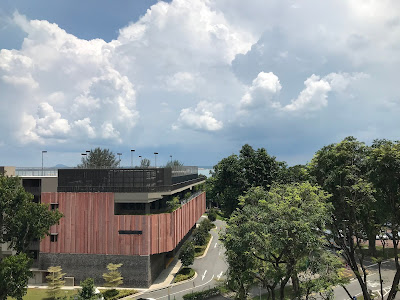
Upstairs garden. This was the view outside the first room that I occupied. I arrived at about 1am and was given a single room for 11 hours. After that I changed to a double room for the rest of the conference, I don't know why I couldn't have booked into the second room when I first arrived on Sunday morning, but oftimes when you travel you just have to go with what you get.

Below are more views from my first room.


More view. It's a lovely area. I wandered around here a bit yesterday as I looked for a cheap lunch option.
Gorgeous display that greets those of us who "live" on the third floor.
A street-level view of the local area. This is close to many vendors, but it delightfully thought out.
Lunch. I didn't sit at this table, but most tables have a quite the variety of nationalitities. People are mixing well.  Many people don't know a lot of others. Each meal has been a
buffet with a fair variety of food. We're certainly not starving: for food or conversation.
This is where we are located on the island. Quite close to the airport, but the plane noise hasn't been a big concern.


23 February, 2016

Two titbits from today

There are some gorgeous flowers in bloom here.
An international network
In an international mission like ours where not only do we come from many nationalities but we serve in many nations, you don't get to meet most members. When you do there is a fascinating way of establishing connection. There are three main establishing questions: "Where's your sending country? Where are you serving? How long?" Then comes the, "Do you know..."

This is where I am staying, the OMF Bangkok Guest Home.
For example, if I'm sitting with someone from Ireland who's serving in Taiwan, I'll ask whether they know Irish people I've known in Japan and Australians I know in Taiwan. The "how long" question gives some help with how far back you can go. 
It is an interesting exercise, actually and highlights how wide a network we have developed during our missionary career. I'm looking forward to visiting some of these people in their home countries when we are older.

I went for a walk with some Thai-based missionaries this evening and
we saw this chicken (or is it a rooster) strutting around on top of a
 truck with a cat respectfully watching (you can see its eyes).

A tricky question
Today we were asked this: 
What builds trust in your home culture?
I found this really hard. It made me realise how we really don't function often in our Australian culture any more. After some thinking I came up with some ideas:

  • Honesty
  • True blue/ integrity
  • Hospitality/socialising
  • Quality time
  • Paying out on others
Am I right? What would you "monocultural" Aussies add to this? 

This differs from how you build trust in Japan. Hospitality is definitely not a key factor, neither is honesty. Longevity and trying to fit in would be high on the list, however. 


21 February, 2016

Flying and writing

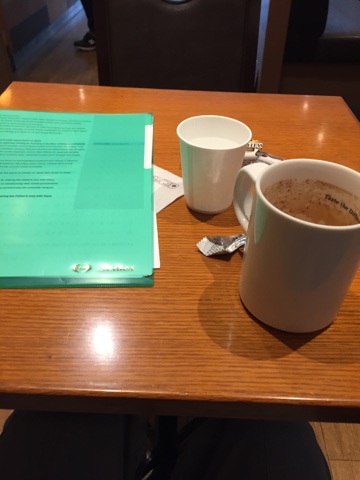
Coffee and editing at the airport
(with the ever present cup of water).
I'm in Bangkok at the OMF guest home and, though it is only 7.40pm here and 9.40 on my body clock, I feel as though my eyes are about to fall out of they sockets. It's been a long day of tiring travel. I don't know how people do 20+hrs on a plane; I'm not sure I could! My bottom was really tired of sitting by the end of my not quite six-hour flight (but I am a restless person).


In any case, I tried to pretend I was one of those travelling writers today! In a coffee shop at the airport I pulled out a couple of articles I'm editing, and then sometime in the middle of my flight I pulled out my computer and did some more editing as well as writing a blog post. Sounds pretty glamorous, doesn't it? Well it wasn't. It was just using what time I had to do things I needed to do (the editing, that is).

Here's what I wrote, it's a bit raw but I'm too tired to do much about that now.


Here’s something I’ve never done before: written a blog post . . . or really anything, while high in the sky over international waters. I’ve flown on many planes (we have counted, it’s more than 60, I think), but the vast majority of those have been with young children. I have only flown on my own internationally three times before. From Indonesia to Australia via Singapore as a 20 year-old and from Japan to Hong Kong and back in 2010.

Today I’m flying to Bangkok to do some training with our mission, training related to teams: participating and leading them. It is a small group, only 12, plus the trainers. I’m looking forward to meeting new people, learning more about leadership and teams, and growing. I have to admit I’m also looking forward to time away from parenting (don’t tell the boys) and a break from wearing my winter clothes, including long-johns!

After so much flying as a family, it is strange to fly alone. No one to look after my luggage while I use the ladies at the airport. No one to keep an eye on my valuables in the plane while I do the same thing. No one to talk to, or sit next to. No one to be entertained. No one to correct or help. No one to lean on when things don’t make sense or I don’t have enough information. It is both fun and a little intimidating and lonely.

On Thursday I met with my language exchange partners. They’re always interested to hear about my latest adventures. And it often seems that I have more "adventures" than they do. They asked, “How many countries have you been to?” I counted them up, “Only seven, all of them in Asia [except Australia which isn't really Asia]. If you count airport layovers it is nine.” Not that many, really. It looks like we have a very international lifestyle, but in truth most of our journeys have been between Japan and Australia.

The other countries were for a short term mission study trip (Indonesia), training (Hong Kong, Philippines, Singapore), and a conference (Thailand). No overseas holidays except for the two Japanese summers that we’ve flown back to Australia to visit family. Those were technically holidays, though we often felt more tired afterwards than we would have if we’d holidayed closer to home. Other than those we’ve never left the country we were living in at the time to go on a holiday. Since we’ve been married the only airplane we’ve caught for a holiday was our honeymoon.

I guess to most people we look well-travelled. Last year in Australia I got the same reaction from members of our home church. Compared to most of them, we travel a lot. But most of it is for work, not pleasure. Therefore it is in our budget, our work budget.

Other travel that’s looks beyond-usual to our friends has been our motorhome trip to the centre of Australia and our camping trip around the top of Japan. Our motorhome trip was by far the most expensive of holidays we’ve taken.

One of these days, after our boys have flown the coop, we’d love to take a holiday somewhere else. Maybe even get out of Asia. Our lives have intersected with many people from other countries, I’m sure we could find someone to go and visit!


But in general I haven’t found travel to be a relaxing occupation. I’d rather go somewhere fairly local (and I’m Australian used to driving country roads, so you know that that means within a few hours drive) and hang-out for a week or two with books and other relaxing things to do. I get overtired by the constant movement and noise involved in travel. I’m also not terribly adventurous with new food, which puts a damper on international travel.

And there it petered out. I got a start on another article for a magazine, but I'd really run out of steam by then. So I went back to watching episodes of Forever.

Now I've totally run out of steam and I'm heading to bed. Good night!

24 March, 2014

Addressing stereotyping

Last year I was assured by an Australian-Asian visiting Japan that you could easily tell which country an Asian is from. That isn't what I've heard from ethnically Asian missionaries here. I'm wondering if it is less easy to tell in Japan than in Australia? What's
Can you tell where these short-termers were from?
your experience? Can you usually tell what country an Asian-looking person is from?


It's easy to slip into stereotyping and labelling. We all like to be able to file people into boxes in our minds.

 Here's an interesting short article about a Japanese writer/artist who's husband was transferred to China. She received many "poor you, having to go to China" comments from friends. The news report is about how she set about addressing those negative stereotypes: http://ajw.asahi.com/article/behind_news/people/AJ201401200006


04 June, 2013

Unexpected cultural divide

Many years ago an older friend with three children, who had five siblings, some of whom were single, told us it was a challenge to cope with the differences between the single aunts and married siblings. The singles had more resources: time and money, to heap upon nieces and nephews than the married ones did.

Divide between multiple children families and single children families
This level of formality for the end of middle school
seems extreme to my Australian eyes. The next day
an elaborate lunch was organised after numerous long
meetings (in classic Japanese style, the numerous
meetings, that is).
Now I'm finding a similar divide, not in my own family (all our siblings are married and have children), but with fellow parents at school. There seems to be a larger number of one child families around and I find that difficult. Mostly because they have more resources to devote to that single child: time and money. I love my kids no less, but my time and energy has to be split between the three of them. And our budget too, accommodates three children, not just one.

This becomes especially noticeable at school events. We cannot be at everything all our kids do. Nor do we have the time to devote huge amounts of it to one child's celebratory event. I guess our laid-back Australian-mess comes out then too. We just don't do formal celebrations to quite the level that other nations seem to.

I'm a conscientious person and I find that I struggle with guilt on these occasions. I say, "No," to participating in or planning various events, but then suffer with guilt. Occasionally it all gets a bit much and, instead of thinking about things rationally, I start to get resentful about a situation and other people. Not right thinking, I know, but I do struggle with it.

Divide between Western and Asian cultures in celebrations
Last Friday and Saturday were classic examples. Despite CAJ being a largely American-style school, about 1/3 of the students are Japanese by nationality (and many others have American nationality, but have one Japanese parent), another good percentage (?17%) are Korean. Both Japanese and Korean people are big on ceremony. This strongly influences the school in many ways. We keep hearing from people who've been around here longer than we have about the changes that have seeped into the school over the years (I'm thinking especially about the ones that aren't Leadership Team directed).

So, we end up with large celebrations at the end of middle school. Something that doesn't happen in Australia or America (as far as I know). I had to pull myself into line on Saturday and realise that what we were seeing happen was significant to those from different cultural backgrounds than my own. Different, not wrong. And because it was significant to others, it was important to honour them.


So, I got a double dose of culture shock at the end of last week: from Asian families with only one child.

Culture shock doesn't end after those first couple years of life in another country. Sometimes it broadsides you later on too!

12 October, 2009

Australia is not Asia

Egged on by a reader after these two blog posts, I'll attempt to show you some ways in which Australia is not Asia. Emphasis on individual rights We've been surprised in Australia at how frequently we've received profuse apologies from various service providers when delays or incidents have impinged on our day. For example, when the doctor couldn't see us on time due to a previous patient's lengthy consultation or a librarian who wrestled with an unknown problem in checking out our books. The only explanation can be that there are a lot of consumers in Australia who are demanding their rights and are in a tremendous hurry. Japanese service providers do apologise in similar circumstances, but in contrast there is a lot more patience from consumers with delay. Less insistence in having their own way in a timely manner. Asians are certainly less vocal about their complaints. Road rage is also less of a problem in Asia. Relationships with one another Australians are very casual in this regard. I find myself calling my doctor by their first name. Many children are calling adults by their first names too. Aussies don't have much regard for status. Asians are much more status-aware. Conversations often begin with a lot of figuring out where you fit in relation with one another. Age, education, position are key points that change how you talk to another. No way would I call my doctor in Japan by anything but "sensei". Nor would I call anyone except very close friends anything but their surname. Japanese find it difficult to call me "Wendy". Education system East vs West is fairly clearly defined. West is focussed on understanding and processing material; "think for yourself" might be a motto of western education. Asians focus on being able to regurgitate the material. This is related to the high position that the teacher holds. Our of respect for the teacher, the students do not question what the teacher says. Switching school for our son in Japan emphasised this. Maths in the Japanese school focused on repetition hundreds of times. Maths in the western international school had a lot less repetition. The Asians who sent their kids to CAJ found this hard to grasp and accept. This is a key point that is probably disregarded when people say Australia is becoming Asian. Our education system is still very western. Immigrants will almost all put their kids into our schools and hence the second generation will be less Asian than their parents. Individualism vs group mentality Westerners value being individualism. "Do your own thing", "Don't be a door-mat" are two examples that demonstrate this. Asians are much more concerned with group harmony and not doing things that would disrupt this. They are also very concerned that people feel cared for and not left out. A good example of this is at Curves, the gym I use. Curves is international, but there are differences between the way an Australian Curves and a Japanese Curves look after their customers. In both countries you do a circuit of machines and recovery stations. In Japan you join onto the end of a line of people exercising and move around the machines as a group. In Australia you start the circuit wherever you want and usually Aussies try to keep a bit of a distance between each person. In Japan, if you are the only person exercising at that time there will always be a trainer with you, either exercising alongside you or talking to you. They feel it is too lonely to be doing it by yourself. I have done many circuits on my own in Australia, with very little attention from the trainer. Westerners often feel there are too many rules in Japan. We've found that many of the rules are in place so that everyone knows how to behave and is not embarrassed by doing something odd. The rules tell them how to conform to the group and that makes them comfortable (as much as it makes us uncomfortable). Privacy "An Englishman's home is his castle." Yes, in Australia too. Aussies need room to breathe. Children in a family very often have their own room. Coming back from Asia we are amazed at how big Australian homes are - and that people are usually planning to add more rooms. Many Asians live in heavily populated areas and their houses aren't big. They may never have the luxury of having space to call their own. Children in an average family probably will never have the opportunity to choose their own room's decor and have their own space. We had friends who had three children and lived in a two bedroom apartment. Their three children shared one room, the youngest sleeping in the spacious cupboard. But their place was quite western by comparison to many Japanese. Many families sleep with their children in the same bed/room until their kids are quite old (like middle primary age). I noticed another aspect of this in Manila. At the shopping centre we were followed around the shop by employees. The overwhelming feeling we had was, "Leave me alone, I'm Australian and need space." Asians, because of their lack of physical space find privacy within their own minds. No one can intrude there. Hence, the inscrutable Oriental. Directness Westerners are very direct in their approach. "What is the problem?" and "How do we fix it?" whereas Asians are more circular in their approach. I haven't gotten a handle on this one yet, to be honest! Well, there are just a few differences. Any comments? Disagreement? More examples? I know that others with more Asian experience read this blog - we'd welcome your input.

08 October, 2009

Is Australia Asian?

On Tuesday I wrote, "Australia is not Asia, no matter what how you try to twist it." A Sydney-ite queried me on this, wondering if I'm a Queenslander with my head stuck in the sand. Actually I am not. We do have significant populations of Africans and Asians living in our suburb. But seriously, I do stand by my statement. Yes, Australia is changing. I don't think there is a culture in the world that is not changing in this era of global communication, mass marketing and internationalisation. Many changes are superficial, however. A book called "One World, Two Minds" by Dennis Lane, a former missionary with OMF International, puts it this way:
An Asian "businessman may know all about economics and be thoroughly conversant with business management, yet underneath he still acts and reacts in an Asian way...We remain deeply influenced by our original culture." p5
Yes, the face of Australia is changing. It has been for a long time. There are micro-cultures within our country. There have been for a long time. This doesn't significantly change the basic fundamentals of our thinking. Our society is basically Western. Our systems and thinking come from Greek philosophy as well as our Christian heritage (not Australia's but British/European). Just because we have immigrants arriving from different parts of the world doesn't change an overall nation. Of course people have written books on this. For all I know people have probably based their PhDs on this. I haven't, and though I've lived in Asia for the last eight years, I cannot claim to be a sociologist. So feel free to challenge me. I'm open to debate, though I might not change my mind.