Showing posts with label conversation. Show all posts

23 April, 2025

The value of listening

The other day I got a message from someone in our organisation in Australia who I don't know. Her role is specifically about helping advise our members about their kids, as needed. We've never met. However, somehow she'd discovered this blog and had been reading bits of our story and wanted to know what we've learned along the way, especially in regards to neurodivergence and what help we'd received that she could pass on to others if she needed to.

A photo from a few years back when the
boys all lived with us in Japan.

I asked if she would be interested in hearing our story in detail. I explained that it would just be easier to tell her, because it's a long, complex story—which is pretty normal for neurodivergence, but I suspect ours is more complex because of the cross-cultural elements. It's a story that would take me hours, even as a fast writer, to get down. She agreed, and we talked for nearly two hours. Well, most of that talking was me! She asked some great questions, including some that I've never been asked before. But I think we were both exhausted at the end. 

I have been thinking about that conversation ever since. It was great to be really listened to (she was even taking notes). But it was hard to make sure I included all the bits and pieces. The story went back around 20–25 years and there were so many threads. In the days that followed that conversation, I kept thinking of more things that I could have added! But I think that in the end she got all (and probably much more) than she needed. It made me aware again of the various people God has given me along the way who have listened to me tell parts of our story, with all my struggles, questions, and tears. I'm so thankful. I'm thankful to all who have prayed for us, usually without much information, but just that we were struggling.

It's a huge blessing to be able to look back at all of that and see where our kids are now and that they're all okay. One of the hardest things about being a parent is not knowing the end of the story. Of course all parents have to make decisions without all the information that you feel you need (especially a comparison between the outcomes of two different decisions). Not knowing what long-term impact your decisions will have on your kid is difficult, but when your children aren't thriving or "fitting the norm" it's even harder. One of the extra hard things about being a missionary parent is not having many people around you whose situation is similar to yours and few who understand the nuances of your situation. It can be quite a lonely and difficult place to do parenting and make hard decisions.

So, what's the point of me sharing this? I think, to shed light on the difficulty of being a parent of a kid with neurodivergence and that it is even harder when one is living a missionary life. But most especially to note that the most valuable thing you might be able to do for such a parent is to listen to them. You might not be able to provide any solutions, or point a parent to a place where they can get help, or help them make an important decision, but if they feel heard then that is a help. Parenting kids who have difficulties is a lonely job, it's hard for others to understand the daily challenges you face. If someone is willing to stop and listen to you talk about those challenges, it's a huge encouragement.

07 December, 2023

Emotions and conversations

We have reached an interesting point in our careers. A point where people saying, "Wow, 23 years is a long time to serve." But there are also younger people asking questions about their own direction in life, and asking about our own journey. Especially people who don't feel called to so called "front-line ministry", for example, church planting and evangelism, but called to the sorts of work we do: support ministry (behind the scenes helping missionaries to continue to do the work they've been called to do).

And a photo of a tree, because we all need
more trees!

I've written on this topic a few times over the years, one that stands out was about four years ago (here) and expressed a fair bit of frustration on how difficult it seemed to communicate to Australians about the importance of the work we do. That mission work involves a lot more than just church planting and evangelism. 

However, it feels like maybe we're making better progress this year. One way we're doing that is by using boxes, of all things! It's become a standard part of most of our up-front presentations. We get the audience involved and show them a little dramatically some of the other things missionaries have to do aside from their stated "ministry", and then show them how overwhelming that can be and how people like ourselves can work as a team to help carry the load. I explained this activity (with photos) towards the end of this blog post five years ago. This single presentation has produced more conversations than most of the stories we've told.

I've had coffee on two occasions in the last week with people who wanted to know more about my story: about working in communications and also about how missions do member care. Both of these conversations were so encouraging to me. I shouldn't be amazed that God's been working through the struggles I've had to help other people (he said he would 2 Corinthians 1:4). In fact neither of these conversations would have taken place if God hadn't given me the boldness to stand up in front of strangers and admit that something in my missionary career had been (or continues to be) hard.

. . . 

I now wish that I'd pressed "Publish" on Tuesday when I wrote this. But now it's Thursday and I've had another lengthy conversation that was quite different to the first two I mentioned. Today I'm feeling far more anxious than I had been recently. The conversation was one of those, "Please explain the situation of your kids, we wish we could provide them with accommodation but we can't, what can we do except pray?" kinds of conversations that we've had many of in the last several months.

I haven't written too much about the situation with our boys, partly to protect their privacy. What's been going on with them has been the unwritten part of the story in what I've written here recently (e.g., struggling to trusting God). My summary is: there's a housing crisis in Australia at present and finding places to rent is hard. Both our younger sons need to find somewhere to live apart from us in order for us to go back to Japan in July. One of our sons will be studying at the University of Queensland and the other hopefully will be working. The latter was the subject of this blog post last year about mental illness and neurodiversity. He's had a rough run, and as his parents we've also been doing it tough at times. Getting these guys settled somewhere else is a key focus of this home assignment, but it's a difficult one. And one that we don't know the end of yet, and it's hard to wait, wondering.

But this is a rather large diversion from how I started this: encouraged by conversations. But that's life, isn't it? One interaction can be an encouragement and another quite the opposite. We're no superheroes here! Please pray for us!

29 September, 2023

Resident missionaries at a high school camp

A few day ago we came home from another camp. We spent four days in Samford Valley, just north-west of Brisbane. This one was a high school camp comprising mostly of youth groups from Presbyterian churches in north Brisbane. There were more than 70 campers. It was a fun camp where we were the official missionaries-in-residence. 

We got to run three 1.5 hour sessions over three days. The first one was for everyone, the other two were electives. 

We got to do our classic: divide the group into four and rotate between four different activities. My job during the rotations was to teach them how to fold an origami balloon: which was pretty challenging when you realise I had just 10 minutes and over 20 people in each group. David taught groups the Japanese words to go with Rock, Paper, Scissors game and one of the four groups learned how to play the "Jan-Ken-Poi train game". We had another missionary who came along to help, ran a chopsticks relay, and they were on their own with instructions on how to run a Japanese slipper relay.

With such generous amounts of time, we got to share quite a lot of stories, especially the story of how we came to be missionaries in the first place, one that originates back in the late 70s. And we spent time on our central theme: missionaries work in teams (at least those in our organisation do). We don't all spend all our time doing church and evangelistic ministry, but we help one another with lots of practical tasks that people don't often think about that are necessary for ministry overseas.

The hidden value of a camp is that you get to talk to people at all sorts of other times too. For example, over a bowl of cornflakes I got to answer the question: So what's helped you stay in Japan for so long? While eating sticky date pudding and ice cream I got cornered by a bunch of older teenage boys who wanted to know about street evangelism in Japan. So many questions: What food do you miss when you're in Japan, and when you're in Australia? How did you meet? Do you enjoy being a missionary? What's your favourite ice cream in Japan? Which convenience store has the best fried chicken (obviously from someone who's spent time there)?

But all this interaction is exhausting. I didn't get to join in all the fun activities because I was so tired, especially at the start of camp (strangely...I think partly due to sleeping badly the first night). We left after dinner on Wednesday night, the day before the camp ended. Yesterday I was fairly blotto. David came and helped me do grocery shopping (on his birthday). Today I'm feeling better, but I'm thankful we have a quiet weekend in front of us, and several days before we're speaking again (next Thursday).

Bush!
The other fascinating aspect of camp for me was that, while we didn't know many people, we had common connections with quite a few. Though we are no longer members of the Presbyterian Church of Queensland (the denomination running the camp), during the first 21 years of my life I went to two of the biggest Presbyterian churches in Queensland. There were a number of other common connections as well, mostly from our university and young adult years.

This camp was not under canvas, but rather we were in cabins. It was in a part of Queensland that we've never been before, a gorgeous large scout-owned site! I'm so glad we went. Most people start to consider mission as something they can get involved in when they are young. Having the opportunity to talk seriously to high schoolers about mission was an incredibly valuable opportunity. Surely more valuable than them just seeing us speak one-time for less than 10 minutes at the front of their church. Only God knows what the long-term effects of our time with these campers and adults will be. 


Campfires every night, with marshmallows on sticks. No s'mores.

This was a fairly central quiet corner of camp: the verandah on the side of 
the main meeting area. I retreated here a couple of times when my voice
and ears were tired!

In case you've never seen one: a paper origami balloon. At least one person 
began this activity saying, "No way, that doesn't even seem possible."

I didn't get the timing right for a full-on sunset, but this was close on the first night.

24 October, 2022

Little exchanges add up to a lot

Have you ever thought about the little exchanges that make up the bulk of connection with others? Our lives aren’t generally full of D&Ms (deep and meaningful conversations). Though often I long for that deep connection with people, there is, actually, a limit on how much of that I can handle in any one day.

On Friday the school held the biggest school-community event it’s had in three years. It’s a descendent of the ginormous garage sale known as Thrift Shop. I’ve blogged about that event many times over the last 12 years (see some of those posts here). Now it is called the Fall Festival and Bazaar. The “bazaar” side of things is a scaled-down version of Thrift Shop, designed to cost less in terms of time-commitment for staff and volunteers. It also includes something new: a place where individuals or groups can rent a table to peddle their own wares. Because, of the last three years, we've been saving up stuff we want to get rid of (that isn't rubbish), we decided to rent a table.

Our table as it looked at the start of the day.
There were a few great things about having our own table: 

  • I had a place to "be" all day. I didn't feel like I was loitering or wasting time. It was also a starting place for conversations that weren't uncomfortable, a here-and-present kind of thing that helped me stay away from topics that aren't so easy to talk about in a light way.
  • We had a bucket of "free stuff" that the younger kids loved. It's such fun giving things away.
  • I got to make and sell fudge (but I was disappointed with the packaging we managed, which made the fudge look decidedly dodgy).
  • We did actually get rid of a fair bit of stuff to places that it will be used (rather than just sent to the rubbish). We were able to give two boxes of stuff to the Salvation Army who came at the end for stuff that hadn't been sold.

I went into Friday expecting lots of more conversations, and came away feeling a little dissatisfied with how insubstantial most of the exchanges were. But, as I've seen as I reflected over the weekend is that on Thursday and Friday I was part of the gentle web of connection that has begun forming again in the community that centres around the school. Looking back, I had short conversations about all the following things:

A future camping trip

Why I had a nearly 100-year-old hymn book for sale (yes, I sold it)

A recent 500 pound, 8-foot bear attack in the US (yes, there was)

How much my youngest son has grown and changed

How to say “poached egg” in Japanese (no, I can't remember now)

How to use a baccarat espresso maker

What Thrift Shop used to look like (for someone new in the community)

Where Kuranda is (inland from Cairns)

How much CAJ pays substitute teachers

The difference between chocolate and fudge (yes, we were confused by the question)

What it was like growing up a few blocks from the US on the Canadian side of the border and how I’ve never lived in a country that has international land borders (only sea borders, hence “going overseas” is synonymous with going to another country). 

Shopping habits: I prefer to be left alone to consider the option and very much dislike shopkeepers in my face.

How exhausting parenting is emotionally, and how ready I am to be moving on out of being the parent of a school-aged child (7 ½ months…but I’m not counting :D).

Fudge and how we’ve given this to our boys’ teachers for years. This is the last year that will happen.

How I got rejected by the blood bank on Friday at the school because my haemoglobin was a little bit low.

Plans for the next couple of years (moving out, home assignment from July 2023, moving back to Japan).

The big gaps that the pandemic has left us with in community: those whose kids started at the school during the pandemic don’t know the parents of their kids’ friends. I don’t know the faces of a bunch of new teachers (and their kids). That's something that rarely happened before the pandemic, due to staff-family gatherings that have usually been held through the year.

I met a lady who works for the same organisation that publishes the magazine. I’ve only really interacted with her over email, though perhaps we’ve met once, I can’t remember.

I got some hugs and got to see some people I haven’t seen in months or years.

And a thank you for my recent blog posts from someone who says she reads everything I write!

I'll stop there. When you add all that up, that's a lot of networking. And the sorts of stuff that doesn’t happen when you aren’t face-to-face with people. I was exhausted on Friday night (and Saturday). But also thankful. 

19 August, 2022

How are you? How do you even answer that?

How are you? Is a difficult question. It often requires one to either gloss over anything that isn't a brief "fine". If one goes beyond that, you have to be careful about "reading the air": is this person going to have the time to hear the whole story, do they even want to know? Or is this just a greeting, not unlike "Hello"? The postman asked me this after lunch, that was an easy one. The guy who sold me the RAT test that several minutes later came back positive, also asked me how I was! 

An array of brightly coloured cut
flowers at a local supermarket
that I enjoyed when I wasn't
feeling up to doing much more
than a bit of grocery shopping.

I'm no longer in quarantine, and more than two weeks past my "positive test day". But I'm not 100% back to my usual level of energy yet. Chronic asthma means my lungs take some time to recover from respiratory illnesses, but this virus has sapped my energy in ways that have surprised me. 

At its height, the illness felt very much like a miserable cold, but the lingering fatigue is different. Twice this week I met friends for coffee or a meal and I lasted about two hours before I was struggling to breath. Sunday, Monday, and Tuesday were busy days with multiple excursions outside the house (appointments with or without my son, church, lunch/coffee) plus people at home to socialise with. These left me shaky and out of breath, or even feeling mild heart palpitations or discomfort in my throat. It's been challenging to balance all I want to or feel I need to do, with the energy I have available. It definitely reminds me of the "spoon theory" and gives me an extra appreciation for the daily struggle that people with chronic diseases or disabilities that sap their energy deal with.

It's now less than two weeks before we have tickets on a flight that will take my son and I back to Japan. This coming Sunday we make our second-last change of accommodation for this trip. We're splitting up. I'm going to stay with a friend and her family and our son will be trying out life in a share house with his brother and some other young guys. It's an experiment that we hope will help be a stepping stone towards independence for him.

Meanwhile, I'm continuing to work as I can on my varied responsibilities in Japan: I'm working on two issues of the Japan Harvest magazine as well as leading the social media team for OMF Japan. 

I'm thankful that I'm able to start most days with a video call with David, the time difference isn't a problem. We're starting each day with Bible reading and prayer, which is normal for us, so is helping to keep me balanced and to catch up quickly daily is also really helpful. He's back at work now and our youngest starts Yr 12 on Tuesday.

It's been good to have time to touch base with a few people in the last week or so and give them a longer answer to "How are you?". But also to be able to reassure them that we're planning to be back in Queensland this time next year, except then we'll be settled here for at least a year and be freed up to catch up with a lot of people. By the way, this coming year is going to be a big one: last year of having a child at school, packing up our home of 13 years, handing over our Japan ministry responsibilities, and settling into life and ministry in our fifth home assignment! 

But I'll be grateful to have August over and be back together with David in Tokyo soon. The prospect of that trip back to Japan is not appealing, it's one of those things that will be better to be in the past instead of the future. I simply can't believe Australians are busting to get back into international travel again, for fun! It really isn't that fun right now. 

However, I have enjoyed the freedom of going out without a mask on, and talking to people without that barrier. Yes, I probably got COVID because of that, but I also may have gotten it anyway. I see the importance of the strategy of masks, but that doesn't mean that I'm really comfortable with wearing one.

Summarising all the above as an answer to "How are you?" is pretty hard...but perhaps the short answer is "I'm doing okay." I'm breathing, my heart is beating, I'm loved, I've got food and a roof over my head. And most of all, I have hope. I was reminded of this encouraging passage again at church last Sunday:

But this I call to mind,

    and therefore I have hope:

The steadfast love of the Lord never ceases;

    his mercies never come to an end;

 they are new every morning;

    great is your faithfulness.

“The Lord is my portion,” says my soul,

    “therefore I will hope in him.”

 The Lord is good to those who wait for him,

    to the soul who seeks him.

 It is good that one should wait quietly

    for the salvation of the Lord. (Lamentations 3:21–26 ESV)

21 July, 2022

Food, awkward conversations, and trust

I've had time to think about a lot of things. Here are some of them:

Providing food for an itinerant family (on a budget)

As I explained in my last post, we've been travelling around Queensland in the last month, sometimes with our own kitchen and sometimes with family (and the presumption that they will organise meals). Planning and grocery shopping has moved to a slightly higher challenge level. I've mostly stuck with the simple options, but trying to keep things healthy means not every night can be pies, pizza, or sausage rolls. Not to mention that I just get bored too easily. 

But cooking dinners without a pantry means you're often missing those important extras like salt, vinegar, or flour—the things I think of as staples, that you buy once every few months, but not for a flying visit of a few weeks. And as one who is not only on a budget but is averse to waste, it's not easy to come up with good meals for hungry young men (not to mention David and me).

Here are some of the evening meals I've ended up making:

  • sausages and veggies
  • chicken wraps
  • bacon, eggs, and damper (like soda bread, it's quick wheat bread made with baking soda as a rising agent, not yeast)
  • dry rub (garlic flavour) on chicken drumsticks, with rice and veggies
  • BBQ (beef patties on bread rolls)
  • Japanese curry (roux bought in shops)
  • roast lamb
It's a mix of things that we enjoy about Australian food, plus some comfort food we're familiar with from home in Japan. It's worked fairly well, though I'm also dealing with the unfamiliar electric stove/hob. In Japan we use gas, and it's a quite a mental shift to go to electric again. Gas is just so fast! The stove top at our current abode is also complicated—I needed to pull out the instruction manual a couple of times! Plus, adjustments are needed due to the different types of equipment in a kitchen that's not my own, for example, where we are right now has a rice cooker (yay!) but no "rice" cup (180ml). Also there's no potato masher or big-sized tongs.

We're only in our own place until the end of this month. Then David and our youngest son go back to Japan. I'm here with our middle son for another six or so weeks, during which we'll be living with other people. That's going to provide different challenges, too, I'm sure. But at least they'll have a pantry with staples in it.

Spotting a missionary out of their “natural” habitat 

Have you ever spotted a missionary out of their "natural" habitat? We expect that missionaries are either in their country of service, doing what ever they do. Or if they are in their passport country, they will be doing home assignment. As we've met people during these last few weeks in Australia, we've answered questions that made us realise that our presence here is a surprise, or even a tad unsettling. We're not in Japan and nor are we doing deputation. "Here to see family" seems an acceptable answer, but "on holidays" is a bit strange, especially when we're in Brisbane (which isn't really a standard holiday destination). However, if someone is willing to stick around and ask good questions, I get to explain a little about the challenges we're facing in transitioning our middle son from high school in Japan to adult life in Australia and that this is one way that we're trying to help navigate that gap. 

I anticipate it's going to get more difficult to explain in August. Then I will be back at work, but will still be in Brisbane. I work from my home office in Tokyo, and will be doing the same here in Brisbane for a few weeks. That's definitely going to be a bit tricky to explain.

But I'm not the only missionary with our organisation working in Australia. Did you know that we have quite a lot of people who work here? Their work helps us stay in Japan, but also they help recruit others to join us. I imagine they often face this challenge in explaining their roles. I know that they struggle to find sufficient financial support (yes, they are supported by gifts from others, just like we are).

Trusting God

I'm also thinking about this. We've been given the gift of time away from work, but it's been harder to "be still" in the midst of that than I might have guessed. Being still and not being consumed with lots of to-dos means there's more time to think. And of course with that comes the thoughts about "bad things that could happen", especially surrounding our upcoming flights back to Japan. I woke up yesterday morning with that all running around in my head and it took a while to shake it off.

One tempting way to avoid getting stuck in that bad place is to fill up my schedule with lot of other things to entertain or distract. 

Another way is to focus on God's character and his all sufficiency. We're so tempted to rely on our own strength: "you've got this" is the classic. In reality we're very fragile and easily knocked over. There's so much that we simply don't have ultimately control over. Even if it looks like we do, things happen that show that that isn't truly the case.

I was reminded of Isaiah 40 yesterday, but also Job 38–42. Both passages remind us of how mighty God is, and how relatively small we are in comparison. Job said: 

“I know that you can do all things; no purpose of yours can be thwarted" (42:2 NIV).

Paul wrote that the Lord said to him: “'My grace is sufficient for you, for my power is made perfect in weakness.' Therefore I will boast all the more gladly about my weaknesses, so that Christ’s power may rest on me" (2 Corinthians 12:9 NIV).

And: "Not that we are sufficient in ourselves to claim anything as coming from us, but our sufficiency is from God" (2 Cor. 3:5 ESV).

And Jeremiah prayed: "Ah, Lord God! It is you who have made the heavens and the earth by your great power and by your outstretched arm! Nothing is too hard for you" (Jer. 32:17 ESV). God responded, "Behold, I am the Lord, the God of all flesh. Is anything too hard for me?" (vs 27).

The Psalmist wrote: "Why are you cast down, O my soul and why are you in turmoil within me? Hope in God; for I shall again praise him, my salvation and my God" (Ps. 42:11 ESV).

And these things are what I should be directing my thoughts to when I start dwelling on what could go wrong!

(Check out this article for more about El Shaddai, the all sufficient God.)

Meet David and Wendy

I've been thinking about this too, and our rough plan at this point is to take a picnic lunch to Rocks Riverside Park in Brisbane on Saturday 30th July, probably from around 11.30. If you're local and would like to join us, please do. To help locate us, I'll plan to wear my bright red jumper. We don't have any chairs, so we'll try to find a table somewhere.

01 February, 2019

A grumble and a joy

I'm frustrated and discouraged this afternoon. Being a mum is a hard slog. Being a mum of teenagers is not for the fainthearted. 

I've been trying to help one boy sort out what he's thinking, help him make a decision, but feel like I've failed this afternoon and now he's not talking to me at all. 

For several days another boy has been struggling with time management both before and after school, so I feel like each of the last few days have been on repeat: do the same stupid stuff and get the same bad result. But nothing I've done so far has made much difference, except resulted in conflict. So there hasn't been much joy with them.

I'm glad that I've got other stuff on my plate, so that I can feel like I'm competant at something! Mind you, they still like my cooking, so at least I can feel that I'm getting that right.


Sorry for downloading my complaints on you. 

I'll move on now!

This afternoon I ran into a Japanese colleague who welcomed me "home" with a hug. It was both unexpected and joyful. I do feel "home" and greetings like that only reinforce it.

Did you know that the place we've called home in Japan, Higashikurume city, is home to one of the top 100 views of Japan? I was there at a bad time of day this afternoon, with a little phone camera, but there are some spectacular views that can be seen from just outside our local train station, especially at sunset in winter.
Can you spy Mt Fuji at the end of this corridor of
 buildings in central Higashikurume?

30 January, 2019

Tips for getting started in conversation

Last night I was procrastinating about leaving our warm lounge room and going to bed when I stumbled upon this great article about tips for making small talk. I'm not bad at small talk, though I don't enjoy doing it for lengthy periods. But there are several members of my family who find conversation just a bit harder at times! 


The article had two easy-to-remember tips for starting (or at least not abruptly finishing) a conversation. I reckon I'll have to tell the guys about these tips.

1. Triangulation rule 
"There’s the “triangulation” approach to small talk (named by Kio Stark, author of When Strangers Meet). This method involves three points: you, your partner, and the observable thing in front of you—in other words, your common ground."
So you work at finding common ground and often the easiest is related to where you physically are right then, or things that you're both experiencing. That's why weather is a big feature of small talk, it's neutral ground that everyone in a physical place has in common.

But the idea of the three points, is that you can work at finding out things about the other person that the two of you have in common. That is why people will ask about where you come from, what you do for a job, where you've lived, etc. 

I always think that asking someone questions about them is a safe option for small talk. People are usually happy to talk about themselves and if you're feeling a bit uneasy or unwilling to share about yourself, asking about someone else takes the focus and pressure off you.

2. The improvisation rule of "yes, and..." 

I hadn't heard this one before, but it makes sense. The idea is that you accept the premise that's given to you, and add to it without hesitation.

For example:
“If we’re improvising and I say, ‘Freeze, I have a gun,’ and you say, ‘That’s not a gun. It’s your finger. You’re pointing your finger at me,’ our improvised scene has ground to a halt. But if I say, ‘Freeze, I have a gun!’ and you say, ‘The gun I gave you for Christmas! . . . ’ then we have started a scene because we have AGREED that my finger is in fact a Christmas gun.” 
So in a conversation that might look like:
"Wow, it's freezing today."
You reply, "Yeah, I had so much trouble getting out of bed today."
And the conversation can move on from there. Adding a question in gets you bonus points as you throw the conversational ball back to the other person.

The "wrong" immediate reply is "I used to live in Sapporo, it gets way colder there, this is nothing." That reply will probably result in an awkward silence. I struggled with this rule in Australia at times, especially if I was tired or sick of small talk. And yes, when my experience of the world is so different to the person I was talking to. For example, if someone in Brisbane said the "it's freezing" comment, I might have struggled to answer that when the temperature was a balmy 18˚C!

And finally:

Don't be afraid to talk about yourself, even if it is about something that seems mundane. For example, about a book you've recently read, or a movie you've seen. Or perhaps something interesting you saw or experienced as you went about your day.

What tips would you give for working on your small talk?


16 August, 2018

Challenging encounters

Coming back into Australia often feels like a cross cultural encounter. Beyond the obvious cultural differences, it's the deeper stuff that is more challenging, especially because others don't usually expect that we have a different perspective on things because we look and sound (mostly) Australian. 
These trees on my parents block remind me it's been a
long time since I grew up here. As a young adult on holidays
from uni I used to mow around these two
big trees—they were saplings.

This is a strange cross-cultural challenge, though, because some things remain the same others change. New ones appear and old things get an unexpected twist on them. Each time we come back for an extended period we tiptoe around a bit, trying to figure out what's changed. We try to spend time asking questions and listening. Sometimes that's hard because some people want to hear all about what we've been doing, but every now and then we can get people to talk about what's going on in Australia and get a feel for the lay of the land.

Topical hotspots
We've discovered that Australia has a number of topical hotspots at present. At the risk of opening some pandora boxes, they include:
  • Plastic bags
  • Gender
  • Gay marriage
  • Drought and farmer assistance (Australia's in the midst of a significant drought and metro areas have just realised, resulting in a lot of "save the farmers" type campaigns and includes blame casting.)
  • Abortion (which is situated in a different political/religious climate to the US, it is nowhere near the political hotspot here as it is there)
  • Refugees (this has been around longer)
  • Anti-vax (which has also been around longer, but has had a financial impact on us as it's now a requirement by the government for our kids to have certain vaccinations that are hard or impossible to get in Japan, if they don't we lose out on some financial benefits that could be ours as low-income earners)
There are more, including a bunch of political issues. I'm also sure that I'm not keen to try to figure it all out. Not because I'm an irresponsible citizen, but I have to acknowledge that we have our limits and dealing with all that we have on our plates at present is plenty. It's also usually enough to seek to weather the conversations our own situation dredges up. 

Here are some real examples from recent weeks:

Japan and cars
Yesterday someone taking our money at the gym wanted to know if we wanted membership and we declined citing that we were moving at the end of the year. "Where to?" he asked.
We sighed, we'd been trying to avoid this.
"Japan"
"Oh cool...they have great cars there."
I have to say I've never had a conversation about the great cars of Japan . . . it's surely not my area of strength. But we heard plenty from him . . . before we finally got to go and work out.

Japan and bikes
When I came back in February and accompanied my son as he bought a bike for commuting to uni, we had a conversation about bikes with one of the staff. He was fascinated with hearing our experiences of using bikes in Japan. His knowledge had been much more of a serious cyclist, but we gave him an insight into daily life with bikes as a "commoner".

"Oh, you've lived in Japan . . . I've been to... (read here an unrecognisable name) what an amazing place!"
This is a more common conversation with a stranger when they discover where we spend most our time. The place name we often have to strain to recognise because we really don't have the Australian accent on Japanese words down pat yet. Japanese has only five vowel sounds and typically Australian mangle these, making many words very difficult to recognise without context. Needless to say, we try to go with the flow on a conversation that starts like this. Usually they aren't too hard to make it through, although if we stay at this point in a conversation too long I'll be cringing inside because I know that people have only seen the surface of Japan: the beautiful front that this nation puts up for visitors.

"Japs"
Believe it or not, I had a conversation with a very earnest young Christian man the other day who used this word as casually and neutrally as he might say "postie" (or postman for non-Aussie readers). I was shocked as I'd consider this an insult, but thankfully he moved on quickly.

Language changes
This relates to words we don't use in our family, words we consider crass or dishonouring to God. Some of these words have made it into polite conversation while we were gone. Our kids brace themselves at school because the language there is often cruder than they are used to hearing.

Odd conversations
There's the odd conversation that leaves me speechless. Something, if you've ever met me after breakfast, will find hard to believe. I can usually dredge up something!

I'm still staggered by an awkward conversation I had with a community nurse a few weeks back. As part of our routine medicals we have to have fasting blood tests. These I hate. A breakfast meeting is not something I volunteer for because I really can't make decisions before I eat (hence I eat pretty much the same thing for breakfast every day) and good conversation is really not  on the cards.

It all started off badly when the nurse asked, "So how are you this morning?"

I responded with an attempt of realistic humour: "I've not had breakfast or coffee yet..." 

She had no response to that at all. We fenced back and forth without finding any traction at all, on any topic. Towards the end of our encounter I tried again:

"It's a bit cloudy today."

She grabbed hold with both hands on this one and went, in almost one breath, from, 
"I wonder if it will rain." 
to
"The Chinese are going to take over our country because the farmers are selling out."

Quickly followed by, "What's your opinion?"

I was speechless. 

In my fragile, pre-breakfast state I was not about to step on this landmine. (Did I have an opinion?). I had the presence of mind to just mumble, "It's a complicated issue." And escape as fast as I could to get some food and coffee.

Conversations is what we mostly do
Conversations are the mainstay of what we do here. You might think it is up-front meetings, but that's just the most visible bits. But in fact, if you add up how much time we spend standing up in front of a large group vs one-on-one conversations with people you'll find the ratio is very much in favour of the latter. In the last six weeks we've spent less than 45 minutes in front of a congregation at worship services on Sunday mornings. We've already spent many hours talking to people—about mission, Japan, and our lives—before and after such events, as well as over coffee or meals or other occasions.

But obviously, from what I've written above, conversations that aren't even missions-related, conversations that are just part of our everyday interactions with the society around us can be treacherous. 

Do pray that we'd be wise. That we'd gain something of an understanding about this land that used to be so familiar to us, but has changed, and continues to change. Pray for our boys too. Australia is even more foreign to them. They've not grown up here and, at times, aren't sure how Aussie they are at all as they observe everyone around them.

01 April, 2018

Ugly is okay?

There were two Australians and an American at a missionary conference in Japan. The American had been in Japan many less years than either Australian.


In a casual conversation, one Australian mentioned their son in passing, using the word "ugly" as a descriptor.

The North American was shocked and said so.

The other Australian pointed out that the comment was a beautiful example of contextualisation: that a Japanese person would naturally say such a thing about their child.

There was a pause in conversation as they considered that.
_______________

Of course the Australian was, perhaps, not being as Japanese in their comment as their colleague suggested (although after a lengthy period of living in this country, the ways of this country do rub off on you). For in Australia such a comment is just a bit of lighthearted tomfoolery. In Japan, a parent might say something like this out of humility. And, well, for an American, it was all rather a shock.

It's easy make assumptions or mistakes when you're dealing with multiple cultures, even between native English speakers.

Please don't assume you know who is who in this scenario!

31 March, 2018

Hokkaido conference is a wrap

We returned at 11pm on Thursday night from the conference in Hokkaido. It was a tiring journey after a tiring week. Thankfully the flight was quiet (benefit of travelling with older kids) and I felt refreshed and able to manage the two hour journey on the trains home (it took five of them, to travel 30km!).
The hotel we stayed in continues to be a curiosity (it's our third visit there). It features:
  • a waterpark in the basement (including a small wave pool, a current pool, several mild water slides, a pool full of watermelon-beach balls, etc.
  • two floors with hot springs.
  • a ginormous buffet that we ate at twice a day (it has enormous floor to ceiling windows)
  • an eclectic interior design and "artefacts"
  • lots of full-length mirrors
I've included some photos for your interest. (Here's more of the decor, photos I took last time.)

One of the many full-length mirrors. There were at least a dozen on every floor around
the elevator enclave. Then there were a bunch of enormous ones in the dining room too,
as well as random ones like this, in the hallways.

Enormous dining room with enormous windows to match. This place was crowded every
mealtime. Though it was huge, there were lines to negotiate to get to the buffets.

The teenagers, some of them anyway. There were about ten families with teenagers (many more
with younger children). Though a smallish group, several nationalities, and at least three
languages, they seemed to have a wonderful time together. Yes, it was still a bit chilly
outside (that's snow), but delightful inside!
On the way back to the airport on the bus, I was on the right side for taking a photo of this large lake.
It's a cauldron lake and has three volcanos around the edges.

After two sleep-ins in the last two days, I'm beginning to feel a little less weary. I think I'm going to have to keep a close eye on my energy in these next three months, I'm running a bit close to the edge. I drank a lot more coffee than I usually drink, just to make it through conference, even coffee for dinner on the last night, but still fell asleep at 11! Almost unheard of for me.

I do enjoy these gatherings, but now I'm home and realised I would have loved more time to talk more in depth to more people. Though it means more travel, I'm looking forward to going up to Hokkaido again next month for a week-long training event. It's at those events that you get the time to talk more in-depth to people.

I sat next to David on the way to the airport and we talked about maybe going camping in Hokkaido again . . . probably after all the boys have left home. It's a beautiful place, though with an extreme winter, it's not an easy place to live.


16 August, 2017

Wednesday Words

I've been having fun since early May by putting up a once-a-week Facebook status I've called Wednesday Words. 

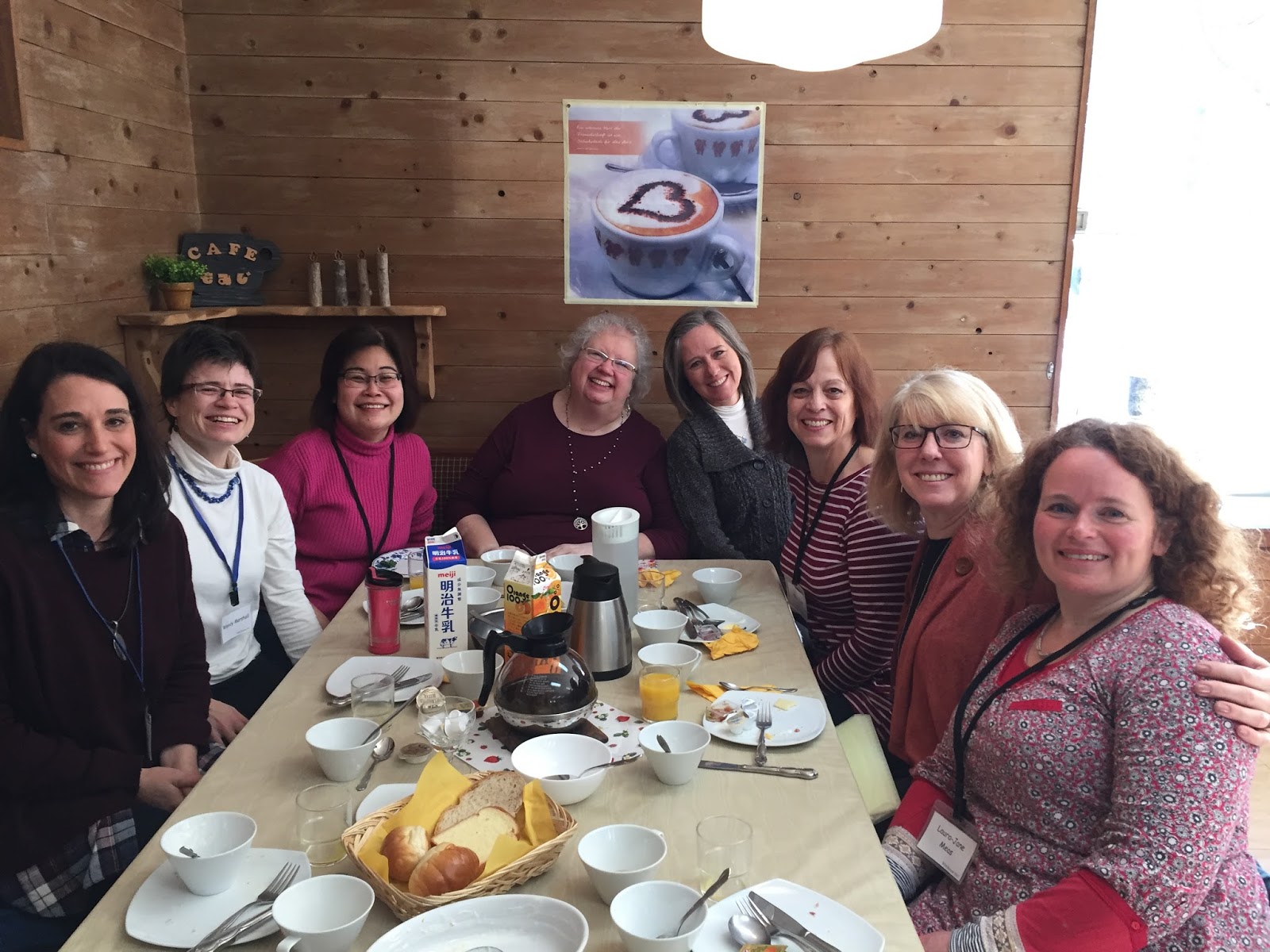
This photo was taken at the women's retreat I went to in
March. It's an illustration of the international environment
I work in. Here we have people from Germany, Singapore,
Ireland, US, Canada, and Australia. And I'm pretty sure at
least one of these ladies wasn't born in the country that they
are a citizen of. Two of them are also married to men from
other countries (Japan and Cambodia).
Under that title, I've been asking people to comment with words from their English background, specifying a certain category each week. I started out quite broad, with topics like food, clothes, nouns, verbs, and prepositions. But recently have gotten more specific like real estate words, abbreviations, occupations. I've had a great time doing it and regularly get upwards of 70 comments on a post.

It's been great to have a safe place to exchange these without exchanging blows.

Here are just a few things I've learned:

  • snow peas (Aust) = Mange tout (UK)
  • My team is winning (US) = My team are winning (Commonwealth)
  • Clean your teeth twice a day (Commonwealth) = Brush your teeth twice a day (US)
  • He's in hospital (Commonwealth) = He's in the hospital (US) [Though this is a bit complex, I might say the latter if there were only one hospital.]
  • Crossing guard (US) = Lollypop lady (Commonwealth) = Scholar Patrol (South Africa)
  • Hospitalist (US for a doctor who specialises in the care of patients in hospital)
  • General Practitioner or GP (Commonwealth) = Primary Care Physician or PCP (US)
  • Professor (Australia) = Department Chair (US). [This one is also a bit complicated, in Australia a professor is a higher title than in the US.]
  • I'm free on Wednesday (Commonwealth) = I'm free Wednesday (US)
  • Meeting one-on-one (US/Aust) = Meeting on-to-one (British)
  • Outwith (Scottish?) = Outside of (every other form of English?)
  • Take a shower (US) = Have a shower (Australian)
  • I'm working 9 while 5 (Northern UK) = I'm working 9 till 5 or 9 to 5 (other English)
  • One step on (Commonwealth) = One step beyond (US)
There's quite a lot there, and some I'm still not that clear on. Many of the things that come up in these discussions I'm familiar with, but it's great to learn more of the subtle variations. I've also got friends from the UK and Northern Ireland who bring up a whole variety of very regional-specific vocabulary and usage points.

This is a good learning opportunity for me, as I regularly edit the written work of people from a variety of English backgrounds. Our editing policy is that we try to edit to the English background that the author comes from. So, for example, an Australian would not have to change their spelling to US spelling. However, we do try to use vocabulary that the majority of our international audience will know, so we don't allow a word such as "sparkie" (Australian slang for electrician).

I've been a little surprised at how much attention this particular Facebook status has received. I've had people tell me they go looking for this post on Wednesdays. Others who've suggested topics or brought it up in conversation. It works on my FB feed because I have friends from a variety of countries, though I haven't received many comments from Canadians, Singaporeans, New Zealanders or other English-background speakers. Mostly just US, UK, and Australians.

I'm happy to receive suggestions for topics for the future!

This week's Wednesday Word topic is children and parenting. For example, the other day I commented about a US/Japanese friend's new "pram". She was a little bit surprised, as no one had yet called it that, though she understood what I meant. "Stroller" I think, was her word, though other words you could use are "baby car", "buggy", "carriage", "pushchair", depending on what your local English preference is.