Showing posts with label networking. Show all posts

20 November, 2025

Unexpected joy

I had a fun day yesterday. The backdrop was autumn colour and the amazing network of people that life in missionary circles brings you. Add a layer to that: a long car trip within Tokyo made interesting by a couple of well-researched and presented podcasts. Then, later, another sound track: that of a gym full of wrestlers training and conversations with spectators. Even later, the sound of two video calls: one with a son and the other with church members from various countries sharing with one another at a prayer meeting.

Over lunch, at a cafe about 30 km away, I met up with some old friends and some new, all from the US, though almost all had spent lots of time outside that country. Conversation was wide and varied—tea and scones, life in Japan, education of deaf kids in the US (which I was appalled to hear is dreadfully lacking), Deaflympics, Costa Rica, ministry to at-risk women, and how God lead two of those present into their current ministry to missionary families with kids that have special needs. Oh, and we talked about wrestling too!

Most of those present have a child with a disability. Three of those present have a child who is a wrestler.

One family, friends of friends, was in Japan for the Deaflympics with their son who is a pretty talented wrestler, in both GrecoRoman and Freestyle (our boys only did the latter, but the former is also an Olympic sport, and basically is wrestling that only allows you to touch, or use, the upper body). I knew that these people were in town and had earlier hatched a plan to see if we couldn't connect up this young man with the CAJ wrestling team, who are currently training for the first meet of the season. It was a bit of a mad scheme that actually came off and yesterday afternoon I was also able to welcome them to CAJ and the wrestling team.

I ended up sticking around at training for a couple of hours, talking with those who were on the side, and just absorbing the wrestling vibes—remembering the faces we got to know in January and February this year when we hung out with the team for several days. Yes, it is this season again and, our part-time hobby (how else can I describe it?) is digging its claws into us again. On the first Saturday of December I'm helping David run the tournament that CAJ holds each year and we have also been asked to help out with chaperoning the girls team to an away tournament at the end of January (I'm sure I'll have more to share on that closer to the time).

But I had yet another unexpected surprise yesterday: I went looking for crutches for an injured wrestler and was surprised to discover a basketball coach who is Australian and a trained physio. So cool to find just the help we needed on campus already (and an Aussie at that!).

One of my delights is making connections between people who otherwise never would have met. I am not a matchmaker of the Anne of Green Gables sort, but I do love a good introduction that leads to a new friendship or partnership between those who are introduced.

Our day ended as most of our Wednesdays have done in recent months: with a video chat with one of our sons over dinner, followed by an online prayer meeting with more than a dozen people from our church in Japan. It was a bit of a hectic day, but when my head finally hit the pillow, I was full of joy at what God had brought my way.

03 February, 2023

Good memories, no regrets

Is another wrestling post warranted? I do want to document that my youngest son was crowned Far East Champion of the 215 lb weight class on Wednesday. He wrestled very well and none of his opponents could find much of a chink in his armour. 

It wasn't our first rodeo, as you may know. We went to Korea to watch our eldest son compete in the same competition six years ago. Each of their journeys was quite different. Our eldest did a lot of off-season wrestling in non-school clubs, and also had a two-year rival who he had wrestled many times and not always won (though his rival didn't beat him during our son's senior year, he did make him work hard for the victories), so when they faced off in the semifinal and again in the final, the result was definitely unknown. 

Our youngest son hasn't been able to do anywhere near the same amount of wrestling during his high school years, for various reasons, including injury and a pandemic. He has spent a lot of time in the gym, though, building up strength and body mass. At the start of the tournament he was also unbeaten so far in the season, but it's also not his greatest passion, so in some ways the stakes didn't feel as high. 

Although no one told my body that. I had the same physiological reactions: lost sleep, messed up digestion, raised heart rate, general shakiness and difficulty concentrating. When I'm at a wrestling tournament, I can't read (and I'm a reading addict), nor can I even feasibly play a game; we tried to play Scrabble on the second day, but struggled. Two nights of waking at 2am and not really falling deeply back to sleep, plus two days of sitting in a noisy gym, really did a number on me. I was glad to not have an international flight and then travel on trains back from the airport like I did six years ago, but it's been hard to get back to work these last couple of days.

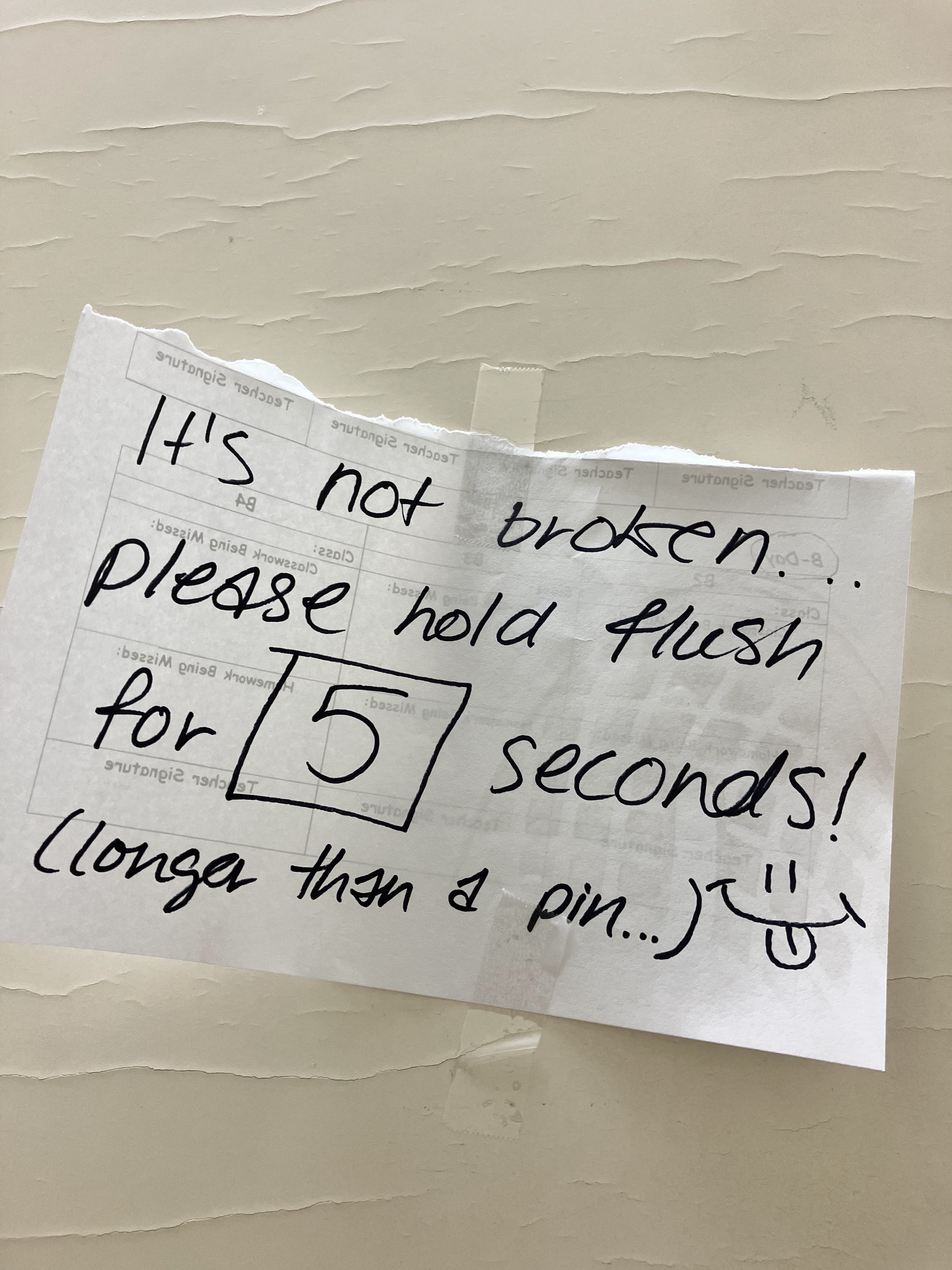
One way to tell that you're at a gym
hosting a wrestling tournament...
you find this on the back of the toilet
cubicle door.
It was fun to go away with David, even if it was for two days of wrestling! We enjoyed doing this together, and shared passions are important as you move towards a time when your kids all leave home. We made great memories and I have no regrets. Oh, and it was fabulous being able to support our son like this.

One fun memory centres around hair. Our son's hair is now wavy and long (below his shoulders), definitely tricky for wrestling, where you can't use anything but hairbands and product to secure it. His brothers have always kept their hair short, so we've never dealt with this before. I've never had much to do with my boys’ hair, actually! But on Monday one of the first things our son said to me when we saw him was, "Can you braid my hair?" Wow! I've had short hair for nearly 12 years and I can't actually remember if I've ever braided someone else's hair . . . I wasn't that kinda girl. 

Neither of us had a comb and my first go at it was straight after he'd warmed up, so he was sweaty! We didn't have hairspray and only two hair-ties, so it got messy pretty quickly after he helped a teammate warm up for a match (they use their heads quite a lot). He wanted me to redo it then, but we weren't sure when his first match would be, and I was already shaky. Braiding hair with shaky hands isn't recommended. 

I was particularly nervous that I'd get partway done and he'd be called up for his match. There's no waiting if you're called. It's something that new wrestlers (and their parents) have to learn about a tournament: there's no timetable, you simply wait for your name to be called, and it can be excruciating (and hard to figure out when to eat). Once you're called, you've got to hoof it to register that you're present and ready to go, with all the gear you need (in your wrestling singlet and shoes and warm-up clothes, plus a water bottle and headgear). This tournament was well organised and had wrestlers waiting "on deck" about three bouts ahead. A bout can last 20 seconds or over six minutes, but they don't tolerate delays.

In any case, I couldn't see myself doing a decent job of braiding his hair in that situation, so I went for a "first aid" solution. My networking came in handy: I knew the mum of one of the female wrestlers, so I went to find her and ask if her team (which had several girls with long hair) had any hairspray. She went right to work and found a girl quickly who dug around in her bag, pulling out not just hairspray but something that looked like mascara. It had a wand that you pull across the top of hair that is "done" to glue those flyaways down—I had to ask her how to use it. Her coach, who I also know, was sitting nearby quietly laughing as I explained how I only had boys and needed help here. She was great!

Well, it worked, and he made it through his first match without distracting hair in his face. Then we had time, and I had another go at braiding it and did slightly better.

The next morning when we met in the gym (our room wasn't near the team), I had a third go, before his final. This time I brought a comb I'd snaffled from our hotel bathroom and handed him some "action" hairspray that I'd bought the night before at the mall near the hotel, and instructed him on how to use it. Our boys haven't grown up with sisters, and he was only six when I cut my hair short . . . there are some things they just don't know!

It's a good thing the braiding was for practical purposes, not aesthetics, but I was pleased that because I was present I could do this one thing for him. In fact the whole couple of days was very much about being wholly present for our son (and his teammates). It was a joy to have the flexibility to do that.

Oh, and giving my sweaty son a shaky hug after he'd won gold was a highlight too. And he didn't pick me up, like he did his coaches!

These moments when we get to intensely invest in our kids are soon going to get more difficult to find. I'm treasuring them.

24 October, 2022

Little exchanges add up to a lot

Have you ever thought about the little exchanges that make up the bulk of connection with others? Our lives aren’t generally full of D&Ms (deep and meaningful conversations). Though often I long for that deep connection with people, there is, actually, a limit on how much of that I can handle in any one day.

On Friday the school held the biggest school-community event it’s had in three years. It’s a descendent of the ginormous garage sale known as Thrift Shop. I’ve blogged about that event many times over the last 12 years (see some of those posts here). Now it is called the Fall Festival and Bazaar. The “bazaar” side of things is a scaled-down version of Thrift Shop, designed to cost less in terms of time-commitment for staff and volunteers. It also includes something new: a place where individuals or groups can rent a table to peddle their own wares. Because, of the last three years, we've been saving up stuff we want to get rid of (that isn't rubbish), we decided to rent a table.

Our table as it looked at the start of the day.
There were a few great things about having our own table: 

  • I had a place to "be" all day. I didn't feel like I was loitering or wasting time. It was also a starting place for conversations that weren't uncomfortable, a here-and-present kind of thing that helped me stay away from topics that aren't so easy to talk about in a light way.
  • We had a bucket of "free stuff" that the younger kids loved. It's such fun giving things away.
  • I got to make and sell fudge (but I was disappointed with the packaging we managed, which made the fudge look decidedly dodgy).
  • We did actually get rid of a fair bit of stuff to places that it will be used (rather than just sent to the rubbish). We were able to give two boxes of stuff to the Salvation Army who came at the end for stuff that hadn't been sold.

I went into Friday expecting lots of more conversations, and came away feeling a little dissatisfied with how insubstantial most of the exchanges were. But, as I've seen as I reflected over the weekend is that on Thursday and Friday I was part of the gentle web of connection that has begun forming again in the community that centres around the school. Looking back, I had short conversations about all the following things:

A future camping trip

Why I had a nearly 100-year-old hymn book for sale (yes, I sold it)

A recent 500 pound, 8-foot bear attack in the US (yes, there was)

How much my youngest son has grown and changed

How to say “poached egg” in Japanese (no, I can't remember now)

How to use a baccarat espresso maker

What Thrift Shop used to look like (for someone new in the community)

Where Kuranda is (inland from Cairns)

How much CAJ pays substitute teachers

The difference between chocolate and fudge (yes, we were confused by the question)

What it was like growing up a few blocks from the US on the Canadian side of the border and how I’ve never lived in a country that has international land borders (only sea borders, hence “going overseas” is synonymous with going to another country). 

Shopping habits: I prefer to be left alone to consider the option and very much dislike shopkeepers in my face.

How exhausting parenting is emotionally, and how ready I am to be moving on out of being the parent of a school-aged child (7 ½ months…but I’m not counting :D).

Fudge and how we’ve given this to our boys’ teachers for years. This is the last year that will happen.

How I got rejected by the blood bank on Friday at the school because my haemoglobin was a little bit low.

Plans for the next couple of years (moving out, home assignment from July 2023, moving back to Japan).

The big gaps that the pandemic has left us with in community: those whose kids started at the school during the pandemic don’t know the parents of their kids’ friends. I don’t know the faces of a bunch of new teachers (and their kids). That's something that rarely happened before the pandemic, due to staff-family gatherings that have usually been held through the year.

I met a lady who works for the same organisation that publishes the magazine. I’ve only really interacted with her over email, though perhaps we’ve met once, I can’t remember.

I got some hugs and got to see some people I haven’t seen in months or years.

And a thank you for my recent blog posts from someone who says she reads everything I write!

I'll stop there. When you add all that up, that's a lot of networking. And the sorts of stuff that doesn’t happen when you aren’t face-to-face with people. I was exhausted on Friday night (and Saturday). But also thankful. 

02 October, 2019

Most people have no idea what I do

Yesterday I worked with the admin staff of the organisation that publishes
the magazine.  We packed the autumn issue of Japan Harvest for mailing.
These ladies also help with advertising, translation, and fact checking
from Japanese sources. While I was there an OMF colleague dropped in
for a while and I also spent time on the phone with another colleague. I always
enjoy volunteering in this way. Though it isn't what a managing editor usually
does, it is a good opportunity to connect with some of my team, but also to
network. I almost always am introduced to someone I haven't met or meet
someone when I'm doing this. The office is in a Christian office building in
downtown Tokyo. Yes! There is such a thing. How that came to be is another
story in itself, but it is a great place to network with others.
"People, in general, don't understand what editors do." I've found this to be true in my time as an editor. It isn't until I've worked with a writer through the process of getting something they've written published, that they have a better idea.

I seem to have ended up in a succession of careers that aren't easy to explain: Occupational Therapist, missionary, and now missionary and editor! None of these work very well in polite conversation with a hairdresser. Finding an "elevator speech" for any of them is challenging.

So when I found this short video by a newspaper editor that succinctly described what we do, I was thrilled.

Here is his summary of various species of editors:


Developmental editor: works closely with the writer in early stages, working with the writer on the idea, focus, scope, organisation, writing, and revising.

Line editor: focuses on the macro editing of a completed text, though focus, structure, tone, organisation, legal and ethical issues often come into it.
Copy editor: takes a micro approach looking at factual accuracy, grammar, spelling, usage, and house style.
Proofreader: takes a text ready for publication and checks it for typographical errors, spelling errors, garble, and similar infelicities. They don't edit the text.

These can blur into one another, especially in a small organisation. I do all of these, though I have a team to help me and I try to keep my hands off the micro stuff if I'm dealing with a piece that needs work at a developmental stage. There's no point in correcting spelling or capitalisation if that word is not going to be used in the end.


He said that editors overall try to establish: what is appropriate for the writer, the subject, the occasion, the publications, and the reader. And they all work to keep the writer from looking bad in public.


Though I do all of these, I find it hard to jump between one and another. I find it hard to do developmental work with one piece of writing and then jump straight into copy editing another. I'm glad that one cycle of our magazine lasts about two to three months, so I can take the time to put different hats on as I go. I also have difficulty jumping into an editing conversation without having had some mental preparation for that (so an unexpected phone call or encounter with an author wanting to talk about a piece of writing is hard).

On top of the above "species" of editors, I'm a managing editor, so I oversee other editors as well as the rest of the members of my team. Plenty of variety, which is just as I like it most of the time.

Because I don't fill out timesheets and aren't paid by the hour I sometimes wonder if I am full-time employed. But I've pretty much come to the conclusion that I am. It's hard to measure how much you do when you're a full-time missionary. All sorts of things are part of ministry: building and maintaining relationships, language learning, dealing with bureaucratic requirements (like visas), and supervising/being supervised. 

But many of these things happen in "regular" jobs too. How much time did I spend at team meetings, doing statistics for the number crunchers, or answering email when I was working in health care? Even just driving to and from home visits or between workplaces on a workday, these were counted as work in the full-time jobs I've had.

The big difference is that my personal life is now much more mixed into my work as I work from home. But that's what I grew up seeing my parents do as they ran a business from home.

Not having an easy measuring stick around your work can make it hard to know when to say yes and when to say no. Being a relatively reliable person who's been around a while now, I often get asked to do things, to attend meetings, help run things, meet with people etc. But I'm finding that I'm in a season of having to say no. I'm close to my limit in what I can do and stay healthy, so I have to pick and choose carefully.

But...now I'm rambling and probably should get back to one of those non-editing jobs I have: writing our prayer letter.


15 November, 2017

Geographically distant teams

My workday yesterday was been bookended by Skype calls. 

The first was a monthly editorial meeting with the executive editor of Japan Harvest. Most it is a meeting that gives us accountability with regards to bigger-picture stuff related to the magazine and communications with the organisation who publishes it (Japan Evangelical Missionary Association). The call only spanned about 9 km, but allows both of us to work from home with no commuting time or cost.

The second call was to the UK, with a member of OMF's International Communications team. She was providing support to me in my role as part of the mobilisation team for OMF Japan. She taught me a new techie trick to use with my social media role.

Both these calls were very useful and extremely convenient. Not to mention time- and cost-efficient.

Over the last seven years I've become an experienced geographically distant team-member. I didn't know this term until I went to a workshop in Bangkok last year and spent a week learning about teams. I was puzzled at the time because the teams I'm involved in are quite different to the face-to-face ones they were talking about, so I did some research and discovered a the term "geographically distant team" (also known as geographically dispersed/distributed, remote, or virtual team). In this world of increasingly fast internet speed, the sorts of teams I'm a part of are increasingly common. Teams where the members work from their homes, or from locations that aren't favourable for regular commuting.

Below I've pasted part of an assignment I researched and wrote following the above mentioned workshop (which was called Project Timothy 3). I wrote it before the mobilisation team of OMF Japan was formed formally, so that team is not mentioned. 

If you're working on such a team, you may find it useful (sorry, it's a bit longer than my usual blog posts).


Project Timothy 3 focused on understanding teams and how to best help them work, but the type of teams the course focuses on is teams that work closely together, they see one another often, and are in the same geographical location. The team that I am most involved in is a geographically distant team. We produce a magazine, Japan Harvest, for missionaries in Japan, but do it from our own homes. Our team lives in several prefectures in Japan and two other countries. So for this assignment I sought to understand geographically distant teams better and then took a look at my own team, at what’s working for us and what needs some attention.

What are they?
Geographically distant teams are increasingly prevalent in this world as companies and organisations take advantage of the technology available to them to connect teams in ways that has never been possible before.  A broader term that’s used more frequently is “virtual teams”. They are groups of individuals not physically in the same place but united by a common goal.

Wikipedia defines a virtual team as “A group of individuals who work across time, space and organizational boundaries with links strengthened by webs of communication technology.”
Powel, Piccoli, and Ives define virtual teams as “groups of geographically, organizationally, and/or time dispersed workers brought together by information and telecommunication technologies to accomplish one or more organizational tasks.” (http://www.managementstudyguide.com/virtual-team.htm)

Virtual teams communicate predominantly by the use of technology and may never meet. In some cases they have cultural, language, time zone, and ethnicity differences also.

Some virtual teams are temporarily formed to accomplish a set or limited task.  Teams aren’t necessarily from the same organization, are frequently topic-specific and dissolved after the completion of the task. Some teams are formed with specialists for the purpose of making recommendations, other teams have more powers to effect change and make decisions. Some virtual teams are set-up to outsource specialist tasks, like software development.

Where do you find them?
“Today it isn't uncommon for companies to have as many as 50% of their employees working on virtual teams” (http://www.reliableplant.com/Read/27807/Virtual-teams-are-different).

You can find them everywhere, from multimillion dollar companies to small business, and even in mission. NASA uses virtual teams to run space missions. Whirlpool developed the chlorofluorocarbon-free refrigerator using a virtual team. You see them in customer service support, consulting firms, management teams in national and international companies, and offshore teams for software development.

OMF International has many virtual teams. For example, the Field Leadership team in Japan—the members live in Tokyo, Tohoku, and Sapporo. One member is currently on home assignment. They sometimes meet in person, but many of their communications are via email, phone, and Skype. Another virtual team on our field this year was the Field Conference planning team. This is an example of a team that came together for a specific purpose for a short period of time.

How do they work?
There are different types of teams. Variables include: purpose of the team, whether members are from the same company or multiple companies, and the length of the project.  Some teams regularly meet, for example, the TED tech team has 29 members spread across several US states and two other countries, they meet via videoconferencing every week, as well as in person every three to four months (http://blog.ted.com/8-tips-for-virtual-collaboration-from-teds-tech-team/). Other teams meet less often or never at all.

A friend of mine in Australia works for a Christian organization called Scripture Union, that especially reaches out to school students. My friend supervises chaplains in schools across a wide geographical region. She periodically drives for several days visiting them at their place of work, and they periodically gather together at conferences. But she told me that the most meaningful thing they do to promote team unity and productivity is meeting weekly via Skype for time of reading the Bible and sharing and praying for one another.

Advantages?
Virtual teams: 
  • save money,
  • allow people with necessary gifts to contribute regardless of their location,
  • can be more efficient,
  • are more flexible to meet needs,
  • can work at times that suit them best,
  • individual team members have more control over where they work,
  • they save time wasted on commuting, and
  • at times it means that they can make decisions faster.
Disadvantages:
  • Essential technology can be expensive and can break down.
  • Trust is hard to build and easy to break.
  • Collaboration is difficult to manage.
  • Conflict can more easily arise from misunderstandings that come with a lack of the non-verbal cues that are part of face to face communication.
  • Members may feel isolated and lack the motivation that being physically with a team can provide.
  • Self-discipline is a must for a well-functioning team.
  • Not being in an office can be less productive.
  • Communication in general can be more difficult.
Specific challenges these teams face?
  • Building trust.
  • Managing collaboration
  • Avoiding and resolving conflict.
  • Accountability.
  • Team spirit and motivation.
  • Finding ways to meet.
Are you  a part of a geographically distant team? How do you make it work?

23 October, 2017

Making sense of today

It's been nearly a week since I've had the time and energy to write here. A typical Thrift Shop week. I've had lots of ideas floating around in my thoughts, but no time to write them down. 
Drying out the content of David's backpack after the Spartan Race.

And now today's had a weird start: a typhoon blew through overnight and school had a late start (10.30), so we slept in and didn't have breakfast until about 9. Add to that my husband, who's flying to the US today (a first for our family). He was only planning to be at school in the morning and then taking off across town, but the typhoon messed with that a bit. Thankfully it's passed and hasn't messed with his flight, though.

The weather has me on edge too. We started the day with grey overcast, gusty conditions and now it is a typical post-typhoon sky: bright blue, but the wind is still gusting at times, which always makes me unsettled.

I did a car trip for groceries yesterday, instead of riding, because it
was raining steadily. This shop had three older guys working hard to
 manage the traffic flow in and out. I love the way Japanese take care of
customers and the public in general.
So now I'm sitting at my computer, trying to make sense of it all and settle down to work. Because I haven't sat here for days, and only vaguely monitored email via my phone amidst the organised chaos that is Thrift Shop, so I'm struggling to get my head back into my usual work.

Though maybe it's partly my head that's the problem. I've felt a cold coming on these last few days and, typically, after relaxing yesterday afternoon, my throat flared last night and the cold is moving in. So, as I type, I'm sipping a honey and lemon drink.

I'm going to try processing the week a bit here in writing to see if I can get an handle on the way forward.

Conversations at Thrift Shop
Thrift Shop is hard work, but also full of wonderful (and random) conversations. On Tuesday, when we began work, I was only remembering the work, but was wonderfully surprised by the joy at working with others and getting to know them better. Here are a few conversations that I remember:
  • Working with an Australian on Saturday all morning who is slightly ahead of us in the sending-kids-to-uni-in-Australia stakes. It was good to hear and share some stories. And with the sharing of stories (this goes for a number of conversations over the week), be reassured that the behaviour we find disturbing or annoying in our teens is well within the normal range of what parents-of-teens experience.
  • Working with an Englishwoman on Friday and hearing her story, of how she met her south American husband and what they're now doing in Japan. Also starting to set up a Boxing Day morning tea with other fruit-mince-pie enthusiasts!
  • A quick conversation where I put my publishing hat on. Getting a quote for a third printing run on our 31 Days of Prayer booklet.
  • Getting to know a Japanese mum, who's spent quite a bit of time in Australia with her Australian husband. It was great to talk about some TCK issues (where do they feel most at home, etc), but just generally get to know her better.
The week was wet and cold, unusually so for October, so it was good to be busy and occupied inside where I didn't have time to brood over the unseasonal dip into winter.

Spartan Race
Saturday, while I worked at Thrift Shop, was an unusual day for the rest of our family. One stayed home with a cold (he gave it to me!) and the other three went to the Spartan Race. A private sponsored obstacle race that you enter like a triathlon or marathon. It was wet and muddy. Apparently that adds to the fun? It certainly makes for interesting photos and stories. 

Our eldest and youngest competed. The race for the 12 year-olds was a little low on challenge and our son was disappointed. He thought it was longer, so was pacing himself. Nonetheless, he came third and got a substantial medal for finishing. Our eldest, with his teammate, took 2 hrs 17 minutes to compete their much more challenging race. They came equal 5th in their age group. Great memories. It was a very wet day and there was no shelter. Even the spectators got thoroughly wet and muddy. Though we ran the heater all day yesterday with my husband's leather wallet on top of it, when he put notes back into it today, they were still getting damp!

Tiny's gone
The other surprise of the weekend was that on Saturday our pet turtle, Tiny, went to another home permanently. We'd put up a sign at Thrift Shop saying we were looking for a new home for him and I got a phone call five minutes before the end of shopping on Saturday (12.55) asking about him and could they take him straight away! It took some quick action, but I managed to get him to his new owners and he was whisked away to adventures at a small Christian school south of here. I hope that he brings much joy to the students there. I discovered later there is a bit of a backstory here. The pastor who's involved in running this school had been looking for a "cool reptile" for the school and so Tiny was just what they were looking for! Though perhaps a little larger than they'd bargained on. We're thankful that he's been taken off our hands. Our boys had outgrown the joy of having a turtle and so he was really just another job on the list of household things we had to do (not to mention that I've been bitten twice this year—I did warn his new owners).

That's enough for now. Tomorrow I'll have Thrift Shop photos for you: bargains and fun moments.


15 November, 2016

My storytelling adventure

Christine and I as I guided her on her first journey through
the Tokyo train-subway system from the airport to our house.
I'm always fascinated with encounters leading to unexpected outcomes, especially when it's clearly not designed or planned.

Ten days ago we had a missionary-friend guest from Taiwan. Christine Dillon is an Aussie missionary and author. She's passionate about evangelism via biblical storytelling.

The main reason she came to visit us was for her to see some "real" Japan before she dived into teaching an evangelism and discipleship course from Monday to Friday. That was mostly to be a long bike ride with me. On the way out of our city we stopped so I could show her our church. While she was taking some photos our pastor came out and introductions ensued.

She had planned to go over to our headquarters on that afternoon, but began to think about staying another night so she could come to our church with us the next morning. It turned out later that that was the best option (her next host became unexpectedly busy on Sunday morning). So she stayed an extra night.

The next day at church she was introduced to everyone at the end of the service, as is the standard custom in Japanese church. Almost immediately the service ended the most extroverted Japanese person I think I've ever met, a long-term member of the church, came over and introduced our guest to a Taiwanese lady who's been coming for a few years to our church. It also transpired that a long-time Japanese missionary to Taiwan also was coming to the church that Sunday for the next service and lunch (something we hadn't known).

Anyway, Christine ended up talking with the Taiwanese lady and her Malaysian friend. While we waited for the missionary to Taiwan to turn up, Christine offered to tell these two ladies and me a story, a Bible story. So, standing near the entrance to the worship area she told the story of Abraham, Sarah, and Hagar (Gen 16). The ladies were excited, but were clearly not as familiar with the story as I was.

After returning home we did what often happens these days when meeting new people: we connected up via social media. The Taiwanese lady was a new friend who I'd planned to connect with over this month anyway, so I messaged her asking if she had time to meet, suggesting maybe her friend could join us as well.

After we'd organised a time I dropped the suggestion that we could learn a Bible story together. This wasn't something I've ever done before, so I was a little shocked but pleased when they both responded enthusiastically.

While washing up our lunch dishes Christine briefly told me her method for learning how to tell a short Bible story in a group. What particularly encouraged me was her exhortation that I didn't need to do any preparation. She gave me six question cards to use after we'd learnt the story (you can see them here).  What basically results is not just learning how to tell a story from the Bible from memory, but a simple Bible study.

I'm glad there was no preparation required, because as it turns out, it was a crazy weekend for me. We met, spent time getting to know one another, and learnt Genesis 3:1-15 together in English (that is our best common language).

What blew me away was how enthusiastic both ladies were. They've done Bible studies before, but not one like this. They really liked this and are keen for much more!

The other thing that amazed me was their answer to the sixth question card: "This week, who could you tell this story to?" They both had people in mind, but neither encounter was going to be in English, these multilingual ladies had Japanese-speaking and Chinese-speaking people in mind. 

So I was not only able to help them learn a story and improve their understanding of Scripture. But they were going to go out and do what I couldn't do. Not only do they have language abilities that I don't have, but they obviously have many friends and colleagues I don't have. It seems almost too basic even to write this out. But if, in my little way, I can equip these ladies to tell people stories from the Bible, and continue that so they get all the way to being able to tell the gospel, it doesn't matter if my language and evangelistic skills aren't great (the things I always beat myself up about).

Exciting and not at all in my usual scope of ministry! But something that's landed in my lap that I intend to follow through with. We're meeting next Wednesday to learn the next story in the series of eight to give a Bible overview that seems to be the current "best practice".

The whole thing reinforces to me that what we're doing in Japan is not of our own making, God has a plan for using our willingness to serve him here and sometimes we get a glimpse of his plans.


If you're interested in this method of ministry, do check out Christine's website: storyingthescriptures.com. If you are on FB you can ask to be accepted into the "Storying the Scriptures" FB group dedicated to supporting each other and asking questions about this.


25 July, 2016

Thinking about the importance of connection

To stay healthy I need to be connected to others, quite a lot of others. That's something that I need more than others in my family. Some in my family are happy to be fairly isolated, others need lots of connection. I guess that's a function that the extroversion vs introversion continuum seeks to report on.

As a result of my personal needs, I tend to drag my predominantly introverted family into more times of connectivity than a few of them think they want or need.
Last year at the end of July we camped
 on the west coast of Japan, spending a day
with a missionary family who work there.
At the end of the day we sat on the beach with
them and thousands of others watching a
spectacular fireworks show.

During CAJ's long summer holidays we have more time to connect with others, but often connect less, because the school schedule doesn't provide natural opportunities to do so and many who we'd normally connect with are travelling all over the world.

However we did manage to connect with three different families during our recent camping trip. The first live and work in Niigata, on the west coast of Japan. I've gotten to know the mum mostly through social media, though we connected first at CAJ homeschooling events that I was involved in in our early days in Tokyo, but also through the missionary women's retreat in March. The two of us have dragged our families together a couple of times in the last 13 months, both times when our family was camping in Niigata. It's been an interesting experiment, especially because we have different demographics in our families, but I think we've all enjoyed it.

I invited a colleague from my magazine work to join us sightseeing in Kyoto in the middle of our camping trip. She lives in Osaka, about a half-hour train ride from Kyoto. She's a relatively new member to our magazine team and it was good to spend time getting to know her and allowing her to get to know me too, even in the midst of a family outing.
This was the house of our friends who we
stayed with at the end of our camping trip.
It was a lovely place to stay.

Then on the last weekend of our camping trip we stayed two nights with a family we've gotten to know a little at CAJ. Their eldest son is in our eldest son's class, he boards with a family from the school and only goes home periodically (they live a couple of hours from Tokyo on the Pacific side of the island). It was good to get to know them better too, nothing like staying with someone for that! 

There is something special about visiting people where they are, especially if they live in a more isolated location. We've periodically done this in our other travels as a family.  On our trip to Uluru we visited a couple from our denomination working in Alice Springs, we also caught up with a former student of David's in Townsville and friends who lived in Mackay, all three units in full-time ministry. We also met up with former missionaries to Japan, now living in rural Queensland. I don't know how much an encouragement it was to each of these folk for us to visit them, but it certainly was an encouragement to us.


I chatted with another friend this morning using the phone call part of Facebook Messenger (what is that called?). She too is in full-time Christian ministry, but in Australia. When I was there we met regularly over coffee, it's been great to continue this with the use of technology since we've been apart. She was very encouraging about the above meetings I've described, the people we deliberately met on our recent camping trip. She commented on how it's just these sort of people who will understand better what we do and with whom we can provide the best mutual support for one another. So true!

Living where we do, near an international school, it is generally easy for us to spend time with other missionaries. Even if it is just as we commute too and from sporting events. But I'm glad that we've been able to connect up with others who are a little more isolated than us and pray that we've been a help to them too.

23 February, 2016

Two titbits from today

There are some gorgeous flowers in bloom here.
An international network
In an international mission like ours where not only do we come from many nationalities but we serve in many nations, you don't get to meet most members. When you do there is a fascinating way of establishing connection. There are three main establishing questions: "Where's your sending country? Where are you serving? How long?" Then comes the, "Do you know..."

This is where I am staying, the OMF Bangkok Guest Home.
For example, if I'm sitting with someone from Ireland who's serving in Taiwan, I'll ask whether they know Irish people I've known in Japan and Australians I know in Taiwan. The "how long" question gives some help with how far back you can go. 
It is an interesting exercise, actually and highlights how wide a network we have developed during our missionary career. I'm looking forward to visiting some of these people in their home countries when we are older.

I went for a walk with some Thai-based missionaries this evening and
we saw this chicken (or is it a rooster) strutting around on top of a
 truck with a cat respectfully watching (you can see its eyes).

A tricky question
Today we were asked this: 
What builds trust in your home culture?
I found this really hard. It made me realise how we really don't function often in our Australian culture any more. After some thinking I came up with some ideas:

  • Honesty
  • True blue/ integrity
  • Hospitality/socialising
  • Quality time
  • Paying out on others
Am I right? What would you "monocultural" Aussies add to this? 

This differs from how you build trust in Japan. Hospitality is definitely not a key factor, neither is honesty. Longevity and trying to fit in would be high on the list, however. 


10 February, 2016

Crucial community

This is a special photo, not so much because of the wrestling, but 
because of a relationship that's developed through supporting 
our boys in sport, living in the same neighbourhood, sharing meals, 
and mutually helping one another through the last seven months.
Yesterday I headed off to get groceries when I realised my bike tyre was completely flat. Pumping didn't work. Bike maintenance has been David's specialty, but he's not here. So, I could have taken it to a bike repair shop, of which there are many, but a closer, more friendly option was an American friend who loves bikes and lives a couple of hundred meters away. He was very happy to help me out. 

When I dropped the bike off we talked about a few things. He mentioned that a mutual friend of ours (also American but who spent part of her growing up years in Japan) was coming over later to help him with admission papers for their son starting Japanese schools in a couple of months.

This morning I was feeling exhausted with all this single-parenting and the various other things that are going on in our extended family. I struggled to get going, but I had, thankfully, already organised to have coffee with a friend who lives one station away. An hour of chatting over coffee was all I needed to get going again.


Community—one of the secrets to our longevity in mission.

Some missionaries look at where we live (300m from the Christian international school that our boys go to and my husband works at) and think, "No way. I wouldn't live in a foreigner 'bubble' like that."


But community, whether it is those from your host culture, or foreigners, is vital to coping with life in a foreign country.


When we first came to Tokyo I felt very isolated, in this sea of humanity I knew practically no one and it was awful. I was stuck at home in a foreign land with three little boys under 7 while David worked full-time at school. We lived further away from the school (7km) at that time, so there weren't many English-speakers around and it takes a while to get to know Japanese people. 


By having our kids attend a local kindergarten we made local Japanese friends, friends who lived as close as our foreign friends live to us now. Friends who made all the difference. You, know, for those times when you need someone to pick up your child from school because you've gotten held up somewhere, or who you need help from to water your garden while you're away, or you simply need someone to drop in on your housebound gastro-struck household to ask if you need anything. Or just someone to ask for some local knowledge or share a coffee with.


Now we live closer to school and have been in this school community for more than 10 years, we have many friends and quite a few of them live within a few kilometres of us. 


But we aren't in a foreign enclave. I don't typically walk out my front door and see a white face. All my neighbours are Japanese. Population density being what it is, there are still thousands more Japanese people in our neighbourhood than there are foreigners.

We are a family with a majority of introverts, so we don't have a lot of people coming in and out of our front door, at least not yet. I can see it coming, especially with our extroverted youngest, but not yet. So though we live close to the school, we're not living in other people's pockets, nor are others living in ours.

I love living here, close enough to easily walk to school or to a friend's house or the station, yet far enough to not have to greet someone every time I step out the front door or have friends looking at my washing.


Just in case you're wondering, I've got Japanese friends who I ask for help from too. One friend helped us find an emergency paediatric urologist late one night a few years ago (don't ask!). Another couple of friends helped me at medical appointments in the last few months. 

Living cross-culturally you learn to be happier with dependence, to asking for help. If I were in Australia it would look different. In many ways we'd be less needy, but we still needed community when we were there: for example the time last year when David was out with our only car and it poured with rain. We asked a friend from church to take the boys to school.

Just occasionally I'm asked about how we've managed to stay on the mission field so long (Japan is notoriously for a high attrition rate for missionaries). One key I would say is community, and being able to recognise when we need help and to ask for it.

27 January, 2016

How do you know so many people?

"So how do you know so many people?" My introvert son asked me this morning. 

"Well, for starters I've been around for 40+ years. I know people," and I started counting them off on my fingers:
These are dear friends we met at uni in the late 80s early 90s.
What a treasure are friendships that last so long.
"from primary school,
high school,
university,
all the different churches I've been a part of since I was a child.
Then there's friends of my parents and friends I met when I got together with your dad.
Then friends I met in Kingaroy..." 

Here he started to get inpatient with me and said,
"Kingaroy, where's Kingaroy? Why Kingaroy?"
"That's where I moved to after I graduated from uni and got my first job."

"But then we became missionaries and it became our job to meet people, going to different churches, and so on. Ever since then it's been one of our jobs to stay in touch with a lot of people. Then we met people in Singapore and in Japan through OMF and other events we've been a part of."

But he was gone, that was way too much information for him.

The original question was sparked by the revelation that I had lunch guests today. Australian colleagues of ours who work in Hokkaido. Our boys have met them a few times, but don't remember them (though I think our eldest did a little).

We do know a lot of people, as I said, it is our job. But my extroverted nature probably contributes (though I know people who have many, many more friends). I love networking!

Of course our jobs/situation at an international school and in an expat community lends itself to a much higher turn over of friends than most monocultural people experience in a whole lifetime.

How many people we know would probably freak some people out, if they knew.