Showing posts with label cross-culture stress. Show all posts

20 January, 2023

Off my game, but seizing the day

It's been a weird week and I haven't been able to settle well to work that needs deeper concentration. The main thing to blame is my schedule. I started the week exhausted from Saturday when I helped run a wrestling tournament (and continued straight on to dinner across town with friends), and end the week nervous about the really long day tomorrow at another tournament a long way from home. In the middle of the week was a day hanging out with missionary women and a funeral of a church member, plus a mid-week wrestling event, all on different days. Add to that two other days with meetings, but not even long meetings! 

All that is enough to throw me off my game. I can sandwich some work in-between other things as well as the next woman, but I find that writing and editing longer or more difficult pieces of writing, takes more concentration and doesn't squeeze well between other things. So I generally chunk my schedule to help me work that way (ideally, two or three whole days in a week without any external events), but it just hasn't happened this week. Oh, and I've been struggling with headaches on and off too, which never helps concentration.

Next week looks better . . . I hope it lives up to that expectation.

But for now I want to tell you a little bit about the funeral. We arrived at church on Sunday to the news of a sudden death the night before of a 65-year-old church member who has quietly served his community and church for decades. He was not obviously Japanese, having American heritage, but his heart was clearly centred on Japan. He was born here and spent most of his life here teaching English. He served the church by simultaneously translating one of the services each week into English in his little booth at the back of the sanctuary, as well as proofreading the bilingual PowerPoint presentation. So many people have been blessed by his service over the years! His Japanese wife and mother-in-law were clearly distraught at the funeral yesterday. He hadn't been ill and died while doing something he loved: watching sumo at home.


It was a small funeral, which surprised us. But we were glad to be present, at this beautiful Christian, Japanese funeral, representing some of the many people who have been served by this humble, behind-the-scenes guy. There are so many funerals that I haven't been able to attend in the last few years, usually because of family responsibilities and distance. I'm sure there were some who wanted to be present at this one, but couldn't.

It's only the second funeral in Japan that my husband or I have attended. Before we came to Japan we were told about Japanese funerals, in particular, about the very strict dress code and the need to own "funeral clothes." It's all black, except the men get to wear white shirts with their black tie and women can/should wear pearls (but no other jewellery except wedding rings). I own very little black (and no pearls), as it just drains my already pale face of all life. And almost none of the black clothes I have are "winter weight". My heart's desire was to honour this man and his family, and not to draw attention by my foreign-ness and what I was wearing or not wearing.

Thankfully I managed to do that, all while not getting frostbite! But let's just say I was wearing a lot of layers under the appropriate black externals!

The service was very different to the Buddhist one I attended many years ago, indeed it was very similar to a worship service. I was taken by surprise by the open coffin where we were guided to lay flowers after the service, but as we aren't close to the family, we didn't stay long after the main service. To learn more about Japanese funerals check out this article I edited a while back.

It's sobering to think that this man was only about 15 years older than us. Truly, a funeral is a good place to get a reality check in our busy lives. I'm always grateful for my husband, but this was a good reminder to seize the day as often as I can.

The fairly spontaneous dinner we went to last Saturday was very much a case of "seizing the day". It wasn't wise, at the end of an exhausting all-day event, but it was a rare opportunity for three families who get along well to get together. And we had fun. I'm really glad we went. Taking time to appreciate those we love is so important. For those of us who have no family in-country it's even more important to invest time in friendships nearby. Just this week we've heard of an expat whose cancer journey has taken an unexpected turn, and another family we know whose overseas journey seems to have come to an end (they aren't returning from home assignment, though continuing to work with a mission). Seizing time with friends that God has given you to walk with this current week, month, year, is important in this life where things can change so quickly.

14 September, 2022

Families: microcosms of cultures

During our time in Australia we stayed in a variety of different places. Twice we stayed with family members, twice (three times for me and our middle son) we stayed in a self-contained apartment attached to someone else’s house. Only once did we stay on our own in a detached house.
This humble house is the only place where
we lived in a detached building as a family
while we were in Australia.

Then, at the start of August, David and our youngest son left for Japan and our middle son and I moved into live with a family as guests. We were like boarders, we provided our own lunch and breakfasts and did our own washing, they provided us with dinner. We each had our own small room. This is where I quarantined with COVID. After nearly three weeks here we separated. He went to stay with his brother in his share house for ten days, and I went to stay as a guest of the family of a close friend. 

Each of these locations had their own culture.  On reflection, we were “free-est” when we rented a (holiday) house for a week.

I’m guessing that most people haven’t stayed for as long as ten days or three weeks with another unrelated family (we've done it a few times, when we visited Perth for deputation). Generally, in our Western culture, we live with our own immediate family, and only visit other families for short periods. For four years I lived in a residential college (dorm) when I was at uni. Then, after I graduated, I lived in three different situations before I got married: on my own, with part-time housemate, and with a full-time housemate. But it’s been almost 25 years since I stayed with someone other than my family for a long period.

As I reflect on what we’ve experienced since June, I’ve realised how some of the things that stressed me most was living with my family with the other family cultures we experienced. I call them cultures deliberately, because they each have rules. They each have unwritten expectations and codes of behaviour that aren’t easily decoded by outsiders.

Family cultures are influenced by so many factors, here are a some:
  • Personalities
  • Ages of family members
  • Life experience
  • Location
  • Environment
  • Pets
  • Habits
  • Work
  • Busyness
  • Expectations
  • Health
  • Division of labour
  • Housing: layout, resources (e.g. hot water), cleanliness, age etc.
  • Tone of voice often used
  • Toleration of conflict
  • Parenting styles
  • Values
  • Goals
For example, a family with school-aged kids who have two parents working outside the home looks very different to a family with older, fairly independent teens and parents who often work from home. Factors that vary enormously include different expectations about what meal times should look like, how recreational time is spent, what expectations the family has about security, showering, feeding and exercise of pets, whether they are introverts or extroverts, and messy or slightly obsessive about cleanliness. 

When you encounter someone outside their home (including on social media), you know very little about their home life and how things work there. When you are a houseguest, you have to be fairly alert to figure some of these things out. Depending on the family, some expectations are overtly stated, but other expectations aren't even conscious. This is complicated by the fact that we guests each bring our own expectations, needs, and values into the situation!

All of this is also affected by our role as a guest in the household. Hosts are being generous, so in reality they hold more power than you do in the situation. Not that I'm saying our hosts abused this power they held (although they may not have realised how much of a power imbalance existed), but it's worthwhile acknowledging that as a guest you are somewhat powerless. Most guests feel the pressure to not to cause any unnecessary inconvenience to their hosts. That can be a stressful tension to live with, especially over a long period.

So, how did I survive all these different living situations, especially when sharing a kitchen/bathroom/living area?

My strategies as a guest this time
If I could avoid the early-morning breakfast-bathroom rush, I did. Most of the time I didn’t need to be up as early as my hosts, so I just waited until they’d finished using the kitchen and bathroom. I tried to ask questions about important things like the laundry, shower use, dishwasher, and security. And I took my own coffee-making equipment (a very portable AeroPress Go)! 

I don’t have food allergies or sensitivities and can eat most things, so that makes being a guest easier. But I can’t use regular soap, it dries my skin out and causes rashes, so I provided my own body soap and my own dishwashing gloves. I also used my own pillow most of the time. 

In each location I tried to unpack as best I could, which included putting clothes on hangers or in drawers, so I didn’t feel so much like I was living out of a suitcase. If I needed space, I retreated to my bedroom for solitary time. 

On a couple of occasions, when something was bugging me about the house that I could influence, I dealt with it myself, rather than expecting that the host would meet my expectations. 

And, I wore comfortable slip-on shoes inside! We’re very used to Japanese houses, where the floor is fairly free of debris, I find walking around in bare feet or socks in most Australian house difficult. I also find it's "unrelaxing" to always be wearing outside shoes inside.

Reflecting
As I write all this down, I realise why I'm struggling to regain my full strength, other than still recovering from two respiratory infections in the last six weeks. It's exhausting being a guest. It's exhausting moving around from place to place. You are outside your own family culture, or as a parent, you've brought your family culture with you and you're trying to do your best to make sure your family are good guests. When you're at home with your usual family in your usual accommodation, you are most relaxed. Most of the unwritten rules are understood. Daily life happens relatively smoothly, because you have routines that work for you. (I know of course that that is the ideal, that there is always some level of friction when people live together, and probably even more so when you add children into the mix.)

However, I am very grateful to all those who generously hosted us. We're not a neat, easy-to-host family. We're a cross cultural family and some of our foibles are born of that. Other foibles are born of difficulty "reading the room" and mental illness. And some of our hosts caught us at the tail end of the nearly three months we spent as guests, and therefore did not catch us at our best.

I'm also grateful to finally be back in my own house, where the unwritten expectations are understood. Where I can choose what mountains to battle over. And where I can sleep on my own bed, with all my stuff in the places where I can find them.

11 May, 2022

An unexpected outing to inner city Tokyo

Earlier this year I worked on a magazine issue themed "Rest". You can check out most of the articles we published in that issue here. When we asked the missionary community in Japan for article proposals, we were overwhelmed with people wanting to write on this topic, so it's obviously something that missionaries in Japan (among others) have thought about quite a bit. 

However, when we talk to people back home, it's not often that people ask us about how we get rest on the mission field. I wonder if this isn't something that people think about until they have actually left their home country and are desperately tired? I know that when we first landed in Japan we were quite exhausted from what had gone before and I can't remember if anyone ever talked to us about pacing ourselves.

I was quite encouraged to see an article in the latest magazine that we've completed (last Saturday) that talked about mentoring people interested in long-term mission. It was an internship program that their organisation runs and one of the five main areas that this couple focus on with their interns is Staying Healthy, which includes incorporating rest into your life.

Well, I've been in Japan for over 21 years now and I've had to learn about rest. I still have lots to learn, but I've learned a few things along the way. Like: How to rest when you've got three lively young boys. How to rest when your to-do list seems enormous and overwhelming. How to rest when no one else in Japan seems to, and how to manage when just making it through a short Japanese-language church service is exhausting. How do you rest when you're very aware of the urgency of reaching Japan for Christ? And when going anywhere away from home just takes so much out of you.

I still remember our first holiday in Japan. Just following the paper map (in Japanese and pre-Navi) was exhausting. Then we needed to figure out buying groceries in a small rural town and a strange missionary holiday house (believe me, they are often stranger than the usual place you'd rent back home). On top of that, we had a lively 2 y.o. and no one but us to look after him.

Over the years we've learned different ways and means of resting and that it isn't an option, rest is essential, as is pacing ourselves. We've had to approach this missionary life more like a long-distance journey, than a sprint. But we still struggle, life and ministry have a way of being busy and both David and I are self-starters, which means that we can be quite driven. I've been trying to finish this blog post for several days. I've been wrestling with tiredness as well as drivenness. Tiredness won out yesterday morning and I rested all morning.

My busyness at work tends to ebb and flow. Thankfully I am not expected to fill out a time-card, so if work is a bit quiet, it's okay to take some time to rest. So last week many people in Japan were resting, or at least recreating, with several public holidays on the calendar. Our house, typically, looked different. Our school didn't take all the holidays, in fact only one. I had plenty of work on my to-do list, including a magazine I hoped we could finish by the end of the week to accomodate the schedule of one of our team members. So I didn't plan to take time off, merely held it as a possibility, if the opportunity arose.

Last Wednesday (a beautiful day, not unlike today), a colleague who lives over an hour away, met me halfway for the afternoon and we explored a little corner of Tokyo. I'm not really a city person, as you might know, but I do find Tokyo to be an intriguing place. Certainly a city where nature isn't completely sidelined. There's still lots of life-giving green to be found if you look.

The area we walked around is near the purple star at the top of the map.

We walked several kilometres, exploring an area around the Iidabashi station, an area just north of the Imperial Palace. That included walking along a portion of both sides of the Kanda River, a short foray along a street in the neighbourhood of Kagurazaka to find lunch, and a stroll around a famous walled garden.

I'm going to show you the afternoon through photos and captions.

Sloped street in Kagurazaka. Lots of quaint stores that beg to be explored.
It's appealing because it's not over-the-top "shiny" and commercial like some famous
areas of Tokyo. This webpage tells me some of the charm is because there's a large French 
expat community here, including a French international school.
This is one of six train lines that run through Iidabashi! Most of them are underground, thankfully. The river is the Kanda, which is only 24 km long and lies entirely within Tokyo borders. This is taken from the southern bank looking northwest away from the palace towards Shinjuku, one of several "city centres" within Tokyo. 
A bit to the left of the photo above, taking looking down the river. In the middle is a place you can fish! I'm not a fisherman, but this just seemed to be lacking any appealing atmosphere.
This is on the opposite side of the river, looking towards the Imperial Palace and the actual "city centre". Later we walked along under those trees behind the train.

More city views from the southern bank.

Who would have thought? Inner city Tokyo? Many of these trees are cherry blossoms and so would have been amazing in a different way a month ago.


Stunning huge tree.

Then we made our way to Koishikawa Korakuen Garden. I'm guessing that some of you have been to a Japanese garden overseas, but in my experience it's a little different in Japan, not that I've been to that many in either place. The biggest difference would be the age. Japanese gardens/parks in Japan, the sort you walk around and admire the ponds, etc., are old. The trees are mature and there's a lot of history embedded in the park. This one is nearly 400 years old.

The English brochure says it was originally built by the founder of the Mito branch of Tokugawa clan (a powerful clan in the Edo period, 1603 to 1868). It is a circuit style garden with ponds and manmade hills centering on the pond. Like many things from Japanese history, it has Chinese influences. It has two special designations: Special Historic Site and the Special Place of Scenic Beauty. Part of this status is the recognition that it is a valuable property that has survived the Great Kanto Earthquake and war damage as well as progressing urbanisation.
Luminescent new-spring leaves.
You can see a hill and winding path behind me in this picture. These small hills and circular paths make the garden seem larger than it actually is. There's no one spot where you can see all the garden.


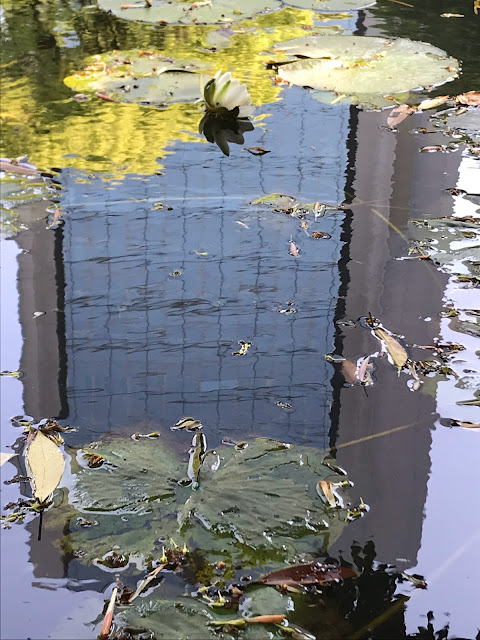
There's no escaping that this is a garden surrounded by a high-density city. The ambience was tempered by the noise of a neighbouring amusement park rollercoaster and a concert in the adjacent Tokyo Dome. Not to mention it was hard to keep the buildings out of some photos, but here I really liked the reflection in the pond.

You've made it this far: well done! This day was not my typical idea of a rest day, but I did come away feeling filled up and refreshed. I got to hang out with a friend and talk about the various things going on in our lives, I got to see a tiny bit more of this amazing city, including some beautiful green and even amazing man-made structures (though a tree will usually trump a building for me).


21 February, 2020

Hidden reasons

The older I get, the more I realise how much what you see is different to what is really going on. And I'm quite convicted, because so often I judge others by what I see, without knowing the bigger story.

This is tricky to write about because I have a big elephant in the room that I want to write about as an example of this, but I really shouldn't write about it because it will invade that person's privacy. So let's go with some common fictional situations:

  • a toddler who loses it in the grocery store
  • a young adult who is sullen and rude
  • a friend who can't seem to meet the goals she's set herself
  • the quiet man in the corner of the room
  • the colleague whose capacity to get stuff done is way less than yours
  • the lady who appears antisocial
Oh, myriad examples. You know what I'm talking about. Behaviour that seems odd, or even unreasonable, that you don't understand and that is easy to judge.

What I sometimes (often?) forget is to stop and think is:

What's going on behind the scenes that I can't see?

There are many legitimate reasons for the above behaviours. From tiredness, poor organisation skills, or personal preferences; to the much more serious: mental health problems, traumatic life experiences, or serious physical illness.

The kicker is that most of the time we don't know why. Unless we know their backstory we don't know why that person is behaving like they are.

I've been on the receiving end of overt judgement from others, especially in relation to my children and our parenting decisions. That's hard. It's actually harsh. Sometimes it's possible to explain why such and such a thing is happening, but even then, it is usually very difficult for someone else to imagine walking in my shoes.

And I really shouldn't judge others for their poor judgement of me. I might not be guilty of saying my judgement out loud, but to my shame much judgement goes on in my head.

So back to my elephant. There are things about the way our family operates that I can't share with many people, and even the people I do share some things with have trouble fully understanding. You can speculate if you wish, or you can just accept that we are very deliberate about what we do. We make choices looking at the full hand of cards that only we can see. And sometimes those choices seem odd.

People look at missionaries and (sometimes) think "aren't they brave?" But they don't see the non-public times. The sheer exhaustion after an international move, or even the daily fatigue from operating in another language and culture. The self-doubt as we question our decisions. The fear as we wonder what the future holds.

Parenting as a cross-cultural worker is very challenging. We have no extended family to help us—though I know that many in our home countries are in that situation also. We're negotiating our way through situations that our parents never had to (and I'm not talking about screen-time here). We're trying to guess what the best decision is, when even small changes can impact our work, or even our ability to remain in the country we serve in. And we have few peers who are like us. 

It's a vulnerable situation, parenting in this way. Lots more people are watching us, more than would be if we'd never left the place we grew up in.

Please don't think that I'm in a bad way right now. I'm writing from a fairly strong position at present (though there are people I do avoid because of their capacity for quick judgment and slow listening). I'm writing from the experience that comes of having lived cross-culturally for over 19 years now. But don't fall into the trap of thinking that all is hunky-dory because I share photos of my family's public successes. And I'll try not to assume the same of you.


04 February, 2020

Looking like an idiot

I've been doing some heavy editing recently and my head is a bit heavy. I think writing a little today might be something of an antidote. Besides, I've got a good story to tell you...

I saw an article today called "Four rarely mentioned (but essential) missionary qualities". These were the qualities:

1. A sense of adventure
2. A sense of humour
3. A willingness to look like an idiot
4. A high tolerance for ambiguity
Generic photo, not from Japan...those number plates are wrong.

I'm not sure if I have all of these, but having stuck around for nearly 20 years, perhaps I do?

Let's see if I can dig out some examples, but I'm going to change the order:

A high tolerance for ambiguity
This is huge in Japan. Not just that we're in a culture where we don't understand many things, but the language and culture itself is full of ambiguity. In Japan people often learn by observation, rather than being explicitly told what to do. Living as a foreigner in this land that is multiplied many times. My observational skills are far better than they used to be, simply because that's often all I've got to make it through a situation. 

When we have visitors, they often ask many questions and we often don't have good-enough answers for them. We can't seek answers to all the questions that arise from what we don't know: we simply don't have the energy or time to do that. So instead we learn what we need to do our business and live our lives, and most of the rest has to just be left to one side.

Sense of adventure
I wouldn't characterise myself as someone particularly adventurous in the traditional sense of the work. I'm am not a big risk-taker. But from where you stand, what I do might look like an adventure, though it doesn't feel like it. However, I think probably our camping reveals our sense of adventure. Wading into the world of wrestling as we have is probably an adventure that many wouldn't care for. Travelling Tokyo trains can be an adventure...that's true!

A sense of humour
Missionary life (and life with teens) can get quite serious. But the willingness to laugh at oneself and at the odd things going on around you is pretty important. I guess one example of that is seeing interesting English or a funny meme or video. I do love to laugh and am happy to do so at myself. Most of the time I'm happy to tell the stories of when I've messed up, and have a laugh.

A willingness to look like an idiot
This is connected to the one above. I guess I often look like an idiot here, whether willingly, I'm not sure! It's common to not know what the protocol is for this or that. Or to get into trouble because you can't read something fast enough. 

This happened to me just last Friday. I drove with a friend to our "local" Costco, about an hour away. It's usually a stressful trip because it involves negotiating around a crowded shop with a large trolley, spending lots of money, and takes a good part of a day. But last Friday another layer of difficulty was added. In fact, it felt like I was in an international airport—there were so many things I needed to keep track of. 
A. My membership card: which was needed to get in, as well as to buy my groceries. 
B. My receipt for groceries: as they check this at the exit.
C. My receipt for the whole pizzas I bought at the restaurant: so I could collect them once they were made.
The above is usual, it was the fourth and fifth that threw me over the edge:
D. Car park ticket: the car park is usually free, but this time they had the gates activated and we had to take a ticket to get in. I presented it at the cashier when I bought my groceries where I got E.
E. Another car park ticket: I had no idea what this was for, but it seemed important and had an all-important stamp on it, so I put it in my purse.

After lugging the full over-sized trolley back to the van and loading everything into it, we joined the line to get out of the car park. There isn't usually a line, so it was strange and frustrating.

When we got to the boom gate there were three buttons on the machine, two yellow and one red. Plus two slots: one for the ticket, and one for money. We'd been waiting about ten minutes to get here and knew that the people behind us were also probably frustrated. So there was time pressure. 

I couldn't quickly read anything on the ticket machine. So I thrust one of the two car park tickets into the slot. It told me I owed them ¥1,000 (about AU$13.60). I wasn't about to pay that! I'd just spent hundreds of dollars buying groceries and the sign at the entry said that entitled me to three hours free parking . . . so I pushed another button and the ticket came out and I tried the other ticket. Then the display told me I owed them ¥6,000. I then pushed another button, in fact I probably pushed all of them one after the other, over and over . . . I can't remember now.

There was no obvious call button, and no staff member lurking nearby. The car behind me started to beep his horn, but didn't back up to let me unblock the single exit lane.

I am so glad my friend was there. Her presence helped calm me, but my cool was pretty much gone. Finally, two men approached our van, one on either side. They told us you had to put both tickets into the machine. Bingo: the boom gate rose and there was great relief all round. Belted into my car, I couldn't bow deeply in apology to those stuck behind us, but I wanted to.

I can't say that I was willing to look like an idiot. In fact I hate looking like one. But I find it easier to cope with that in Japan than in Australia. My white skin betrays me time and time again. But it does give me an excuse to mess up on occasion. I'm not sure the men who helped us would have been so patient with a woman who looked Japanese. 

Our foreignness got us off the hook, but in Australia it doesn't. Every time we go back we get odd looks at one time or another when we reveal our "foreignness" with a "stupid" question or lack of understanding of a situation. Our white skins don't save us there, nor do our Australian accents!

But back to those four characteristics. I don't know that I'd be known by any of them, except perhaps the humour. However, we have had to grow in each of the others. An ongoing sense of call, a strong desire to make an eternal difference, meaningful work we're gifted in doing, and a dogged stubborn streak has meant that we've stuck around.

22 May, 2019

Looking back at last week's retreat

More than a week ago I wrote about going to a spiritual retreat. I guess I should get around to letting you know how that went.
The cabin I stayed in. It can accomomdate about nine in
beds, there were just two of us though, one upstairs and
one down.


This retreat was actually closer to the true meaning of its name than other retreats I've done in the past. Yes, other retreats have been a "withdrawal" from everyday life. But generally I've come home at least as physically tired as I left. I may have been refreshed spiritually and socially, but tired from the intenseness of being with a lot of people and a generally busy schedule.

This retreat was much smaller (12 people, plus the facilitators) and the intent was much more about rest. On each of the two full days (not Tuesday or Friday, the part-days) we had spiritaul input in the morning and free time all afternoon and into the evening. Our accommodation was also arranged spaciously, so if you wanted time alone, that was easily achievable during free time.


View from my bed.
I was, as I'd expected, very tired when I got there. I even found it hard to concentrate much on what was going on in some of the sessions. In some ways it would have been good to do less of the input/interaction time at the start of our "long weekend". On the Tuesday we travelled there after lunch and then had sessions from 4.30 till after dinner. My small group was still sharing about "where they were at" after 9pm and I struggled to keep my "nice face" on.

Wednesday morning was focused a lot on the problems, stresses, and griefs of our lives, especially in cross-cultural work. It was good to name it all, but also a bit overwhelming in the number of challenges we face. 


My kintsugi pot.
This culminated in an activity that provoked strong emotions in some. It's an Japanese method of mending broken pots with gold called kintsugi. According to this article, it began in the 15th century. The activity we did was a poor-man's version, as in we didn't use real gold, of course! But we did have to smash our own pots, which in itself was traumatic and far from easy. Some pots smashed too much and were super hard to put back together. Mine didn't, so I was rather quickly able to glue mine back together and paint over the glue with gold paint. I found it a bit troublesome to watch others (we were seated in a u-shape) try to fix theirs. The missionary beside me got a bit distressed. However, not only could I not help her, it was a silent activity, so I couldn't really encourage her either. Being both an encourager and a helper, I found this difficult to cope with. After a bit I put on another familiar hat and wrote down some of my thoughts.

I took it easy on Wednesday afternoon, reading a novel on my bed for a lot of the time. Wednesday night many of us joined in lighthearted board and card games.


Games, puzzles, and imprompu karaoke.
On Thursday morning we spent a lot of time dwelling on the Trinity and God's love for us. That was good, but I found it overwhelming after a while. A tiny bit like some of the scenes we see in the Bible where people see a bit more of who God is than they are able to handle. (See Isaiah 6 and Revelations 1). Nothing close to what those two passages mention, but a sense of the love of God being way too big for me to grasp to the point where I could barely even think about it any more.

Thursday afternoon I wasn't so lazy, I went for a 45 minute walk and also spent over an house in a "soul-care" conversation with one of our facilitators. Thursday night was a campfire. No, we didn't sing Kumbaya, nor did we have any majorly deep conversations or testimonies, it was mostly a fun time together. Probably what I needed! Confession: I did tell some camping stories, including that time we accidentally went camping in the snow ;-). 

One of my reflections on the retreat is that missionaries don't often have lighthearted stuff in their schedule. The needs are great and we can lurch from serious day to serious day without much break. I think that's especially the case in Japan where even hobbies are taken very seriously! It was great to have the "excuse" to have fun.
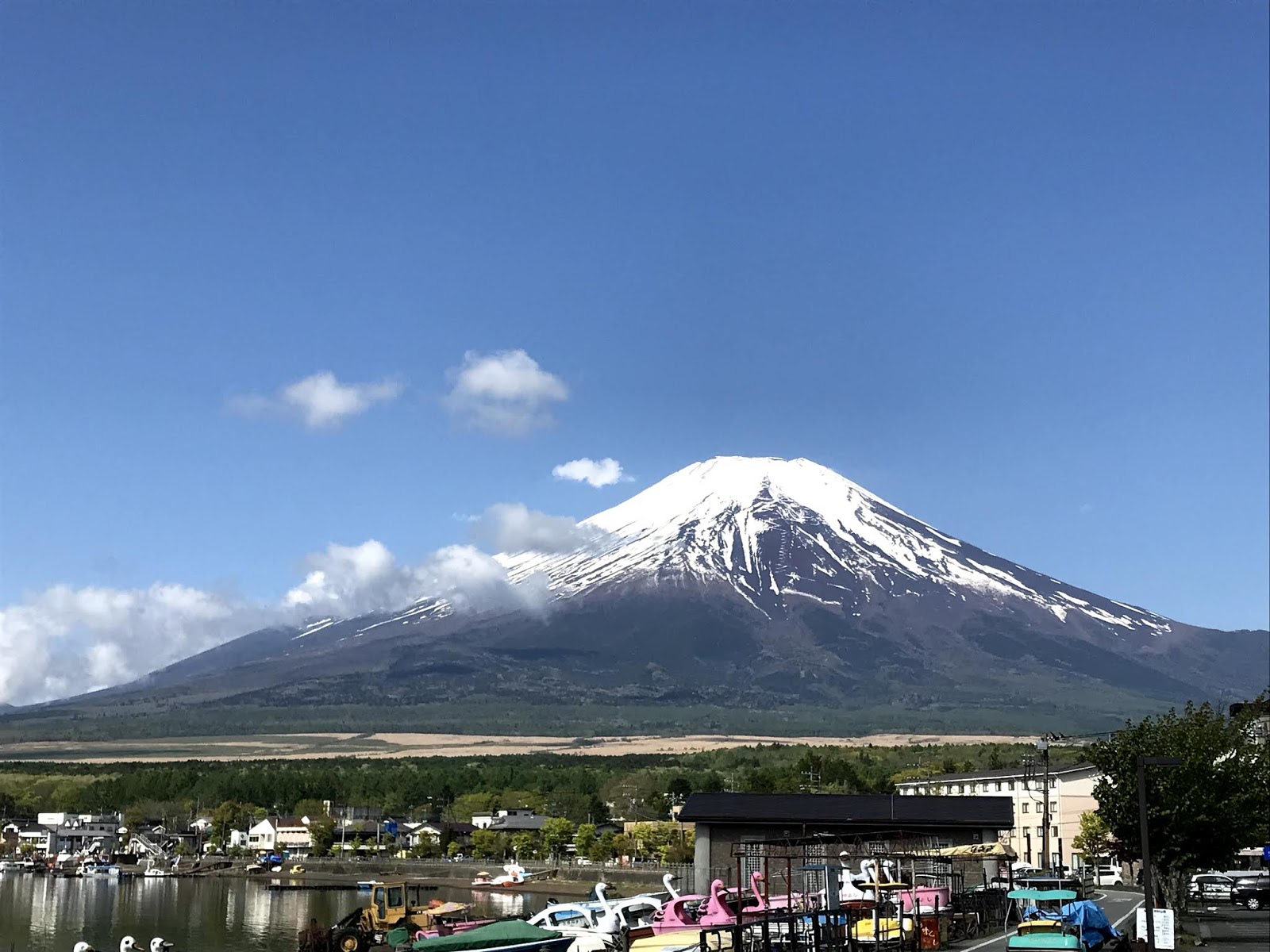
The mission holiday compound is almost wedged between the lake and Mt Fuji.
And entirely delightful (yet cool) place to be.


Most of the week Mt Fuji looked like this during the day (I
was told by early birds that it was often visible early).

On the last day the clouds cleared and Mt Fuji appeared in all its glory.

Another lake view from in front of the property.
There is a pathway around most of the lake. I walked a short way on Thursday:

I have definitely come back more rested than before I went, so just in that it was a worthwhile adventure. I'm left pondering if I can build something into my life on an annual (or more frequent basis) that wouldn't cost too much, yet would provide time to both rest and dwell on spiritual matters more deeply. Still pondering that.

Have you ever done a spritual retreat? How was it structured? What did you think about it? I've avoided doing one up till now for a couple of hard-to-articulate reasons, but I don't think it's so bad a thing. I'm not so sure how I'd deal with a "silent retreat", though.


02 April, 2018

Building resilience in middle age?

Building resilience in children is a popular topic these days, but this article by Tara Parker-Pope rightly asks, what about adults, can we build resilience too? The answer is yes, and perhaps we even have an edge over kids, just because we are often better at things like regulating our emotions and have a broader perspective on life because we've got more life experience.

The article has some good suggestions for how to speed our emotional recovery when life hits you with challenges.
And of course I would select a wrestling photo. Resilience is one
thing that a wrestler needs in spades! You won't go far in most
sports without it, actually.


  • Practise optimism. Look at a bad situation in a more hopeful way, hang out with optimistic people. I generally don't find this too hard as I'm an optimistic person, but I can imagine some would struggle with this.
  • Rewrite your story How we talk to ourselves and others about our struggles affects how we cope with them. For example, I could be saying "woe is me" about our son moving to Australia, however, I'm deliberately focusing on this being a great opportunity for growth in him (and us) and that this is what we've been preparing him for for the last 18 years.
  • Don't personalise it. This is one I struggle with. I tend to blame myself when I've made a mistake or something I've done has caused the problem. I struggle with perfectionism and am sometimes too conscientious. This quote from the article is helpful: "remind yourself that even if you made a mistake, a number of factors most likely contributed to the problem and [then] shift your focus to the next steps you should take."
  • Remember your comebacks. This is where a bit of life experience comes in handy. Remind yourself of when you've had tough times before and gotten through them.
  • Support others. A strong network really helps. But apparently you can get an even bigger boost in resilience by helping others.
  • Take stress breaks. I'm sometimes good at this, sometimes not. Depending on the situation. Parker-Pope suggests things like a walk break, lunch with a good friend, or even a five-minute meditation. Muscle growth occurs during the rest time following training (or stress), same for our emotional strength.
  • Go out of your comfort zone. Yeah, well this isn't hard to do in our expat lives. The author suggests things like taking an adventure vacation (camping, anyone?"), take up a new sport or craft.
I would add a couple of suggestions:
  • Remember when God has helped you in the past.
  • Have a healthy, balanced lifestyle as much as possible: eat, rest, play.
Most of all, keep your eyes on Jesus. Honestly, Scripture and song steeped in Scripture have been my go-to when life gets especially tough. Some of the comments on the above mentioned article point out that when life gets really hard, these coping mechanisms just don't hold you up sufficiently. I would say in answer to that that's because there's a spiritual element that's missing. You can't do it on your own, though many try!


17 November, 2017

How about managing stress?

I've really not had much time here to write my own stuff today. I seem to be spending a lot of time with other people's work . . . I guess that's part of my job and I'm not really complaining. It's great to have a skill that I can use and enjoy doing.

At times like these I look at my "draft" blog posts. I've got nearly 100 of them. Many of them are simply a link that I've found and pasted into a blog post for future use. Here's one I found recently: http://www.alifeoverseas.com/managing-stress-overseas/

This is simply one person's list of what she and her family are doing to keep stress under control in their household in Indonesia (she's quite a mix of cultures herself). It includes sleep, hobbies, exercise, and thankfulness.

The question she ended her list with was: "How about you? What routines have you found helpful in managing stress?"

Well, here's my current list in no particular order, and probably not exhaustive:

  • try not to look at email after dinner
  • try to get regular exercise, including bike rides to parks with my camera
  • get to bed before 10 most night
  • rest in bed on Sunday afternoons
  • do at least one card game (Spider) on my phone each day, sometimes I also get to do a  Sudoku challenge and Words with Friends games
  • schedule evening meals, including one or preferably two left-over-type meals
  • read good books before falling asleep
  • watch a TV episode with my husband in the evening
  • take time regularly to have coffee with friends
  • meet about once a month with a good friend over Skype
  • take time to recalibrate spiritually on my own at a coffee shop when I need to (mini retreat)
  • go camping periodically
  • take holidays during the summer and at Christmas
  • get massages and don't feel guilty about that
  • get out of Tokyo when we can
  • not feel guilty at saying no to things that I know I'm not good at
  • try to burrow back in my thoughts and figure out why I feel upset, or angry, or unsettled, or any upset of my usual balance (it's usually a small trigger, but figuring it out is helpful)
  • writing this blog!
Phew. That's a lot. Am I high maintenance? 

I've been struggling with headaches this week. I'm not exactly sure why. I have many triggers for headaches, including stress but I don't feel especially stressed at present. I hope that next week is better.

So, what about you? What do you do to manage stress? (You don't need to write as detailed a list as mine!)


27 June, 2017

Some keys to living overseas

Free photo from pixabay.com
There are lots of things that are challenging when you move (or even travel) to other countries. Some are more obvious than others. For example, eating breakfast can be a challenge or being able to get around in a country where you don't speak or read the language are pretty obvious.

Here are a three less obvious challenges I've been reminded of in recent weeks.

Not knowing or understanding
The total sum of what we understand about Japan is much less than Australia, it always will be. Additionally, on a daily basis there is a lot less that we understand about what's going on than we do in Australia. I can't read all the signs, I don't get all the jokes. I'm pretty ignorant in many ways, compared to the average Japanese citizen, about life in Japan. That's something you need to become at peace with in order to live here long-term (although possibly I'm too relaxed about it).

Trust
We also need to have a trusting attitude, rather than second guessing everything, thinking that we know better. Some cynicism is good, but too much is unhelpful for being able to live here long-term. Not trusting produces increased stress. In order to survive here, I have to be fairly trusting, especially seeing as I don't have all the information that I might otherwise have had access to in Australia.

For example, I often don't understand everything the doctor says to me. That would be totally unacceptable to me in Australia, but here I do my best and get the essence of the important stuff: diagnosis and treatment. That works in a relatively simple medical situation. I may not know exactly what medicine I've been prescribed, but that's (generally) okay.

Not black or white
I read this recently in a blog post about resilience
Sue Takamoto wrote of a transformation that takes place in successfully adapted missionaries—“a move from black and white, egocentric thinking to an ability to become more flexible and open.”
This is so true. Things that are done differently here to my home country aren't wrong because they're different. They might be strange or mysterious to me. They might even be less efficient or inconvenient to me, but a willingness to accept them anyway is needed to stay sane if you're living here. 

For example, if I got upset because I had to wait an hour for a simple medical test result because there was no appointment system, that wouldn't help my stress levels. I'm not hankering after the medical treatment I might have had in Australia, because here is where I live. And of course that ties in with trust and not-knowing. I trust my doctor here, even though I don't understand everything he says.


Over the years I've seen foreigners struggle with these three things while in Japan. Because we've adjusted to living here long-term, probably people who've spent their whole lives in one country struggle to understand us now too.