Showing posts with label challenge. Show all posts

14 November, 2022

Discovering I've got a skill I didn't realise I had

Me in my comfort zone
In the last week or so, I think I've done more writing than editing! It been an unusual period, but I'm not unhappy, I do enjoy writing. However, I did get pushed outside my comfort zone. In order to attempt to solve a lack of content problem with our magazine, I asked our Japanese pastor if he'd consent to an interview (in English). He agreed, and promptly found three other people I could also talk with about the topic at hand. So on Tuesday afternoon, I spent about two hours interviewing Japanese people. The second hour was mostly in Japanese and stretched me greatly. They had a lot to say, and I didn't catch all of it, but I have enough to write the needed article. [Ironically, I've ended up with the opposite problem—after I implemented a few other strategies to find more articles, we now have more than double the number of potential articles than we need.]

I've been working in publishing for over 10 years now, but I've always avoided doing interviews. I'm not sure why, but I thought it's something I'd probably not be good at. Maybe I'm thinking about the sort of journalism that is intrusive or controversial, or requiring the journalist to do "cold calls". I'm just not that sort of person.

However, I've discovered that I've had many years of learning to ask questions of others, of learning to draw people out. Not for the purpose of writing about them, but just getting to know them, or simply to enjoy their company when we've been together for some reason (like a car journey, or as volunteers, or eating together at a group meeting). 

I've also spent many years living with non-chatty introverts and have worked at facilitating conversation at home. These interviews, in comparison, was easy. My questions were welcomed, and the interviewees wanted to talk. It would have been a lot easier if my Japanese had been better, but I was with our bilingual pastor, so he's helped me a lot.

I'm happy that I discovered this and that I consented to be pushed beyond my comfort level. I'd hate to be starting to plateau in my middle age! I want to continue to grow as a person. I'd like to continue to find opportunities to practise this newly discovered skill (as well as figuring out how to write a 1,500 word article from an interview).

But, reflecting on the last few years, I've been continually pushed beyond my comfort level, but usually not by choice. Mental illness has become part of our everyday lives since before 2018 (we only got the diagnosis that year, so could see it for what it was)—that's definitely pushed us out of our comfort zones. I never anticipated that any of my boys would struggle to complete their studies, but we've had that experience now too. Watching our older two struggle to find their way into adult lives has been really hard, and we've needed a lot of grace to walk alongside them through this stage, and it's certainly not over yet. It's all left me feeling a bit vulnerable and shaky.

But, of course, missionary life is continually pushing us past what's comfortable, more so than perhaps might have happened if we'd never left our native land. But as I said to a newer missionary early last week—I think that this is a privileged life. Not that it isn't hard, but we keep encountering challenges as a result of what we do that push us to depend on God, and on others. Whereas otherwise we might have been much more self-reliant, we've been frequently cast upon resources that we couldn't conjure up ourselves. And experiences like that make you grow.

I was surprised to have a friend who knows more about me than most write to me that she has been observing "a positive shift in me from anxiety and feeling isolated to coming to peace with what is and inviting others into a space of being honest and vulnerable." I can't especially detect that myself, but am glad to hear that she senses this. Apparently God's been at work in me during the "grit your teeth and get through the day" times that I've had in the last few years and I'm glad.

I feel like we've hit a little bit of a breathing space, a bit of light in the tunnel. But the next big challenge is coming at us like a freight train: home assignment next year. Just the other day I wrote two emails one afternoon about pencilling in dates for later next year in Australia—that's a tiny bit scary. And we've already been working on downsizing, that's what the bazaar helped with last month, but since then we've given away more of our stuff too. 

But if I keep in mind that through it all God has never failed us, that he's always with us, and not only that, but he's growing us through the challenges. That as a result of all the "out of my comfort zone" we're going to be better people. When I remember this, then I'm calmer.

Here are a few Bible verses I've found to remind myself of (and maybe you too), that God is at work in us:
No discipline seems pleasant at the time, but painful. Later on, however, it produces a harvest of righteousness and peace for those who have been trained by it. Therefore, strengthen your feeble arms and weak knees. 'Make level paths for your feet,' so that the lame may not be disabled, but rather healed. (Heb 12:11–13 NIV)
And this was in Paul's prayers for the believers in Philippi: 
In all my prayers for all of you, I always pray with joy because of your partnership in the gospel from the first day until now, being confident of this, that he who began a good work in you will carry it on to completion until the day of Christ Jesus. (Phil. 1:4–6) 
For it is God who works in you to will and to act in order to fulfill his good purpose. (Phil. 2:13)
And Romans 8:28 of course: 
And we know that in all things God works for the good of those who love him, who have been called according to his purpose.

And of course "for the good of those who love him" doesn't mean God's our genie in a bottle. It means that God is working to make us more like Jesus, more likely to do things that glorify him and achieve his purposes in this world.

That same passage in Romans goes on to say we can't be separated from God's love, nothing and no one can do that, not hardship or danger or distress or poverty or criticism or even death. So therefore, we should live as ones who have nothing to fear (preaching to myself again, for surely there is more fear in me than I'd like to admit).

Okay, I didn't expected to end up here when I started writing this blog post last week, but here we are. I need to get back to various other writing assignments and emails (and all those people I have to write "no-thanks" emails to for their magazine article proposals). Next blog post I want to write about an unsung hero I learnt about yesterday. A man after my own heart.

18 November, 2021

Milestones for older kids

When kids are little we celebrate them being able to walk, to talk, to use a pencil, and to use the toilet on their own. As they grow they learn to take care of all their hygiene needs (my boys took way longer to achieve this than I thought it would, specifically, willingness to shower without prompting). 

An interesting perspective. Likewise, we
need perspective when we're parenting.

But gets blurrier as they get into the teen years. Walking is pretty clear cut for most kids, it's around 12 months (mine walked a full two months earlier!). But as they grow you gradually realise they are on a time schedule that you don't know much about. There's a lot of stuff that needs to slot into place for them to become fully independent adults, but that arrives at different times for different people and in different cultures and situations.

Higher level skills include time management and self-management. They learn to get themselves up on time and take themselves to bed, to get schoolwork done and find time to spend with friends outside of school. They learn to organise their things, to shop, and to get themselves places. They learn to advocate for themselves and ask for help, to seek medical care, and make appointments. They learn to manage their emotions and who to trust. They grow in willingness to do necessary tasks to maintain their living environment. They learn to plan ahead a longer distance and make big decisions about their lives. They also learn, sooner or later, how to act as an employee.

We adults all struggle with some of these things to one degree or another. But they are all skills important for living as an independent adult. But teaching them to our kids isn't necessarily easy. Some kids do pick up these things easily, but others struggle and as a parent you aren't always ready for that. I have to admit I kind of expected that these things would come naturally, but so far not all of these things have been natural for each of our boys. However there has been variation, just like there is for learning to walk and talk.

But no one really talks much about this. And you can bring to the parenting "table" the assumption that if your kids pick up these things quickly and easily, then you are a good parent. Indeed, perhaps, a better parent than others. Obviously, when I write it out in black and white here, it's a skewed view of self, but it sneaks into our thoughts about ourselves.

So, I'm here to say to you parents of older kids—stick at it. This is challenging, in different ways to when we were teaching them how to wipe their noses (which also took a long time for my kids, though I can no longer remember how long). And try to keep your eyes down, don't compare your kids to other kids. Don't equate your own "success" or "value" with your kids quickly achieving these milestones of independence.

Here are a couple of quotes from a book I read several years ago (and should probably read again): 

Parenting, like all tasks under the sun, is intended as an endeavor of love, risk, perseverance, and above all, faith. It is faith rather than formula, grace rather than guarantees, steadfastness rather than success that bridges the gap between our own parenting efforts, and what, by God's grace, our children grow up to become. (This actually comes from Leslie Leyland Fields, , "The Myth of the Perfect Parent," Christianity Today, January 2010, 27.)

And: 

No parent, no matter how dedicated, expert, present, and loving, can produce a perfectly healthy and happy adult. Such a feat is simply not within our power.


25 September, 2021

Feeling a bit buffetted


I think it's been nearly four months since I rode to the big park to the south of us. I made it there on Wednesday for a solo picnic. I’ve had a lot of Zoom time in the second half of this month. So when it dawned on me on Wednesday morning that I had a small window where I could escape from the house (and work), I seized it. 

Even though we’ve had some hot days this week, the season is definitely early autumn. Nights have cooled down. In the park some of the leaves are starting to change. And though Wednesday was a warm day, it was a tad cool in the shade at times. 

As I always do before going on a longer ride, I'd checked the weather and there was no forecast of rain. But as I got closer to the park, the sky got greyer and the wind stronger. Had the forecasters made a mistake? When I arrived, I pulled up my trusty weather app and looked at the radar. There was a small thunderstorm headed my way! So I parked myself at a table near a small non-ornate gazebo and ate lunch.

Thankfully it never did rain, though it looked like it could for quite some time. The sky eventually cleared to the white puffy clouds we’d started the day with.

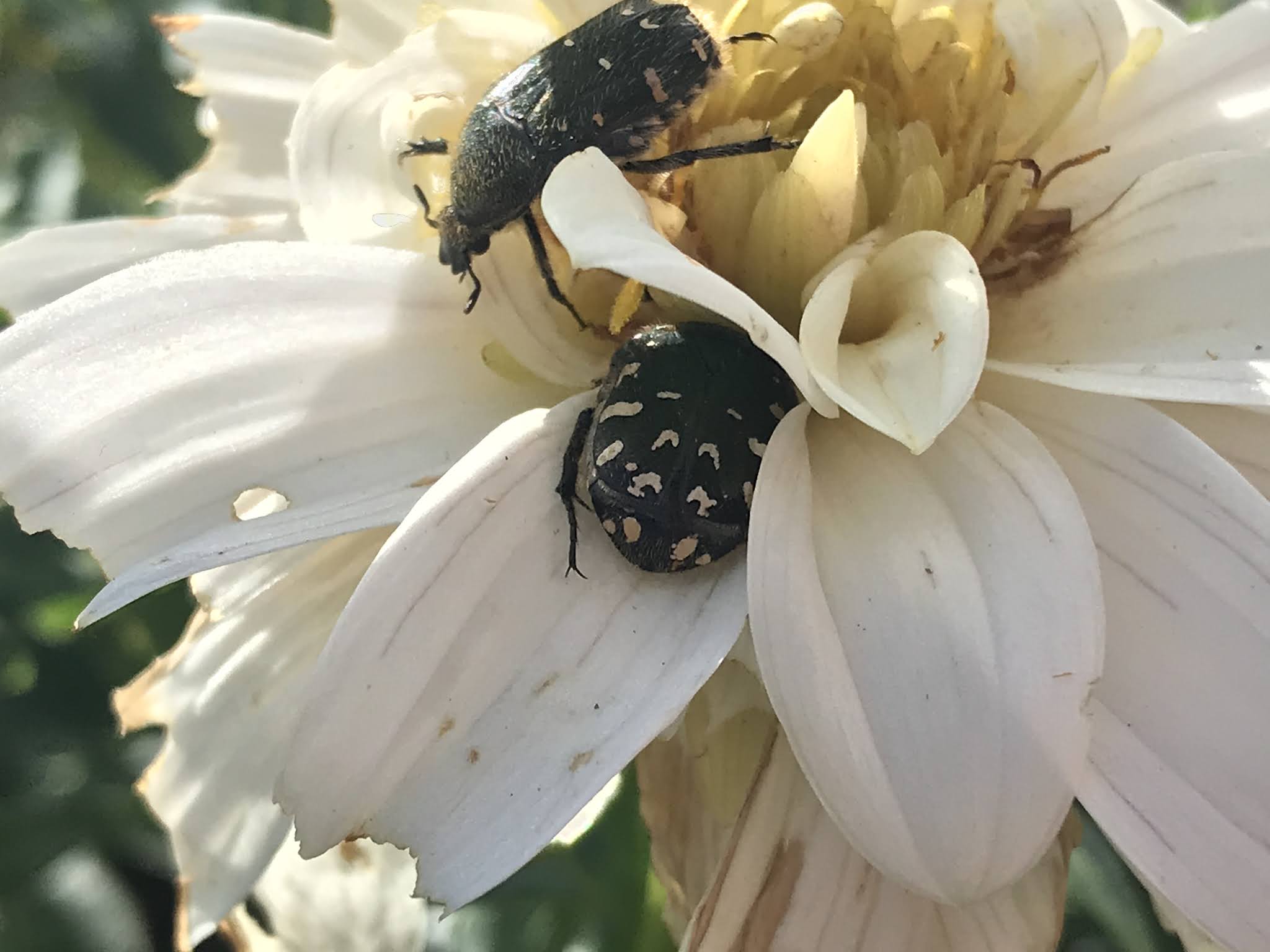
If I'd hung around longer, I might have gotten
better captures of these two bugs who were
very intent on harvesting the remains of this
past-its-prime flower. I think they are Middle-east 
flower scarabs.

After I ate I read for a while and then took some time searching for photos, having been inspired by a nature photography seminar I participated in the day before. The seminar encouraged us to take our time, to breathe, to be renewed as we looked for things to photograph. I have for some years now been on the lookout for things to capture, often small or unusual things or angles, but mostly opportunistic things. That is, as I’m out and about doing other things. It was good to take a few minutes to change focus a little bit, to feel like it’s more than okay to do that. In the midst of so many video calls and intense interaction, it was very good to be out in the fresh air, and away from buildings and people.

But this morning, as I sat in my relaxing chair in our lounge room, rotating between various activities: Scrabble, game on phone, Japanese vocab and kanji (character) review, I’ve been reflecting on the last couple of weeks and wondering why I’m feeling a bit buffetted. I think it’s not just the busyness of those days, but also the emotional highs and lows. And a list is good to help explain that, so in the last two weeks I’ve—

    Light was difficult for capturing this ant,
    but I tried.
  • Led nine hours of meetings with my magazine team over two days. This was an emotional high, but also a heavy responsibility that exhausts me.
  • Sat through two days of online field conference, during which we farewelled ten colleagues who are retiring in the coming year and brought tears.
  • Interacted in person, via text, and on video calls with a handful of friends and colleagues who wanted to know how I really was, and I got mixed responses. One of which really disappointed me and others that really lifted me up.
  • Had to share briefly in a small group of OMF colleagues about the challenges of the last 18 months. I know none of these people well, and wasn’t sure how much to share. It turns out my brief summary was enough to make them feel like they had nothing significant to share :-( So I felt that perhaps I did have reason to be feeling a bit overwhelmed and tired, if other people, who hadn't heard most of the details, are taken aback.
  • Made a small step forward in planning for the next few months for a member of our family. It was a small, but significant step that had me feeling elated.
  • Low-key celebrations of a birthday and our wedding anniversary.
  • Led a prayer meeting online for our mission. At night, which is a challenge for me.
  • Had an article published in the US that was quite personal (it’s here). It was great to have a writing opportunity, but also emotional to get my thoughts out there.
That’s probably enough! Yes, I think there are a few reasons there to feel like I’m a bit depleted. So in retrospect I see that the couple of hours I was able to spend in the park on Wednesday was a real gift from God. As is this quiet weekend. And no, I’m not going to be an overachiever today. I think sitting quietly is really okay, otherwise I’m probably going to end up saying something to someone that I really will regret (a classic sign of exhaustion for me).

So, here are a few photos from my God-given time out.
  • Summer cypress

    Balloon flower.

    Not exactly where I sat to eat and read, but close by. You get the idea that this park has
    some lovely tall trees, and more than a few.

    A dahlia, I think, reaching for the sky.


19 October, 2020

Fixing my eyes on Jesus

Yesterday I read a chapter in a book that's been sitting on my bedside table for a few months now: Enjoying God: Experience the power and love of God, by Tim Chester. The chapter mentioned fixing our eyes on Jesus. It's a concept that I return to time and time again in my life, so it was good to think about it again with some concrete ideas on how to do it. Simply: remembering what God has done, what he continues to do in us and around us, and what he's got planned:

You can look back to his work on the cross; you can look up to his presence in heaven for you; and you can look forward to the day when he returns for his people. (Chester, p 84)

I'd completely forgotten my 2014 goal of blogging once a month on one of my favourite Bible passages: Hebrews 12:1-3, but it came up when I did a search of my blog before I started writing a new blog post today. In June that year, 2014, we went on our third home assignment. At the start of the year I knew it was going to be a challenging year, so the challenge of focussing my thoughts and words on this passage, was important. I ended up only writing six times (though I've blogged about or mentioned this passage numerous other times through the years, for example here).

2014 blogging on Heb. 12:1-3:

Today was a difficult day. I had goals for the day—a long To Do list for work, on which very little got done because a couple of other urgent matters arose that I had no control over. So when I rode in the rain to get some groceries, it was good to remember that chapter I read yesterday and ask myself some questions:

  • What's unchanging here? God! He's God whether or not I do what I'd intended to do. He's God even when things don't go the way I want them to, when the future looks murky.
  • What's my ultimate goal? That I serve God wherever I am. If that means doing something other than what I'd planned, then that is okay too.
  • What is my hope based on? God, it all comes back to him. No one else is the Rock on which I can base my hope (Psalm 18:2,31).
While I rode my bike along a familiar route and peered through the raindrops on my glasses, it was good to remind myself of these foundational things that my faith is based on. And that is "fixing my eyes on Jesus". Do you have a recent story where you deliberately focused your eyes on Jesus?

15 July, 2020

Seven-book-cover challenge

Quite a number of weeks ago there were different challenges flying around social media, when some people had a lot of time to spare and time to reflect. One of them was seven-day book covers, and alas I got "tagged". However, typically, I wasn't keen on doing it the same way as everyone else, "no explanation" is really very boring. It's easy for the person posting, but not that interesting for those who see it, who (if they are like me) want to know why the person has picked those books. 

The challenge was to post the covers of seven books I love. Quite a challenge for someone who reads as much as I do. I'm reading about two books a week at the moment, and most of those are books that have more than 300 pages. 

So, here are eight! With short explanations of why I love/loved them. I can't say categorically that these are the books I love the most, but they are loved. For some of them they represent a genre or a series of books that I love. You'll get the picture. This is largely a chronological list.

Both this and the next "Billabong" were favourites of my childhood that I've read to my kids. They are also parts of a series of books.

The Muddle Headed Wombat is a fabulous book, probably if it was published today it would be called a "Chapter book". There are three main characters: Wombat, Mouse, and Tabby. Together they have fabulous, hilarious adventures. I love the language. All three characters have interesting character flaws and Wombat in particular has a fun way of speaking.

The Billabong series is an enduring favourite of my childhood. Quite possibly the books that I've read most number of times. My maternal grandparents bought the most of the series and gave them to me bit by bit over several years: birthdays and Christmases. I looked forward to the next instalment each time and also re-read the whole series from the beginning each time. My grandparents have now long passed away and I treasure these books as many of them have the spidery writing of my grandmother on the first page.

It's a story of the Linton family, who live on a property in Victoria the early 1900s. The main characters are teenagers at the start, Jim and Norah, their dad (mum had died), and Wally, Jim's friend from boarding school in Melbourne. The books follow the family through the first World War (when they go to England). I love historical fiction and this really gives you a sense of what it might have been like to live in rural Australia back then. I grew to love the characters and the books still make me cry because not only do I love the characters, in most of the books at least one of them is on the point of dying, but there is plenty of hilarity also. Wally is a lighthearted chap, and the three have a lot of fun. There are very few fiction books that I will re-read, but these I will.


As a 20 year old I went on my first overseas trip. A mission trip to Indonesia. It was a study tour, actually, we weren't there to do anything except learn. It was a lot of hard work, but we did learn a lot: both book learning and practical learning. We learnt about some of the practical challenges of missionary work (eg. sickness, diet, language). We saw different religions and talked to missionaries about what they did. We saw various churches and ministries. We also had to read and do presentations. We were given responsibilities for the team. All of these were important parts of the tour and I learnt so much about myself, about mission work, and about God.

Second-Mile People was the book I was assigned to read and do a report on. It was very challenging. I'm short on details (that was more than 25 years ago). But the book challenged my thinking about living a comfortable life, about what I would do for God if he called me to mission. Reading that at a time when I wasn't particularly comfortable was very challenging. That trip and this book were key steps on my journey to becoming a missionary. Isobel Kuhn is not a modern writer, but she's worth seeking out.


This book is also one of a series. I discovered this Australian author when I heard her interviewed on the radio on one of my long car journeys in my early 20s. I've loved her ever since. This series is historical fiction of the Roman Emperor, around Julius Caesar's time, an era I enjoyed in my yr 11 and 12 years studying Ancient History. The series is challenging because it is stuffed full with details and many characters, but thoroughly interesting. 

The author is amazing, although sometimes a bit too crude for my taste. I've got a lot of her books. They aren't all historical fiction, though I do love her Morgan's Run, which is historical fiction, a saga about a man who was transported to Australia for a very small crime. 

So this book represents that genre, one that I love. Not all authors do it well, but when they do, I find it a fascinating way to learn about history. At present David and I are watching The Crown, a TV series about Queen Elizabeth II and really enjoying it.

Now for something very different. I got married at 24, became a mother, then left for Japan before I turned 28. Our second child was born before I turned 30, while I was still supposed to be studying Japanese full-time. It was a crazy time of life. While I kept reading—unless I'm especially exhausted I find it very difficult to shut my brain off long enough to fall asleep, reading is my secret weapon—I can't remember much of what I read in that period. 

However, parenting our challenging boys on our own in Japan drove me eventually to this book (after we had made two more international moves, had a third boy, and moved to Tokyo where I knew almost no one). It helped me with things like relabelling "stubbornness" as "determination" and many other things. There are very few parenting books that I've found helpful (to the point where I stopped reading them at all) but this was a book I kept going back to over the years when my boys were young.

This book is another Australian author. It's in the missionary autobiographical category. I read it early in my writing journey and found it such an encouragement to find another Aussie woman/missionary with a similar background to me (allied health), who also had three boys and was a writer! I love biographies, honest autobiographies by female missionaries is a particular soft spot.

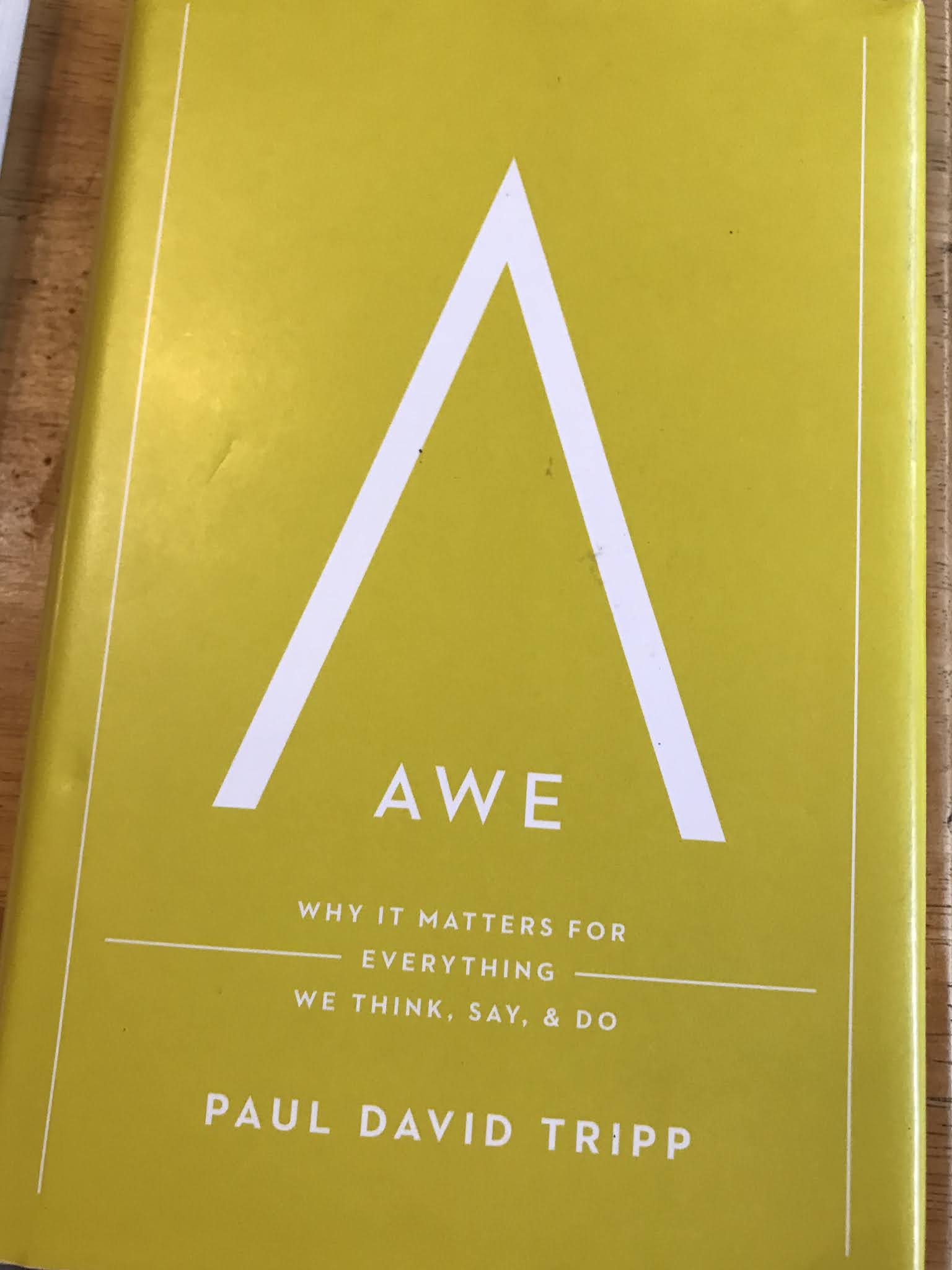
This book is one that I've read in the last few years. I keep coming back to it. The author writes well and honestly about the key problem that underlies all our perceived problems: that we don't have an adequate sense of awe for our Creator. It's a profound book written in a very digestible format. Definitely worth getting your hands on!

And I couldn't end this journey of books I love without including one from another of my favourite categories. In fact I'd say in fiction it would be my most favourite: mystery/thriller/crime. I live in a family of fantasy/sci fi lovers, but not me. I read books like Memory Man as often as I can! And David Baldacci is one of my favourite authors in the genre.

I also read a lot in my job as an editor. So I'm find it increasingly difficult to read poorly edited or written books. I simply don't have the patience for that. There are so many good books out there that the half-baked ones, the less-than-honest, or ones that beat around the bush are ones are not worth my time. Also, because I read a lot for work, my recreational reading veers strongly towards books I can relax with. I struggle with reading challenging non-fiction books that aren't story-based, though I know there is still much to learn from many of them!


10 June, 2020

The great brownie recipe hunt

March 21 was a wet, cold day this year. It also was a Saturday and, as I often do on free Saturdays, I wanted to bake. So I wrote this post on Facebook:
I’m looking for a really good brownie recipe. We’ve enjoyed American packet mixes from Ghirardelli in the past, but our two local sources have dried up. As a baker I’d love to be able to replicate these from scratch. Can anyone help me with a recipe? I’ve got harsh critics waiting in the wings!
I got 36 comments on that post, including lots of recipes. Which sparked an 80-day kitchen adventure I hadn't planned when things started to get cancelled on us in late February!

I decided to try a few of the recipes. The local critics automatically ruled out any that didn't have chunks of chocolate in them, in case you're wondering. We've been "burned" before. So I ended up only making five of the recipes. Here are they are:

That first afternoon I tried this one:
Molten choc-chunk brownies

On my "brownie" rubric it got a 38/40 (judged on texture, taste, ease of making, and cost). It was amazing. I especially loved how easy it was and that it was Australian, which made it even easier.

And, had I not been given so many other brownie recipes, I probably would have stopped there. But, with extra free time on my hands, a love of baking, and an appreciative audience, I kept going. Not to mention that it was an interesting challenge to tackle in the middle of the mind numbing sameness of a COVID-19 "stay at home" season,
Thick, chewy better than boxed brownies

Next time (April 18th) I tried this one:

It came out really well, but we gave it a 35. The only significant difference was that this had a more fiddly method and that it was American (they seem to like measuring things in cups, when I really prefer weight, especially in something like butter).

No chocolate chips in this recipe, but I added them ;-)


Ultimate Brownies are the bottom in the photo.
Top is a chocolate zucchini cake.
Mmm-mmm Better Brownies came from two friends. I made this one on May 2nd (no photo). It didn't rate as highly as the above two, with 31 out of 40. It was easy to make, but lacked a little in taste and texture (we've got very high standards here).


Ultimate Brownies had a lot of chocolate. I made it on May 16th and it was all going well (included more chocolate and sugar than flour), but I couldn't get it to bake according to the instructions. So it turned out very gooey. We gave it a 27.

No-name brownie
And the final recipe I tried last Saturday (Jun 6). This one from a former Home Economics teacher, so I had high expectations. It was pretty good, but was a bit lacking in the texture department. It came out quite cake-y, despite a large amount of chocolate and butter. It lacked the chunky, chocolate-y crunch we've come to associate with exceptional brownies. We gave it a 32/40.

380g dark cooking chocolate
250g butter
4 eggs
420g sugar
½ teasp vanilla essence
300g plain flour

  1. Melt chocolate and butter
  2. Lightly beat eggs, add sugar and vanilla
    My quick diagram of a recipe, rather
    than use a screen in the kitchen.
  3. Combine above
  4. Add flour and mix lightly.
  5. Bake in 30cm x 24 cm x 4cm tray
  6. Bake for 20-25 minutes at 180C.

So, it turned out that the first one I tried was the best. Family favourite: consumers and cook!

I think we've had more brownies in the last three months than we've ever had. But I don't regret it. And with a good, easy recipe in my grasp now, I'm confident to make them from scratch every time!

I'm also glad for the small distraction of this challenge. It was something fun to look forward to when there wasn't much else to look forward to. A type of "lily pad" that helped make it through a rough patch.

Now I'm wondering if I should start another baking challenge to make it through the next 10 weeks until school starts again. Any suggestions?

30 May, 2020

It's still stormy

On Wednesday I rode to my favourite large park and enjoyed some time on my own. I read a book, but then words of my own started breaking into my concentration. So I stopped and put the book down and started to put my own words down. I "wrote" on my little phone screen, so poetry seemed easier than prose. Or maybe it's just lazy prose...
This was part of my view on Wednesday while
I wrote.

What's below is an edited version of what came out in the park.

It's still stormy
Same storm different boat
It's a phrase people are using
About these strange pandemic months.

It makes sense.
Most of us have been stuck at home
Doing things differently to usual
Spending more time with some
And less time with others

But each one has a different household
A different set of griefs, of longings.

I've lost solitude.
I've gained more time with some of my family.
I've lost time with friends.
I've gained space in my schedule to rest.
I've lost a summer visit from a loved one.
I've lost precious farewells with friends.
I've lost more than I've gained.

Every morning I cast myself
In the arms of the God who bears our daily burdens
Lately that’s felt more important than usual
Maybe that will be what I've gained when the storm is over.

Life is usually full of ups and downs
This year they’ve been more intense 
More unpredictable 
More universal 

It’s been odd to go through a global disaster
To experience the same storm here as everyone else
Yet our boats are all different

My boat has two teenage boys and husband
My boat has a tiny backyard, but a beautiful tree
My boat affords little solitude, but it's safe

My emotions have crashed around
From gratitude to grief
From relief to fear
From joy to lethargy

I’ve bounced between 
Action and resignation
Energy and boredom
Feeling free and struggling against confinement

I’ve been disappointed
By myself
And by others

But I’ve also been surprised
By unexpected blessings

I long for things that will never be regained:
time, goodbyes, opportunities.

And some that will be regained, but will take time:
freedom to travel, to go outside without my face covered.
For a life free from the fear of other people's germs.

Same storm. Different boat.
I long to be through the storm.
To be reflecting on this from a distance.
But the clouds haven't cleared yet.

So I'll continue to daily
Cast my burdens on the Lord
The one who promised rest for our souls.

25 January, 2019

What transition has taught me

It’s good to read about other people’s transitions because in the midst of a major transition it’s easy to feel quite at sea and isolated. Without any regular contact with other people, with many goodbyes having been said, there are few people around to help give us some ballast.

A friend recently described to me her experience of transition as akin to being in a washing machine. And yes, it does throw you around, at times it’s hard to know which way is up and there’s not much predictable, not much to grasp ahold of in the midst of transition. I have felt more like it’s been a rollercoaster, with emotions and energy riding up and down unpredictably. That hasn’t been helped this time by arriving in the midst of term-time. School is in full tilt, church, and OMF also. It feels like we’ve been dropped into a rollercoaster that’s heading down a slope rather fast.

I saw this blog post several months ago and I’ve used it to springboard into my own post today.

A simple life?
The blog post author had hoped for a simple life, but found that a call to cross-cultural mission work means that life gets complicated. However, in the same breath, transition also strips you down. It helps you to see where you are putting your trust and that truly the only place to put your trust in in your Heavenly Father. Our only true, permanent identity is as a child of God.

I agree. Being regularly stripped of the trappings of life, of status, of a residence, of settled routines, makes you re-examine yourself. Moving often and, in our case, living in a smallish Japanese house, means that you tend to be faster to throw things out than you might have been if you hadn’t lived this life. Our lives are simpler in terms of materialistic goods, simply because multiple transitions helps you to see what’s not so important to hold onto.

Leading to growth
The author goes on to talk about spiritual growth. It really is an extension of what is mentioned above: that transition strips you and leaves you to lean on the only true Rock. The shake-up that happens with every major transition rips away those things that you were relying on and hopefully the result is growth.

Trusting God to provide
Yep, pretty much all missionaries have this challenge, some more than others. But there are points about God’s provision that are beyond monthly support figures. Because we don’t have a large budget we rely on others to help us with practical things like moving, finding accommodation, borrowing cars, finding furniture etc. This post I wrote in the middle of our move earlier this month highlighted the many “helps” we received.

Then there’s other things that you have even less control over, that God often provides, like a friend for your child, a sympathetic teacher who will help your child adjust to their new school, a friend who will stop and listen to you when you’re less than likeable, groceries or a meal provided, or help to complete a bureaucratic errand. God provides people and things like these in the midst of transition, at a time when you’re most in need of help.

Because we’ve seen God provide in these ways in the past it gives us more confidence to face the next transition. For all those people who look at us during transition and sigh, “I couldn’t do what you do,” it’s important to understand the context we’re operating under: we’ve done it before and know God’s great provision. It doesn’t mean that transition is a breeze, it definitely isn’t. But it does mean that we possibly do it a little easier than someone who never has and never could imagine doing it.

Holding onto God
The author mentioned God giving her a “word” to cling to during transition. I haven’t had that exact same experience, but I have known God’s special reassurance when returning to Japan. Except for this last time, every transition back to Japan, within a week or so of returning I’ve felt a deep sense that God has called me to this land and will continue to enable and provide. This last time I think that reassurance came several weeks earlier when we were seeking God’s leading in the midst of the financial questions thrown at us late in November.

Where is home?
Transition between cultures makes you question where home is. Another aspect of the experience of transition that makes you realise that our only true home is with God. That’s both an unsettling thought (I’ll never feel 100% “at home” here on earth), but also reassuring that there will eventually be somewhere I feel at home, even if I have to wait a while for it. And that home will last forever.

There are other things I’ve learned through transition, for example, to be an observer and inquirer about culture and “the air”. The latter is great Japanese euphemism for picking up the atmosphere, being perceptive to what’s going on that’s not necessarily being stated outright. After we returned to Australia I wrote a post about what I perceived as being “in the air” in Australia. Some was obvious as it was in newspaper headlines, but others I only picked up through conversations with various people, articles, and observations in the community.

There are other things I've learned too, but this is enough for today!

15 September, 2018

Big elephants

I wish I could write about some stuff that's been going on recently. There are a couple of elephants in my room that I just can't write about on this public forum because they concern private family matters. But they're taking energy and headspace.

I had someone ask me the other day what was wrong, that I seemed more stressed this home assignment than in previous years . . . but I didn't feel I could share honestly with them either. 
These rice plants looks great. But do note that it has its
feet in the mud! Missionaries can be the same. Look good
on the outside, but don't forget that there is mud too.


So what can I share? How can I write in a way that's consistent with my philosophy of being honest and open, and yet protecting people I love (and myself)?

Perhaps a reminder that what you see isn't all that's going on.

Missionaries deal with stressors that are common to others, but often there is a twist. Check out this list (not all these are mine, but some are):

  • Educational issues. TWIST: educational options aren't so broad on the mission field. Home assignments mess with education, especially when moving between different educational types, and different school years eg. Japanese to American, American to Australian.
  • Job satisfaction. TWIST: ministry in a country like Japan, where few receive the Lord means it's hard to see what a difference it makes. It can be hard to come back to tell people about what's going on and not be able to report amazing results from the ministry there. 18 years ago we were saying that less than 1% of Japanese people are Christians. We're saying the same thing this year.
  • The challenges of extended family. TWIST: we rarely see extended family and problems can be amplified by this absence. Also, they're used to doing things without us, so including us can cause problems. Not to mention non-Christian family members who don't understand why we do what we do.
  • Lack of community. TWIST: our community (i.e. people we call our friends) is both widespread (our good friends live across the globe) and constantly changing. Then we change countries for home assignment and find that, for various reasons, community is even harder to find. Loneliness and relationship stress is a big issue.
  • Psychological problems. TWIST: often psychological care is harder to access on the mission field. Psychological problems also can be exacerbated by the stressors of life on the mission field.
  • High expectations. TWIST: in my experience the expectations on missionaries are different to those on other people. At times it feels like we're expected to be amazing people who don't struggle. We're expected to not make mistakes. We're expected to be able to move in and out of our home country with ease. We also have high expectations of ourselves, for example, expect that we can survive without good community, cope with high stress, persevere without encouragement.

Okay. I'm going to stop there.

To counter the above, I'd have to say that we have the amazing experience of being supported by many in prayer. You shouldn't underestimate how important that is. I think we are in a very privileged situation that many Christians never experience: having many people praying for us. More than 200 people get our prayer letter every month. I've got no idea how many of those pray for us, or how often or how in-depth they pray. But I know that there are people who aren't on our mailing list who pray for us!

James 5:16: "The prayer of a righteous person has great power as it is working."

Last Sunday we were asked, as we stood in front of a church congregation, for an example we've seen of God at work. I said, "That we've never asked for money and we're still in Japan after 18 years." If I'd been faster at thinking on the spot, I would have expanded that —it's not just the money that God's provided, it's being able to stick at it through all the challenges that have come, and continue to come our way. But all the praise goes to God!

16 August, 2018

Challenging encounters

Coming back into Australia often feels like a cross cultural encounter. Beyond the obvious cultural differences, it's the deeper stuff that is more challenging, especially because others don't usually expect that we have a different perspective on things because we look and sound (mostly) Australian. 
These trees on my parents block remind me it's been a
long time since I grew up here. As a young adult on holidays
from uni I used to mow around these two
big trees—they were saplings.

This is a strange cross-cultural challenge, though, because some things remain the same others change. New ones appear and old things get an unexpected twist on them. Each time we come back for an extended period we tiptoe around a bit, trying to figure out what's changed. We try to spend time asking questions and listening. Sometimes that's hard because some people want to hear all about what we've been doing, but every now and then we can get people to talk about what's going on in Australia and get a feel for the lay of the land.

Topical hotspots
We've discovered that Australia has a number of topical hotspots at present. At the risk of opening some pandora boxes, they include:
  • Plastic bags
  • Gender
  • Gay marriage
  • Drought and farmer assistance (Australia's in the midst of a significant drought and metro areas have just realised, resulting in a lot of "save the farmers" type campaigns and includes blame casting.)
  • Abortion (which is situated in a different political/religious climate to the US, it is nowhere near the political hotspot here as it is there)
  • Refugees (this has been around longer)
  • Anti-vax (which has also been around longer, but has had a financial impact on us as it's now a requirement by the government for our kids to have certain vaccinations that are hard or impossible to get in Japan, if they don't we lose out on some financial benefits that could be ours as low-income earners)
There are more, including a bunch of political issues. I'm also sure that I'm not keen to try to figure it all out. Not because I'm an irresponsible citizen, but I have to acknowledge that we have our limits and dealing with all that we have on our plates at present is plenty. It's also usually enough to seek to weather the conversations our own situation dredges up. 

Here are some real examples from recent weeks:

Japan and cars
Yesterday someone taking our money at the gym wanted to know if we wanted membership and we declined citing that we were moving at the end of the year. "Where to?" he asked.
We sighed, we'd been trying to avoid this.
"Japan"
"Oh cool...they have great cars there."
I have to say I've never had a conversation about the great cars of Japan . . . it's surely not my area of strength. But we heard plenty from him . . . before we finally got to go and work out.

Japan and bikes
When I came back in February and accompanied my son as he bought a bike for commuting to uni, we had a conversation about bikes with one of the staff. He was fascinated with hearing our experiences of using bikes in Japan. His knowledge had been much more of a serious cyclist, but we gave him an insight into daily life with bikes as a "commoner".

"Oh, you've lived in Japan . . . I've been to... (read here an unrecognisable name) what an amazing place!"
This is a more common conversation with a stranger when they discover where we spend most our time. The place name we often have to strain to recognise because we really don't have the Australian accent on Japanese words down pat yet. Japanese has only five vowel sounds and typically Australian mangle these, making many words very difficult to recognise without context. Needless to say, we try to go with the flow on a conversation that starts like this. Usually they aren't too hard to make it through, although if we stay at this point in a conversation too long I'll be cringing inside because I know that people have only seen the surface of Japan: the beautiful front that this nation puts up for visitors.

"Japs"
Believe it or not, I had a conversation with a very earnest young Christian man the other day who used this word as casually and neutrally as he might say "postie" (or postman for non-Aussie readers). I was shocked as I'd consider this an insult, but thankfully he moved on quickly.

Language changes
This relates to words we don't use in our family, words we consider crass or dishonouring to God. Some of these words have made it into polite conversation while we were gone. Our kids brace themselves at school because the language there is often cruder than they are used to hearing.

Odd conversations
There's the odd conversation that leaves me speechless. Something, if you've ever met me after breakfast, will find hard to believe. I can usually dredge up something!

I'm still staggered by an awkward conversation I had with a community nurse a few weeks back. As part of our routine medicals we have to have fasting blood tests. These I hate. A breakfast meeting is not something I volunteer for because I really can't make decisions before I eat (hence I eat pretty much the same thing for breakfast every day) and good conversation is really not  on the cards.

It all started off badly when the nurse asked, "So how are you this morning?"

I responded with an attempt of realistic humour: "I've not had breakfast or coffee yet..." 

She had no response to that at all. We fenced back and forth without finding any traction at all, on any topic. Towards the end of our encounter I tried again:

"It's a bit cloudy today."

She grabbed hold with both hands on this one and went, in almost one breath, from, 
"I wonder if it will rain." 
to
"The Chinese are going to take over our country because the farmers are selling out."

Quickly followed by, "What's your opinion?"

I was speechless. 

In my fragile, pre-breakfast state I was not about to step on this landmine. (Did I have an opinion?). I had the presence of mind to just mumble, "It's a complicated issue." And escape as fast as I could to get some food and coffee.

Conversations is what we mostly do
Conversations are the mainstay of what we do here. You might think it is up-front meetings, but that's just the most visible bits. But in fact, if you add up how much time we spend standing up in front of a large group vs one-on-one conversations with people you'll find the ratio is very much in favour of the latter. In the last six weeks we've spent less than 45 minutes in front of a congregation at worship services on Sunday mornings. We've already spent many hours talking to people—about mission, Japan, and our lives—before and after such events, as well as over coffee or meals or other occasions.

But obviously, from what I've written above, conversations that aren't even missions-related, conversations that are just part of our everyday interactions with the society around us can be treacherous. 

Do pray that we'd be wise. That we'd gain something of an understanding about this land that used to be so familiar to us, but has changed, and continues to change. Pray for our boys too. Australia is even more foreign to them. They've not grown up here and, at times, aren't sure how Aussie they are at all as they observe everyone around them.