22 July, 2016

Eating while camping

Last night I went to a friend's house with a few other ladies associated with CAJ. At this time of year there is no schedule and it's easy to become isolated. As for me . . . well I've just spent the last two weeks camping with four guys! Hanging out with girls was just fun, though perhaps I ran off at the mouth more than I usually do?

Anyway, they had some questions about this camping. Several were about cooking: did you use a fire, what did you cook, how did you keep things cold, did you take everything with you or buy along the way?

We did cook with a fire, but we also have a compact single ring gas burner, using easily available gas cans. This was a good back up or for when we didn't make a fire like on moving mornings (when we had cereal, tinned fruit, and yoghurt), but we still wanted a cup of coffee or tea. But I didn't take a photo of it.


Here is our main stove. It was a new one that I bought unused from a local second hand store. The main attraction is that it packs very flat. But it also folds out large and you can cook quite a lot on top. Additionally, it has a lot more air flowing around it, so was generally easier to start a fire on than what we previously had, which was basically a deep metal tray with little air flow.

On top you can see our two Japanese rice cookers as well as various root vegetables in foil, one of our favourite ways to have veggies at camp.
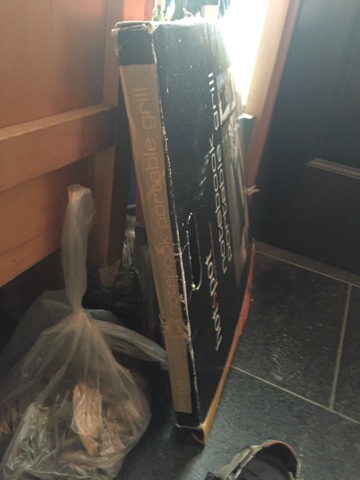
This is how thin the stove is folded up. It's called a portable notebook!

On moving days, or days when we were not at camp we usually ate take away food from convenience stores or at stops on the expressway. Japan has a wonderful array of fairly healthy food available for reasonable prices in convenience stores everywhere. Pictured is a doria, basically a cheesy white sauce baked over rice. I think it had some meat in it, but I can't remember now. We ate this lunch in a laundromat on a wet day between our first and second campsites, obviously while we washed and dried clothes.


Here was another lunch when we were in town for the day, visiting sights. We took a picnic lunch and ate it in a multi-storey carpark. David did a great job of making it look tasty. We even had a view, to the right was out to the road, but we could see potted flowers out there! There were toilets nearby, so we had everything that we needed.
My son's face is blanked out, I don't put photos of them on my blog.


This is a classic Japanese stir fry cooking over the fire: yaki soba. We didn't have room to take food for us all for two weeks, so bought food in standard Japanese grocery stores along the way. My menu therefore held things that were easily available in most Japanese stores. 

Someone asked if we had a generator and the answer is no. We camped electricity-free. This is our cooler (Esky in Aussie English). It held sufficient cold stuff for a couple of days and we bought blocks of ice (see below) daily to keep things cold. Interestingly most stores sell blocks in sealed plastic, which last much longer than ice chunks that you might put in drinks.


One of our favourite meals was veggies in foil cooked in the fire. Potatoes, pumpkin, and carrots, but the best was sweet potato! A couple of times we had BBQ meat with the veggies, that was also enjoyed by all. Japanese butchers do the best BBQ meat: thinly sliced meat (only a couple of mm thick) cooks so fast and is easy to eat.
Here's another meal on the go, we were eating out the front of a convenience store at an expressway layover.

We even had pizza, twice! A new camping meal I hadn't thought would be possible. We made pizza on top of basic damper dough (flour, raising agent, and water) folded it over and cooked it in foil. Was so yummy the boys clamoured for a repeat.

There's nothing quite like a fire to make camping great. One day a storm blew in just after we'd finished setting up and in the middle of my starting the fire. So, in the midst of the wind and the rain (actually it was mostly rain), I stood there and fanned the fire which we'd dragged under our annex. We were able to eat dinner soon after, even though we were surrounded by quite soggy ground. 

Cooking on this fire, I believe, is my favourite camping dessert: a banana boat. A banana sliced in half lengthways and filled with chocolate and marshmallows. Absolutely scrumptious.




21 July, 2016

Powering through

I noted on Monday that it was pretty quiet around here. There is a pretty big difference to having 11, 13, and 17 year olds on holidays as opposed to 1, 3, and 7 year olds! There is a 17 year-old missing this week, so that also makes a difference. Mind you there has been a lot of electronic usage, but that's been tempered by other things like sleep-ins, exercise, reading, jigsaw puzzles, board games, planning a scrap book of memories from our trip (youngest son), and even making dinner for the whole family. Actually the latter was part of our guidelines that I wrote about back here.
This looks a lot more exciting than sitting at my desk in Tokyo, doesn't
it? Part of our Tokyo survival plan is camping: remembering what we've
done and planning for the future. Even now we're thinking about our
next 12 months and what exciting camping adventures we'll get up to.

Now that we're done with all our big family plans for the summer I'm actually finding myself with more time than I thought I would when school finished (for 10 days after school finished I had boys here, but no husband, that's changed too, so I'm not doing as much household stuff as I have to when he's at work and the boys are here). 

I'm powering through my work-to-do list and feel like I might actually get to some of the more pie in the sky ideas. That feels very satisfying. Early in the week I was feeling quite stressed about all I had to do over the next six weeks, but it's now looking okay. I might even get some more sneaky holiday time in.

My pie in the sky ideas include some sewing and seeing if I can get started on learning how to use the software that our designers use to layout the magazine: inDesign. I've heard it is difficult to learn and a very steep learning curve, so perhaps it is best that I don't have any other goals besides these two. We'll see how far I get.

We also have a mild goal for the family (anything's mild after the camping trip we just did, right?): to go out somewhere in Tokyo for a day once a week, that plan will of course involve food, like chocolate cake at a cafe or ice-cream, bribery anyone? One of the places we have our eyes on is the Japanese Sword Museum.

20 July, 2016

Photos from a special garden in Kanazawa

When we were in Kanazawa we visited a garden that is rated in the top three beautiful landscape gardens in Japan, Kenrokuen. It is very old and used to be the outer garden of Kanazawa Castle. They're not sure how old, but probably it was begun in the 1600s. Nearly the whole garden was destroyed in 1759 in a fire. In fact this is a common story we heard as we traipsed around historical sights: things destroyed in fires or earthquakes.

We foreigners find Japanese history quite intimidating because it is so long and complex. Similarly the history of this garden. But I'm going to take a stab at giving you a taste. Four hundred years is a long time and many people have made many changes to the garden in that time. But it was formed and developed during the Edo period (1603-1868) by the local feudal lords.

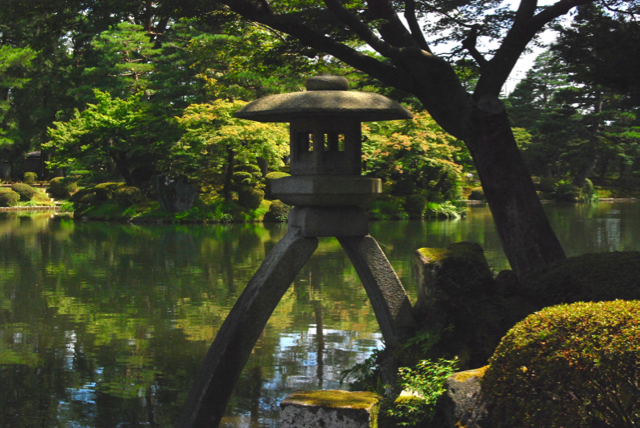
This is an unusual two-legged lantern, is a signature piece in this garden (most lanterns have just one leg).
The ruling family in the area was the Maeda clan. They were one of the most powerful (and wealthy) samurai families in Japan and became daimyo (powerful feudal lords who ruled a large territory in Japan) during the Edo period. When you read about the garden you see the "fifth lord Maeda Tsunanori" who, in 1676, moved the garden house to the castle. He apparently started landscaping the garden that has become Kenrokuen. He also established three divine islands in the pond.

The "11th lord Harunaga" who restored the garden after the above mentioned fire.
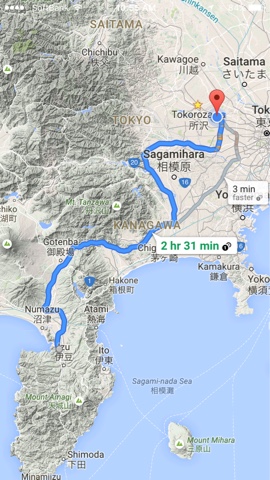
See Kanazawa on the left towards the top of this map.
Tokyo being towards the bottom right.

The 12th lord extended the garden, adding some winding streams and build a villa. At the completion of the villa the garden was renamed, taking on its current name which embodies six attributes of a perfect landscape garden, according to a gardening book written by Li Gefei, a famous Chinese poet. The name of the garden means "Garden of the six sublimities" referring to spaciousness, seclusion, artificiality, antiquity, abundant water, and broad views.

The 13th lord planed a pine tree, taking seed from a place near Lake Biwa. It's now very old and I'm sure it was one of the pines we saw with many poles propping up its limbs. 

One of the things I came away with was a greater appreciation of how much Japanese people revere history. In one place there was a two-foot stump poking out of the ground. It had a sign on it explaining how it was one of the oldest trees in the garden, but it had rotted away just a few years ago. I'm doubting that it's stump would have been honoured like this in many western countries, including my own.

The garden wasn't open to the public until 1874. Entry was free for many years, but in recent times they've charged for entry to help pay for the upkeep, it doesn't surprise me. It looked so picture perfect everywhere, I imagine it takes a whole team of gardeners to maintain it.

Moss is also an essential in a Japanese garden (the Japanese national anthem apparently includes the word "moss"). I love its lush green. What you can see below is not grass, but moss. Hmmm, maybe I could start my own inside moss garden...apparently in this humid climate it isn't hard.


There are many more photos and explanations here. I truly now wish I'd read up about the garden more before we went. It was hard to appreciate all the history. It's much more than just a park, like a 25 acre piece of art, pretty much everything has an intended meaning or detailed history. It was hard to know where to look, because every view was amazing.

I wish that I'd had my camera working properly. All my photos were underexposed because of a setting that I'd messed up. I'd also love to go back in a different season (though the green was lovely) and take more time to explore. The boys did really well, but it surely isn't their forte, exploring historical, beautiful gardens! But they did have some fun:


19 July, 2016

How much would you pay to camp?

This was our most expensive campsite, but the toilet and
shower facilities weren't so great. The view and grassy site
itself, however were wonderful (aside from the puddle that
arose in the middle of heavy rain and wet our bedding).
I thought today I would add a few extra not-on-the-road thoughts about our trip and camping in Japan general.

First I want to tell you that we counted up how many prefectures (like states) that we drove through or stayed in over the fifteen days, it was 16! That's not bad. Japan has 47, but we don't currently have a plan to drive through or stay in them all, though you never know. I haven't counted how many other prefectures we've been through in the last 16 years, but it's probably about nine others.


I'm curious about how much people would pay to camp in their country. We don't do very rough camping, we always camp in places we can drive to that at least have water and toilets, and preferably showers too. 

When David's looking for a campsite he looks for the above things, as well as the cost, he tries to keep it to ¥3,000 or less per night (that's currently about AU$38). This trip our cheapest campsite was ¥700 per tent per night with ¥100-for-five-minute showers. Our most expensive was ¥5,100 per night with ¥200 for five-minute showers (these ones you could pause and therefore share your shower time).

View from the above campsite.
There are all sorts of variables in campsites in Japan, almost every campsite is different. Some campsites charge per tent and some charge per person. Some do both. It's complicated. One site charged us an extra "tent" fee for putting up our blue awning. Granted, it's as large as another tent, but we ended up only having it up for about half an hour as a storm blew through and we never ended up putting it back up again.

Our last campsite was next to a lovely stream. The campsite
didn't have showers, though.
The view from our first campsite, also our cheapest site.
"Free" camping means no electricity, not no cost, "auto camping" means there's a spot for your car next to your tent (as opposed to possibly a car park some distance away for the free camping), but may not mean electricity.

Some campsites have very small flat spots to set up on (most camping is done in the mountains and obviously flat spots often have to be created). One of the places we were booked in to this time had their "free" campsites up on a hill above the reception area, you could drive up there, unpack and then drive back down to the carpark. The sites up there were tiny, though. Our tent is rather large for this country (officially a 10-man tent, but we've only ever slept five or six in it). We drove up to these sites and looked around but ultimately decided to transfer to an auto campsite that were larger, but also cost more.

The ground upon which you set-up is variable too, we've seen gravel, grass, rocky ground, and dirt. The other option some campsites have is a wooden platform, which doesn't work with our tent.

Moss grows in so many places in this country. I love this wall.
Some campsites charge for showers, four campsites we used this time charged us for showers. One didn't have showers and the other didn't charge. Some had timed showers, others didn't. We've seen ¥100/¥200 for five minutes, but there are more expensive showers out there. David saw one today advertising ¥200 for three minutes. That adds up with a family! 

One thing that seems pretty standard for these campsites that you pay for are "camp kitchens". At the most basic they are sinks with running cold water under a solid roof, and very handy for sheltering under in a storm.

Most campsites don't allow open fires or provide firewood. So we used charcoal that's readily available in hardware stores (and often other stores too) in our portable stove that I wrote about here (with photo).

I don't know how much you'd pay to camp. All I know is that cheap holiday accommodation isn't common in Japan, that's why missionaries usually stay in holiday houses owned by missions. Hotels are expensive (they charge per head here too, not per room). So camping is still cheaper.

Having done two of these camping tours now, we can compare Hokkaido and the Kansai and greater region. Hokkaido is definitely cheaper. We encountered really nice facilities up there for not much price compared to what we got for our yen this time.

Of course the other thing that pushed up the cost of this particular trip was the expressways. Most of them cost, but without them we would have been travelling many  more hours at 40 or 50km/h!

These rocky islands we could see from our campsite on
the island. I said it was our first camp on an island, but was
quickly shot down as boys pointed out that all our camping
in Japan has been done on islands. This one was our smallest
island by far, though, at 47 km square.
No regrets, though. The weather was rotten at times, but at no time did we have to abandon camp. A couple of times boys ended up with wet beds for some of the night, but we were able to dry them out pretty quickly after that. We've not come home especially tired. A little physically tired, perhaps, though it's hard to tell because the weather isn't kind at this time of year and makes you feel tired anyway. It was, as usual, mentally refreshing to get out of our usual routine and focus instead on surviving in less convenient, but more beautiful surroundings.

We've come home with a new appreciation for the simple things in life, like a spider-less toilet across the hall at night, a refrigerator and freezer, and a rain-proof house.


18 July, 2016

Settling back at home

Today begins five and a half weeks of the rest of the school holidays. The stay-at-home part of the holidays. We did the vast majority of our unpacking and putting away of camping stuff yesterday afternoon, after arriving here at 4pm. Living in a small house without spare, covered outdoor space means that it's best if we don't just leave things lying around. Our habit is to unpack as soon as possible after arriving home. David's been washing clothes and sleeping bags and other stuff all day, it's good drying weather.

I've been playing catch-up at my desk. Catching up with many magazine and mission things that need to be done early this week. Getting my head back in the game. Which isn't as hard as it usually is because I've been checking email and tracking with at least part of the magazine over the time we were away. I usually guard my time-off better than that, but this time it was unavoidable as we tried to get the Spring issue of the magazine out before the end of July (summer)! However it's had the effect of meaning that it hasn't been so hard to get back into work today. I'll just have to remember to get some rest at other times (not having to get people to school and work by 8/8.30 will help, though).


Putting this here as a reminder of all the green we saw.
These are rice plants and I've never seen so many in Japan
before. I guess I've not travelled so much in the country at
this time ever before. I never get tired of looking at this
amazing green!
For breaks between work today I've been downloading and editing photos from our trip. Some really nice photos and memories! Though it's a pity I was still learning how to use the camera as I went, because some photos would have been a lot better if I'd had the right settings on the camera.

It's a bit quieter here than usual this week as our eldest has gone to a high school summer camp, he left early this morning and won't be back till Saturday evening. I'll have to remember not to cook so much food!

I'm not particularly enjoying Tokyo's humidity, though it's not so hot today (only around 30C), it feels oppressively humid (70/80%). Probably, though, by the end of the summer I will have acclimatised and won't be bothered so much. Last night it barely cooled at all, sticking around the high 20s all night, so I was up much early than I would have preferred.

Some people were concerned that we'd be too hot camping, but we really weren't. There were a couple of hot nights, but mostly we were up on mountains or next to water with a breeze. Plus there was lots of rain, which tends to hold the heat in check. Kyoto had been hot, but the day we were there it was rainy and pleasantly cool. There was only one night that I didn't pull the sleeping bag up a little over me at some point in the night (we slept on sheets and used the sleeping bag as a blanket).

16 July, 2016

Camping tour 2016: Days fifteen and sixteen (Saturday and Sunday 16 &17 July)

We slept Friday and Saturday nights at our friends' house. Friday was the first night out of a tent and I had a lovely sleep (as I did on Saturday night too). It was especially nice when it rained but we didn't need to do anything to prevent that threatening our bedding. 

We enjoyed a late breakfast after the guys watched a Top Gear DVD of their Burma challenge (very entertaining), then we went off to the park and enjoyed some ball and frisbee games on a lovely but unusual expanse of flat, mowed grass. Finally the cricket bat we'd hauled around on our trip was pulled out and given a hit. 

After a picnic lunch and more playing we headed back to our friends' house. After dinner the "girls" (two mums) watched The Queen, and the "boys" played board games. It was a delightfully quiet day. A really nice way to finish off our camping tour. 


On Sunday we went to the small church where our friends work. It is the only church in their city. We were given a wonderful welcome by the church folk, it seems to be a lovely community. It was really good to get another glimpse of the sort of work that many missionaries in Japan are doing: labouring away in small churches. 

We ate lunch with them and then headed home. Thankfully it is the middle of along weekend and the traffic was very reasonable indeed. I'm always a little depressed at coming back to earth after a much anticipated event, and coming back to Tokyo after all the wonderful green we've lived amongst is not easy. But I do admit it is nice to be back at home. It's just a little easier life than life under canvas, even if it isn't as pretty. 


We've got many memories from our journey that will stick with us for many years. I'm so glad we were able to do it. 

I'm left with an enduring impression of a green Japan, the land of many mountains and hills, of much natural beauty and rich intricate history. A land that I'm growing more and more attached to as the years go on. But one that will always remain my adopted country, not my home country. 


15 July, 2016

Camping tour 2016: Day fourteen (Friday 15 July)

Today we packed up camp for the last time this trip and moved to our last two nights at friends' house in Shizuoka prefecture (on our fourth peninsula for the trip, the Izu peninsula).
I survived! This selfie was just before we left the campsite. 

The stream looks lazy but had a strong current in spots. 

The campsite was pretty basic, more orientated towards picnickers (called "day campers" here). These were the toilets, a set of three pedestals and one urinal, the latter with no door. Basin on the outside. 

There were numerous shelters along the stream, some more substantial than others. This is the first place we've seen that has as much a love affair with blue tarps as we do. There were many strung up around the place. I can't believe I forgot to take any photos of them. This is one of the "camp kitchens", a typical shelter with large sinks and water found in most campsites we've stayed in. 

We spent most of the journey on expressways. This was a fun picture to take. I don't think I've seen trucks with polished metal like this. It can be distracting as you can see your own vehicle. 

A closeup of the above, that's us on the move with the telltale blue bundle on top. 

It was a little odd to go into and stay in a house after two weeks of continuous camping, but definitely enjoyable. This is a beautiful house too! Up on a hill above the city of Izunokuni. 

It's great to sit with and get to know people we've met at CAJ, but not had a lot of time with before. Their eldest son is in the same class as our eldest and has slept over at our house, but because they live a couple of hours from school we don't see them often (their son boards with a local family during term time). But actually it's unusual to stay in someone else's house in Japan. We hardly ever do, most people don't have room for five guests!

It's also interesting to see inside other families with teenage boys. I won't say any more for fear of embarrassing anyone!

Some of our guys played board games last night, which was great to see. 

We're here till Sunday and then home!