Showing posts with label parks. Show all posts

30 July, 2026

Finishing off our home assignment in Perth

I'm dropping in here quickly from Western Australia. We've been very busy since we got back from holidays just over two weeks ago. In Queensland we spoke at a church and two Bible/theological colleges before flying to Perth (five and a half hours) last Friday. In Perth on Sunday we spoke at two churches. This coming weekend we've got four more speaking opportunities before we fly to Tokyo on Monday.

In between all these up-front opportunities we've been meeting various people over meals, in fact we're out every night this week except one. It's been a lot and my body is protesting. It's been very encouraging, but also very tiring, despite getting good food and sleep and even some exercise (we've walked nearly 30,000 steps in the last three days). Unlike some missionaries on home assignment, we've only slept in six different beds over the last 11 weeks, and one of those was for a total of about seven weeks (in three segments). That's definitely worth being thankful for! But nonetheless, we're longing to be home in our little apartment, and back into our own routines.

It's also been a lot easier doing this HA without any children or teens under our care. We've spent time with them in the last 11 weeks, but then they went back to their own lives (in their own cars to their own homes). Juggling the care of kids while doing speaking on home assignment was the norm for us many years and it's really nice to put that behind us now.

One thing we've continued to do, though, is try to appreciate the localities that we have passed through. This week we've been enjoying Perth. We've been to Kings Park and walked along the nearby stunning rivers (Canning and Swan). Our hosts even took us to Fremantle to enjoy fish and chips (but it was at night, so we saw little of this historic city). Here are some photos from our recent outings:

Canning River and a Coral Tree.

Perth and the Swan River from Kings Park

Fraser Ave in Kings Park

False Sarsparilla or Native lilac (Australian native)

More Swan River

Pink (or Hill) gum, viewed from the Federation Walkway

A portion of the elevated walkway

Queensland Boab tree

Ornamental pincushion (native to southern Africa)

The above sign describes the below flower—an astoundingly large flower on a gum tree.


Close up of the Coral Tree flower

Another gum tree in silhouette. 

The soil here is very sandy, hence river-side beaches aren't uncommon.

Can you see the Black Swans, the birds the river is named after?


17 May, 2024

Day 52: Ferry to Geelong to Melbourne

We arrived in Geelong on the ferry before sunrise. Based on our experience a month earlier, we immediately drove up to the car park between the botanical gardens and the foreshore, where we could park for free for as long as we wished. We ate our second breakfast there (we had muesli bars before leaving our cabin at 6.30 am) and enjoyed savouring the sunrise over the ocean.

We had two goals for this day: go to the National Wool Museum in Geelong and drive to a caravan park in north Melbourne. It took us much of the day to get this done! 
Foreshore of Geelong. We walked
along this former pier.
The Wool Museum didn't open until 10, which is a long time to wait when you've been up since 5.45! We wandered through the botanical gardens and then along the foreshore, out on a jetty and finally arrived outside the museum at 9.45 where we ate some morning tea.
Scarlet-star, of the bromeliad family.
Native to north and south America

The museum was worth visiting. We learnt about the history of the area as well as more about the wool industry. Australia was a wealthy nation from pretty early on in its history, mostly due to wool, an industry that remained a major part of our economy for almost 200 years. Sheep arrived with the first fleet, but less than 10 years after the first white settlers landed on the continent sheep were imported with the goal of developing a wool industry. I had no idea that Australia had once had natural grasslands. I'd always assumed that trees covered the land until they were cut down by immigrants. In any case, the museum told us that the native grasslands were largely destroyed by sheep and there is little left now.

The main reason wool was a great industry for this new nation was because it didn't degrade with time—it took months to get produce to the "motherland". Of course they had to develop sheep that would cope with Australian conditions and succeeded in that endeavour very well.

Geelong is where my mother was born (her family moved to Queensland before she was school aged). Apparently for many years the city was known as the wool centre of the world. It was a fascinating couple of hours we spent in the museum. The blue-stone building itself is historical. It was built in 1872 as a wool store.

On the top floor we happened upon the Wildlife Photographer of the Year photo exhibition on loan from the Natural History Museum London. It was astounding. I had to stop reading after a while (all the photos had good stories with them) as I was running out of energy prior to lunch.

We walked back to the motorhome, ate lunch, and headed to Melbourne, stopping along the way for some groceries.

Greenhouse at Geelong botanical gardens
A False African Violet. Native to
Tanzania
The biggest stress of the day came late. We were booked to do a tour of the MCG (Melbourne Cricket Ground, an internationally famous stadium) the next day, but had to figure out how to get there and it wasn't easy. Public transport is hard for visitors, I wonder why cities don't work harder to make it more accessible. After visiting several Australian cities this year, my favourite is Sydney, where you are allowed to use your credit card as a "transit card" and don't have to pay extra for a card you're only going to use for a short time. The complexities didn't just include where we could get on and off, we had to figure out where we could by a local transit card on a Saturday morning and on our way to the train stations and buses replacing trains on the weekend.


We were thankful for another place to lay our heads (though it was the most expensive place that we slept in the motorhome in our whole journey). I was a little bit discombobulated by the loud local radio playing in the ammenities block, though. We'd definitely landed in AFL (Aussie Rules football) territory. The radio broadcast that night from a live game at the MCG was just a taste of what was to come the next day.

You find weird plants in botanical gardens. This
one is an Arizona cypress?

Museum
This internal blue-stone wall in
the museum has been restored.
An exhibit of various sheep breeds. These were real
sheep with names that had been expertly taxodermied.

12 September, 2023

Western Australia work trip

It's over a week since we arrived in Western Australia and a lot has happened. In addition to speaking at five formal meetings in the last week, we've met a handful of people over coffee/meals, as well as enjoying fellowship with our hosts. On top of that I've had three Zoom meetings with people in Japan (and other places).

Anyone who's been following us on social media will know we've been enjoying getting out and seeing some sights in this region too. We spent a few hours in Kings Park, time in Fremantle, and a day out on Rottnest Is, as well as several walks around our local area in western Perth/eastern Fremantle. We spent several hours at the Western Australia Maritime Museum too. Check out some photos at the end of this post!

To be guests has been a welcome break from being the ones in charge of the household and meals. This is the longest trip away from our kids that we've ever had in 24 years, and it's been quite enjoyable so far. When we left Queensland we were wondering if we had been wise in planning this trip. It hasn't quite looked like we'd imagined, but have had to trust God that he's had things planned that we couldn't see or imagine.

This coming week includes six more formal meetings, a couple of informal meetings, as well as being guest missionaries at a church camp before we fly back to Brisbane on Monday. I'm guessing I'll be pretty exhausted on Monday and Tuesday, and maybe even Wednesday next week!

Enjoy the following photos from this remote part of the world. I checked out that by finding some statistics. We're 4,328km from our home in Ipswich, Queensland. That would take us around 46 hours to drive, according to Google. It's around 110 miles less than the distance from Los Angeles to New York, but that trip would take around 41 hours (same source). For a European comparison, the distance is from approximately the top of Scotland to Athens, Greece. Perth is closer to Singapore and Jakarta than it is to the east coast of Australia.

One of these days, we're hoping to see more than just a tiny part of this giant state, just not this time. But a good rule to remember is to leave wanting to come back again some other time!

Perth: old and new, like many cities.


View of the Swan River from King's Park.

Another angle of the park with the river in the background.

This young magpie wasn't bothered by me or the reversing car on our driveway.

Black swans on a local lake.

Our national flower: the Golden Wattle.
This one had particularly large, vibrant flowers.
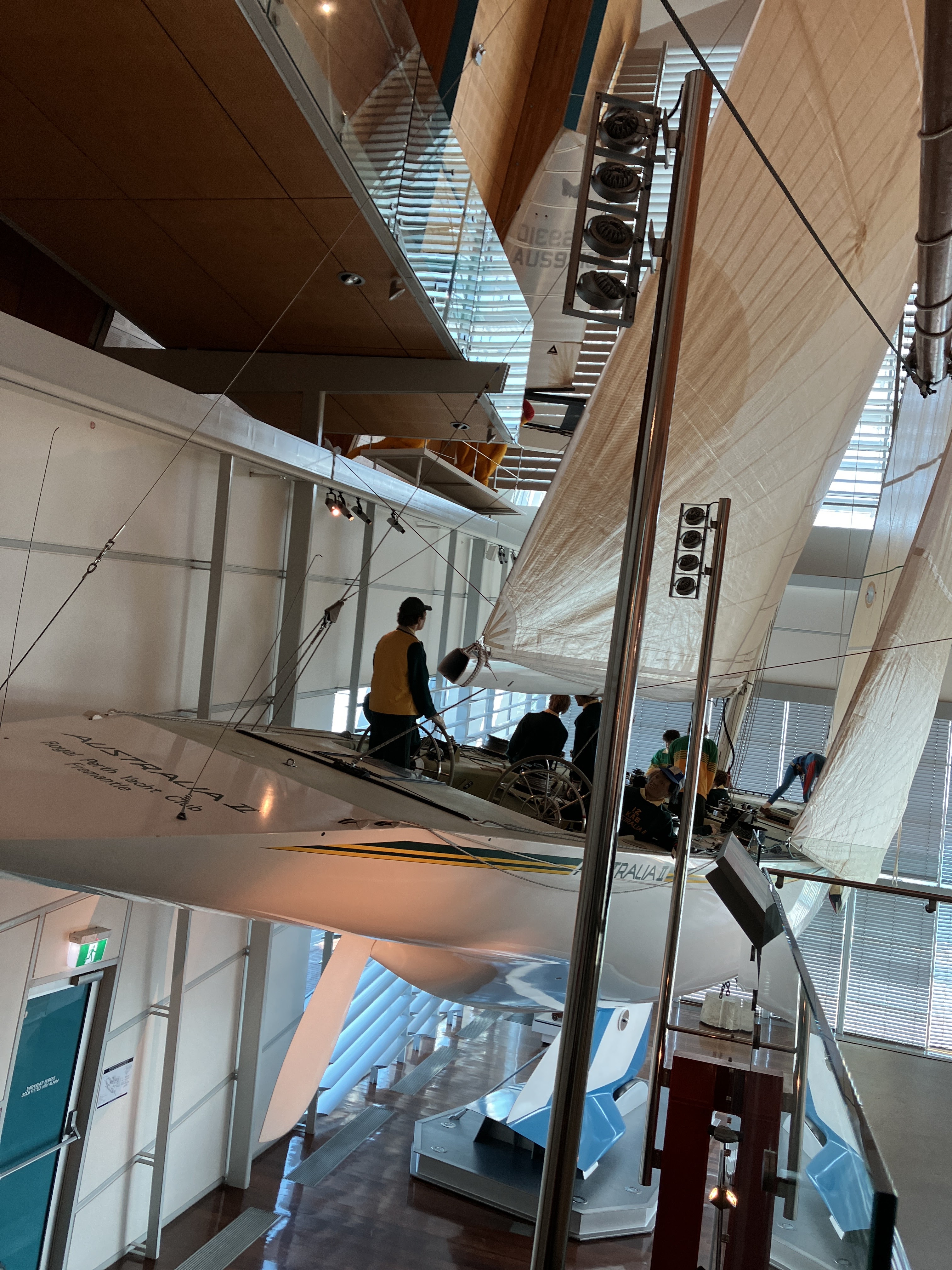
Australia 2,  the boat which famously won the America's Cup in 1983.
Located in the Western Australia Maritime Museum.

After wandering around Fremantle for a few hours we had a decadent afternoon tea.
This cake is called Death by Chocolate, and despite sharing it, we couldn't finish it.

Out on Rottnest Is. The colour of the sea was spectacular
all the way around the island. I used to associate colours
like this with tropical islands, but that's not true of Rottnest.

We had lunch with this view (180 degrees, actually), with almost
no one else around.

No private vehicles are allowed on the island, so if you're able,
bikes are the perfect way to see the sights. It seemed like every five minutes or so 
we were hopping off our bikes to check out a new scene. Stunning!

Quokkas are native to the island. The ones in the populated part of the island 
were quite bold, but we did see three in another part that were more timid.

Working: this group of around 50 people from two or three churches
 gathered on Friday night to hear about OMF and mission work in Japan.
They provided a yummy dinner too! It was a great evening, but I
came home exhausted!

Cliffs at Point Walter Reserve on the Swan River.

Cute shaded beach on the river. With my pale skin
a rare beach with shade is worthy of attention!


23 August, 2022

Unexpected joys and regaining of health

It's only been a few days since I last blogged, but I'm feeling quite a bit better. Which is very good, especially considering all that I've ended up doing over the weekend. 

One very large tree at the park on Saturday: an Indian
Banyan. Obviously not all the trees in the park 
were native! My friends and I were imagining our kids
climbing in this tree when they were younger (and
probably even now).
On Saturday I spent several hours in a native-tree park with two of my best friends. It was delightful weather and fantastic company. The evening was also busy as my son and I socialised with our hosts over pizza and a documentary about the Thai soccer team rescue, followed by our usual weekend family video call.

And Sunday also ended up being very social. At 8.30 am I went to church with my two oldest sons, then talked to various people I knew there, some I first met as a child. The church now runs two services on a Sunday morning, to accommodate the restrictions the government had at one point for COVID, and so you can only talk inside after the 8.30 service for an hour before you have to leave. I ended up talking with an acquaintance who is an illustrator and author. After it was clear we needed to vacate the church building we progressed on to coffee at a nearby cafe, talking about writing, editing, writing retreats, creative process, etc. It was an unexpected delight, and one that has sparked some positive ideas and connections for the future. 

I then gathered my sons and we went for a Korean lunch in the home of a retired missionary; I first met her as a child when she came and taught my Sunday school class about Korea. We've stayed in touch all these years and it's wonderful that our eldest is now in the same church as her. She loves young people and enjoys inviting them round to her house, so our son isn't a stranger to having lunch with this lady.

After that we went back to where my middle son and I have been living and packed up our stuff. From there I took him to move in with his big brother. And I drove 30 minutes away to a friend's house, which is a real blessing to me at the end of this long period of living out of suitcases. These are our seventh abodes since mid-June, and we're a little travel weary! This is just for ten days and then we'll head to a hotel near the airport for our last night (hopefully) before flying back to Japan.

So, our sojourn in Australia is drawing to a close. We've still got a couple of appointments to take care of and I'm planning to spend time with my parents and sisters on Saturday. On Sunday I say see-you-next-year to the folk at our home church. And in the meantime I'm continuing to work at staying on top of the usual editing/managing/writing responsibilities I have for the Japan field, and thankfully I'm feeling a lot more able to do that this week. 

I came across the term "knowledge worker" yesterday while editing. It's the first time I've heard of that classification. And what I do fits it very well. My job is to "think for a living". I think it's a helpful term to understand some aspects of what I do. It was encouraging to hear my writing friend say on Sunday that recently, for some reason, she didn't have the headspace to cope with the larger editing tasks that her editor had asked her to do on her latest book manuscript. I often feel like that, only able to approach some of the harder editing tasks I have when I'm "in the right headspace". This month it's been challenging to try to push through getting editing work done while being below par health-wise. If you're a "knowledge worker" you have to be well enough for your brain to function at a higher level than if you're just doing relatively mundane tasks, like, say (for me), cooking a simple meal, or answering basic emails.

Back in March, I wrote this about one of the reasons we were coming to Australia at this time:

I'll stay longer in Australia with our middle son to do some reconnaissance for his future. He's still deciding about what his next steps are, and I hope that an un-hurried period in Australia as a young adult will help him consider what he might like to do next. Last time he was there he was 16, and in a period of high anxiety and stress at school, so it's really hard for him to imagine what life in an English speaking country might be like as an independent adult. 

It's hard to judge how well this reconnaissance has gone. But I think we'll be reaping the benefits over the coming year as we plan to relocate both our youngest sons more permanently in Australia. We've certainly been able to give them both plenty of "this is what it's like to be an adult or older teen" experiences. It's quite remarkable to do something they're familiar with in Japan, like going to the dentist, and see them experience the remarkable difference when they do it in Australia. Language makes a huge difference, and culture does too.

I'm heading into a more intense period of "transitionitis" again over the coming nine days, but hopefully not too bad, especially as we know that we're heading back "home" and into a familiar routine. And it's only one plane and two countries, not three and three! Hopefully I'll find some headspace to write here next week before I fly.

05 October, 2020

Big historically significant park in Yokohama

We had online conference meetings for our mission from Tuesday to Thursday last week. Usually an in-person conference is five days long and very social. Online is much harder, so our leaders urged us to spend time with missionaries who live closer to us on the days surrounding the online meetings. In that spirit, we had lunch with another family with teens last Sunday (27th) and then last Friday (2nd) I met two colleagues for a day at a park in Yokohama. 

At the end of a week of being stuck to screens, of straining to connect with others in a large group, connecting really fast in small groups, and processing all the other information being given to us, it was a relief to get outside and hang out in nature. Even the train trip was good. Yokohama is a fair way from us, but from our local station we can catch a direct train there. It takes a bit over an hour, but I got a seat at the very start, so it wasn't a hard journey. At the end of the day I had usual end-of-week fatigue, but a whole day of nature and talking for several hours in-person had rejuvenated my soul.

I didn't get to blog about it last week, though. I spent Saturday catching up on some urgent things I didn't get done on Friday and Sunday catching up on rest. So today, I'm catching up on the less urgent things, including this. Here are some photos, with commentary. This is a fascinating park! I love history, and this park has a few centuries of history attached to it. I'm thankful that there were lots of signs around explaining elements of the park, and they were all bilingual.

This park used to be, as many of these old parks were, a private property. It has about 20 buildings, many of which were brought to the park in the early 1900s by the then-owner of the park, Sankei, a successful Yokohama businessman (silk). Many of the buildings come from the Kansai area (around Nara/Kyoto). Though it used to be the family's private property, the "outer garden" was opened to the public for free from 1906 (we had to pay!).

This is the "Main Pond". Intuitively named! It is the first feature of the park that you come across when you come through the main entrance. Note the red spider lily flowers, late-summer early-autumn flowers that we're seeing a lot of at the moment.
A small bamboo "arbour" that was unlabelled.
This is the only building that we were allowed inside. It was designed for farmers, but is grander than what most farmers lived in.  It was large, but very dark and dusty inside this building. Not the warmest place to live in winter either!  
Pictured is part of an autumn-moon-viewing tradition, the purpose is to give thanks to the gods for a harvest (as best as I understand it).
This is the front of the same building. I'm not sure what was stored in the ceiling.
This fire is kept burning all day long. It was very smoky. I find it hard to imagine living in this house: with the smoke, dust, and draftiness!
This bridge had unusual "railings". Many of the structures in the park were damaged in the 1923 earthquake, rebuilt, then damaged again during WW2. Additionally, they've struggled with the flora. Several thousand plum trees were planted at one point, and destroyed by wind. Not to mention the proximity to the ocean, so salinity has also been an issue. It's quite remarkable how much work has gone into this park and understandable that it has been named an official cultural asset. The family gave the park to a foundation for its management and it was opened for the public again in 1958, this time the "inner garden" was also opened.
A bridge with a covered place to rest halfway across.
One of several water features.
This was our lunch view! Serene.
Beautifully manicured banks of the Main Pond.
This building was built in the mid-1500s at a temple in Kyoto, the same temple as the
three-story pagoda that you'll see if you stick with this blog post! This building housed
a Buddha statue. It was damaged by a typhoon after WW2 and disassembled.
In 1987 it was relocated to this garden. It is listed as an Important National Cultural Property. 
From under a wisteria trelllis, we spied a couple having pre-wedding photos taken.
And later we saw another couple doing the same thing (pre-wedding photos).
Cute gateway into the "inner" garden, where the family used to live in the early 1900s. Pictured are the two colleagues I spent the day with.
The garden is in a shallow valley, somehow all the noise from the nearby expressways, heavy industry, and closely built residential areas didn't penetrate the garden. The signs promised a view here, but though we could see the ocean, the foreground overwhelmed it. One of the original buildings on the property was built on this high vantage point (1887), presumably because of the seaside views at the time!
Lots of water features and bridges, as is typical in a Japanese garden.
This wooden pagoda was originally constructed in 1457 and moved to the garden from an 
abandoned temple in Kyoto in 1914. 
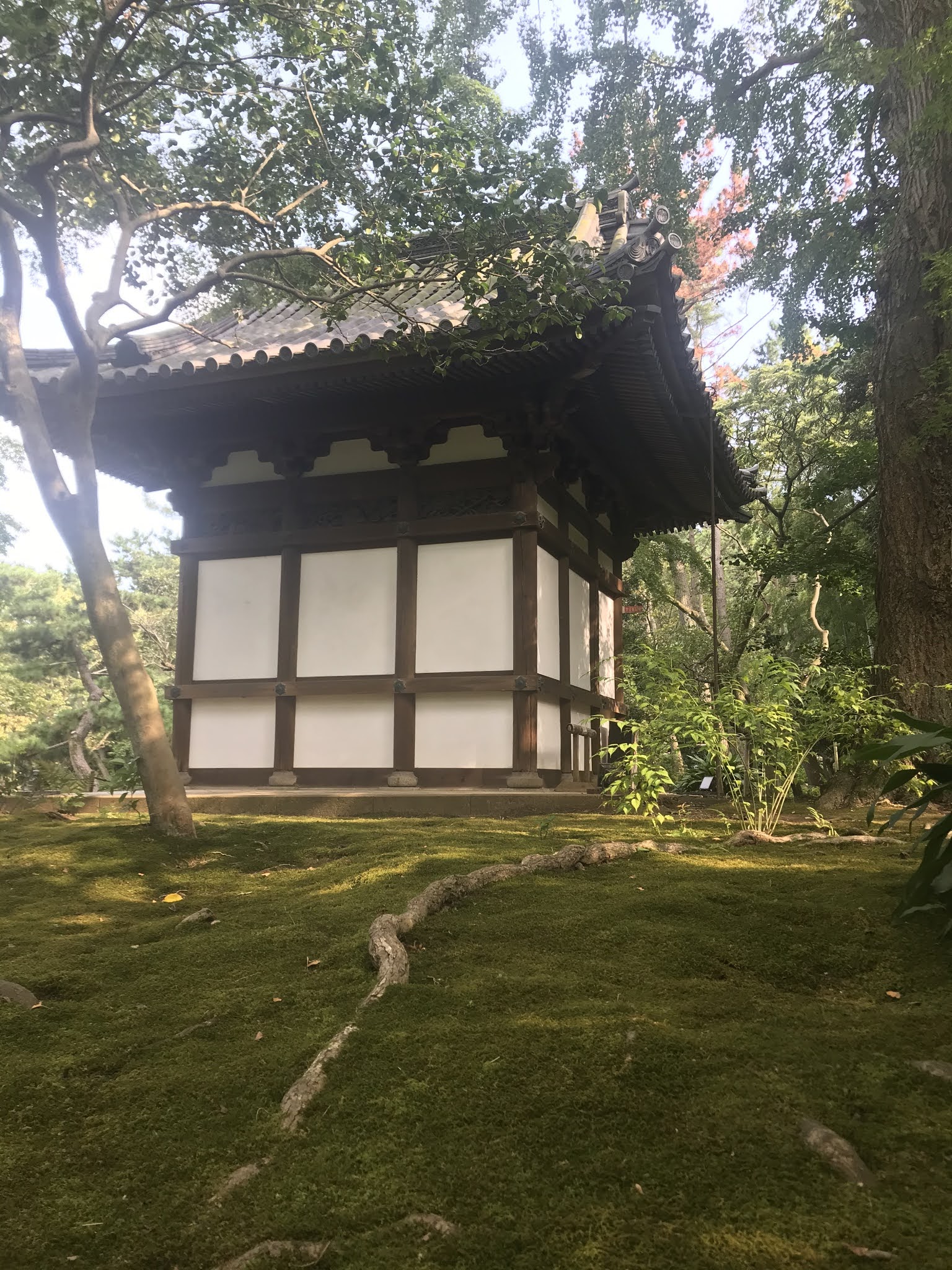
This little building fascinated me. It was moved to the garden in 1905, but was
originally build by a feudal lord (son of the first shogunate of the Edo period,
Ieyasu Tokugawa). It contains a stone monument to wish for his mother's
health and long life. In the foreground you can see thick moss.
It wasn't easy to take this photo. I discovered the dragonfly next to my leg and
tried not to move suddenly to startle it. I love seeing these insects.
In the Main Pond, they've anchored this wooden boat that the birds were enjoying. In the foreground you can see a big spot light. There were a number around. As the gardens shut by 5pm, I can only imagine these are for special nighttime events (the gardens can be hired for private events).
At this time of year there weren't many flowers around, but red spider lilies 
(and these rarer white versions) were looking brilliant. I love how they
randomly appear in the least likely places.

Well done for sticking around to the end of this post! A bit lengthy. But I enjoy the discipline of looking up some of the history to go with my photos when I do get to visit these historical sites in Japan. This nation has many many centuries of history. Of which I know only a tiny smidgen and have no hope of learning a large chunk. However, little tidbits every now and then is fascinating and gives a little more insight into this place I've lived most of my adult life.