Showing posts with label Camping 2016. Show all posts

23 November, 2017

Not camping this weekend

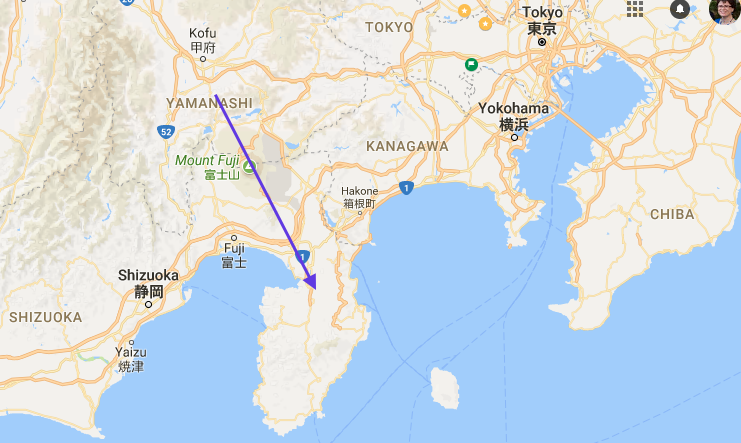
This is approximately where we're headed.
Tomorrow is the anniversary of our snow camp. Did you hear about it? If not, here it is: Remember the time mum and dad took us camping in the snow?
Us, last year this weekend.


In the last year we've had some great conversations with other people about this camping trip. Most have been in the realm of "you're crazy!" But we do have super memories. And it really is fun to have done something a little extreme like this and survived.

The amazing sight we discovered on our way back
from the toilet block on our first morning.
As I wrote when we went camping last month, we decided not to camp this year at Thanksgiving time (which had been our tradition for several years). It turns out that the weather is going to be quite favourable if we'd chosen to do it—sunshine with daytime temperatures in the teens, night times still low single digits. But we've made other plans.

We're still going to a campsite, but we're spending more money and renting a cabin instead. Hopefully a cabin that has a heater!

We're also going to a place where we know local church planters from the UK and will spend time with them and their teenage boys over the weekend. Because the weather is forecast to be good we should be able to have some fun at a local beach (but not in the water!).

If it's a good experience, we might even go back in warmer weather sometime with a tent. Apparently there are good views as it's up on a hill.

We're looking forward to getting out of Tokyo, even if only for two nights and three days.

28 November, 2016

More photos from camping

Here are some other miscellaneous photos from our camping trip.

Defrosting a tea towel over the fire so we could wash-up breakfast on our first morning. Do notice the boy in the background. This guy regularly wears shorts to school in winter, it is notable that he has a hat and gloves on!

Second morning: frozen washer (face cloth).

We needed snow chains just to get into the campsite and out again. These things are tricky to get on and very noisy if you get off the snow onto bitumen as we did on Friday going out to get a couple of extra ingredients for lunch.

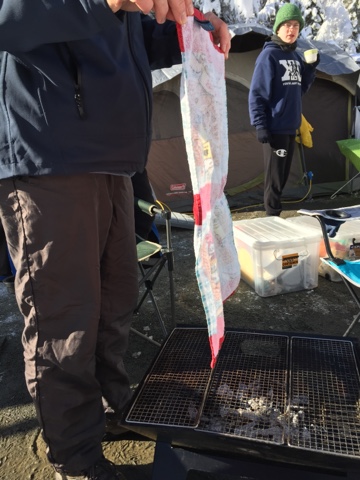
We were amused to find this toilet-paper origami chart next to the pedestals. I guess it would be useful if you were planning on spending a lot of time sitting there. 32 steps!

A large icicle found by our youngest. Notice his bare arms! He'd been digging in the snow and got quite warm.

The ubiquitous pickup truck that all campsites in Japan own, as do most farmers. They all look the same as this!

Not the best of photos, but this is snow piled up on a fence. Any slightly horizontal surface catches snow and it piles up: even on power lines and washing lines!

I looked in envy on these on-site accommodations as we set up camp on Thursday. They are still "tents" and you have to bring most of your own bedding but have heaters inside and a covered area with a table and BBQ outside. But we paid a lot less for our little piece of snow-covered gravel, and had the satisfaction of doing a reasonably good job of it too. No one has come home sick or any the worse for wear (except for a bit of weariness).

I can't finish without putting up this amazing view. This David and I both saw on walking back from the toilet block to our tent on the first morning and I snapped it on my iPhone that happened to be in my jacket pocket. I put the photo up on Facebook and to my boys' amazement it garnered more than 130 likes, loves, and wows plus many comments. A friend said: that could be anywhere in the world, but I wouldn't have picked Japan!


27 November, 2016

Our unexpected camping adventure

We're back from our camping trip. It turned into a bigger adventure than we'd planned for and for a little while I wondered if we'd finally bitten off more than we could chew. If you thought we were crazy for going camping at this time of year when temperatures regularly dip below zero, then this story will convince you we really are.
What our journey out of Tokyo looked like.

On Thursday school finished at midday and we planned as usual to leave as soon after that as possible. The unexpected was snow. It snowed all morning!

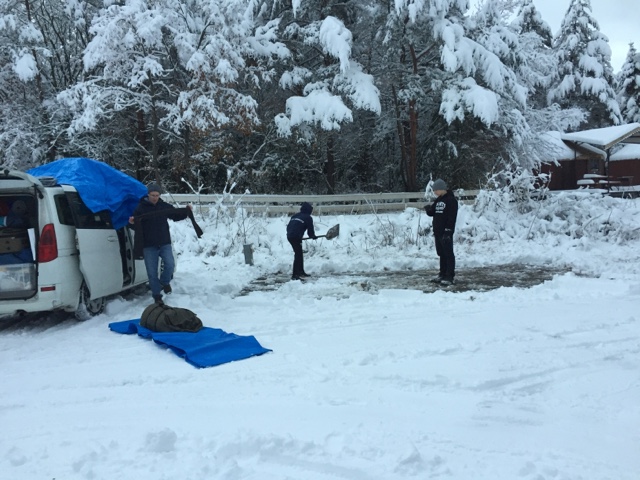
Digging out our tent site with a borrowed spade. The boys were great,
they just wished that we had more than one spade.

Because we lived in snowy Sapporo for four years (with its average yearly fall of five meters) we aren't usually impressed with Tokyo snow. It's often a small amount and very short-lived. November snow is almost unheard of here. The last time it snowed this early in the season was more than 50 years ago! The snowfall on Thursday was bigger than we expected. We even got stuck behind snowplows on the highway.

We were prepared for cold but not snow. We had to borrow a spade to shovel our tent site. It was covered with several inches of loose snow when we arrived.

There were doubts we would make it but when the boys managed to dig out a rectangle that was the perfect size (without measuring) we cheered. At that moment we realised how experienced we were at camping and from that point doubts drained away.

We arrived only thirty minutes before the sun disappeared, however, so we did much of the extraneous setting up in the dark, including bed-making and fire-starting. Thankfully it was a powered site so we used our one light to advantage as well as the light inside the backdoor of the van. Thankfully, too, I'd spent that morning making dinner (Japanese Curry Rice) so all we had to do was warm it up.
Dessert on our first night: foil packets with bananas, chocolate, and
 marshmallows, or some combination of those. We accidentally left
a left-over banana out of the cooler overnight and it froze!

After dinner we washed up and raced to the ofuro (Japanese bath) then raced back and jumped into our beds still warm.
The next morning we were greeted with an amazing winter wonderland. Indeed it was a gorgeous blue-sky day.
Walking back from the toilet block at 7am.
Lake Sai.
Autumn caught snoozing.

-5.9˚C is a record for us!
But it was exceptionally cold. I wore many layers and my core was okay but my feet suffered. As the day wore on it didn't warm up past about 5C but it was enough for the places that got sun to become mush and we were sloshing around by early afternoon. My outside ugg boots got soaked and kept my feet cold.


We walked down the road to see some local lava caves, formed during Mt Fuji's explosion in the 800s. A bit sobering as we realised we were camping at the foot of the giant mountain (though we couldn't see it due to a small mountain between us and it). The caves were pretty cool, however. Just the thing even big boys could enjoy.
Lava cave.
Though most of us weren't prepared for wet
snow, our youngest was, with all his plastic
snow gear and he had fun building snow creations.

As we began to lose light at 4.30 we started dinner (simple hot dogs) with the goal of getting to the bath then bed (and getting our feet into dry socks) as soon as possible.

I think late afternoon as the temperature dipped again was the worst I felt, almost nauseous at times. However, despite what you may suspect we had happy campers 95% of the time. One of the keys was lots of food and frequently!

Our second morning wasn't as cold but neither was it as pretty. The sky was mostly grey and much of the pretty snow had melted or turned into grey mush.

Everything outside was covered in frost and inside the
tent everything that hadn't been touched by the water
seeping up through the holes in the floor was covered in
condensation.
We took our time packing up and it was a little complex as almost everything was wet, inside and out. We had huge puddles inside the tent but amazingly our bedding was protected by an aerobics mat and thin silver-coated foam that we'd put down for insulation from the ground.

Our trip home was all autumn again. Like the clock had been wound back! 
Autumn leaves on the way home.


People may think we're crazy but we weren't out there alone. There were several other campers, including several who arrived well into the evening on Friday and set up completely in the dark. There were people fishing, even water skiing. As we packed up on Saturday a guy came with his two large parrots and set them up with a playground then put up his tiny tent beside them! If we're crazy, we've got plenty of company in Japan!

These two older guys set up in the dark after we went to bed on Friday night.

We have created some great memories. We'll be talking for a long time about "that time we went camping in the snow"! On our way driving down we introduced the boys to "TheFour Yorkshireman" skit by Monty Python. Our guys now have their very own "you're lucky . . . . remember the time Mum and Dad took us camping in the snow". I personally will treasure conversations had while we washed up (one adult paired with one kid makes for great conversation) and while huddled around the campfire trying to warm our hands and feet.


On Thursday evening when we were nearly set up I realised that everyone was in high spirits. After living with guys for the last 19 years I've gradually realised that guys love to be challenged, especially a physical challenge. Even if you have to boot them into the challenge, they love pitting themselves against the odds and coming out a winner. That is what we've done this time. We pitted ourselves against extreme weather with less than ideal equipment—our tent is not a winter tent and all our sleeping bags are second-hand, not what you'd take to trekking in Nepal. And we survived, not just survived, but came out the better for it as a family, I believe! 

But just so as we're clear, we never planned to camp in the snow and don't plan on doing it again. But we will camp again at this time of year. Anyone know of a warm place we can camp at within two hours of Tokyo at the end of November?


30 July, 2016

Nijō castle in Kyoto

WARNING: some Japanese history coming up!

We visited a Japanese castle when we were in Kyoto. It was built by the famous Shogun Tokugawa Ieyasu as his Kyoto headquarters at the start of the 1600s. This is a flat-land castle and looks a lot different to European castles (not that I've ever been to one, just seen photos). 
In this case it includes two layers of fortifications (moats and formidable stone walls). Inside those are gardens and two palaces in traditional Japanese style. It's one of more than a dozen places in and around Kyoto that have been designated by UNESCO as a (single) World Heritage Site.

Tokugawa Ieyasu
Tokugawa Ieyasu was the founder of the Tokugawa shogunate that virtually ruled Japan for nearly 300 years from 1600. He was a powerful lord who seized power in 1600 and was appointed by the emperor as shogun (hereditary military dictator) in 1603.

I've been doing a little bit of reading about him, here's a summary of what I've learned. He was born in 1543 towards the end of a century called the Age of Warring States, where there was no central control over the country, though there still was an Emporor in the Imperial Palace in Kyoto, he had no real power over the country. 

Ieyasu's mother was sent back to her family when he was two and never lived with Ieyasu's father again. His father was killed when he was six. And he lived much of his childhood as a hostage because there was warring within his family.

The 45 years leading up to Tokugawa Ieyasu becoming shogun was a gradual period of unification (subduing) the country by a few powerful men, the most well known being Hideyoshi. One of the things this guy did was a "sword hunt", banning all non-samurai from owning weapons. To this day there are very strict laws about weapons of any sort in Japan, including knives!

Hideyoshi even tried to invade Korea twice in the 1590s, with the goal of taking over China (he was quite brilliant, but a little megalomaniacal), but suffered an untimely death in 1598. Hideyoshi's only heir was five at the time. 

Hideyoshi had established a regency council of leading lords, however within two years Ieyasu had gotten half to sign allegiance to him and then, at 59 years of age, he won a decisive battle near Kyoto in 1600, and became the de facto ruler of the country. In 1602 the Emperor gave Ieyasu the title of shogun.

Ieyasu moved the capital to Edo (now called Tokyo) and handed his son the shogun title in 1605. During the remaining eleven years of his life he spent consolidating the position of his family, including devising a complex administration structure to create a viable system for ruling this decentralised country. Having traveled a bit now in Japan, it amazes me that anyone was able to do that at all. The country has many nooks and crannies that are difficult to access, even today with motorised vehicles. 

One of the keys was that all the 300 feudal lords had to travel to Edo on a regular basis. Also there was a rigid class structure set up, so everyone know where in society they were and how they should behave. You see still reflections of this in Japanese language and culture today.

He managed to create a system that maintained peace and foster growing prosperity for over two centuries. However there was significant xenophobia and the doors to the outside world were closed for most of that time. It was Ieyasu that sighed a Christian Expulsion Edit in 1614 which banned the practice of Christianity and led to the expulsion of all foreign missionaries, marking the end of open Christian witness until the 1870s.

Back to Nijō castle
It was built by Tokugawa Ieyasu (but funded by the feudal lords of Western Japan) as the Kyoto residence of the Tokugawa family. They were living in Tokyo, but still obviously came to Kyoto at times. Especially because the Emperor still resided in Kyoto (until the late 1800s).
This is one of the outside walls of the Ninomaru palace. The white is paper-
covered sliding doors! I don't know what happens when it rains.
There are two palaces in the complex, but we could only see inside one of them: Ninomaru. It is a wooden building that was used for administrative meetings. The rooms are huge, all covered with traditional tatami flooring. 

This was part of one of the gardens on the grounds.
I want to say that it is filled with beautiful artwork, but that gives you the impression of paintings on walls, statues on pedestals etc. But that's not what it is like at all. The walls are covered with amazing paintings that includes gold , the ceilings too. The upper parts of some of the walls separating rooms have incredible carvings that go all the way through, but are completely different images on each side. We were not allowed to take photos, so all I can offer you is this webpage.

The floors of the corridors are famous and called "nightingale floors". They squeak when you walk on them and have been constructed to prevent anyone from sneaking into the palace undetected.

Ieyasu came to the castle in 1603, but he never entered the Ninomaru palace as that wasn't completed until 1626, after he'd died.

The palace was where authority was returned to the Imperial Court in 1867. In 1939 the palace was donated to the city of Kyoto and opened to the public the following year.

I'm enjoying this, I've always liked history, but never really gotten into Japanese history. My resolve is to keep reading and learning about Japanese history this year and hopefully well beyond that!

However that's probably enough history for here for one day! 


24 July, 2016

Water

One of my sons saw my two most recent blog posts last night and was impressed that I'd written about food and then toilets. Today's might or might not be so impressive. As I look through my photos I'm struck by a lot of green, but also the prevalence of water.

At church this morning someone asked about our camping trip, especially noting that we got very wet. I pointed out that we really only had particularly two bad episodes with rain, at our first campsite and then our fourth. But water featured in other ways too, we camped next to water or in view of bodies of water several times.

But here is our 15-day camp from the viewpoint of water.

First day: stopped at Naeda falls


 Campsite one: Niigata ken, overlooking Joetsu city

This campsite had a great view, that included the Japan sea from this campsite, especially when it wasn't raining. Alas it rained quite a bit. Our tent leaked when a storm blew in within the first half an hour of setting up and our tarpaulin annex didn't hold up to the wind either. So we moved the tarp over the tent and shifted our kitchen to a more solid location.


 We also packed up in the rain at the end of that two-night stop.


Campsite two: Noto island. 

We drove through rain most of the day to get to this campsite. While setting up it was drizzling. We set up a wet tent because it had been raining when we took it down that morning. I mopped out the inside of the tent before we took our stuff in there. Thankfully we gradually dried out over the next couple of days and our bedding wasn't wet.

We had a water view here too, it's Toyama Bay, off the Japan sea.
We had a dry pack-up on Noto island and spent part of the day then driving around on the Noto peninsula. This is a spot on the wild west coast, again the Japan sea.


Campsite three: Kanazawa hinterland

It was a fairly dry set-up, though I'm pretty sure we had sprinkles at one point soon after set-up and the next morning we had fog. This was probably our least watery campsite, with no natural bodies of water nearby and no water views.

 There was water at the garden we visited in Kanazawa, though.

Beautiful water...

Campsite four: Lake Biwa

Gorgeous lake-side campsite. We gazed and gazed at the changing view. However this is the campsite that we got waterlogged on our first night. It rained hard and three of us were up at around 4am doing adjustments to tarps and bedding. Eventually David and our eldest son were able to stem the growing puddle under the tent, but not before most people got their toes wet inside the tent.


Campsite five: Kii peninsula

We went down this fairly remote peninsula to see Nachi falls, the tallest single-drop falls in Japan, but we weren't camped next to them. But another stream was close-by our tent, to the point where we couldn't tell if it was raining or not. It rained here just after we put our tent up as well! 


Nachi falls. Part of a World Heritage listing.

Campsite six: north of Nagoya

We again camped next to a stream. We also again encountered rain within the first hour of being set-up. This time it was a storm. Thankfully everything remained pretty dry inside the tent, despite a large amount of water being dumped on us in a short period of time. The stream was lots of fun to play in.

It was the rainy season after all...but we really didn't have that bad a time of it, not as bad as it apparently sounded!