21 July, 2022

Food, awkward conversations, and trust

I've had time to think about a lot of things. Here are some of them:

Providing food for an itinerant family (on a budget)

As I explained in my last post, we've been travelling around Queensland in the last month, sometimes with our own kitchen and sometimes with family (and the presumption that they will organise meals). Planning and grocery shopping has moved to a slightly higher challenge level. I've mostly stuck with the simple options, but trying to keep things healthy means not every night can be pies, pizza, or sausage rolls. Not to mention that I just get bored too easily. 

But cooking dinners without a pantry means you're often missing those important extras like salt, vinegar, or flour—the things I think of as staples, that you buy once every few months, but not for a flying visit of a few weeks. And as one who is not only on a budget but is averse to waste, it's not easy to come up with good meals for hungry young men (not to mention David and me).

Here are some of the evening meals I've ended up making:

  • sausages and veggies
  • chicken wraps
  • bacon, eggs, and damper (like soda bread, it's quick wheat bread made with baking soda as a rising agent, not yeast)
  • dry rub (garlic flavour) on chicken drumsticks, with rice and veggies
  • BBQ (beef patties on bread rolls)
  • Japanese curry (roux bought in shops)
  • roast lamb
It's a mix of things that we enjoy about Australian food, plus some comfort food we're familiar with from home in Japan. It's worked fairly well, though I'm also dealing with the unfamiliar electric stove/hob. In Japan we use gas, and it's a quite a mental shift to go to electric again. Gas is just so fast! The stove top at our current abode is also complicated—I needed to pull out the instruction manual a couple of times! Plus, adjustments are needed due to the different types of equipment in a kitchen that's not my own, for example, where we are right now has a rice cooker (yay!) but no "rice" cup (180ml). Also there's no potato masher or big-sized tongs.

We're only in our own place until the end of this month. Then David and our youngest son go back to Japan. I'm here with our middle son for another six or so weeks, during which we'll be living with other people. That's going to provide different challenges, too, I'm sure. But at least they'll have a pantry with staples in it.

Spotting a missionary out of their “natural” habitat 

Have you ever spotted a missionary out of their "natural" habitat? We expect that missionaries are either in their country of service, doing what ever they do. Or if they are in their passport country, they will be doing home assignment. As we've met people during these last few weeks in Australia, we've answered questions that made us realise that our presence here is a surprise, or even a tad unsettling. We're not in Japan and nor are we doing deputation. "Here to see family" seems an acceptable answer, but "on holidays" is a bit strange, especially when we're in Brisbane (which isn't really a standard holiday destination). However, if someone is willing to stick around and ask good questions, I get to explain a little about the challenges we're facing in transitioning our middle son from high school in Japan to adult life in Australia and that this is one way that we're trying to help navigate that gap. 

I anticipate it's going to get more difficult to explain in August. Then I will be back at work, but will still be in Brisbane. I work from my home office in Tokyo, and will be doing the same here in Brisbane for a few weeks. That's definitely going to be a bit tricky to explain.

But I'm not the only missionary with our organisation working in Australia. Did you know that we have quite a lot of people who work here? Their work helps us stay in Japan, but also they help recruit others to join us. I imagine they often face this challenge in explaining their roles. I know that they struggle to find sufficient financial support (yes, they are supported by gifts from others, just like we are).

Trusting God

I'm also thinking about this. We've been given the gift of time away from work, but it's been harder to "be still" in the midst of that than I might have guessed. Being still and not being consumed with lots of to-dos means there's more time to think. And of course with that comes the thoughts about "bad things that could happen", especially surrounding our upcoming flights back to Japan. I woke up yesterday morning with that all running around in my head and it took a while to shake it off.

One tempting way to avoid getting stuck in that bad place is to fill up my schedule with lot of other things to entertain or distract. 

Another way is to focus on God's character and his all sufficiency. We're so tempted to rely on our own strength: "you've got this" is the classic. In reality we're very fragile and easily knocked over. There's so much that we simply don't have ultimately control over. Even if it looks like we do, things happen that show that that isn't truly the case.

I was reminded of Isaiah 40 yesterday, but also Job 38–42. Both passages remind us of how mighty God is, and how relatively small we are in comparison. Job said: 

“I know that you can do all things; no purpose of yours can be thwarted" (42:2 NIV).

Paul wrote that the Lord said to him: “'My grace is sufficient for you, for my power is made perfect in weakness.' Therefore I will boast all the more gladly about my weaknesses, so that Christ’s power may rest on me" (2 Corinthians 12:9 NIV).

And: "Not that we are sufficient in ourselves to claim anything as coming from us, but our sufficiency is from God" (2 Cor. 3:5 ESV).

And Jeremiah prayed: "Ah, Lord God! It is you who have made the heavens and the earth by your great power and by your outstretched arm! Nothing is too hard for you" (Jer. 32:17 ESV). God responded, "Behold, I am the Lord, the God of all flesh. Is anything too hard for me?" (vs 27).

The Psalmist wrote: "Why are you cast down, O my soul and why are you in turmoil within me? Hope in God; for I shall again praise him, my salvation and my God" (Ps. 42:11 ESV).

And these things are what I should be directing my thoughts to when I start dwelling on what could go wrong!

(Check out this article for more about El Shaddai, the all sufficient God.)

Meet David and Wendy

I've been thinking about this too, and our rough plan at this point is to take a picnic lunch to Rocks Riverside Park in Brisbane on Saturday 30th July, probably from around 11.30. If you're local and would like to join us, please do. To help locate us, I'll plan to wear my bright red jumper. We don't have any chairs, so we'll try to find a table somewhere.

13 July, 2022

Update from Australia

I've been off the air (here and also social media) for much of the last month. One reason for that is travel.

On June 19–20 we travelled 5,380 + 6,302 + 750 = 12,432 km by air. It's actually only about 7,100 km between Tokyo and Brisbane, but in June no airline was flying directly from Tokyo to Australia, so we had to fly via another country (in our case, Singapore) and another state (Sydney). In Sydney we hit congestion and baggage delays, so missed our connecting flight to Brisbane. A journey that could take less than 12 hours, door to door, took 35! We've done this journey a number of times in the last 21 years, but never has it taken so long. It was exhausting.

We spent the week after that in Brisbane recovering from the journey as well as taking care of some urgent things. Our eldest son, who we hadn't seen for three years, was going to meet us at the airport, but he came down with COVID the day before we arrived, so that reunion was delayed. We did drive over to see him later in the week and shared a brief afternoon tea in his yard (at an appropriate distance).

On the road in inland rural Queensland. It's been good to
see the land thriving. Last time we were here
it was in drought.

Then we gathered ourselves for a "tour" of Queensland. First a week's holiday by the beach with two special friends and their families; a few days with David's family, and then my parents (who live eight-hours drive apart). So, since 25 June we've travelled 360 + 390 + 690 + 120 = 1,560 km by car. A total of about 17 hours of journeying in the car, on four days. (That's just counting the drives between beds.) And we didn't leave the state, in fact we didn't even make it half-way up the coast of Queensland. This country is huge.

Here are some other photos from some of the places we've seen.

Brisbane River

First view of Brisbane after 35 hrs of travelling

Queensland beaches, even in winter, beat most Japanese beaches.

South of Yeppoon, central Queensland

Woodgate Beach

Our youngest with two dogs belonging to family.

This week we arrived back in Brisbane and laid our heads on our fifth beds in Australia since we arrived just over three weeks earlier. I've struggled with headaches most days since I've been in Australia (and in the days leading up to leaving Japan) and my body is showing other signs of strain. I'm now on antibiotics (for a non-respiratory infection), a common sign I've been travelling, a lot!

I've held off posting much on social media because just dealing with all of the above, plus trying to make the most of time with important people who we haven't seen for several years, has taken most of my daily strength. I've been trying hard to "be present" in the moments. That, of course, has meant that I've had little time alone, and little time to reflect. Writing is one way that I process my thoughts, and I've missed having time and energy to do it. I'm glad to be settled in one place now, in a self-contained place that's "just us" in Brisbane for a few weeks.

It's been good to spend precious time with family and close friends, to hear and discern how they are just now. I have two-and-a-half more weeks of personal leave, during which we've got a few important appointments. But we especially see these weeks as opportunities to help our younger two boys see life in Brisbane through eyes that are older (they were 13 and 16 last time we were here), and to think about what it will be like to move here in the middle of next year. Exactly how these weeks will shape up, we're not sure. That makes me feel a bit uneasy, but I'm trying to relinquish my desire to plan and be in control, and to wait and see how God works things out.

Those of you who live in the Brisbane area, please be patient with us. We are actually on leave from OMF! We aren't doing deputation, but we're thinking about an informal open invitation social gathering before David flies back to Tokyo, details haven't been worked out yet, though. Stay tuned.


13 June, 2022

Transition-itis


We've entered the last few days before we transition for a time to Australia. It's the seventh time we've done this as a family in the last 21 years, so we're not unfamiliar with "transitionitis" as I recently saw it called on Instagram @takingrouteblog. I've been a little bit in denial about this actually being a transition, because:

1. We're not going on home assignment, so in that regard it's like a longer holiday

2. It's a relatively short time to be away (two us will be back in six weeks) compared to the most of the longer trips we've made to Australia as a whole family. Only twice before have we travelled there as a family for less than six months, yep, we're not big travellers.

3. We're not changing jobs like we usually do for a home assignment, just pausing (or at least I am, a school teacher does this every year, so it's nothing strange for my husband).

4. We're not moving out of our house either (though that's only happened twice in 21 years prior to moving to Australia). So there's been no packing of boxes, limited sorting of stuff and cleaning, and minimal work to clear out the pantry. Yep, my image of a transition is pretty major!

But when I saw this Insta post yesterday, I realised that we do have some significant transition going on. The definition that they author somewhat tongue-in-cheek gave was: "Transitionitis is a very common ailment affecting hundreds of travelers each year. it is caused by the change in routine brought on by transition, and anxieties (often underlying) relating to the unknowns of a new location and losses associated with leaving the current location."

Several points come to mind out of this:

* Though we're not permanently transitioning to a new location, we'll be in a number of new locations in the coming weeks. My middle son and I will be in seven different houses in the next three months, none of them are familiar to us (even staying with our parents: they've all moved in the last couple of years). We're also thinking about the future on this trip: how will it look to transition both our youngest two out of our household in the next couple of years.

* There's always lots of anxiety surrounding international travel, even for people who aren't living with anxiety as a daily pathological reality. Things like: how will we cope travelling the busy trains with heavy suitcases, will there be unexpected bureaucratic barriers to be met when checking in at the airport, will we be able to sleep on the overnight flight? Though things have settled down a lot with regards to COVID, there are still extra hurdles in place (even just the thought of wearing a mask for 24 hrs is on my mind). I'm really glad we didn't have to travel earlier in this pandemic! We've also been going through a long saga all year with a passport renewal and visa renewal (which has a surprising number of flow-on effects, like when your health insurance expires and when you can apply for an international vaccination passport). We have reached a final hurdle this month that is yet to be completed: we haven't been able to collect our new residence cards with our new visas. It's out of our hands as we're waiting on notification that they're ready for us to collect. [Please pray!]

* And of course change in routine. Some people find that stimulating, but in our family, maintaining a fairly routine life is a way of managing overall stress and anxiety. Travel throws that all to the wind, of course. But the advantage we have here is that our kids are older. They understand what's going on and they have prior experience to help them anticipate what's about to happen.

I'm glad that we don't have many losses this time around, so we haven't had to make a lot of farewells, which only compounds the stress.

This is beside my bed. A good verse to
remember as I drift off to sleep each night.

The author listed a dozen symptoms of "transitionitis". I can recognise some of them from the past. Not so many this time as it's not such a major transition, but recently I've had:

  • mushy brain
  • inability to think straight—affecting my ability to edit this morning)
  • fatigue
  • turbulent emotions
  • a little bit of sleep deprivation—usually in the form of waking in the middle of the night and being unable to quickly drop back again. This happened at 4am today. My cure is to pick up my Kindle and read my fiction book. I dropped off quickly this morning with this strategy, only to wake again later when I rolled over and knocked my Kindle on the floor!
  • stomach issues—I've seen my body in much worse shape, but transition for me usually comes with feelings of hunger, at times I shouldn't be hungry; indigestion/reflux; and often an upset tummy on the day of travel.
  • often daily headaches: the result of muscle tension, loss of sleep, and later on, unfamiliar beds.
The only way to "fix" this is to move through the transition to the other side. So I'm getting to the point where I just want to go. But I am trying to be kind to myself, in part, by working hard to prepare beforehand, so there isn't a last-minute push to finish things. We've also been exercising and eating pretty well, and "chilling" in the evenings.

As I've said before, it's been three years since we've seen our eldest son in person. Because just before the pandemic, we let his dependent visa go and Japan hasn't been letting people on tourist visas in. To compound matters, getting to Australia has been very expensive for they had compulsory hotel quarantine for ever so long.

But in the last 18 months we've had weekly family video calls with him. It's been precious time, often two or three hours, of rambling conversation and online board games. And on Saturday we were able to sign off with the sweetest words: We'll hug you next Saturday at the airport!

02 June, 2022

Dwelling in the grey areas

My family are all into sci fi and fantasy. Oh, and action and super heroes. None of this is my natural bent. And I didn't grow up with brothers, or a dad who was into that kind of thing, so it's been challenging as my boys have grown older, because they clearly come alive when they're talking about these topics. If I've learned anything about parenting teenage boys, it's that seeking to engage with them in areas they're enthusiastic about is really important for maintaining a relationship with them that is beyond being just a basic caretaker. I've got no experience of parenting girls, but I suspect this is also helpful with them too. In our family, my husband's interests generally align with our boys, in terms of fictional genres, so it isn't so challenging for him as it is for me.

I've sat through many, many hours of movies that I would never have chosen. However, I'm now reaping the benefits of that, because I can have a semi-intelligent discussion with the boys on some of these topics!

I've learned, in my own way, to enjoy these movies. I look for the meta-story and themes, and let the details I don't understand just slide by. If I can, I try to pull together intelligent questions to ask the guys later (not during the movie!!!). If you like, I've learned to live with the grey of not understanding many of the details of the movies we've seen.

A cross-cultural worker, Linda, recently asked on her Facebook page about "ambiguity" and what comes to mind when her friends hear that word. My answer was:

Yesterday I had a conversation here in Tokyo with a fellow cross-cultural worker and we talked for quite a while about the "grey" we've learned to live with. Everything from not understanding everything around us in everyday life to spiritual matters (e.g. not being a member of the church we attend here and being a member of a church in our home country that we rarely attend).

These types of "grey" are an integral part of life in a foreign country. There's so much we don't understand about what's going on around us. I remember being stressed by a visitor we hosted from Australia in our early years who constantly asked "why" about what they saw around them. We simply didn't have many answers (and probably still don't).

This is one of 47 pieces of art
one from each prefecture of Japan.
I've included it here because not only is
it actually grey, but it's situated in the
grounds of a controversial shrine.
The Japanese equivalent of the
Australian War memorial. It's contro-
versial because it also enshrines
people convicted as war criminals and
where they are worshipped as deities.
Definitely a grey zone.

Can you see the parallels between these? Just as I've learned to live with not understanding a fair bit in some of the movies I watch with my boys, I've learned to live with not understanding a lot about Japan. I've also learned, in both areas, to focus on the "big picture" rather than get bogged down in the "small details". For example, before I came to Japan many of my friends were fairly similar to me in that they were mostly Australian and from a fairly narrow band of evangelical Christian background. Now I have friends and colleagues across a wide spectrum of nationalities and Christian beliefs and practices.

But living with the grey doesn't mean that I disengage my brain. I'm continuing to seek to understand and learn. And to live with the grey in a graceful manner. Learning when to speak and when to hold back and, as my cross-cultural friend, Linda said, "and trying not to feel overwhelmed by the enormity of it all."

We're preparing to head into a grey area that is going to be misunderstood by a lot of people. We're going to Australia for some holiday time and some "other leave" time. What we're doing is not a traditional home assignment, so we're not visiting groups to talk about Japan or what we do here. We're also not consciously seeking out friends to spend time with, it's too short a time to do much of that, though I'm sure that we will catch up with some close friends, or people who happen across our paths. 

The "other leave" is very murky and hard to explain, but especially relates to helping our sons with thinking about their futures. Those weeks are part of what we're calling "reconnaissance" for the next couple of years. I wrote a bit about that in this post in March. It will also contain things such as medical appointments and regular tests that we're due to have which are easier (or better) to do in Australia. Once we get there that murkiness is going to be even more in our faces as we try to explain (or decide how much we need to explain) to the people we encounter, that we're only in Australia for a limited period this time.

But my focus in these next couple of weeks is mostly preparing to put my work down: either handing on to others, or getting it to a place where I'm able to walk away from it for six weeks. I can't book many more appointments in Australia at this time. And we're praying: that our final piece of accommodation is able to be confirmed and that our Japanese visa extensions arrives before we leave.

26 May, 2022

Honshu OMF conference 2022

We got back from our two-night conference on Saturday feeling rather exhausted, or at least I did. It was an intense, but valuable three days away. There were lots and lots of conversations and I savoured the time to spend in person with people. At times it was surreal, the faces I've been seeing on screens for years came to life on real people, some of whom I'd never met before. I sidled up to one person I've had many an online meeting with and said, "Good to meet you!" She was surprised.

Of course for me, savouring in-person time comes at a cost. It took me till yesterday (Wednesday) to not feel blotto (not drunk, just wiped out) when the alarm went off in the morning. The post-event exhaustion for me is exacerbated by my mind replaying many of the conversations, especially after I turn the light out or awaken during the night. Does that happen to other people too?

I've been to many mission conferences in Asia over the last 21 years. Venue quality and food have varied, but this is the first time we've done it with restrictions on breathing on people. We had limitations on how long we could be in the dining room and plastic barriers down the middle of the tables. The latter made talking difficult, which is a pity, because meals are one place at a conference when you get to interact informally with your colleagues, a huge bonus for developing trust! We also had restrictions on bathing: we had to sign up for a 15 min slot in the Japanese communal bathroom (only showers, though, no baths). We had to do a COVID test before coming and wore masks the whole time. 

But despite the inconveniences, it was worth getting together. I'm in one of the more unusual support roles in our organisation in that I communicate one-on-one with many of our missionaries via email. Many of them entrust their valuable words to me to edit, often without ever having had a meaningful conversation with me. Meeting the person on the other end of the email is so valuable!

What did we do, aside from eat and bathe? We had several "worship times", singing, people spoke about the Bible and what God had to say to us about unity, and we discussed the talks in small groups. We had a fun evening and a prayer evening. There was an option to choose to attend a small "focus" group on a specific topic. I got to lead one about good writing and prayer letters. It was also the first time that our social media team had all been in the same place at the same time, so we gathered for a short time too. We had some free time on Thursday afternoon, where most people chose to either go to a local dam (that was me) or a local Japanese bath (onsen). The kids had their own program, which parents were so thankful for. Our boys are older and chose to stay home. That's the first time we've gone together to an overnight work event in Japan without at least one of our boys.

Here are some photos from our time away.

Meet Stella, the mascot of the
Iwate Prefectural Kennpoku Youth Outdoor Learning Center.

We travelled over 500 km to get to this conference. It was a joy to be told to catch
the shinkansen (bullet train), rather than drive. They are so much more convenient than planes: no security or baggage checks. And so much more spacious. I know I don't have long legs, but even I never have this much space between my knees and the seat in front of me in a plane.

We could see this sunset view from the second floor meeting room, though I took a stroll with a colleague in the car park to see if we could get a better view. However, the site was surrounded by trees, so it was hard to see much from the ground.

The center had a craft room where they can teach all sorts of crafts. I would have loved to have time in here making stuff! And of course Stella featured widely in their displays.

The center has their own ice rink! Yes, this is a part of the world that gets quite cold. It is therefore fitting that Stella is wearing ice skates.
I wish I'd had a zoom lens here, this tree was covered with wisteria. A very different sight to the highly crafted wisteria sites in the city.
This is an enormous flower larger than my hand. It's scent wasn't super pleasant, though. Officially the Magnolia tripetala, a different type of magnolia than we commonly see in Tokyo. The leaves and bud (seen below) are also huge.

The trip to the dam was interesting. This is Aoba Lake/Dam. While writing this post I discovered that it was named after a Japanese flute, which was a prized possession of a famous samurai, the story of this is told in a Japanese classic "The Tale of the Heike".
Some of my colleagues. 
We were surprised by this windmill and a lot of tulips. Most of them were past their best, but some were still gorgeous.
A turtle towing a boat?
Meals were pretty basic, Japanese style, and none of them piping hot. This was almost the only "Western" item we had in the six meals we ate there. A few years ago I wouldn't have coped very well with rice for breakfast, but it was okay. I made sure to bring my water bottle to each meal because the only drink offered was green tea, which I still haven't grown to enjoy.

Conference was a "big rock" in my calendar this first half of the year, although it seemed unlikely it would ever happen until even the night before when I got a negative COVID test! This week I've had to face up to the less-than-four-weeks before we fly to Australia. One of the things I'm working on is leaving my various roles and teams in good shape while I step aside for six weeks leave. That's unsettling and not at all easy as I juggle a lot of balls in each role. But thankfully I'm gradually making progress! 

Other things such as accommodation and transport, and key appointments are largely already organised, so at least I can relax on that front. Aside from our usual work we're mostly waiting and praying about: waiting on our visa renewal to come through (submitting our application to an immigration office was an early-morning start on Tuesday) and waiting on one final accommodation spot to be confirmed. And we're also praying that the time we spend there will be helpful in the long-term goal of transitioning our two youngest boys to Australia in the next couple of years.

18 May, 2022

This week is unusual

Tomorrow we are catching trains to our first in-person overnight mission conference in four years. It's 550km north of here, but we get to go on the super-fast Shinkansen, so it's a shorter journey than if we were driving. 

OMF Japan field has usually held all-field conferences every two or three years. We were about to gather in March 2020 when all plans had to be cancelled for the pandemic. Since then we’ve had two online substitutes, but they really have only been “better than nothing” events.

This is the grand dining room of the venue of
our last all-field conference, in 2018.

One of the best things about on-field conferences is actually gathering with other missionaries. It really is pretty exhausting, because not only do you have various meetings and gatherings to attend, you spend a lot of the “free time”, coffee breaks, and meals catching up with people you haven’t seen in a long time, but it's a "good" exhausted. This is our family-away-from-home. The noise is quite something! I think this one is going to be more overwhelming for me than they have in the past, because rarely, in the last 2 ½ years, have I been in a room with more than 20 people who are talking to one another.

Nevertheless, I'm looking forward to gathering with our “OMF Family” in May for the first time in four years. (Incidentally it will be first time in Japan that we've been to a conference without any kids—our boys are staying home.) This isn’t a full-field conference, but about two-thirds of our missionaries will be there. There will be many new faces, and, sadly, many faces missing—people who’ve retired or left the field for various reasons, as well as most of those who don't work on Honshu. It's going to be an all-masked affair, and I'm hoping that wearing masks all the time will not hinder our time together.

I don't get off with being just a participant, either. I'm running a writing workshop for an handful of people on Friday afternoon and playing the piano for a short while during communion also. But I'm okay with these! What I have had trouble with is actually believing that this is going to happen. We've had so many plans cancelled in the last 2 ½ yrs, it seems surreal to actually have something big like this really happening. And we've done our Covid tests, so we're really good to go! I'm packing my suitcase soon.

By the way, if you're interested, this was my blogpost after our last conference, in March 2018: https://mmuser.blogspot.com/2018/03/hokkaido-conference-is-wrap.html This time we're going to a much more bare-bones venue, a youth hostel.

11 May, 2022

An unexpected outing to inner city Tokyo

Earlier this year I worked on a magazine issue themed "Rest". You can check out most of the articles we published in that issue here. When we asked the missionary community in Japan for article proposals, we were overwhelmed with people wanting to write on this topic, so it's obviously something that missionaries in Japan (among others) have thought about quite a bit. 

However, when we talk to people back home, it's not often that people ask us about how we get rest on the mission field. I wonder if this isn't something that people think about until they have actually left their home country and are desperately tired? I know that when we first landed in Japan we were quite exhausted from what had gone before and I can't remember if anyone ever talked to us about pacing ourselves.

I was quite encouraged to see an article in the latest magazine that we've completed (last Saturday) that talked about mentoring people interested in long-term mission. It was an internship program that their organisation runs and one of the five main areas that this couple focus on with their interns is Staying Healthy, which includes incorporating rest into your life.

Well, I've been in Japan for over 21 years now and I've had to learn about rest. I still have lots to learn, but I've learned a few things along the way. Like: How to rest when you've got three lively young boys. How to rest when your to-do list seems enormous and overwhelming. How to rest when no one else in Japan seems to, and how to manage when just making it through a short Japanese-language church service is exhausting. How do you rest when you're very aware of the urgency of reaching Japan for Christ? And when going anywhere away from home just takes so much out of you.

I still remember our first holiday in Japan. Just following the paper map (in Japanese and pre-Navi) was exhausting. Then we needed to figure out buying groceries in a small rural town and a strange missionary holiday house (believe me, they are often stranger than the usual place you'd rent back home). On top of that, we had a lively 2 y.o. and no one but us to look after him.

Over the years we've learned different ways and means of resting and that it isn't an option, rest is essential, as is pacing ourselves. We've had to approach this missionary life more like a long-distance journey, than a sprint. But we still struggle, life and ministry have a way of being busy and both David and I are self-starters, which means that we can be quite driven. I've been trying to finish this blog post for several days. I've been wrestling with tiredness as well as drivenness. Tiredness won out yesterday morning and I rested all morning.

My busyness at work tends to ebb and flow. Thankfully I am not expected to fill out a time-card, so if work is a bit quiet, it's okay to take some time to rest. So last week many people in Japan were resting, or at least recreating, with several public holidays on the calendar. Our house, typically, looked different. Our school didn't take all the holidays, in fact only one. I had plenty of work on my to-do list, including a magazine I hoped we could finish by the end of the week to accomodate the schedule of one of our team members. So I didn't plan to take time off, merely held it as a possibility, if the opportunity arose.

Last Wednesday (a beautiful day, not unlike today), a colleague who lives over an hour away, met me halfway for the afternoon and we explored a little corner of Tokyo. I'm not really a city person, as you might know, but I do find Tokyo to be an intriguing place. Certainly a city where nature isn't completely sidelined. There's still lots of life-giving green to be found if you look.

The area we walked around is near the purple star at the top of the map.

We walked several kilometres, exploring an area around the Iidabashi station, an area just north of the Imperial Palace. That included walking along a portion of both sides of the Kanda River, a short foray along a street in the neighbourhood of Kagurazaka to find lunch, and a stroll around a famous walled garden.

I'm going to show you the afternoon through photos and captions.

Sloped street in Kagurazaka. Lots of quaint stores that beg to be explored.
It's appealing because it's not over-the-top "shiny" and commercial like some famous
areas of Tokyo. This webpage tells me some of the charm is because there's a large French 
expat community here, including a French international school.
This is one of six train lines that run through Iidabashi! Most of them are underground, thankfully. The river is the Kanda, which is only 24 km long and lies entirely within Tokyo borders. This is taken from the southern bank looking northwest away from the palace towards Shinjuku, one of several "city centres" within Tokyo. 
A bit to the left of the photo above, taking looking down the river. In the middle is a place you can fish! I'm not a fisherman, but this just seemed to be lacking any appealing atmosphere.
This is on the opposite side of the river, looking towards the Imperial Palace and the actual "city centre". Later we walked along under those trees behind the train.

More city views from the southern bank.

Who would have thought? Inner city Tokyo? Many of these trees are cherry blossoms and so would have been amazing in a different way a month ago.


Stunning huge tree.

Then we made our way to Koishikawa Korakuen Garden. I'm guessing that some of you have been to a Japanese garden overseas, but in my experience it's a little different in Japan, not that I've been to that many in either place. The biggest difference would be the age. Japanese gardens/parks in Japan, the sort you walk around and admire the ponds, etc., are old. The trees are mature and there's a lot of history embedded in the park. This one is nearly 400 years old.

The English brochure says it was originally built by the founder of the Mito branch of Tokugawa clan (a powerful clan in the Edo period, 1603 to 1868). It is a circuit style garden with ponds and manmade hills centering on the pond. Like many things from Japanese history, it has Chinese influences. It has two special designations: Special Historic Site and the Special Place of Scenic Beauty. Part of this status is the recognition that it is a valuable property that has survived the Great Kanto Earthquake and war damage as well as progressing urbanisation.
Luminescent new-spring leaves.
You can see a hill and winding path behind me in this picture. These small hills and circular paths make the garden seem larger than it actually is. There's no one spot where you can see all the garden.


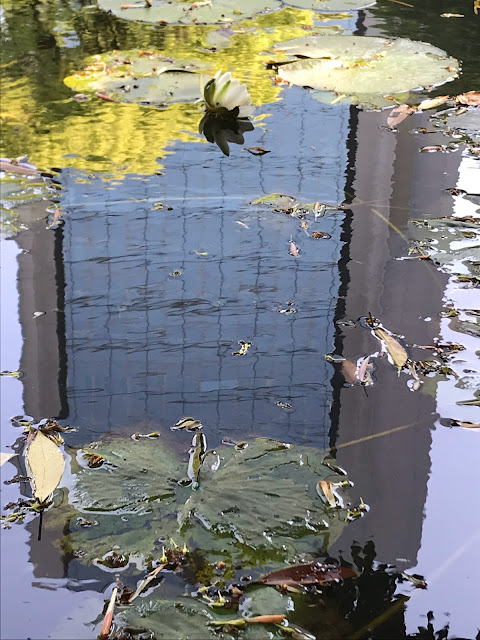
There's no escaping that this is a garden surrounded by a high-density city. The ambience was tempered by the noise of a neighbouring amusement park rollercoaster and a concert in the adjacent Tokyo Dome. Not to mention it was hard to keep the buildings out of some photos, but here I really liked the reflection in the pond.

You've made it this far: well done! This day was not my typical idea of a rest day, but I did come away feeling filled up and refreshed. I got to hang out with a friend and talk about the various things going on in our lives, I got to see a tiny bit more of this amazing city, including some beautiful green and even amazing man-made structures (though a tree will usually trump a building for me).