26 May, 2022

Honshu OMF conference 2022

We got back from our two-night conference on Saturday feeling rather exhausted, or at least I did. It was an intense, but valuable three days away. There were lots and lots of conversations and I savoured the time to spend in person with people. At times it was surreal, the faces I've been seeing on screens for years came to life on real people, some of whom I'd never met before. I sidled up to one person I've had many an online meeting with and said, "Good to meet you!" She was surprised.

Of course for me, savouring in-person time comes at a cost. It took me till yesterday (Wednesday) to not feel blotto (not drunk, just wiped out) when the alarm went off in the morning. The post-event exhaustion for me is exacerbated by my mind replaying many of the conversations, especially after I turn the light out or awaken during the night. Does that happen to other people too?

I've been to many mission conferences in Asia over the last 21 years. Venue quality and food have varied, but this is the first time we've done it with restrictions on breathing on people. We had limitations on how long we could be in the dining room and plastic barriers down the middle of the tables. The latter made talking difficult, which is a pity, because meals are one place at a conference when you get to interact informally with your colleagues, a huge bonus for developing trust! We also had restrictions on bathing: we had to sign up for a 15 min slot in the Japanese communal bathroom (only showers, though, no baths). We had to do a COVID test before coming and wore masks the whole time. 

But despite the inconveniences, it was worth getting together. I'm in one of the more unusual support roles in our organisation in that I communicate one-on-one with many of our missionaries via email. Many of them entrust their valuable words to me to edit, often without ever having had a meaningful conversation with me. Meeting the person on the other end of the email is so valuable!

What did we do, aside from eat and bathe? We had several "worship times", singing, people spoke about the Bible and what God had to say to us about unity, and we discussed the talks in small groups. We had a fun evening and a prayer evening. There was an option to choose to attend a small "focus" group on a specific topic. I got to lead one about good writing and prayer letters. It was also the first time that our social media team had all been in the same place at the same time, so we gathered for a short time too. We had some free time on Thursday afternoon, where most people chose to either go to a local dam (that was me) or a local Japanese bath (onsen). The kids had their own program, which parents were so thankful for. Our boys are older and chose to stay home. That's the first time we've gone together to an overnight work event in Japan without at least one of our boys.

Here are some photos from our time away.

Meet Stella, the mascot of the
Iwate Prefectural Kennpoku Youth Outdoor Learning Center.

We travelled over 500 km to get to this conference. It was a joy to be told to catch
the shinkansen (bullet train), rather than drive. They are so much more convenient than planes: no security or baggage checks. And so much more spacious. I know I don't have long legs, but even I never have this much space between my knees and the seat in front of me in a plane.

We could see this sunset view from the second floor meeting room, though I took a stroll with a colleague in the car park to see if we could get a better view. However, the site was surrounded by trees, so it was hard to see much from the ground.

The center had a craft room where they can teach all sorts of crafts. I would have loved to have time in here making stuff! And of course Stella featured widely in their displays.

The center has their own ice rink! Yes, this is a part of the world that gets quite cold. It is therefore fitting that Stella is wearing ice skates.
I wish I'd had a zoom lens here, this tree was covered with wisteria. A very different sight to the highly crafted wisteria sites in the city.
This is an enormous flower larger than my hand. It's scent wasn't super pleasant, though. Officially the Magnolia tripetala, a different type of magnolia than we commonly see in Tokyo. The leaves and bud (seen below) are also huge.

The trip to the dam was interesting. This is Aoba Lake/Dam. While writing this post I discovered that it was named after a Japanese flute, which was a prized possession of a famous samurai, the story of this is told in a Japanese classic "The Tale of the Heike".
Some of my colleagues. 
We were surprised by this windmill and a lot of tulips. Most of them were past their best, but some were still gorgeous.
A turtle towing a boat?
Meals were pretty basic, Japanese style, and none of them piping hot. This was almost the only "Western" item we had in the six meals we ate there. A few years ago I wouldn't have coped very well with rice for breakfast, but it was okay. I made sure to bring my water bottle to each meal because the only drink offered was green tea, which I still haven't grown to enjoy.

Conference was a "big rock" in my calendar this first half of the year, although it seemed unlikely it would ever happen until even the night before when I got a negative COVID test! This week I've had to face up to the less-than-four-weeks before we fly to Australia. One of the things I'm working on is leaving my various roles and teams in good shape while I step aside for six weeks leave. That's unsettling and not at all easy as I juggle a lot of balls in each role. But thankfully I'm gradually making progress! 

Other things such as accommodation and transport, and key appointments are largely already organised, so at least I can relax on that front. Aside from our usual work we're mostly waiting and praying about: waiting on our visa renewal to come through (submitting our application to an immigration office was an early-morning start on Tuesday) and waiting on one final accommodation spot to be confirmed. And we're also praying that the time we spend there will be helpful in the long-term goal of transitioning our two youngest boys to Australia in the next couple of years.

18 May, 2022

This week is unusual

Tomorrow we are catching trains to our first in-person overnight mission conference in four years. It's 550km north of here, but we get to go on the super-fast Shinkansen, so it's a shorter journey than if we were driving. 

OMF Japan field has usually held all-field conferences every two or three years. We were about to gather in March 2020 when all plans had to be cancelled for the pandemic. Since then we’ve had two online substitutes, but they really have only been “better than nothing” events.

This is the grand dining room of the venue of
our last all-field conference, in 2018.

One of the best things about on-field conferences is actually gathering with other missionaries. It really is pretty exhausting, because not only do you have various meetings and gatherings to attend, you spend a lot of the “free time”, coffee breaks, and meals catching up with people you haven’t seen in a long time, but it's a "good" exhausted. This is our family-away-from-home. The noise is quite something! I think this one is going to be more overwhelming for me than they have in the past, because rarely, in the last 2 ½ years, have I been in a room with more than 20 people who are talking to one another.

Nevertheless, I'm looking forward to gathering with our “OMF Family” in May for the first time in four years. (Incidentally it will be first time in Japan that we've been to a conference without any kids—our boys are staying home.) This isn’t a full-field conference, but about two-thirds of our missionaries will be there. There will be many new faces, and, sadly, many faces missing—people who’ve retired or left the field for various reasons, as well as most of those who don't work on Honshu. It's going to be an all-masked affair, and I'm hoping that wearing masks all the time will not hinder our time together.

I don't get off with being just a participant, either. I'm running a writing workshop for an handful of people on Friday afternoon and playing the piano for a short while during communion also. But I'm okay with these! What I have had trouble with is actually believing that this is going to happen. We've had so many plans cancelled in the last 2 ½ yrs, it seems surreal to actually have something big like this really happening. And we've done our Covid tests, so we're really good to go! I'm packing my suitcase soon.

By the way, if you're interested, this was my blogpost after our last conference, in March 2018: https://mmuser.blogspot.com/2018/03/hokkaido-conference-is-wrap.html This time we're going to a much more bare-bones venue, a youth hostel.

11 May, 2022

An unexpected outing to inner city Tokyo

Earlier this year I worked on a magazine issue themed "Rest". You can check out most of the articles we published in that issue here. When we asked the missionary community in Japan for article proposals, we were overwhelmed with people wanting to write on this topic, so it's obviously something that missionaries in Japan (among others) have thought about quite a bit. 

However, when we talk to people back home, it's not often that people ask us about how we get rest on the mission field. I wonder if this isn't something that people think about until they have actually left their home country and are desperately tired? I know that when we first landed in Japan we were quite exhausted from what had gone before and I can't remember if anyone ever talked to us about pacing ourselves.

I was quite encouraged to see an article in the latest magazine that we've completed (last Saturday) that talked about mentoring people interested in long-term mission. It was an internship program that their organisation runs and one of the five main areas that this couple focus on with their interns is Staying Healthy, which includes incorporating rest into your life.

Well, I've been in Japan for over 21 years now and I've had to learn about rest. I still have lots to learn, but I've learned a few things along the way. Like: How to rest when you've got three lively young boys. How to rest when your to-do list seems enormous and overwhelming. How to rest when no one else in Japan seems to, and how to manage when just making it through a short Japanese-language church service is exhausting. How do you rest when you're very aware of the urgency of reaching Japan for Christ? And when going anywhere away from home just takes so much out of you.

I still remember our first holiday in Japan. Just following the paper map (in Japanese and pre-Navi) was exhausting. Then we needed to figure out buying groceries in a small rural town and a strange missionary holiday house (believe me, they are often stranger than the usual place you'd rent back home). On top of that, we had a lively 2 y.o. and no one but us to look after him.

Over the years we've learned different ways and means of resting and that it isn't an option, rest is essential, as is pacing ourselves. We've had to approach this missionary life more like a long-distance journey, than a sprint. But we still struggle, life and ministry have a way of being busy and both David and I are self-starters, which means that we can be quite driven. I've been trying to finish this blog post for several days. I've been wrestling with tiredness as well as drivenness. Tiredness won out yesterday morning and I rested all morning.

My busyness at work tends to ebb and flow. Thankfully I am not expected to fill out a time-card, so if work is a bit quiet, it's okay to take some time to rest. So last week many people in Japan were resting, or at least recreating, with several public holidays on the calendar. Our house, typically, looked different. Our school didn't take all the holidays, in fact only one. I had plenty of work on my to-do list, including a magazine I hoped we could finish by the end of the week to accomodate the schedule of one of our team members. So I didn't plan to take time off, merely held it as a possibility, if the opportunity arose.

Last Wednesday (a beautiful day, not unlike today), a colleague who lives over an hour away, met me halfway for the afternoon and we explored a little corner of Tokyo. I'm not really a city person, as you might know, but I do find Tokyo to be an intriguing place. Certainly a city where nature isn't completely sidelined. There's still lots of life-giving green to be found if you look.

The area we walked around is near the purple star at the top of the map.

We walked several kilometres, exploring an area around the Iidabashi station, an area just north of the Imperial Palace. That included walking along a portion of both sides of the Kanda River, a short foray along a street in the neighbourhood of Kagurazaka to find lunch, and a stroll around a famous walled garden.

I'm going to show you the afternoon through photos and captions.

Sloped street in Kagurazaka. Lots of quaint stores that beg to be explored.
It's appealing because it's not over-the-top "shiny" and commercial like some famous
areas of Tokyo. This webpage tells me some of the charm is because there's a large French 
expat community here, including a French international school.
This is one of six train lines that run through Iidabashi! Most of them are underground, thankfully. The river is the Kanda, which is only 24 km long and lies entirely within Tokyo borders. This is taken from the southern bank looking northwest away from the palace towards Shinjuku, one of several "city centres" within Tokyo. 
A bit to the left of the photo above, taking looking down the river. In the middle is a place you can fish! I'm not a fisherman, but this just seemed to be lacking any appealing atmosphere.
This is on the opposite side of the river, looking towards the Imperial Palace and the actual "city centre". Later we walked along under those trees behind the train.

More city views from the southern bank.

Who would have thought? Inner city Tokyo? Many of these trees are cherry blossoms and so would have been amazing in a different way a month ago.


Stunning huge tree.

Then we made our way to Koishikawa Korakuen Garden. I'm guessing that some of you have been to a Japanese garden overseas, but in my experience it's a little different in Japan, not that I've been to that many in either place. The biggest difference would be the age. Japanese gardens/parks in Japan, the sort you walk around and admire the ponds, etc., are old. The trees are mature and there's a lot of history embedded in the park. This one is nearly 400 years old.

The English brochure says it was originally built by the founder of the Mito branch of Tokugawa clan (a powerful clan in the Edo period, 1603 to 1868). It is a circuit style garden with ponds and manmade hills centering on the pond. Like many things from Japanese history, it has Chinese influences. It has two special designations: Special Historic Site and the Special Place of Scenic Beauty. Part of this status is the recognition that it is a valuable property that has survived the Great Kanto Earthquake and war damage as well as progressing urbanisation.
Luminescent new-spring leaves.
You can see a hill and winding path behind me in this picture. These small hills and circular paths make the garden seem larger than it actually is. There's no one spot where you can see all the garden.


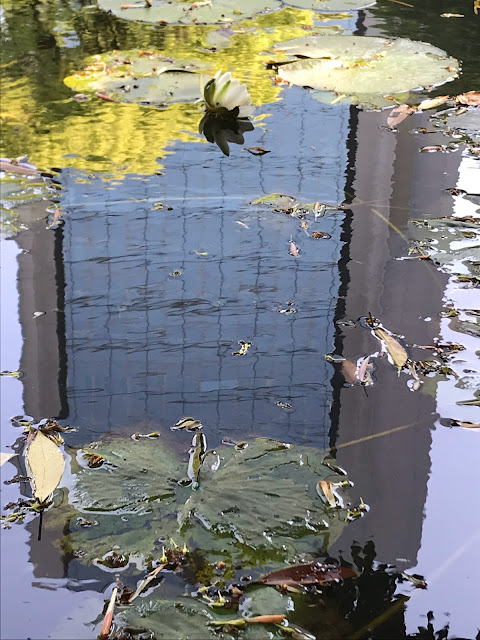
There's no escaping that this is a garden surrounded by a high-density city. The ambience was tempered by the noise of a neighbouring amusement park rollercoaster and a concert in the adjacent Tokyo Dome. Not to mention it was hard to keep the buildings out of some photos, but here I really liked the reflection in the pond.

You've made it this far: well done! This day was not my typical idea of a rest day, but I did come away feeling filled up and refreshed. I got to hang out with a friend and talk about the various things going on in our lives, I got to see a tiny bit more of this amazing city, including some beautiful green and even amazing man-made structures (though a tree will usually trump a building for me).


29 April, 2022

I don't fit in a neat box

Someone asked me what I've been up to this week. It's been a very detailed-focused week. I'm working on the pointy-end of the next issue of the magazine (i.e. the part when we finalise the text for the designer to work on it). This is the stage when I need to be hyper-alert to nailing down all the details and getting them right. That, for me, also involves, getting to a point of agreement with authors about their work. I also need to get to a point of agreement with our production team (designer and proofreader), but we work well together and usually this is fairly smooth. But sometimes we can get too detail focused—like how important is it to know whether or not to put that semicolon there or if a font looks exactly right—and I need to pull back a little and look at the bigger picture.
I've come to the conclusion that I'm a bit of an all-rounder when it comes to the big-picture vs details dichotomy. I'm neither one nor the other. That's actually a helpful balance, at least in the work I usually do. It means I can juggle a job that requires intense concentration on details and stay fairly well on top of organising myriad things. But I can (usually) also step back and take in the bigger picture. But, like social vs alone time, I need a balance. Doing lots of ultra-detailed focusing tires me out. So does lots of big-picture stuff.

This is true in many systems of understanding humans: I don't fall into a neat box. But I think that is true for many people. We get a little bit stuck on questions like—"is she an introvert" or "is he an enneagram 5?" or "am I an ENTP or and INFP?" These systems of understanding personality are fascinating and sometimes helpful, but are they sometimes unhelpful? The older I get the more I struggle to answer the questions in these kinds of assessment. Thoughts like "Well, when I'm having coffee with Sue, I would do this, but if I was at work I'd do that. If I was really tired, I'd choose this, but if I had just had coffee on a Tuesday morning, I'd act like this." Truth is, I'm not consistent in how I react. 

My reactions are a combination of my personality, the immediate context, and what's gone before. Living cross-culturally hasn't helped, either. In Australia I act differently to in Japan! It's true. I really struggled with that when I first came here, it made me feel like I had a dual personality. Having a clear understanding of language and culture taken away from you can turn you into much more of an introvert than you used to be! You get much more observant, and work harder to interpret your context than you ever had to in your home country. Oh, did you know that I change how I speak according to who I'm speaking too, also? So an American won't usually hear me say, "I'm going to the toilet" but I would say that to a British person. British people won't usually hear me say, "See you this arvo" but an Australian might.

This can all be a bit exhausting! 

I'm glad God's given me the ability to read social situations and adapt to different contexts, because I've seen up close how that can go wrong, even in small ways. But I'm also glad that he's my dependable rock in the midst of all the shifting and changing. He doesn't require me to react in any specific way to earn approval with him. I often chastise myself for not concentrating in church, or falling asleep during prayer time with my husband. It's easy to have regrets about my past behaviour, to question if I've been the best parent I can be, etc. But I need to keep coming back to the solid truth that I'm loved regardless of how good or bad I am. And indeed, on my own, I can't ever be good enough to reach the standards God demands.

And with that thought, I'm winding down towards my weekend. I'm weary, how about you? Thankfully tomorrow's looking quiet!

21 April, 2022

Top ten tips for editors on working with writers

I've just discovered this blog post: it was in my draft folder, almost completely finished, but never published. I wrote it over a year ago. It think it's time to let it out into the wild. Of course most of you aren't editors, which is probably why I didn't end up publishing it. But, I've been reminded that many of us have to edit our words or other people's words, whether we identify as an editor or not. In the last year I've read The Subversive Copy Editor by Carol Fisher Saller. She says, 

"In the routines of almost any office job, a worker is likely to be responsible for a chunk of writing, and in any chunk of writing there is likely to be a problem. Solving problems with writers is what copyediting is."(p 3)
I like that: lots of us are editors, whether we think of that as part of our skill-set or not. I also like the idea that editors are problem solvers. That's what I love to do: solve problems!

By the way, it's an excellent book. I've underlined many passages in it. For example:
Editing "matters because inaccuracies and inconsistencies undermine a writer's authority, distract and confuse the reader, and reflect poorly on the company...Discriminating readers look for reasons to trust a writer and reasons not to . . . [We] help the writer forge a connection with the reader based on trust—trust that the writer is intelligent and responsible, and that her work is a reliable source." (p 10)

This book is about doing a good job as an editor (tonnes of practical hints about how to organise your work etc.) and but also also how to build a good relationship with writers. It's one of those books I'd love to have read before I started work as an editor—I had to learn so much by trial and error! 

Editors also need to build trust with their writers and that's not easy to do when you don't have a face-to-face relationship with them. I look back now and realise that most of the difficulties I had early on was that writers didn't trust me. And quite possibly I needed to do more to gain their trust than I did.

The three key words she emphases in her book are carefulness, transparency, and flexibility. 

I could go on and on about this book, but anyway, if editing is part of your job, I recommend you grab this book and read it. It'll be worth your while. You can skip past bits that don't apply to you, but a lot of it is very relevant if editing in some form and working with others with their words is part of what you do. Oh, and there's a chapter just for writers too!

Here is what I wrote in March last year:


Last week I taught a short session at a non-fiction book-writing workshop. Online, of course! I first talked about working with editors and, obviously, gave advice about how writers could work well with editors. At the end of that I asked for "bad experiences" with editors. I was shocked. My advice to editors, is the same as what I gave the writers (in this blog post): be professional and treat this work as a team event.

The best quote I've seen about editing was in an acknowledgement of a book I picked up recently. The author noted that the editor "was both an enthusiastic supporter of the author and a faithful advocate for the reader." This succinctly explains the careful tension that an editor must work under in order to do good work. I don't believe the best editor is one who has the best understanding of English. I think the best editor is one who can keep these two elements in mind while working.
"The relationship between writer and editor can be as complex as any marriage. The common perception seems to be that the editor holds all the power. [Magazine editor talking to writer] 'Do it my way, or forget about the assignment!' he bellows, 'And forget about ever working here—or anywhere else—ever again!'  (The Layers of Magazine Editing, Michael Robert Evans, p. 123-125)
In reality, the relationship is, or should be, much more balanced than that. Yes, the editor can block the publication of an article...[but] the last thing an editor wants to do is leave a good writer feeling abused, mistreated, neglected, or otherwise."
"Editors don't hold all the power. And they know that. So they work to keep their writers happy." (or they should!)

It is the "tension between nurturing and pressuring that makes the writer-editor relationship so delicate and challenging."

My philosophy is to remember whose name will be on this work at the end of the day. If it is the writer's name, then they hold more power than I do, though hopefully we've build a respect for one another that they at least hear my opinion and take advice. The caveat with that is that there might be other considerations, especially if this writing represents a group larger than the writer. For example, the magazine I edit is published by an organisation, and I can't let writing that violates their name go into the magazine. I work in social media for my mission organisation and can't let writing go out under that name, or on the website, that goes against its principles. 

What I do is somewhat different to book editing, in that I have fairly strict deadlines and word-limitations to keep to. So, sometimes I have to choose not to publish something, or seriously shorten something because of these limitations. I also have a team of people who help me with this publishing work, I have occasionally rejected an article because I deemed it unfair to demand my team do the excess amount of work that would be required to publish that author's work.

So here are my tips for any out there who edit other people's work:
  1. This is not your work, it is the author's and will have their name on it, don't ever lose sight of that. Your goal is to make their writing shine. (The caveat to that from The Subversive Copy Editor, is that "it's not the author's right to offend or confuse the reader, defy the rules of standard English, fail to identify sources, or lower the standards of your institution.")
  2. Be kind, but not dishonest. Writers, especially new or inexperienced writers can take changes to their work personally. It's a good policy to seek ways that you can legitimately encourage the writer.
  3. If you think big changes are needed (eg. removing large amounts of content, changing structure, significant change in tone or audience or main focus, rewording larger segments), go back to the author and see if they can make the changes themselves. Explain your reasons. The best editors do as little rewriting as possible.
  4. If rewriting is necessary, be willing to go back and forth on it with the author, giving clear direction as to what you're expected.
  5. Editing is not black and white. A number of the changes you will want to make are instinct or opinion. There is usually more than one way to express something. So be willing to revise your decisions if a writer is adamant.
  6. Good communication with writers is vital. Try to keep your communication succinct: not long-winded, but also not multiple emails/phone calls.
  7. Be clear about what you want. For example, word length, audience, main emphasis, due date, tone, even how they format the article before sending it to you. This might chafe some writers, but it is better to have these things clear and avoid wasting the writer's time and then having to waste more time afterwards with major rewriting or worse. For this reason with Japan Harvest magazine, I ask for proposals before people write, so I have a chance to direct them in their writing before they've invested valuable time into writing.
  8. Keep your readers in the forefront of your mind. Your goal is to help the writer communicate clearly with them.
  9. Make sure you check your changes with the writer before you publish.
  10. And again: be professional. That means be respectful, don't take things personally, do what you say you will do, and don't be unreasonable.
As a Christian I do my best to build a gracious relationship with writers. After all, as a Christian I am called to have a character full of these: "But the fruit of the Spirit is love, joy, peace, forbearance, kindness, goodness, faithfulness, gentleness and self-control" (Gal. 5:22–23 NIVUK).

15 April, 2022

Thinking outside the box was helpful this week

A Pacific rhododendron I spied at
our meeting on Monday. Gorgeous!
This week started with a wonderful influx of people-time. On Monday we had a gathering of missionaries with our organisation. That was very busy with little time for free conversation, but after several months of not having the energy on the designated gathering-day, I was able to be there, which was great. 

The huge bonus was the 24 hrs following that time. One of my colleagues has become a close friend over the last couple of years. The main way we've invested in our relationship has been by regularly staying in touch through the week via texting. We have shared meals and picnicked with her family a few times.

But we've struggled to actually physically get together and have time for just the two of us, because we both juggle many responsibilities and live on opposite sides of the metropolis of Tokyo. It's over 1 ½ hrs by train or an hour by car, but the latter is expensive for one person as it involves tolls.

So after a couple of failed attempts, I jumped out of my box and suggested that I could have a sleep-over at her house after the meeting on Monday. My mother would have frowned at that if we were kids: I basically invited myself over to her house! But it worked. And we had a great time, in fact I struggled to leave when I had to head home again. Neither of us had taken a day off, so it was more like doing life together. I took my computer and we both worked between meals and coffee breaks. But it was great, and refreshing.

Since coming home I've struggled to concentrate on my work. That's actually been a problem throughout March, as we have been preparing for our trip to Australia mid-year. We've booked, cancelled, and rebooked flights; followed leads on accommodation and transport; lined up accomodation in a few places and found transport; communicated with family about schedule; investigated options and appointments for health needs; and many other things. It's been a buzz, but also a huge distraction. And then just last week daily life included accompanying my son to a passport interview and a medical appointment—that equalled more than a whole day of travelling around (not mentioning the stress plus recovery time from the stress). 

So just hanging out with a friend on Monday night and Tuesday felt like a calm amidst the storm, something of an oasis to mix my metaphors. I'm back in my boat in the storm now and need to get back to work, as crazy as that sounds.

Postscript: I wrote the above at the beginning of my working morning and after writing, went on to have a productive couple of hours of editing. I'm thankful. And sometimes writing works like that for me: it helps me process what's going on and then move on.

08 April, 2022

Camping in Tokyo again

It's been a week since we got back from our latest camping trip, so it's about time that I wrote about it. My days have been a bit crazy since then—I've visited the Australian embassy to renew a passport, plus I spent a morning taking my son to a medical appointment and a day packing magazines; not to mention time spent organising various other things related to our mid-year trip to Australia. After taking three days off to camp last week, it's not a surprise that my usual work has been pushed to one side a little bit, so I've been trying to catch up on that too. 

But the camping trip was worth it, as usual. It was also much anticipated, after we failed to secure a campsite last autumn. I still have this lingering feeling, though, that things we plan will get cancelled, so it was hard to get excited up until the actual day that we left.

We were a small group: just me and David, with two friends and two of their kids. It's a bit different camping with just six people (last time we camped with 11, three of which were teenage boys with big appetites). We're thinking about the future, though—for Christmas we bought a tent-for-two, which we enjoyed trying out. We also used less equipment, including a scaled-down kitchen setup.

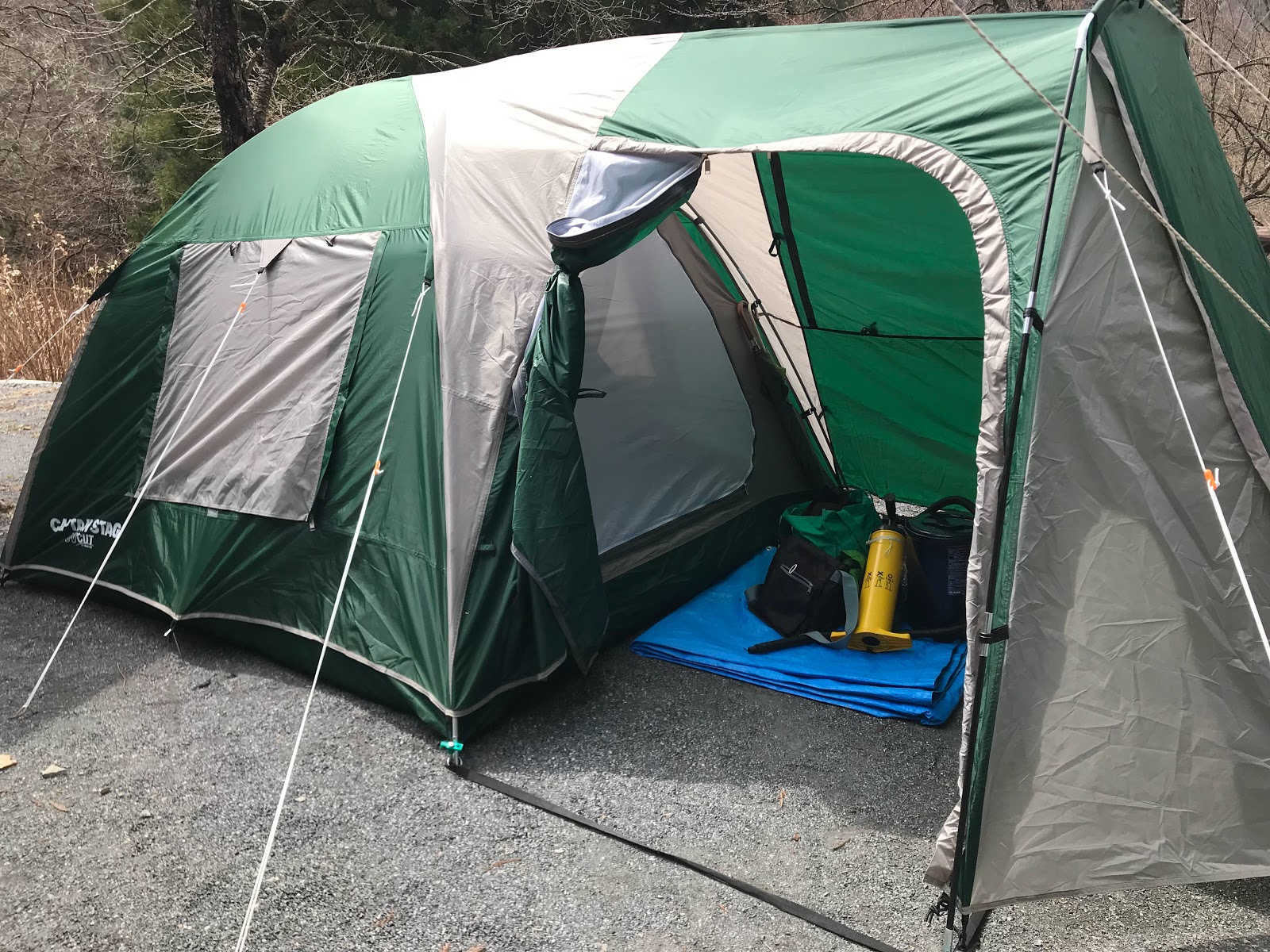
Our new tent is lower in profile and includes an entry area which can be enclosed on all sides. It made getting in and out easier in the rain. The main challenge was figuring out how to get our bottom halves dressed when our airbed took up almost all the floorspace inside.
The campsite is only 46 km away (still within Tokyo Prefectural borders), but in typical Tokyo fashion, took over two hours to get to. Upside was that there were no toll roads involved, so it was a cheaper journey. In fact the campsite itself is super cheap as it's owned by the Tokyo government. This is actually the very first campsite that we ever used in Japan, back in 2011. We camped there one more time in 2012, but haven't gone back since, for a few reasons. It was fun to return, even if we didn't have our boys with us this time.

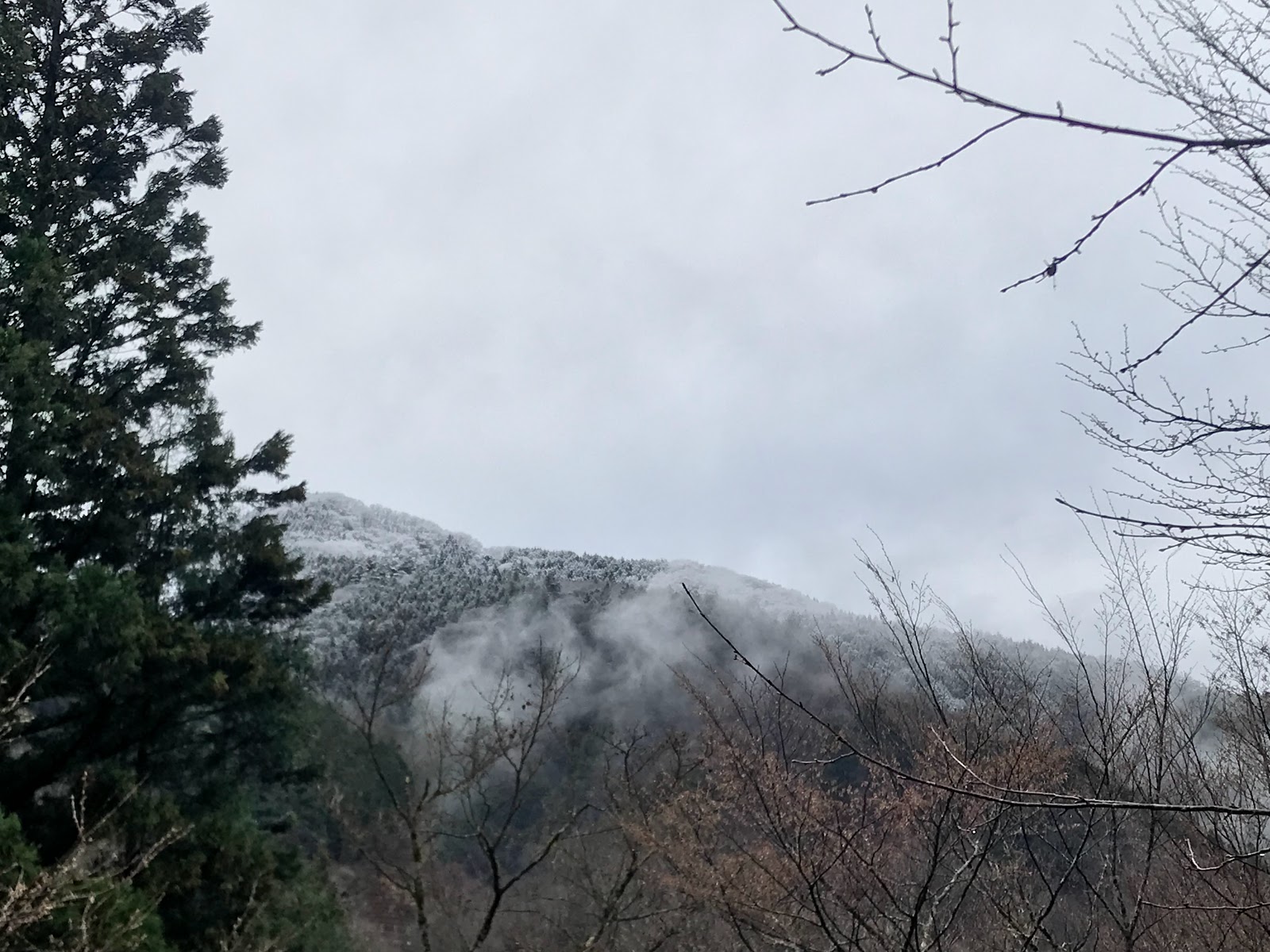
It was chilly, though. The forecast on Thursday, our only "whole day" there, was 20C, but I reckon if it made it that high, it was only for about 30 minutes. Mid morning the temperature started dropping and rain set in by mid afternoon and continued all night. We narrowly missed getting snowed on, as you can see from this photo taken from our campsite on Friday morning, snow fell on the slopes above our campsite.

Our friend brought his and his son's mountain bikes and did a couple of rides, but he was frustrated by the strict rules about where they could and couldn't ride. The second night we had to lock both bikes in our van as we were prohibited from keeping them at the campsite and had to put them in the separate car park a few hundred metres away down the mountain.

Food is one of the main events of camping—at least that's my opinion. When we camp with our friends we share meal preparation, which makes it easier, and even a bit more fun. We did one dinner and one breakfast each and took care of our own lunches. The dinner we provided was potatoes in foil with BBQ chicken drumsticks and onion, served with mixed vegetables. Oh so yummy! It was pouring rain at the time, we were very thankful for the solid camp kitchen that gave us even better shelter than our usual tarpaulin-covered kitchen.

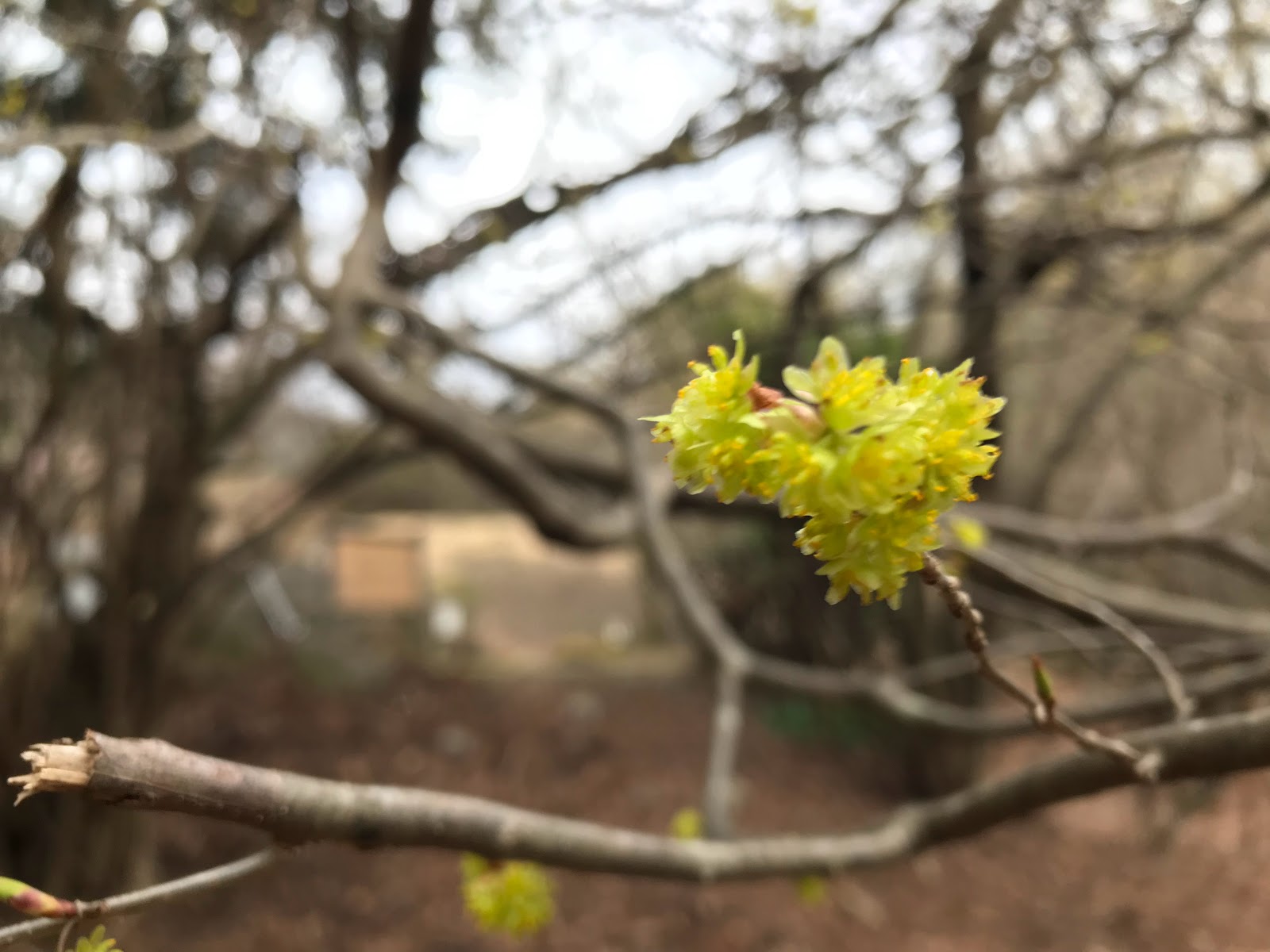
Common sassafras
We were up in the mountains, so there were less signs of spring than in warmer Tokyo, so it wasn't a terribly picturesque camp. However a few lonely flowers were out and some trees had leaf buds about to pop.
Hairy bittercress, smaller than my little 
finger nail.


Early on Thursday afternoon we walked down to Lake Okutama to see what we could see. But there wasn't a lot. The wettest part of the year is still ahead of us, so the lake was fairly low and therefore the inlet at the bottom of the campsite looked a bit like a moonscape. We had to walk a long way to get to the water. We have memories of bringing the boys here in summer, really early in our camping journey, and playing in a fast-flowing, shallow stream that feeds into the lake. There wasn't much evidence of that play-place this year. We did find a cool-looking rusted out old jeep, though!


There was moss everywhere.
It's been a while since this access hole was opened!

It's moss, not grass!

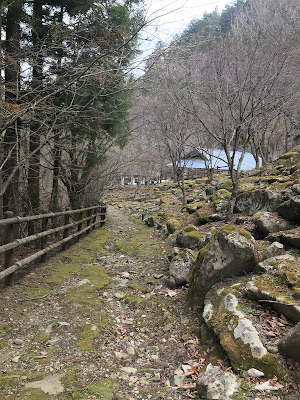
Pathway "paved" in moss.


Tall, straight trees lined the mountainsides all around.


Our campsite on Wednesday afternoon, while the sun still shone.
I really didn't take many photos. This trip was like putting on an oxygen mask: much needed for recovery, but I was too tired to do much beyond the necessary.

We're planning a trip to Australia mid-year, so we won't get to camp again until October. Already looking forward to that trip!