Showing posts with label Tokyo. Show all posts

24 September, 2026

Unexpected hospitality in the rain

It's been months since I've been able to ride my bike to my favourite park south of here. After arriving back in Japan in early August we've had plenty of heat and rain and I've had plenty of work to fill my days. In the middle of it all, I was longing for a quieter day that coincided with good weather. Up until we got up yesterday morning, it looked like it was going to be that perfect combo! But somehow the weather didn't conform to those earlier forecasts! 
My only photo from the day, just after 
arrived home.

With stubborn optimism I rode off mid-morning into very light rain. From there it went downhill! Partway into the ride I pulled out my rain jacket. By the time got to the park about 30 minutes later, my glasses were wet, but my jeans weren't too damp.

Koganei Park is one of the largest parks in Tokyo. It's about 80 hectares (112 professional soccer fields or 80 400m running tracks; or to use a park in my hometown: more than three times the size of Queens Park in Toowoomba). It's a beautiful place, but there are only a couple of places that you can shelter if it's raining.

So, I headed for my favourite sheltered spot and discovered that a few others were sheltering there too. I wasn't surprised, but a little disappointed. I cruised past on my bike, but recognised a couple sitting in the shelter: two people from church. Initially I was going to find somewhere else to hang out and eat my packed lunch and read the book I'd brought, but something prompted me to change my mind and I circled back to say hi. They were surprised to see me, but welcomed me and we ended up spending nearly three hours together. We were all hoping that the rain would ease up while we talked, but it really didn't, it got worse, and chillier. So, in the end we departed, me, for my seven kilometre ride home and them, for a much shorter walk to their nearby house.

This time I donned my full rain gear, and covered my two bags with plastic. Nothing I could do about keeping my glasses clear, though, so I peered between raindrops on my specs and thankfully had a safe trip home. My rain gear did a pretty good job, though the cuffs on my jeans and flannie (US Eng: flannel shirt) both got fairly wet. It was a relief to get inside and dry off my face!

Hospitality

The sermon at our church on Sunday was on 1 Peter 4:7–11. Here's 8–10:

Above all, love each other deeply, because love covers over a multitude of sins. Offer hospitality to one another without grumbling. Each of you should use whatever gift you have received to serve others, as faithful stewards of God’s grace in its various forms. (NIV)
It's a rich passage with many concepts, but a couple are hospitality and loving one another. At lunch after church one man asked "How does hospitality look if you're an introvert?"

It so happened that that was the same man I encountered in the park with his wife. Hospitality is much a broader concept than hosting someone at your home for a meal or a night. In fact we have a whole industry using this name, an industry that encompasses providing food and beverages, accommodation, tourism, travel, and entertainment. 

I would venture to say that Christian hospitality is welcoming others, it's having a heart that is genuinely open to others. A heart that creates space (physical and otherwise) for others. I would also say that sitting and chatting to another person is a type of hospitality. 

When I arrived this man and his wife did practical things like shuffled over to give me a dry place to sit and offered a cloth to wipe my glasses. They also shared some of the food that they'd brought (something I forgot to do, but it's very Japanese to do this when eating together like this). They didn't dash off, they welcomed me into their conversation and we spent a few hours getting to know one another better. This was blessed fellowship and one that we would have missed if not for the rain (we probably wouldn't have met at the shelter except that we sought respite from the rain and would have left earlier if it hadn't been raining).

I'm thankful. I was able to share this story last night at our church's prayer meeting and another lady said she was encouraged by it. It reminded her that God has the power to make "coincidences" like this happen and encouraged her to pray for someone she occasionally encounters.

What other things would fit under the umbrella of Christian hospitality that we don't typically first think of?

11 May, 2022

An unexpected outing to inner city Tokyo

Earlier this year I worked on a magazine issue themed "Rest". You can check out most of the articles we published in that issue here. When we asked the missionary community in Japan for article proposals, we were overwhelmed with people wanting to write on this topic, so it's obviously something that missionaries in Japan (among others) have thought about quite a bit. 

However, when we talk to people back home, it's not often that people ask us about how we get rest on the mission field. I wonder if this isn't something that people think about until they have actually left their home country and are desperately tired? I know that when we first landed in Japan we were quite exhausted from what had gone before and I can't remember if anyone ever talked to us about pacing ourselves.

I was quite encouraged to see an article in the latest magazine that we've completed (last Saturday) that talked about mentoring people interested in long-term mission. It was an internship program that their organisation runs and one of the five main areas that this couple focus on with their interns is Staying Healthy, which includes incorporating rest into your life.

Well, I've been in Japan for over 21 years now and I've had to learn about rest. I still have lots to learn, but I've learned a few things along the way. Like: How to rest when you've got three lively young boys. How to rest when your to-do list seems enormous and overwhelming. How to rest when no one else in Japan seems to, and how to manage when just making it through a short Japanese-language church service is exhausting. How do you rest when you're very aware of the urgency of reaching Japan for Christ? And when going anywhere away from home just takes so much out of you.

I still remember our first holiday in Japan. Just following the paper map (in Japanese and pre-Navi) was exhausting. Then we needed to figure out buying groceries in a small rural town and a strange missionary holiday house (believe me, they are often stranger than the usual place you'd rent back home). On top of that, we had a lively 2 y.o. and no one but us to look after him.

Over the years we've learned different ways and means of resting and that it isn't an option, rest is essential, as is pacing ourselves. We've had to approach this missionary life more like a long-distance journey, than a sprint. But we still struggle, life and ministry have a way of being busy and both David and I are self-starters, which means that we can be quite driven. I've been trying to finish this blog post for several days. I've been wrestling with tiredness as well as drivenness. Tiredness won out yesterday morning and I rested all morning.

My busyness at work tends to ebb and flow. Thankfully I am not expected to fill out a time-card, so if work is a bit quiet, it's okay to take some time to rest. So last week many people in Japan were resting, or at least recreating, with several public holidays on the calendar. Our house, typically, looked different. Our school didn't take all the holidays, in fact only one. I had plenty of work on my to-do list, including a magazine I hoped we could finish by the end of the week to accomodate the schedule of one of our team members. So I didn't plan to take time off, merely held it as a possibility, if the opportunity arose.

Last Wednesday (a beautiful day, not unlike today), a colleague who lives over an hour away, met me halfway for the afternoon and we explored a little corner of Tokyo. I'm not really a city person, as you might know, but I do find Tokyo to be an intriguing place. Certainly a city where nature isn't completely sidelined. There's still lots of life-giving green to be found if you look.

The area we walked around is near the purple star at the top of the map.

We walked several kilometres, exploring an area around the Iidabashi station, an area just north of the Imperial Palace. That included walking along a portion of both sides of the Kanda River, a short foray along a street in the neighbourhood of Kagurazaka to find lunch, and a stroll around a famous walled garden.

I'm going to show you the afternoon through photos and captions.

Sloped street in Kagurazaka. Lots of quaint stores that beg to be explored.
It's appealing because it's not over-the-top "shiny" and commercial like some famous
areas of Tokyo. This webpage tells me some of the charm is because there's a large French 
expat community here, including a French international school.
This is one of six train lines that run through Iidabashi! Most of them are underground, thankfully. The river is the Kanda, which is only 24 km long and lies entirely within Tokyo borders. This is taken from the southern bank looking northwest away from the palace towards Shinjuku, one of several "city centres" within Tokyo. 
A bit to the left of the photo above, taking looking down the river. In the middle is a place you can fish! I'm not a fisherman, but this just seemed to be lacking any appealing atmosphere.
This is on the opposite side of the river, looking towards the Imperial Palace and the actual "city centre". Later we walked along under those trees behind the train.

More city views from the southern bank.

Who would have thought? Inner city Tokyo? Many of these trees are cherry blossoms and so would have been amazing in a different way a month ago.


Stunning huge tree.

Then we made our way to Koishikawa Korakuen Garden. I'm guessing that some of you have been to a Japanese garden overseas, but in my experience it's a little different in Japan, not that I've been to that many in either place. The biggest difference would be the age. Japanese gardens/parks in Japan, the sort you walk around and admire the ponds, etc., are old. The trees are mature and there's a lot of history embedded in the park. This one is nearly 400 years old.

The English brochure says it was originally built by the founder of the Mito branch of Tokugawa clan (a powerful clan in the Edo period, 1603 to 1868). It is a circuit style garden with ponds and manmade hills centering on the pond. Like many things from Japanese history, it has Chinese influences. It has two special designations: Special Historic Site and the Special Place of Scenic Beauty. Part of this status is the recognition that it is a valuable property that has survived the Great Kanto Earthquake and war damage as well as progressing urbanisation.
Luminescent new-spring leaves.
You can see a hill and winding path behind me in this picture. These small hills and circular paths make the garden seem larger than it actually is. There's no one spot where you can see all the garden.


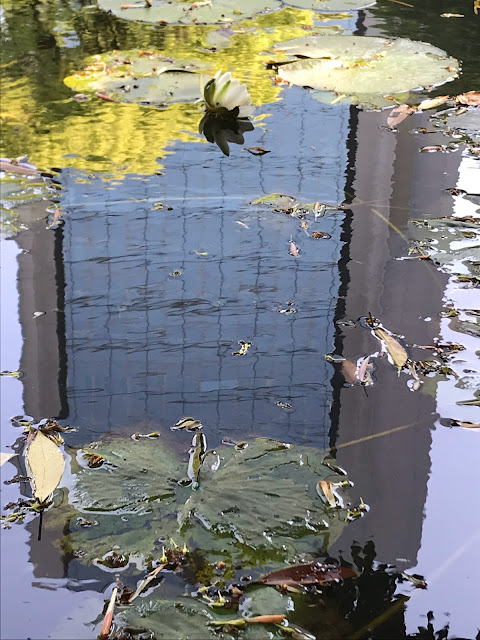
There's no escaping that this is a garden surrounded by a high-density city. The ambience was tempered by the noise of a neighbouring amusement park rollercoaster and a concert in the adjacent Tokyo Dome. Not to mention it was hard to keep the buildings out of some photos, but here I really liked the reflection in the pond.

You've made it this far: well done! This day was not my typical idea of a rest day, but I did come away feeling filled up and refreshed. I got to hang out with a friend and talk about the various things going on in our lives, I got to see a tiny bit more of this amazing city, including some beautiful green and even amazing man-made structures (though a tree will usually trump a building for me).


08 April, 2022

Camping in Tokyo again

It's been a week since we got back from our latest camping trip, so it's about time that I wrote about it. My days have been a bit crazy since then—I've visited the Australian embassy to renew a passport, plus I spent a morning taking my son to a medical appointment and a day packing magazines; not to mention time spent organising various other things related to our mid-year trip to Australia. After taking three days off to camp last week, it's not a surprise that my usual work has been pushed to one side a little bit, so I've been trying to catch up on that too. 

But the camping trip was worth it, as usual. It was also much anticipated, after we failed to secure a campsite last autumn. I still have this lingering feeling, though, that things we plan will get cancelled, so it was hard to get excited up until the actual day that we left.

We were a small group: just me and David, with two friends and two of their kids. It's a bit different camping with just six people (last time we camped with 11, three of which were teenage boys with big appetites). We're thinking about the future, though—for Christmas we bought a tent-for-two, which we enjoyed trying out. We also used less equipment, including a scaled-down kitchen setup.

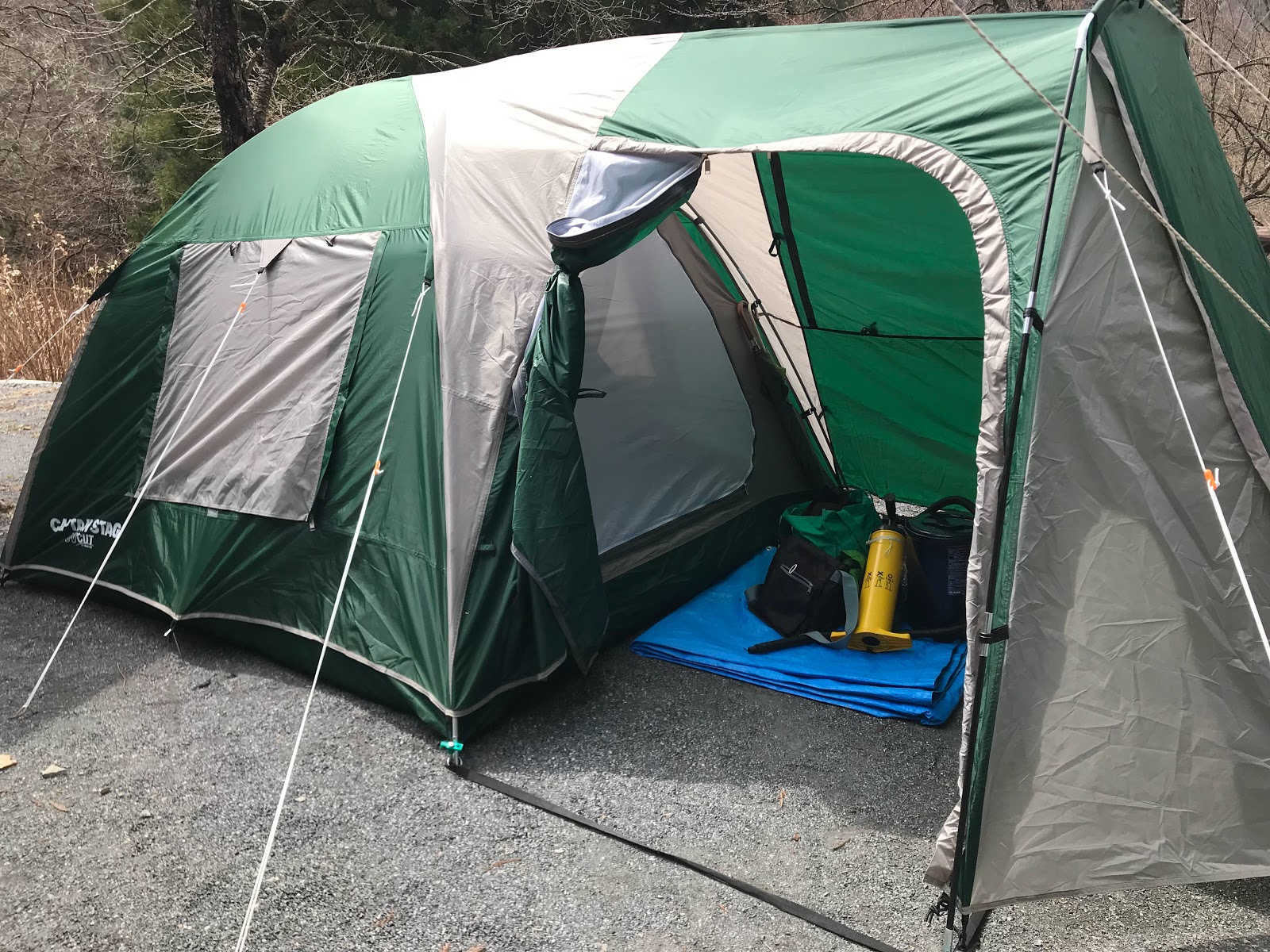
Our new tent is lower in profile and includes an entry area which can be enclosed on all sides. It made getting in and out easier in the rain. The main challenge was figuring out how to get our bottom halves dressed when our airbed took up almost all the floorspace inside.
The campsite is only 46 km away (still within Tokyo Prefectural borders), but in typical Tokyo fashion, took over two hours to get to. Upside was that there were no toll roads involved, so it was a cheaper journey. In fact the campsite itself is super cheap as it's owned by the Tokyo government. This is actually the very first campsite that we ever used in Japan, back in 2011. We camped there one more time in 2012, but haven't gone back since, for a few reasons. It was fun to return, even if we didn't have our boys with us this time.

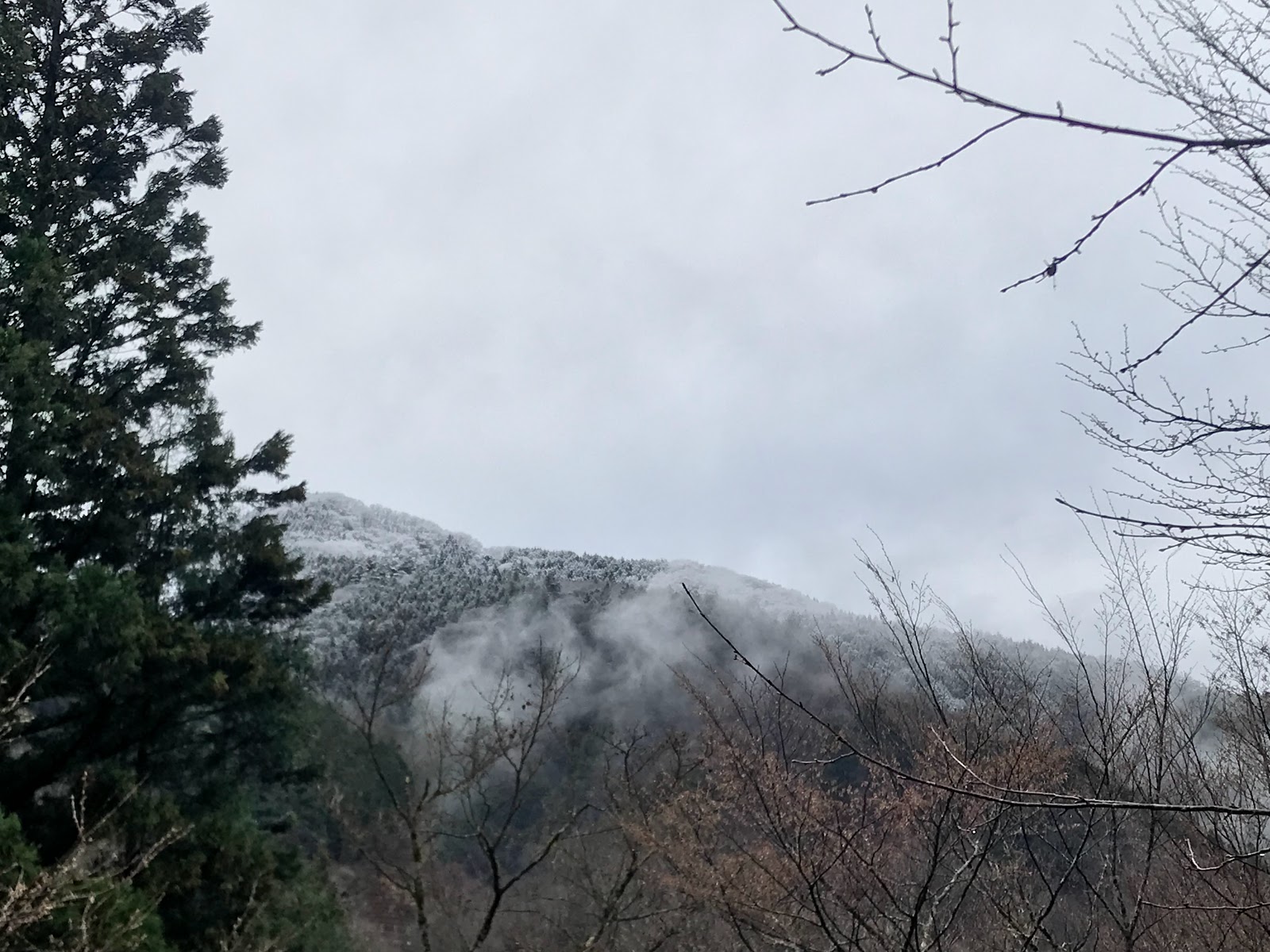
It was chilly, though. The forecast on Thursday, our only "whole day" there, was 20C, but I reckon if it made it that high, it was only for about 30 minutes. Mid morning the temperature started dropping and rain set in by mid afternoon and continued all night. We narrowly missed getting snowed on, as you can see from this photo taken from our campsite on Friday morning, snow fell on the slopes above our campsite.

Our friend brought his and his son's mountain bikes and did a couple of rides, but he was frustrated by the strict rules about where they could and couldn't ride. The second night we had to lock both bikes in our van as we were prohibited from keeping them at the campsite and had to put them in the separate car park a few hundred metres away down the mountain.

Food is one of the main events of camping—at least that's my opinion. When we camp with our friends we share meal preparation, which makes it easier, and even a bit more fun. We did one dinner and one breakfast each and took care of our own lunches. The dinner we provided was potatoes in foil with BBQ chicken drumsticks and onion, served with mixed vegetables. Oh so yummy! It was pouring rain at the time, we were very thankful for the solid camp kitchen that gave us even better shelter than our usual tarpaulin-covered kitchen.

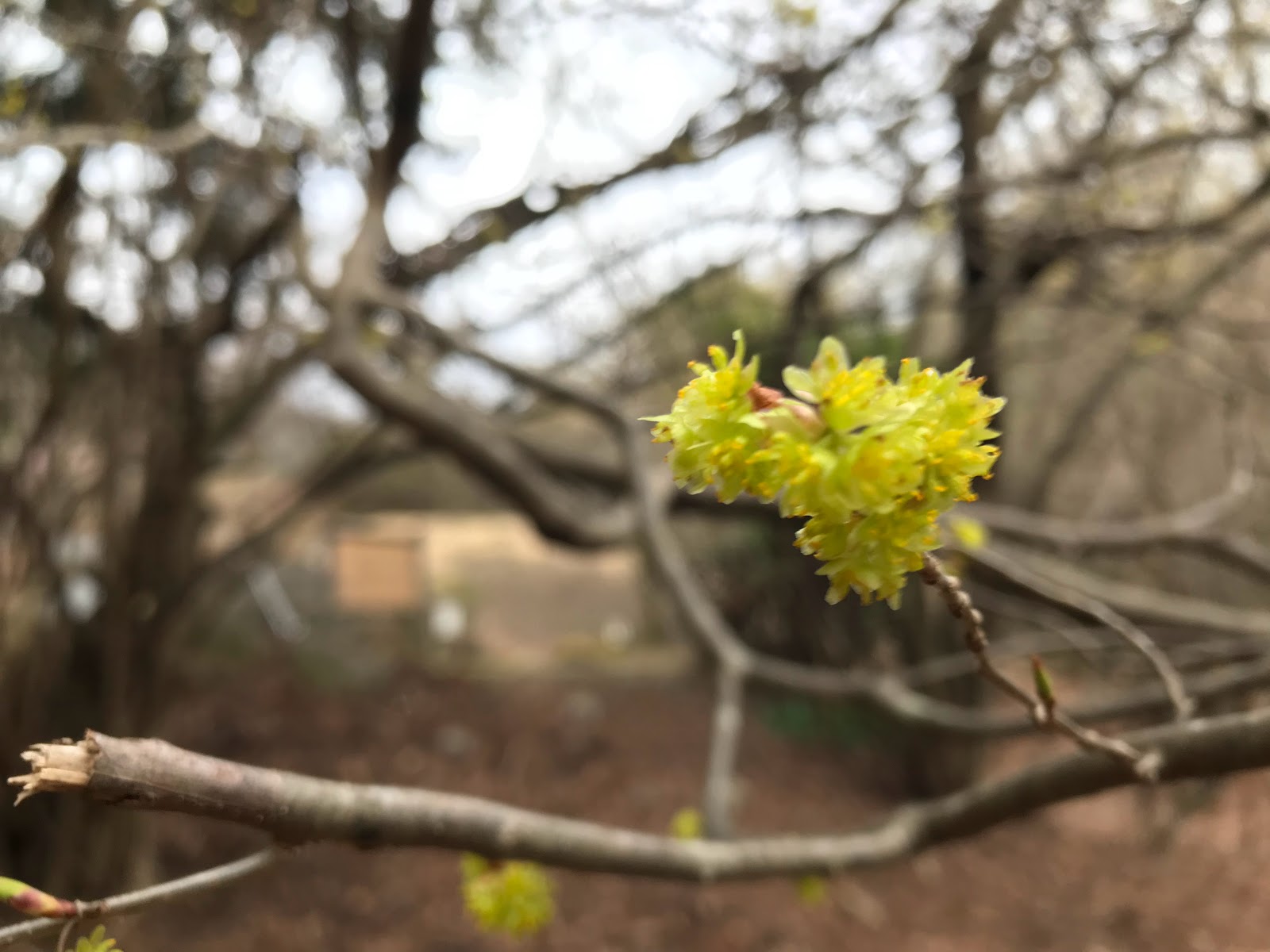
Common sassafras
We were up in the mountains, so there were less signs of spring than in warmer Tokyo, so it wasn't a terribly picturesque camp. However a few lonely flowers were out and some trees had leaf buds about to pop.
Hairy bittercress, smaller than my little 
finger nail.


Early on Thursday afternoon we walked down to Lake Okutama to see what we could see. But there wasn't a lot. The wettest part of the year is still ahead of us, so the lake was fairly low and therefore the inlet at the bottom of the campsite looked a bit like a moonscape. We had to walk a long way to get to the water. We have memories of bringing the boys here in summer, really early in our camping journey, and playing in a fast-flowing, shallow stream that feeds into the lake. There wasn't much evidence of that play-place this year. We did find a cool-looking rusted out old jeep, though!


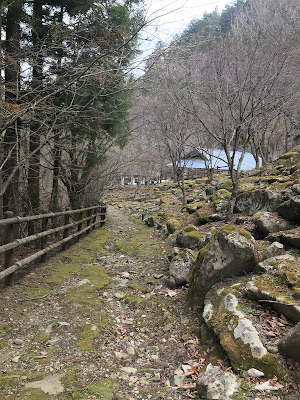
There was moss everywhere.
It's been a while since this access hole was opened!

It's moss, not grass!

Pathway "paved" in moss.


Tall, straight trees lined the mountainsides all around.


Our campsite on Wednesday afternoon, while the sun still shone.
I really didn't take many photos. This trip was like putting on an oxygen mask: much needed for recovery, but I was too tired to do much beyond the necessary.

We're planning a trip to Australia mid-year, so we won't get to camp again until October. Already looking forward to that trip!


28 November, 2019

Crowded trains: more complex than you imagine

These last nine days my husband has again been in hospital. He had surgery last Wednesday for a skin graft over the area that they excised due to suspect skin cancer in September. His hospital is in Shinjuku, one of Tokyo's main city centres.

I've visited on five occasions so far, the final time will be tomorrow when he's (hopefully) discharged. The journey is an hour via two to four trains—often standing—and involves numerous flights of stairs and walking about 1.5 km. I love going to see him, but the journey really takes it out of me. 


Most of the trains I've been on have been okay, but on Monday I stayed for dinner and came home around 7.30pm. The first train I hopped on was not a fun experience. 

My first clue it was going to be difficult was when the train arrived and no one got off. It already looked full. But people in the line in front of me literally pushed their way in and I had little choice but to push in too (the next train was unlikely to be less crowded). The lady in this photo could have been me. I had to check to make sure neither of the bags I was carrying were protruding into the space where the door was going to shut.

But that was only the start of the "fun". Standing jammed in like that is technically fine as long as either:
1. the people getting out at the next stop are next to the doors, or 
2. everyone is getting out at the same stop.

But that is rarely the case in an inner-city line where there are lots of intersecting train lines (it was a different experience I described here when I headed into the city from the suburbs and almost everyone was headed for the end of the line in the city). So at the next stop I got "spewed" out onto the platform while the train disgorged itself of people who were buried deep inside and needed to exit. 

Then we repeated the previous action of pushing our way back on, except that this time I got to be buried deeper inside. Which is not necessarily better. 

Thankfully, though I am only 157cm high, Japanese people aren't as tall as Australians on average, and I usually get some air, but still, being jammed such as your body is touching four or five other people is not fun. You can end up in very awkward situations. I've had my hands jammed to my sides, so I couldn't reach my face, been stuck behind a lady whose long hair swept over my face and tickled my nose, and most commonly, had someone's elbow or shoulder or hip pocking into me. I am thankful that I've never experienced wandering hands, but in a situation like this, it does not surprise me that women are harassed.

Here is a photo I took the other day at a quiet moment on my way into the hospital mid-afternoon. This is the standard layout of seats on a Tokyo commuter train. In a crowded train there is usually three lines of people standing down the middle between the people sitting down and then a tonne squeezed into that small area near the door. That's where I got stuck on Monday.

The aforementioned cycle of "shoving into the train—travelling one station—people disgorging—people pushing back on the train" happened eight times in my journey of 16 minutes. I only got pushed out onto the platform once, but it was a great relief to get off the train finally and change lines to a train where I wasn't squished up against strangers nor having strangers pushed past me or pushing me so they could get onto the train. For a nation that can be characterised by generally "no touching" and "not being a bother to others", this pushing-shoving experience is quite strange.

It is all quite quiet too. Quiet enough for me to hear someone exclaim, "There's a foreigner here" when I first got on.

The other strange thing about it is how orderly this is (there are even arrows in the stations to help modulate the flow of foot traffic). Lining up, pushing on, jiggling around so we all fit, pushing off again. There's generally a quiet sense of order and no rudeness (though I have experienced rudeness beyond the general shoving required). Certainly being aware of people around you and doing your best not to take up more space than you have to is part of it. It is routine for people to wear backpacks on their fronts to take up less room.

What's interesting to note is that the culture of orderliness and taking care of others as best they can in such crowded situations on trains has spilled over into the use of elevators. My husband is in a 19-floor hospital and the elevators are very busy. They aren't as crowded as trains, but we've seen the same practice of people close to the door hopping off the elevator if someone behind them needs to exit.

Needless to say, I am glad that I don't have to commute every day in conditions like these. I will also be very happy to have my husband home again and not have to visit him in hospital again soon!

10 September, 2019

Giving blood, typhoons, and a cross country meet

None of these things are related, but constitute notable or interesting things that happened in the last week. Much more interesting to write about than the 30+ emails that I've written today as well as numerous editing and social media scheduling decisions I've made.

Giving blood
The blood donation centre is on prime real estate, looking
down over an intersection in the city centre that I've
crossed many times.
On my way back from Osaka last Tuesday I stopped at Ikebukuro (the nearest "big city centre" to us). They have have a permanent Red Cross blood donation centre there that I'd been intending to visit for some years. Periodically the Red Cross has been invited by CAJ to set up a temporary clinic at a CAJ event and I've donated a couple of times there. However, as donation was something I didn't find hard to bear, it seemed that I could do better than that. 

I've been a blood donor since I was 17 when I volunteered to go with a school group to get signed up. However, between "frequently" changing countries, learning Japanese, having under-school aged kids at home for ten years, and ill-timed illness (I was refused twice for medical reasons in recent years when I had the opportunity to give), I've rarely given in the last 20 or so years. It was time!

I have to say it was a satisfying experience. Not only did I negotiate this new non-English environment on my own, I felt like I was giving a tiny bit back to a country that has hosted me for so many years. Satisfying. Oh, and they have a cool vending machine which meant I got as many free drinks as I wanted, plus free biscuits and ice cream at the end!

Cross country meet
We've been going to cross country meets in Tokyo since 2010 when our eldest son first joined the CAJ cross country team. It seems a terribly normal part of September and October. Last Friday when I questioned the sanity of choosing to get up at 5 the next morning to accompany the team, I quickly dismissed the question. It's simply "what we do", no point questioning it. Our middle son is in the team and our youngest is a "team manager", the latter which is basically "coach's assistant".

I was happy when I got there: the venue is amazing, and I've shown it to you before (see here for just one of my posts). It's probably as close to seeing what "natural" Tokyo used to look like as you'll find.
A portion of the course that I walked. It all looks very similar to this.


This is such a tradition for us that I missed some "old faces" of other parents. Either their kids have graduated or they are on home assignment or not in the team this year for one reason or another. David wasn't even there this time as the school had need of a driver for the middle school soccer team and he was the only one available. So I busied myself with walking along the course when I wasn't helping "newbie" parents understand what was going on. (It helps to know that there are places you can walk to during the races to see the kids part-way through the race.) I managed to walk about 5 km through this beautiful forest.

Typhoon
Then on Sunday we had a typhoon set its "sights" on us. We watched it all day (an oppressively hot and humid day) and it finally started raining around 7pm and continued through the night. It was a noisy night as the rain pelted and wind blew. It was also hot as we usually rely on our open windows to cool our un-airconditioned bedrooms down just a little.


But we didn't cop the worst of it. Chiba (the prefecture to the east of Tokyo) did and they are still restoring power there today. Chiba is where Narita, one of Tokyo's two international airports, is located. It seems as though things didn't go so well there because public transport shut down, especially the trains, and many thousands got stranded at the airport.

Our monthly OMF prayer meeting on the other side of Tokyo (in Chiba) was scheduled to start at 9.30 yesterday, but the trains were all off schedule, and that left millions in quite a mess trying to get anywhere (not an exaggeration, from the statistics I can find, approximately 40 million train journeys are undertaken in Tokyo every day). So, with little damage in our area, the concern for getting to the meeting was about how crowded the trains would be and if they were running at all. I deliberately set out late and took a different route to usual and made it there fine (if a bit hot and bothered as it was very hot and I ended up at a station 1.4km from our HQ). Some people intending to come never made it, purely because of train problems.

There were thousands without power yesterday and even this morning. A colleague's son got to skip school for a second day running because power was yet to be restored to the school. That sounds lovely, until you realise that many were without power to keep them cool in the mid-30˚C temperatures.

The rest of my week is not shaping up to be anything nearly as exciting as any of the above, though we do have another early rise on Saturday for cross country.

22 March, 2019

Cute Tokyo apple pie cafe

We moved to Tokyo fourteen years ago with three little boys . . . anyone who's ever had multiple little boys knows that little cafes aren't great places (nor were the trains to get there). Then they got bigger and discovered a liking for cafes, but by then they ate too much and it was something that was an occasional special treat. 


Tokyo is a crowded city in a land fond of cute everything. There are thousands of tiny places to eat and hang out in this city, but we've not visited many of them as a family. Somehow it isn't so kind to other customers to drag our "large" family into a little cafe. Over the years I've been to some with friends, but often I look with longing at little places I walk past when I'm traversing the city and wonder what they'd be like to try.

So last night, when I walked past an eatery I've seen a few times in recent weeks—Granny Smith Apple Pie and Coffee—I decided to indulge. I had about 20 minutes spare as I waited for an appointment and, why not, Granny Smith apples are an Australian export after all!

Granny Smith Apple Pie and Coffee is a homey little shop, you feel almost like you're in someone's country kitchen. 

Turns out there are several of them in Tokyo and one in Yokohama too. This year is the first time I've ever seen one. Their apple pies are divine, if a little pricey! I'm tempted now to make another one of my own...


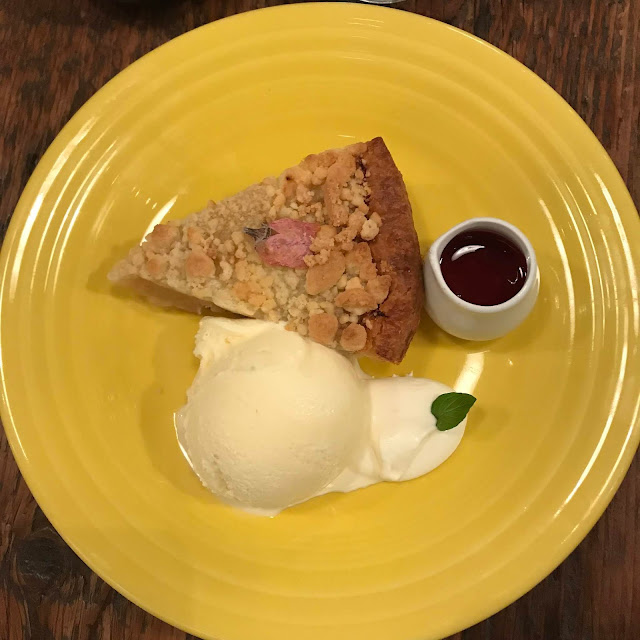
Why not go seasonal: sakura apple pie, with vanilla ice cream and raspberry sauce. Yum!

13 February, 2019

Foil gift

An important value in Japan is to not inconvenience other people (or, another way to say that is: not annoying other people, as I wrote about in a post three years ago). 

As a foreigner, it is not always easy to figure out when you might inconvenience other people and we're still learning. But in a city where space is at a premium, where you put yourself, your children, and your belongings is a serious issue.

But when it comes to doing construction work on your house, you're heading into a land of much inconvenience to others. So we find that construction workers are generally very considerate about things like their vehicles blocking the narrow roads. However, to ward off any potential bad feelings, prior to doing construction it seems that they do an obligatory run around the neighbours to give an apologetic notice accompanied by a gift.

Last year we got a towel from the neighbours behind us. And we got another towel six years ago when a neighbour's fence was being fixed.

This time we got 20m of foil.


A house on our street, about 30 m from ours, has been demolished. It looks like they are going to be building again very soon. The block of land is bordered by two roads, neither of which is very wide. They aren't main roads, but they do get a reasonable amount of traffic on roads that are only about 5m wide. We've caused minor traffic jams by someone stopping near there to pick us up by car. 
Blue rectangle: our house
Red star: the construction site
Green arrow: entrance to kindergarten
Orange arrows: roads

I'll have to write another blog post to explain why there's
white paper suspended from string in the middle of the block!
Obviously, large construction vehicles are going to potentially cause traffic congestion and inconvenience to pedestrians, especially because across the road is a large kindergarten where most kids arrive by bus and on foot. They have a car park, but it is down the street about 50m. 

So, we've received a letter of apology in advance and some foil! I presume the kindergarten and all our neighbours received something similar in the name of keeping neighbourly relationships smooth.

07 February, 2019

Why do you ride when you could drive?

It might seem strange if you never lived in Tokyo, that we often ride our bikes here when we could drive (especially when the weather is nasty). The truth is that often we can get somewhere local faster on a bike than in a car. Tokyo roads are narrow and have low speed limits. Add to that the traffic, including pedestrians and bikes, that you might have to deal with, and driving can be very slow. Not to mention that when you get to the other end, you might, or might not find a free park to put your car in, or have difficulty parking your car. In most cases it is much easier to park a bike!

Here are roads I rode on today:
Note that this narrow road has all sorts of obstacles on the actual road: electricity poles and signs. To drive this you can't actually drive much faster than 20km/h because you'd be dodging these obstacles as well as any pedestrians or cyclists who are sharing the space with you. Not to mention the possibility of kids or other vehicles emerging from the many near-invisible roads that empty onto it. You will often have to give way to oncoming traffic on these narrow roads as it's not possible for two cars to pass easily in all places along the road.


 This one is a bit wider and faster at 30km/h, though still has some poles on the road. There are no dedicated footpaths (sidewalks), the painted lines are to indicate where you should walk.


This is a quite a wide two-lane 40km/h road that wasn't very busy, mostly because it's got t-intersections at either end of its relatively short length.

And the "big" two-laned 50km/h road. Cars were ripping along here, probably faster than the speed limit. I've driven on this road many times, and the lanes are quite narrow in places. There are also many traffic lights, so if you get up to speed, you quickly have to decelerate to stop again.

Here's another 30 km/h road, with a footpath and poles on the road. The white T on the road is to indicate that there is an entering road on the right.

09 April, 2018

My Saturday was edgy

Saturday was a track and field meet, yep, it's started up again and doesn't stop until it's all over now (mid May). It was really good that middle and high school comps were at the same venue, so we were both able to see both our boys! 

The venue is out near Tokyo Bay (40-50km away, depending on whether you take tollroads or not), and the fastest way to get there on a Saturday is by train (not to mention parking...). But it still took 1 ½ hours and four trains. The day promised to be warm-ish (around 17/18C), so we didn't rug up very much. However a nasty cold wind arrived not too long after we did and that made the day a challenge to get through.

Our family was represented in several events: 100m, 200m, 400m, 4x400m, and the 1,500m. We also had an entrant in the middle school discus, but the wind started to move the giant cage surrounding the discus circle and so they cancelled that event. The venue has a lovely tall grandstand, but that wasn't so lovely on Saturday as it caught all the wind. I ended up hiding in one of the rooms at track-level to stay out of the wind, popping out only when my boys were running.

Despite all the discomfort, it was good to be there to watch our boys. They rarely say so, but I choose to believe that they appreciate us being there. Several of their classmates tell their parents not to come and so their parents don't come, and I think that is just sad. As I've written many times before, sports provide us a valuable way to remain connected through these challenging teenage years, so I'm very thankful that they are sporty and that we have the capacity to go and watch them.

I did enjoy pulling out my camera and working to get the setting right, it's added an extra element of fun and challenge to spectating. Got some good action shots too!


By the end of the day, though, I was tired. I really don't like wind, it makes me feel edgy. My eyes were irritated by the wind and all the stuff flying around too (dust and pollen).

At the end of the competition I had to make a decision: go home with David and the team (he drove them team home in the school bus) or take the trains again. I opted for the trains, and I'm glad. It took me half the time that the bus took to get back! I also got more exercise—I took more than 8,000 steps on Saturday, mostly just because I took trains! It also gave me time "alone". I was tired enough that I didn't feel like interacting with people all they way home, so I travelled on my own (in the usual crowds). Amazingly I got a seat on each of the three trains too! Then when I arrived home fully two hours before everyone else, I was able to have a shower and have some relaxing time all on my own. Quite refreshing, really.

Interesting to ponder this from an Australian perspective: it seems to me that is definitely a little on the edge of ordinary to choose to take a train instead of riding in a vehicle and certainly that the train was way faster than the vehicle. But that is life in Tokyo. We choose what mode of transport we will take in the context of where we're going (among other things).