25 September, 2020

You have stories no one can tell but you

On Tuesday I saw a short video by my son's English teacher. The wall behind him had lots of novels on shelves. I immediately felt at home as I watched it. My kind of classroom! And above the books were the words: "You have stories no one can tell but you." This reminds me of the message I heard from a speaker at a women's retreat back at the start of my writing journey over ten years ago. She too urged us to write our stories.

My son's English teacher briefly introduced what he'd be teaching his students in this coming school year. He said "we'll be finding ourselves in God's story and telling the part of it that only we can tell."

That resonates with me too. Each of us has a unique story, though there are common themes that we find when we share our stories with others. I am passionate about helping missionaries share their stories. I believe that by doing so, we will all be richer in our understanding of what mission work really is like (and therefore be better at supporting missionaries), as well as grow in our own walk with the Lord. 

This deep passion carries me through the various work I do: from editing a magazine for missionaries to managing our mission's social media content, from being on the editing team of a prayer booklet to communicating with our own supporters and on this blog. Even leading writing retreats and facilitating workshops that help missionaries prepare for home assignment.

These last ten days I've spent several hours with the Japan Harvest magazine team. Once a year we have a time of team building, evaluating the magazine, and planning for the future. Because we're geographically dispersed (several prefectures in Japan plus three other countries) it's difficult to get together. Usually some of us meet together physically and others join us via a video call, but this time we did it entirely online. It worked very well, though I missed the informal opportunities to interact around the edges of the meeting.

I love getting together with this team because they also are passionate about what we do. Not just about the skills that they bring to the table, but about the bigger picture of the magazine. Our mission is to encourage, inspire, and equip people who serve Japanese people (specifically members of the organisation that publishes the magazine). I can say that the volunteers who make up our team are passionate about this—that's what makes this magazine better than just average (in my opinion), and makes working on the team a joy to me.

I've come to see that what I do is a rather unusual endeavour for a missionary. If I'd come to the field saying that I wanted to be involved in helping missionaries publish their stories, I would probably have found a quite different path. If you say that, then people immediately think "books" and "publishing companies". Certainly, trying to explain to someone what I do and why in under a minute is hard.

Missionaries have a challenging and ongoing demand on them to explain what we do to people who've never experienced living outside of their home country—our lives are not as private as they would be if we were not in full-time ministry. But I think David and I are saved, in a way, by one of us in our marriage doing a more easily recognisable (and easy-to-remember) role: teaching missionary kids. That's how we're most often identified. And in general I'm okay with that.

Celebrating our wedding anniversary on Sunday.

I am very happy with the direction God has led me in and the continuing opportunities he has brought for me to pursue. Amazed, actually, at where I began and where I am now! And indeed, I've got some stories to tell, and hope that I can keep on telling them.

But I'm wondering if it's a little odd to look at some of the things my boys are studying and wish I could be a fly on the wall, learning from their teachers too! There's another class that one of my guys is taking that I'd love to audit (about Japan).

18 September, 2020

Big camping goal

We started camping back in 2011 because we wanted to see more of Japan (on a missionary's budget). Back in 2017 I wrote a post that showed, using a jigsaw puzzle, how many prefectures we've visited (either driven through, or stayed a night) And just to clarify: a prefecture is like a state, and—aside from Hokkaido, which is bigger tham Tasmania—they're a lot smaller than Australian states! So it's been an informal goal for some time, but recently I've found myself saying, "We want to camp in every prefecture before we retire." Someone asked me this week how many prefectures we've already camped in, and I wasn't sure. 

So I took some time to figure it out. I think it's 14, so we've got a fair way to go to get all 47 in before we retire (granted, we've theoretically got more than 15 years left). Given we camped in five of these in a single two-week trip, we can probably manage to knock a few off fairly quickly in a summer "camping tour". For example, one trip to Shikoku Island (the smallest of Japan's four main islands, which is roughly one quarter of the size of Tasmania) and we'd be able to visit the four prefectures on the island fairly quickly. Japan doesn't seem so large when you realise that we come from a country that is about 20 times larger and hence the prefectures are a lot smaller than our states.

These are the prefectures we've camped in, some of them multiple times: Hokkaido, Akita, Niigata, Ishikawa, Tochigi, Nagano, Saitama, Tokyo, Chiba, Kanagawa, Yamanashi, Aichi, Shiga, and Wakayama. (Pictured below)

These are the prefectures we've camped in (we've stayed in several others, but not in tents).

One hard aspect about this year has been how difficult it's been to plan. I had a conversation about this just yesterday. I'm supposed to be helping run a two-week onsite workshop in January. But it's really hard to know if that's going to be able to go ahead in its usual format. How much do you plan, and risk wasting a lot of time? When do you make the call?

Starting school this last month is another example. Usually we would be able to count on certain events happening: like inter-school competitions, camps, bazaars, etc. But this year we simply haven't. A week or so ago I realised that we've got a four-day weekend next month (teachers have good holidays, but there's not much choice about when you take them). October is a beautiful time to camp in this part of the world, so we're working on a plan for that. We're aiming to visit a prefecture that we've missed up till now, but really isn't that far away: Gunma. Nothing set in concrete yet, but you'll hear about it! 

Red arrow is where we live. Purple arrow points to Gunma Prefecture. Not quite
sure how we've missed camping there!

Camping, and planning for camping, are good ways for David and I to stay mentally and emotionally healthy. I'm so excited that there's one more chance before winter clamps its bone-chilling hand on the remainder of our year.

11 September, 2020

Fear of being too much

This week it feels like we've turned a corner here. On Monday the boys finally went back to school on a usual timetable. Things feels a lot more like what we considered normal in February. I've got the house to myself again from 8.30 to 4 or later on school days! I know that is not normal for many people in cross-cultural ministry, or indeed in this current season with many people still working from home, or schools operating in a hybrid fashion. But it feels good to be returning to what our family is used to working with.

On Monday I also travelled across Tokyo for the first time on trains to a meeting at our Japan headquarters. That's the first time I've done that since early March. I was thankful that the meeting started later, so I didn't have to battle peak-hour trains and had a seat on five out of the six trains I rode on. It made the journey less stressful.

Then yesterday I went out to have coffee with a friend I haven't seen for months. I didn't have to tell anyone where I was going, or be back by a certain time. It felt free-ing.

That's not to say that everything is the same as it was in February. Every time we go out we're wearing masks. And we're still having Zoom meetings for many things. This week I had a mission small-group on Zoom as well as a parents' prayer meeting for school.

This time of year we're usually going to cross-country meets every Saturday. It's not happening this year.  I'm rejoicing that I've got sleep-ins every Saturday, but missing the interaction with other parents that these meets often provide. And these are not the only events in the coming months—where there usually are opportunities for building relationships—that have been cancelled, or radically changed.

The start of a cross-country race.

September is often when I have a second wave of grief at the losses that happened in June when the school year ended. When school starts up again, I realise that life isn't quite the same as it was. There are people missing, "empty chairs" in my life.

So it's been good to connect with two or three friends who are around, but with whom I haven't invested much time in getting to know, usually because they don't live close. It takes intentionality to get to know people who you don't see regularly, especially people who look very busy. But I've also realised of late that I have a nagging voice that warns me not to overwhelm others. A fear of "being too much" in conversation and friendship. That can make it hard to venture out to push a friendship beyond "occasional contact".

Do you ever feel this way? 

I'm not sure why I feel this way. 

Maybe a deep-seated memory from childhood of being overwhelming to others when I got over-excited. As I child I probably didn't care so much, but now I am much more sensitive to making others feel overwhelmed and therefore turning them off.

Or perhaps it is just coming to the surface now when it's pretty common in my house to be told by my teenage boys that I talk too much (they wouldn't believe they are echoing what my primary teachers repeatedly said of me...). Of course that's been exacerbated in our house over the last months when my non-family outlets have been reduced. I was once asked by a female teammate of my son, how I coped living in a house full of guys. Simple: I have girlfriends! Though it hasn't been so simple of late, has it?

Of course it's never all about me. It has a lot to do with the other person too—what their personality is, what their situation is like, etc. I know, for example, that I live in a household dominated by introverted males who aren't into talking about feelings. In this house I can easily overwhelm everyone with too many words or emotions, so I tend to pack them away and then unsuspecting others I encounter can cop the overflow later.

I love raw, authentic conversation, but I know that that is something that makes some/many others uncomfortable. I also value that authenticity reciprocated, so I ask questions that helps me understand what it's like to walk in your shoes. That too can make people uncomfortable.

But perhaps I'm indulging in too much introspection!

Anyway, this week, after a particularly emotional time at our small group, I ventured to ask a friend if I could text her more often. I even expressed my concern that I might overwhelm her, and she assured me that that wasn't the case. Ah—that was a balm to my heart.

It's hard to keep making the effort to build up friendships when you've had others torn away. That effort gets harder as we get older. And, as I've said many times before, living outside of one's own culture, the turnover rate of friendship is much higher.

That being said, I was also able to drop in on an old friend yesterday: my best Japanese friend. I was passing within 50 metres of her stationery shop, so I popped in. We go back to 2006 when we had children in the same kindergarten class (and I had a one-year old!). It is good to have local friends who stay put!

If you have read all the way to here, thank you! My blog is a safe place for me to process my thoughts, and to put a lot of words and know that if someone is feeling overwhelmed, they can easily click away! 

04 September, 2020

Trusting God when life is hard

A disclaimer here to start: my life isn't that hard at the moment, and it has never really been majorly hard! (Not in the ballpark of an unfaithful spouse or death of a close family member.) Probably the biggest thing hanging over us at the moment is that our boys are at the age where we're wondering about their futures and wondering how they'll get from where they are to fully functioning adults in the next few years. Sometimes that causes me to want to pull my hair out, and I commented to a friend just this week that sometimes it's hard to "count it all joy".

Nevertheless, it has been good to ponder this topic again recently. I think it is a topic that we try to avoid, so that when trouble does hit it catches us by surprise. So it is good to think on it, and examine our hearts closely.


I mentioned last week that I'd been reading When God's Ways Make No Sense, by Dr. Larry Crabb. It's really another book about suffering—about how we tend to think about God when we hit rough times.

I like the way Crabb writes: he's honest, much more soul-wrenchingly honest than most writers! Plus, he writes clearly, for the layperson, not the theologian. He states upfront that he's not theologically trained himself, but he obviously works hard to understand scripture and what theologians say about it. So I didn't find his book hard to read at all (which is quite a feat in light of the challenging topic), in fact if anything it bordered on repetitive at times.

But I didn't set out to write a book review on the book, rather to reflect on the theme. Crabb says there are three main ways that "Christians" respond to hardship: like Jonah, like Saul pre-Paul days, and like Habakkuk. That is, run away from God when trouble strikes, believe a counterfeit gospel, or tremble and trust.

With something of a shock, I realised that though I struggle at times to feel at peace with my faith in God amidst the troubles around me, I have not ever tended towards running from God, or distorting the gospel. I'm not boasting here. God put me in a family where I grew up in a church that didn't shy away from hard truths, I grew up in a family that valued reading the Bible. So it is God's gracious work in me from a very early age that means I am what I am. 

From an early age I understood that the Christian life involved trouble. As I read the book it jarred me to realise that many don't understand or believe this, even those who aren't so obviously into Prosperity theology. God never guarantees that life will be easy this side of heaven. He never guarantees blessings that will make life more comfortable, or to protect us from what we fear. He doesn't give blessings as a result of my good behaviour or that if I pray a lot (or get lots of people to pray with me about something) he'll answer in the way I want. He also doesn't seek my advice about what a good result would be in a situation, and go about making it happen.

And I'm starting to feel very dubious about writing about this topic at all, after-all, I'm no theologian either. As I've pondered this topic, it's occurred to me that even if I'm not dramatically rebelling against God in this matter, I certainly am guilty of thinking wrongly at times. So many of our "Christian ways" are potentially tainted by these thoughts, e.g., some of the songs we love to listen to, the fervent praying we engage in for present-day blessings.

But basically, the conclusion I've come to in my life (and Crabb agrees) is that I'm "too small of brain" to comprehend the ways of God. Actually God says this too:  

Have you not known? Have you not heard? 

The Lord is the everlasting God, 

the Creator of the ends of the earth. 

He does not faint or grow weary; 

his understanding is unsearchable. (Isaiah 40:28 ESV)

I've not thought specifically about the word "unsearchable" in that verse before. In the days of the Internet and search engines, the word "search" is more common than it was pre-computer days. But the word "unsearchable" is not such a common word. The thesaurus lists as its synonyms words like "inscrutable", "mysterious", and "enigmatic".

And indeed this is the impression you get of God as you read the Bible carefully.

After God spoke to Job (recorded in Job 40-41), Job said this: 

Then Job answered the Lord and said:

“I know that you can do all things,
    and that no purpose of yours can be thwarted.

‘Who is this that hides counsel without knowledge?’

Therefore I have uttered what I did not understand,
    things too wonderful for me, which I did not know. (Job 42:1-3)

Paul agrees: "Oh, the depth of the riches and wisdom and knowledge of God! How unsearchable are his judgments and how inscrutable his ways!" (Romans 11:33 ESV)

And one of my long-time favourite Psalms 139 starts this way:

Lord, you have searched me and known me!

You know when I sit down and when I rise up;

    you discern my thoughts from afar.

You search out my path and my lying down

    and are acquainted with all my ways.

Even before a word is on my tongue,

    behold, O Lord, you know it altogether.

You hem me in, behind and before,

    and lay your hand upon me.

Such knowledge is too wonderful for me;

    it is high; I cannot attain it.

For further pondering, see Ecclesiastes 8:14-17.

So ultimately, I think that I would do well if I could follow the wisdom of Proverbs 3:5: "Trust in the Lord with all your heart, and do not lean on your own understanding" (ESV). Easy to say, not so easy to live by every moment of the day and in every thought.

We are to tremble at problems that might not be solved the way we'd like them to, and at the same time "trust that all is well. [God's] good story is on-track." (Crabb, p 229) Because God "cannot and will not allow true disciples to be satisfied with less than the depths of His holy love. Suffering is inevitable in order to combat premature contentment with a comfortably blessed life. God can and will do a good work in us that empowers us to patiently endure life's difficulties. He does not prevent as we wait eagerly for the eternity of perfect joy He promised." (Crabb, p 228 and 229)

This is a bit of rambling post that I actually tremble to hit the "Publish" button on. But it's been pressing on my heart, so my hope is that these rag-tag thoughts might be a help to someone else.

28 August, 2020

Seizing the day in the park

On Wednesday we finished the Autumn issue of Japan Harvest magazine, several days before September, the theoretical start of Autumn (according to some). I saw in my Facebook memories today that five years ago we were packing the Spring issue this week—wow, we've made progress in efficiency in those intervening years! (Five years ago we were still recovering from me taking a year off managing the magazine to go on home assignment, and had a designer who was trying to fit the magazine around a full-time job.)

Finishing each magazine is a milestone worth celebrating, and it frequently means I get a tiny bit of breathing space before the next thing begins. This week I really needed that. School started on-campus for our boys for the first time in nearly six-months last Thursday, but due to COVID-19, they've had a slow start (only half days till Sept 7). There have been sudden announcements and changes in what we expected of the school-start as we've progressed through the week, including more distance learning for one. So, I've been cooling my heels as I long to get my family-free office hours back.

That all came at the end of a stressful month. The first eight working days after coming back from holidays on August 3rd were frenetic as I caught up on the previous two weeks. 

It's been the usual August weather—crazy hot and humid—so our sleep hasn't been the best and for the first time in six months we've been getting up at 6am to get David to work on time, so we've been extra tired. 

Additionally, I've had interactions with several people I usually work with that have been more fraught than usual. I put it down to the stress of living in the midst of a slow-moving, and not-yet-ended disaster. 

Then I've had email problems that have come to a head on the weekend when my magazine email address stopped working. (The problem with email is that you don't know if it has arrived.)

So, on Wednesday afternoon, as I looked at what I needed to get done in the next few days, I realised that I had time to take a morning at the park. Unfortunately it didn't cool down as much this week as I'd hoped (we had a cooler day on Sunday and I hoped that would continue, but it hasn't). So instead of riding to the usual park, I took a couple of trains (only 15 mins on trains) to a different park for the morning.

I've never been to this park on my own, and I've not been there for a couple of years at least. We went there many times with the boys when they were younger, as well as with smaller and larger groups of people. There is a big playground that was great for getting rid of energy. It also has an aeroplane museum that was a great place to go when the boys were younger and we needed "out" on an inclement day. I even lost a child in this park one time...he's now at uni in Australia, so he was found, eventually!

It's called Kōkūkoen or Tokorozawa Aviation Memorial Park. Wikipedia says, "The park is built on the former site of Tokorozawa Airfield, Japan's first airfield, which was opened on April 1, 1911. Japan's first plane, the Kaishiki biplane No.1, made its first flight at Tokorozawa on October 13, 1911."


Though only 30/32C, the humidity was high (in the 70% range), so I quickly found a spot to sit. This was part of my view. Disconcertingly, it was close to a running track (you can see it in the photos). So I watched people actually running in the hot, humid conditions!


Below was my view from my seat above. Beautiful mowed lawns.

This small lake is quite pretty in spring and autumn, not so much in late summer.

The park has two or three long, straight roads like this (no external traffic on them). I'm guessing they are former runways.

No idea what this is, but they were pretty much the only flowers in the whole park.

Wisteria in the summer is a wonderful shade plant. These have amazing, twisted trunks, revealing they aren't youngsters. (In the background is part of the museum.)

One of the things I did while sitting, was read a recent book by Larry Crabb. It's given me much food for thought that will probably make its way into another blog post soon.

I'm thankful for a job that is flexible and with low accountability. I have no one closely looking over my shoulder. This suits me very well. It means I can run into difficulty if I'm slack, but generally it works out okay as I'm one of those people who repeatedly had "conscientious" on my report cards at school. I've learned to "seize the day" when slower periods like the latter half of this week happen along. If I don't they will slip away, and I might not get another chance for several weeks!

Do you get free-er moments sometimes in your week/month? How do you deal with them? Do you have a go-to activity?

22 August, 2020

Broken minds: learning more about mental illness

I read a lot, but I don't enjoy writing book reviews. However, I think this book needs to be shared. It was one of several non-fiction reads I picked for my summer reading and I'm so glad I did.

I didn't grow up with mental illness close by, indeed, I actively avoided this area as a young allied health professional, because I didn't understand it or feel comfortable with it. But, as a middle-aged adult, without my bidding, mental illness has come much closer to my life, but I am still an observer. It is a bewildering and challenging subject and, while I've learned more about it in recently years, there is still much I don't know. I’ve struggled to write about this area, in part because I’m protecting the identity of people I know and love, but also because I know I don’t know a lot about this topic.

This book has been a very helpful way of learning more. It is a great balance of personal story and information. The bonus is that it is written by a Christian couple who have intimate experience with major mental illness (as sufferers as well as a professional). But the book is written with the express purpose of addressing some of the concerns of the Christians about mental health and how it should be viewed and treated.

I am thankful that my family has been spared the worst of Christian viewpoints on this matter, but still, reading this book has been enlightening. As an Australian I come at it from a somewhat different angle to an American. There are many more American Christians than Australian Christians and, Americans have in the past generally been more willing, as a culture, to accept psychology and counselling than in Australia. (That’s changing as Australian become more open to counselling and psychological care.) Therefore, in most of Australia there is a paucity of Christians who are professional counsellors or psychiatrists. Yet, we have been advised in the past by Christians to only seek the counsel of Christian professionals in this area. This hasn't always been helpful advice—we've experienced both bad and good Christian mental health professionals. And we've also received good help from non-Christian professionals. 

The authors highlight how differently we treat non-brain disorders, and repeatedly ask us to consider whether that is a legitimate divide. Do I only go to a Christian doctor for my asthma? In my thinking about the people close to me who struggle with mental illness, I’ve had to remind myself that there is a legitimate biological problem. This is not something that they are choosing, it isn’t something they can will themselves out of. It has been great to see how medication helps, but also realize that medication isn’t a magic pill that makes everything normal again.

The book focuses in on biological depression (as opposed to depression that is caused by challenging circumstances and often resolved through counselling alone), however the authors do touch on other types of mental illness.

Here are some of my highlights from the book:

  • understanding better how biological depression affects someone
  • helpful explanations about medication
  • a historical explanation of how mental illness has been viewed and treated over the centuries
  • an explanation of three main schools of thought in Christian circles (sadly none of them 100% helpful)
  • an examination of people from the Bible and history who may (or may not) have had varying levels of mental illness
I was even comforted by the admission of one of the authors that she has avoided the companionship of those who can't accept that mental illness is a medical condition. This is a challenging enough issue to live with, without unhelpful comments from other people. I’ve had limited exposure to such attitudes, but have no desire to expand that exposure!

I think most of us know someone these days who has been diagnosed with a mental illness. Do them, and yourself, a favour and learn a little more about this poorly understood area. This book would be a good starting point.

14 August, 2020

Our July holidays

We went away for two weeks in the latter half of July and I jumped back into work on August 3, only to be swamped. I'm only just in the last couple of days starting to come up for some air! 

However, I want to tell you a little bit about our holidays before they get too far in the distant past. Because other prefectures are nervous about Tokyo-ites visiting them at the moment (many more cases of COVID-19 in Tokyo than in other places), we decided to have a very quiet holiday. We mostly stayed at the holiday home, or only went to places where there were virtually no other people close by.

We did lots of sleeping, reading, game-playing, and movie-watching. That probably sums up our fortnight away very well. It was at the same place as we went this time last year (and also at Christmas), a delightful Swiss-chalet house that OMF Japan owns and rents to its members at a low rate. We appreciate the views, the green-all-around, the peace, and a place without Wi-Fi.

As I did last year, I organised myself to not do any work during those two weeks, that included not looking at email at all. Our daily routine was simple and refreshing. To get even more sleep I also took time-out from caffeine. Not without a challenge (my body is very sensitive to caffeine), but in the end I manage to stay off caffeine totally for a week and have been on reduced caffeine in the two weeks since then (instead of 2 ½ cups of fully caffeinated coffee a day, I've had two half-strength cups a day, decaf coffee is a very handy thing, even if the coffee snobs turn their noses up at it). As I result I got 9 or 10 hours sleep every night for a couple of weeks, which was very nice indeed! During July I also stopped doing my daily Japanese review. The sum total of all that was lots of read and many books read. 

So, even though today I feel pretty blurry and am having difficulty thinking clearly, I know that I did have a good rest in July, so I'm hopeful that that will be a good thing for whatever lies ahead for the rest of the year. For starters, we've got our second son beginning year 12 next week. That in itself will potentially mean stress for the family, if it is anything like his big brother's senior year! Not to mention that we're by no means free of the wide-reaching consequences COVID-19 pandemic.

But back to our holidays in the mountains. Staying "home" made things very simple and we slipped into a gentle routine. Dinner and an evening movie we did together, sometimes late afternoon included games. Watching a movie each night was something we did last year also and it seems to be a helpful way to enjoy the holiday as a family, as well as provide fodder for conversation around the table. We watched The Hobbit and the Lord of the Rings series, then several other older movies like Back to the Future, Forest Gump, and Jonny English. 

All these latter movies were borrowed from a local DVD rental store—yes, Japan still has them! But let me tell you that it's not easy to find movies in a Japanese store if you're an English speaker. Have you ever thought about learning "alphabetical order" in another language? Japanese has its own order! And even if that is fine, and your Japanese reading is up to scratch, many English movies have completely different titles to their original versions.

Things are ramping up again now in our house with both David and I have worked full-time this week and school starts (I say YAY) next Thursday. But we think back fondly to our July holiday with great thanks that we could take the time off and had a place to go, and look forward to next time we can recharge like this!

Here are some photos from from our time away:

We caught the last two weeks of the rainy season and everything was very
green. This was one of the trees in the local park where we played Park Golf.
Park Golf. I am appalling at it, but it's a fun activity (if you don't record your score).

This lily's flower was bigger than my hand!

A cute frog posing on our youngest son's hand.

We had many rainy days and only saw two sunsets. This is the view that we could see from the dining
room and lounge area.

David and I went on a couple of local walks. Beautiful!

Wild boar trap along one of the roads we walked on.

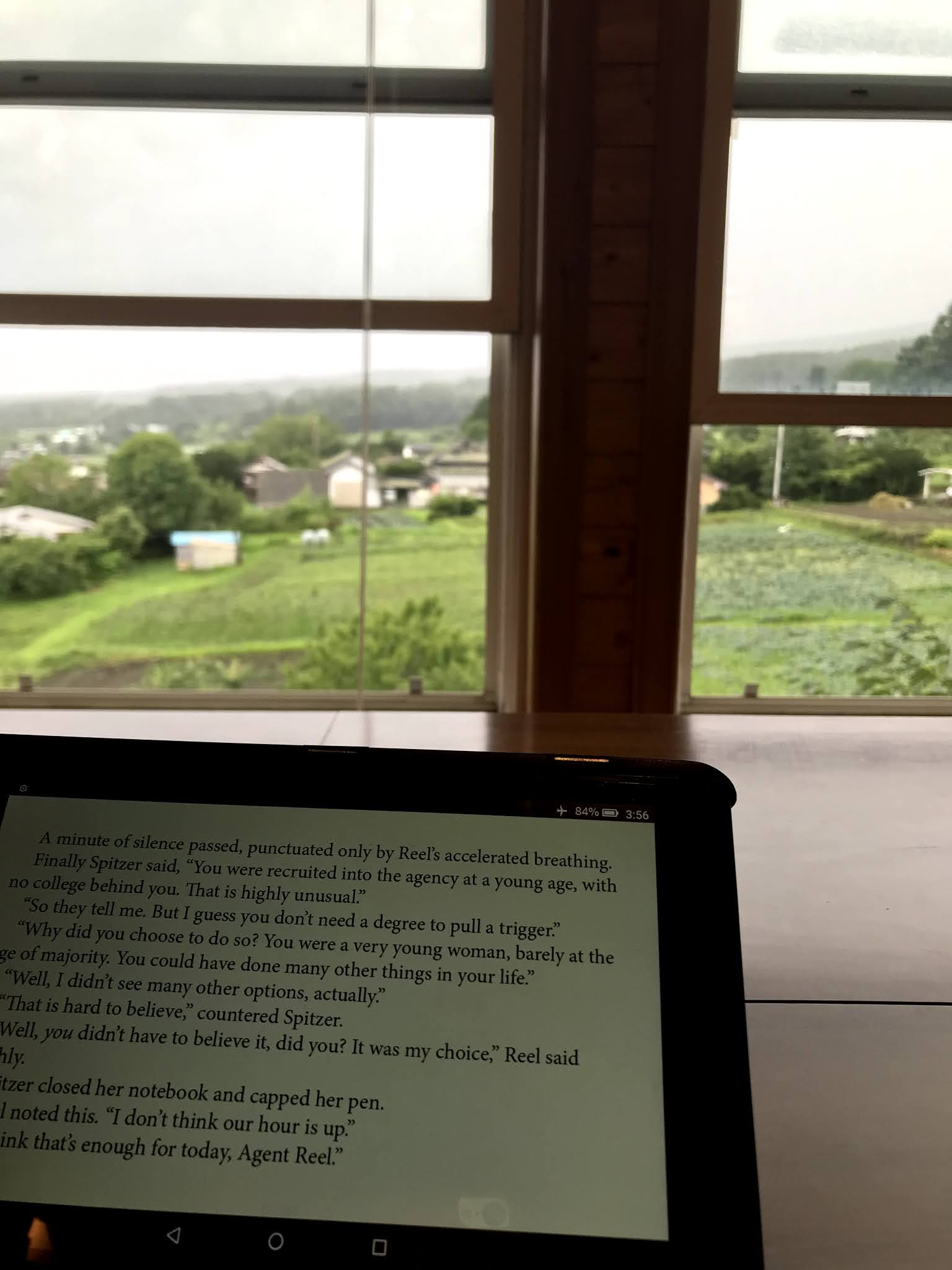
Reading my Kindle at the dining table...with a view.

We took one 1,000-piece puzzle loaned to us by friends, it was fiendishly difficult. An overall picture of Yoda,
but made up of 1,000s of micro pictures.

Wet = fungi. I had my eyes open for some photogenic mushrooms in the park.

One of the two sunsets we saw from our living area.

Inside our holiday apartment. Our middle son loves this loft. He set up
his bed and recreation area up there. Our bedroom door is on the right of the photo,
the other side of the ladder is the entrance to the bathroom and far left of photo
is the kitchen. It's pretty compact, but the lofty ceiling with exposed beams
makes it feel spacious.

In the last couple of days the volcano we were perched on showed its peak.
This is taken from the verandah.