04 February, 2020

Looking like an idiot

I've been doing some heavy editing recently and my head is a bit heavy. I think writing a little today might be something of an antidote. Besides, I've got a good story to tell you...

I saw an article today called "Four rarely mentioned (but essential) missionary qualities". These were the qualities:

1. A sense of adventure
2. A sense of humour
3. A willingness to look like an idiot
4. A high tolerance for ambiguity
Generic photo, not from Japan...those number plates are wrong.

I'm not sure if I have all of these, but having stuck around for nearly 20 years, perhaps I do?

Let's see if I can dig out some examples, but I'm going to change the order:

A high tolerance for ambiguity
This is huge in Japan. Not just that we're in a culture where we don't understand many things, but the language and culture itself is full of ambiguity. In Japan people often learn by observation, rather than being explicitly told what to do. Living as a foreigner in this land that is multiplied many times. My observational skills are far better than they used to be, simply because that's often all I've got to make it through a situation. 

When we have visitors, they often ask many questions and we often don't have good-enough answers for them. We can't seek answers to all the questions that arise from what we don't know: we simply don't have the energy or time to do that. So instead we learn what we need to do our business and live our lives, and most of the rest has to just be left to one side.

Sense of adventure
I wouldn't characterise myself as someone particularly adventurous in the traditional sense of the work. I'm am not a big risk-taker. But from where you stand, what I do might look like an adventure, though it doesn't feel like it. However, I think probably our camping reveals our sense of adventure. Wading into the world of wrestling as we have is probably an adventure that many wouldn't care for. Travelling Tokyo trains can be an adventure...that's true!

A sense of humour
Missionary life (and life with teens) can get quite serious. But the willingness to laugh at oneself and at the odd things going on around you is pretty important. I guess one example of that is seeing interesting English or a funny meme or video. I do love to laugh and am happy to do so at myself. Most of the time I'm happy to tell the stories of when I've messed up, and have a laugh.

A willingness to look like an idiot
This is connected to the one above. I guess I often look like an idiot here, whether willingly, I'm not sure! It's common to not know what the protocol is for this or that. Or to get into trouble because you can't read something fast enough. 

This happened to me just last Friday. I drove with a friend to our "local" Costco, about an hour away. It's usually a stressful trip because it involves negotiating around a crowded shop with a large trolley, spending lots of money, and takes a good part of a day. But last Friday another layer of difficulty was added. In fact, it felt like I was in an international airport—there were so many things I needed to keep track of. 
A. My membership card: which was needed to get in, as well as to buy my groceries. 
B. My receipt for groceries: as they check this at the exit.
C. My receipt for the whole pizzas I bought at the restaurant: so I could collect them once they were made.
The above is usual, it was the fourth and fifth that threw me over the edge:
D. Car park ticket: the car park is usually free, but this time they had the gates activated and we had to take a ticket to get in. I presented it at the cashier when I bought my groceries where I got E.
E. Another car park ticket: I had no idea what this was for, but it seemed important and had an all-important stamp on it, so I put it in my purse.

After lugging the full over-sized trolley back to the van and loading everything into it, we joined the line to get out of the car park. There isn't usually a line, so it was strange and frustrating.

When we got to the boom gate there were three buttons on the machine, two yellow and one red. Plus two slots: one for the ticket, and one for money. We'd been waiting about ten minutes to get here and knew that the people behind us were also probably frustrated. So there was time pressure. 

I couldn't quickly read anything on the ticket machine. So I thrust one of the two car park tickets into the slot. It told me I owed them ¥1,000 (about AU$13.60). I wasn't about to pay that! I'd just spent hundreds of dollars buying groceries and the sign at the entry said that entitled me to three hours free parking . . . so I pushed another button and the ticket came out and I tried the other ticket. Then the display told me I owed them ¥6,000. I then pushed another button, in fact I probably pushed all of them one after the other, over and over . . . I can't remember now.

There was no obvious call button, and no staff member lurking nearby. The car behind me started to beep his horn, but didn't back up to let me unblock the single exit lane.

I am so glad my friend was there. Her presence helped calm me, but my cool was pretty much gone. Finally, two men approached our van, one on either side. They told us you had to put both tickets into the machine. Bingo: the boom gate rose and there was great relief all round. Belted into my car, I couldn't bow deeply in apology to those stuck behind us, but I wanted to.

I can't say that I was willing to look like an idiot. In fact I hate looking like one. But I find it easier to cope with that in Japan than in Australia. My white skin betrays me time and time again. But it does give me an excuse to mess up on occasion. I'm not sure the men who helped us would have been so patient with a woman who looked Japanese. 

Our foreignness got us off the hook, but in Australia it doesn't. Every time we go back we get odd looks at one time or another when we reveal our "foreignness" with a "stupid" question or lack of understanding of a situation. Our white skins don't save us there, nor do our Australian accents!

But back to those four characteristics. I don't know that I'd be known by any of them, except perhaps the humour. However, we have had to grow in each of the others. An ongoing sense of call, a strong desire to make an eternal difference, meaningful work we're gifted in doing, and a dogged stubborn streak has meant that we've stuck around.

23 January, 2020

Living with the tension of not understanding why

I finally got myself back to the gym this morning. Ever since my husband was in hospital in the latter half of November (followed by family holidays and school holidays), I haven't really caught up on work. And if I'm behind on work, I find it hard to justify the time it takes to go to the gym. Anyway, after five straight work-days at my desk (with just grocery shopping to interrupt my computer time), I'm feeling like I'm not paddling so desperately anymore. It's a nice feeling! 

The gym is a good place to think and process and I spent time thinking over the recent weeks and what I might write here this week.

So, after three weeks of very lazy holidays, our family got whiplash on the 6th when we went back to school and work. Work that I had put to one side over the break suddenly overwhelmed and I paddled with fervour. Those first ten days after getting back came with two big deadlines: 

1. The prayer booklet for Japan that I'm working with. From mid-November I was responsible for liaising with authors, acquiring content, and doing the initial edits. that was all due in my first week back.
2. Last Wednesday morning I taught about writing and social media at our mission's annual pre-home assignment workshop. It was a first for me to stand up in front of a mission workshop like this as "the expert" and it took both time to prepare for, and time to recover from!

In the latter part of last week it was a relief to have those two things over, and be able to concentrate on my more regular work (although #1 is by no means over, I've got more to do there, but I did [mostly] meet that particular deadline).

As I reflected on these weeks this morning, while working the machines, the undercurrent of grief that flows ever stronger, the older I get, worked its way closer to the surface. I've had to ignore it to meet my deadlines and get my work done, but on reflection, there's a lot of "brokenness" going on around me.

Australia's disasters
I think I may have offended some non-Australians recently when they've asked me about my country's state. As much as I love social media, it is capable of spreading misinformation and ugliness quickly. Most of the rest of the world has been under the impression that the majority of Australia is burning. Unfortunately, the fires are a more dramatic story than the devastating drought that my country's been labouring under for years now. And, yes, the fires are of enormous magnitude, but no, the majority of Australia is not on fire.

I hate the blame-casting. Of course, everyone who talks to us about it wants to know why the fires have been so bad this year (Australia has fires most summers). But so far as I can see there is no easy answer to this question. There are many factors that have tragically combined to produce this disaster. (Please note that I really don't want to have a discussion on this on social media and will delete comments on this post that are to that effect.)

Once again it hurts to be watching from a distance as our loved ones suffer. Though I am very thankful that none of my family or close friends have lost their houses or lives, my heart goes out to those who have. The air quality of our beautiful land has been difficult for many millions. And again, the suffering brought on by the drought is hard to comprehend, but our farmers, in particular, are doing it really tough.

Personal disasters
And then there's family and friends who are suffering just now, apart from the national disaster: watching a child die from cancer, trying to find a way through this year as a marriage dies, and dealing with the false accusations and old-boy-style of working in a new job. Just a few of the currents that are running under the surface of my life at present.

I'm trying to compartmentalise: seeking to enjoy the blessings God brings into my life (thanking him for clean air to breathe, for example) while at the same time holding the pain of my friends (which is also my own to a certain degree).

Yesterday I listened to an English sermon while I ate lunch and did other household tasks. It was specifically about what God thinks about the fires in Australia. It pointed us back to the fact that this world is broken and groaning and nothing is going to fix it before Jesus comes back. The preacher compelled us to be compassionate and do what we can for those who are hurting, but also to fix our eyes on Jesus. To put full trust in him alone, because no other can save us in the long run. 

We can put the fires out, but will still die of some other cause later. We can follow God's lead to a new job, and find that the rug has been pulled from underneath us before we even arrived. We can be as good as we possibly can, but still have the person we pledged to love forever turn their back on us. We can devote our lives to serving others, only to have cancer take our lives.

God's most extensive answer to someone who asked "Why?" that is recorded in the Bible is in Job. If you read through chapters 38 to 41, you quickly have your breath taken away. God didn't answer Job's question about why he suffered so greatly, but rather revealed to Job the vast chasm of difference between his knowledge and power and God's. Afterall what human can answer the question: "Do you send the lightning bolts on their way? Do they report to you, 'Here we are'?" (38:35 NIV).

And again in Isaiah 40 God speaks to his people, people who are in a world of pain: exiled, crushed, and without hope. He points to his great power and wisdom, "Who has measured the waters in the hollow of his hand, or with the breadth of his hand marked off the heavens? Who has held the dust of the earth in a basket, or weighed the mountains on the scales and the hills in a balance?" (v12 NIV).

So, I'm pointed back to God, who says:
"We are hard pressed on every side, but not crushed; perpelxed, but not in despair; persecuted, but not abandoned; struck down, but not destoryed... 
So we fix our eyes not on what is seen, but on what is unseen. For what is seen is temporary, but what is unseen is eternal" (2 Cor. 4:8, 9, 18 NIV).
For me, now, today, that means continuing to trust God no matter what comes across my path. I don't understand and don't want, the pain, grief, or strife. But I won't turn my back on God, whose understanding far surpasses mine. For the time being, we all have to live with the tension of not-understanding: just like we do when we watch a movie that doesn't lay out all the pieces at the start.


16 January, 2020

What do you do and how does that contribute to reaching Japan?

These are essentially the questions that many supporters want to know the answer to. Even more, they want a person such as my self, who works in support ministry, to answer this question for them. For in roles like mine the line between what we do and reaching Japan for Christ is not a clear, easy-to-discern path.

What do I do?

I am an editor, writer, and manager. I actually juggle a number of roles. I'll quickly outline them before I explain how that fits with reaching Japan for Christ.

Managing editor of Japan Harvest: this is a magazine by and for missionaries in Japan. I am involved throughout the process of putting the magazine together: from planning themes, to acquiring articles, editing, and the design/proofreading stage. I also manage the team that works together to produce the magazine.

Social media/website content manager for OMF Japan: I do a number of things in social media for OMF, including coordinating it. That includes acquiring, creating, and editing of content for OMF's Facebook and Instagram pages. I also edit and upload articles written by missionaries to the OMF website. (See below for why we're doing this.) I'm also the one who answers those who click "Contact us" on OMF Japan's website.

Editor: I've been involved as an editor in various publishing projects. The latest one is a prayer booklet for Japan that has 29 contributing authors.

Investing in others: I also seek to encourage others in their writing. This has taken various forms over the years, but this year includes facilitating a writer's retreat and teaching on written communication and social media at an OMF workshop for missionaries. 

Encouraging and helping others: It's not an official role, but I love to encourage and help others whenever I can. So when I can fit it into everything else I do, I get together with others. This happens at sports meets, volunteering at school events, at prayer meetings, at annual women's retreats, hospitality and driving, etc.

How does all that I do contribute to reaching Japan for Christ?

On our last home assignment David and I spent a lot of time explaining we support missionaries and (I in particular) mobilise for mission. I'll break that down according to the roles that I outlined above.

Managing editor: Japan Harvest magazine goes out to over 1,000 missionaries. It contributes to reaching Japan for Christ because it encourages missionaries, it inspires missionaries, and it equips them. 

Japan has a poor retention rate for missionaries. At 19 years of service David and I are well over the average length of stay for a missionary here. For many reasons it is hard to stay here for a long time in mission work. This magazine goes to many missionaries who are alone in their ministry, facing discouragement because they're not seeing results, or needing inspiration. 

It gives a venue for missionaries to share what they are doing and therefore to inspire others to try different things. It provides a place for people to encourage others in their work or to challenge them to keep their eyes focused on Jesus as they labour in this hard place. Through what people write, we learn insights about culture, language, and ways of working, we're challenged to use different methods or technology, or discover more resources (like books and websites) on relevant topics to ministry in Japan. So it is contributing to our professional development also.

Social media: this is plain mobilisation. Mobilising people to be more involved in mission—whatever that looks like for them. We're using these free platforms (Facebook and Instagram, plus our website) to tell people about what OMF is doing in Japan, to show what it's like to live here and what missionaries are like. We're helping people to know how to pray for this land and challenging them to consider serving here or to encourage others to come and serve here or to reach out to Japanese people where they are. Stories are powerful vehicles for our message and it is my joy to be able to get the stories of missionaries out to an audience of thousands! To places that it would be difficult, expensive, or even impossible to get a speaker to. (Can you tell I'm passionate about this?)

Editing: again mobilisation. Providing people with tools to help them pray or to help them help others to pray for this needy nation. By applying a high level of quality to OMF's publications and social media I am also raising the authenticity of OMF. Because we're producing good quality material, others see OMF as a mission worthy of their trust, interest, and involvement.

Investing in others: almost a decade ago God placed on my heart a desire to help missionaries get their stories out to more people. To help them help others see how God uses ordinary people to do his extraordinary work. I see that being played out across almost all of what I do now: editing people's work, helping people with their writing, and using people's stories in our social media. All of these are helping us in Japan tell others about what God is doing in Japan. I trust that God takes all of these things and uses them in ways I couldn't imagine to raise up prayer and workers for his work. Which in turn reaches Japan for Christ, but not in an easy-to-see way that evangelism and church planting does.

Encouraging and helping others: if my small contribution to someone else (be it a word of encouragement, hospitality, or some other way that I've helped them) means that they are encouraged to continue to serve, then I am contributing to reaching Japan for Christ. A number of missionaries I know are involved in church planting and evangelism and are gifted in these areas. Who knows, but perhaps a word or deed that I've done has made a small contribution to them being able to continue to work in Japan reaching Japanese people for Christ. A contribution that I would not have been able to make if I were based in Australia!

This is a bit of a rough piece of passionate writing. Do you hear my heart? I am not on the so-called "front line". I am not a soldier who is in combat. My gifting is not in evangelism or church planting. But I am passionate about supporting those who are. 

Just take a moment to think about what if everyone who was serving in Japan with OMF was a church planter or evangelist, what would that look like? Here are some ideas:
This is one of my colleagues who is also in support ministry. She processes
applicants to serve with OMF Japan as well as works in member care.
One of her previous ministries was running OMF's language school.
  • We'd have lots of church plants, but the workers would be frustrated because they couldn't devote all their time to the work. They would also be spending time educating their kids, plus hours working on filling out forms for the government related to their visas, taxes, insurance, banking, rental properties etc.
  • We'd have almost no prayer material, because no one would have any time to produce it, therefore we'd have almost no one praying for the work here.
  • People would stagnate in their work because there would be no training, no one would have time to think about upgrading their skills, or learning new ways of working. They would be discouraged.
  • There would be no one to process new applicants who wanted to come to Japan to work.
  • We would have no website telling people about what we're doing in Japan.
  • We wouldn't have a short-term program, or if we did it would be much smaller, and potentially cause a lot of frustration to missionaries as they took a lot of time out of their work to do the administration work necessary to get a short term worker to Japan.
  • We'd have no direction or goals as a mission because we would have no leaders. Or if we did have leaders, their attention would be very divided because they would be spending most of their time leading church plants. So our work would be very ad-hoc and lacking cohesion.
  • We wouldn't have a language program, people would be responsible for finding their own language teachers and program. Again, it would be ad-hoc and potentially ineffective.
Well, it's getting a bit negative. But you can see what happens when support ministries are taken away. There is a lot that needs to be done in order run a local church. The same (or more) in a mission. Of course many people come as independent missionaries or as tent makers, and people make good cases for this way of working. I'm not here to pit independent mission work vs being in a mission, except to say that I appreciate the support that OMF gives and I doubt that we would still be in Japan except for that.

Well, it's time to sign off. I hope that this is a helpful insight into my role and possibly a challenge to think more deeply about the sorts of roles missionaries can legitimately do as part of the greater missionary effort.

10 January, 2020

Why are these stereotypes of missionaries so hard to change?

In that nebulous time between Christmas and New Year we took the train into town to meet a couple of tourists. 

Special tourists. They were a couple from one of our supporting churches in Perth and happened to be taking a family holiday in Japan. They messaged us several days earlier asking to meet up somewhere between their hotel near Tokyo's waterfront and our place. 

There's an awful lot of humanity in that space and it's possibly not surprising that it's challenging to find a good place to meet and talk on a busy holiday-Saturday. Tokyo was partying and shopping and so we stood around at the "designated" coffee shop (that has over 120 seats) for more than 20 minutes to get four seats together!

David using boxes to illustrate how many 
extra tasks a missionary has to manage, 
tasks that take time that an evangelist or 
church planter could otherwise be 
using in people-ministry.
These tasks can be taken on by 
missionaries who specialise in these 
tasks, freeing others up to do their work.
It turned out to be more than just a casual catch-up. This man is a key player who has been pushing for several years for our small, relatively young denomination to have a group overseeing mission work. We talked for over an hour and a half. Conversation roamed around ministry in Japan, why the work is so slow here, missions networks in Australia and the tendrils that extend to Japan and extend out to the US also. 

But the biggest thing I took away from the conversation was how challenging it is to communicate that missionaries do more than just church planting or evangelism. We've been talking for over a decade on the importance of support ministry, but it seems that it's an even harder sell than we imagined. It also seems as though the education of missionary kids is okay, but what I do is mysterious to the point of being suspect of whether it is worthy to be called mission work at all.

I have to say that is discouraging. 

I can come up with dozens of metaphors that show how important the "behind the scenes" work and workers are: the support staff for Australia's cricket team, the ticket ushers, physios, administrators, and coaches at the Australian open, the canteen staff for the athletes at the upcoming Olympics. 

Or non-sport examples: the receptionist for your local dentist, the tech staff in a big business, and the logistics staff for an army. What about the childcare workers who enable both marriage partners to work or the garbage collectors who keep our garbage from stinking out our houses? Or the accountant who helps you keep your finances in order.

Or think about a hospital: cleaners, medical records, receptionists, electricians, plumbers, maintenance workers, and groundskeepers. 

All these people have the less visible and less glamorous jobs. But they are all important jobs.

I'm left wondering why missionaries are all expected to have the visible and "glamorous" jobs. Why are the stereotypes so fixed? Here's a great article pondering the same topic: In Defense of Second-class Missionaries

This blog post has been written this week during little bits of time between the end of my working day and the start of my evening family responsibilities. I hope it makes sense to you. I could write in defense of my own job, explaining in more detail about what I do and how that helps the message of Christ reach Japan, but not this time. This time I just want us to ponder why it is so hard to imagine that not all missionaries are evangelists and church planters. And what we can do about that. I feel like we're trying the best we can to communicate why support ministry is important, I wonder what else we could be doing?


04 January, 2020

Looking ahead to 2020

It's been very laid back here over the last three weeks. Something I'm very thankful for. However the rubber hits the road on Monday morning when everyone is back at school and I head over to the other side of Tokyo for the first monthly prayer and fellowship meeting for our mission this year, and then I've got tonnes of deadlines facing up to me when I get back behind my desk on Tuesday. So, before all that hits, I want to take a few moments to look forward to 2020.


I did a little bit of this while texting with a couple of friends a few days ago. Truth be told, missionaries often measure their lives by large chunks that consist of overseas flights and periods of time sometimes called "home assignment" that mean catching up with a lot of people who support us. But I've found that whenever I mention the sorts of distant dates that such measuring entails, it usually shocks people. So hold your breath and take a quick sweep of what we can foresee of our next few years:
2020 No trips to Australia. Possibly no call to travel through an international airport at all! 
2021 Our middle son graduates from high school in June and we take a few weeks during our summer to visit Australia.  
2022 Possibly I'll take a trip to Queensland to settle our middle son into university in February.  
2023 Our youngest son graduates from high school in June and we pack up here and move to Australia for 12 months of home assignment.  
2024 Returning as a couple to Japan to continue serving here.

Okay, now you can breath again!

It is in the face of that that I suggest that 2020 might be a quiet year! Of course we don't know what unexpected events the year might hold, but what I've listed above are reasonable expectations for the future, barring factors we don't know about like illness.

So, back to 2020 and what I'm thinking about that. I like to have events to look forward to, it helps with the everyday grind to have bigger things to look forward to (and little ones too, like a good book to read at night). This is what I'm looking forward to this year:
  • My usual Women's retreat in early March (maybe with a writer's retreat as well...something I need to get onto next week)
  • Camping in the last week of March
  • National OMF conference for a week in Hokkaido, ending on my birthday (3 April)
  • our eldest son visiting mid-year?
  • family holidays in July?
  • Olympics in July-September (we've got tickets in the resident's lottery to see the hockey...going to have to learn a bit about that sport before then)
Not too crazy, compared to other years we've got coming up (a trip to Australia is always a big deal, it's not just two days of travelling, it means a big climate change, it means catching up with many people, and numerous unexpected cultural adjustments. In one word—exhausting.)

So I'm putting four questions to myself about the coming year to force some reflection:

1. What's something I'd like to see change about myself this year?
  • I'd like to be able to look back at my year and have no regrets as to how I've conducted myself, or the words I've used. That's an unrealistic goal, I know. However I think I can strive towards that. To be especially mindful about my words when I feel the adrenaline rushing and my stomach churning. To be slower to speak/type an answer. And of course daily looking to God for help!
2. Is there an intentional change that I'd like to make this year?
  • This borders on making new years resolutions, but I don't make them (See my post four years ago about this: New Year's Day is just another day). In some ways mid-year was "new year" for us and I made some decisions then for changes that I've mostly stuck to (including writing here once a week). 
  • I'd like to read more, and have already started doing that with my new Kindle Fire. I'm having a great time with it!
  • I can't think of any great changes I want to make at this point, especially as my roles haven't changed a lot and don't leave too much room for anything extra. Although I'm aware of the editing course I started with udemy.com a couple of years back that I'd like to continue (it has no deadlines, which is good...and bad!).
  • It would be good to do more writing for other publications (this year I've mostly written only for Japan Harvest magazine, this blog, and OMF Japan's blog), but I'm not sure what or where. So it's not a very measurable goal!
  • It would be good to take more time for dates with David. Often we're so tired by Friday night (or are facing an early start on Saturday), that it's much easier to stay home.
3. Is there something that you are currently doing that you want to persevere with?
  • Yep, that would be my Japanese study. I've been using wanikani.com for a couple of years now, trying to improve my reading and vocabulary. It's working, but it is a slow, agonising journey. I'll never be fluent in this language, but if I can make improvements and keep my head in the game (even as I head ever closer to 50), then it's good.
  • Reading my Bible. A year ago I embarked on a two-year reading plan from theGospelCoalition.org (which takes you through the whole Bible and the Psalms and Proverbs four times). I've made it through a quarter of that in one year. Hmmm, maybe I could pick up that pace.
  • I've been listening to one or two sermons a week from Australian churches during my lunch times, depending on how busy my weeks have been, that's something I'd like to continue.
4. Are there people you want to connect with more (or less) this year?
  • Yep to both, but no names I'm willing to put here. 
  • My "four friends" are definitely on my radar as an ongoing effort to maintain a stable base for whatever griefs the year holds. But also to be there for them as they deal with pain (and joy) in their lives.
Hmmm, and I didn't think I had much to write. But I will stop here. 

Have you had time to write down any thoughts about 2019? Or think about what you'd like to change for the coming year?


30 December, 2019

Looking back at 2019

Well I've neglected this blog for the last couple of weeks. I was tired and needing a break from many things. Hunkering down for a break meant majoring on reading, recreation with the family, more sleep, and basics that continue as usual like feeding everyone (plus some festive baking).

But it's time for an end-of year blog post! Actually I'm finding that our six months in Australia last year has disrupted my memories of this last year somehow. Not sure why, though I do know we started the year very tired and that hasn't much abated as we've been propelled along by life's responsibilities.

I read an article recently that suggested some interesting questions. I thought some of them were helpful, especially if I'm having trouble remembering details about my year. So I'll give this a go.

1. What makes this year unforgetable?

  • Coming back after six months away and jumping straight into school was a new experience for us. We won't be keen to do that again! Especially with all the last-minute drama surrounding our departure.
  • Having David in hospital for two operations was also a new experience. One I'd also be happy not to repeat. 

2. What did you enjoy doing this year?

  • I enjoyed staying in touch with four special friends in Australia, friendships I'm counting on more than I have in the past. It's a new strategy to keep me emotionally healthy that I am very grateful for.
  • A two-week holiday in July that wasn't camping was something we haven't done for several years. Our boys were initially opposed to it, but it turned out really well, something we'd like to repeat in 2020.

3. What/who is one thing/person you're grateful for?

  • David, of course. Having him incapacitated in hospital for 20 days (in total) was a sharp reminder of how much we work together as a team to keep us afloat here in Japan.

4. What did you read/watch/listen to that made the most impact this year?

  • This is a hard question! I could glibly say "the Bible". That's a good Sunday School answer! But more specifically, having special friends (note my question one answer) who are going through hard times, but love the Lord and love me too, has meant we're keeping each other accountable to keep our eyes on Jesus. I can't pin down any one time or passage or book that has made the most impact, though.
  • However, in the last couple of months the verse "Be still and know that I am God" (Psalm 46:10) has been special. That verse was given to me on a little card at the spiritual retreat I went to in May. It's a verse I've known since childhood, but only recently have I realised the deeper meaning of it: God is way above my ability to understand him, I need to continually relax my desire to control things and people around me and let God be God. I need to continually remember that worry doesn't help and God actually tells us not to be anxious (Philippians 4:6). I can walk away from my work and leave anything unresolved in God's hand. I can go to sleep at night and leave all my concerns with him.


5. What did you worry about most and how did it turn out?

  • Well this follows uncomfortably on the tail of the previous question. I can't answer this too transparently here as that would impede on the privacy of some I love.
  • I did worry about David's hospitalisations: about how I would cope and about what could go wrong. It all turned out okay, though.
  • I worried about one of our sons and some educational hoops that he had to or chose to jump through in the last 18 months. That also worked out okay, but not without a good deal of stress incurred by our family.
  • When we came back in January we had some unfinished business that we had to attend to to transfer our family here well. That took some time and travel, but I couldn't say I wasn't worried about it at the time. It's also turned out well.
  • Finances were a concern early in the year as our mission only conditionally cleared us to return to Japan. Worries again unfounded and God has provided all we've needed.

6. What was your biggest regret and why?

  • Another hard question! Words are one of my strengths, but also my biggest downfall and I've used my words unwisely on occasion this year. There are words I wish I'd never typed (or spoken). 

7. What's one thing that changed about yourself?

  • Yikes, these questions are getting harder. Perhaps because of the four special friendships I've cultivated in Australia I am more settled? I'm very grateful to the two ladies who I text with almost every day. Because we are so frequently in touch I don't need to explain much. If I'm having a good or bad day, I can just say it.
  • Our eyes are on the goal of getting our youngest two through high school and then moving on the empty nest stage. It's not that far away! I think that change in focus is probably significant.
8. What surprised you the most this year?

  • Possibly a few of the decisions our boys made in relation to what they've committed to do or not do. 

So . . . after that forced reflection, here are some highlights from the year:

  • Coming back to Japan in early January and feeling at home pretty quickly. That was underscored by how close we came to not coming back at all which made us all the more thankful.
  • Having our eldest visit twice during the year.
  • Three camping trips: to the beach in March, the mountains in June (though excessively wet), and northern plains in August.
  • Two family holidays in the mountains.
  • Continuing to plug away at Japanese study and slowly seeing the benefits of that.
  • Spiritual retreat in May.
  • I had a pretty healthy year.
  • Discovering I could borrow ebooks from our library in Australia.
  • Receiving a huge care package from our home church this month. Seeing them learning about what supporting their own missionaries looks like.
  • Starting a new prayer booklet publication project.
Lowlights of the year
  • Hospitalisations of David, as previously mentioned.
  • Sometimes feeling a lack of motivation for my work. Possibly fatigue, but also a product of having reached something of a plateau, as in I'm doing a lot of the same work with all the challenges and not many changes.
  • Hardships that family and friends in Australia have endured: deaths, cancer, marriage breakups, mental health problems, drought and fire, etc.
  • Having to say goodbye to our son at the end of his visits here.
Later this week I will write a "looking forward to 2020" post, so I won't go there now. But I will finish this post with thoughts about being real. Mid-year, in an attempt to resolve some of the angst I've felt about not writing here as often anymore, I resolved to write weekly. 

I've not done too badly at that, however I'm aware that it's meant I've moved a little bit away from my desire to write about my daily, ordinary life. However, I remain committed to that ultimate goal: to write so that people will see that we are not some superhero missionaries living a life most people could never imagine or attain. 

On Sunday a song was playing on our computer (with a son with misophonia, we often have music playing in our dining room). It's a song I've heard many times before, but it grabbed my attention. It's called "Just Pretending", here are some of the lyrics towards the end:
What if we just all agreed
To wear our hearts on wrinkled sleeves
And live the mess and mystery
Of a real life
That's what I'd like to do. But before I traverse into the land of "looking forwards" I'll quit and let you hear the song itself:


12 December, 2019

Thoughts at the end of a 16-week "term"

We're nearly there: at the end of the first "block" of school. In Australia they have four terms: each of 10 weeks. I originally wrote "we are used to", but the truth is we've rarely had our kids in that system, so we really aren't "used to" that anymore, though we grew up in such a system and hanker after it every now and then. 

Here, we get only two breaks of a week or more within the school year. The first one is over Christmas-New Year and is about three weeks. The second is just a week, at the end of March. [Of course we then get a rather long summer holiday of nearly three months! But I honestly would rather have it split up through the whole year.]

School started over 16 weeks ago  we've had just a couple of long weekends in that time. Plus, this year, two hospitalisations during that period. Not to mention that the last four weeks of our summer break was fraught with stress as our middle son, with the assistance of David, completed a whole year subject of high level maths. [Long story about how that happened, but it was much more than we expected.] I was working from home (as usual) during that period, and the daily saga of wondering if he'd get through this mountain of work, and sitting in relatively close proximity to the drama, was stressful.

When the boys were younger it was crazy by this time of the year: fatigue, plus the excitement of Christmas overwhelmed our household in early December. Now the boys are older that is lessened, but we have noted that these older boys are having a bit more difficulty getting out of bed. That's compounded by the fact that it really is nicer in bed than out on these cold mornings, and that the sun doesn't get up until after 6.30 (not as bad as many northern European places, I know, but still, it doesn't help).
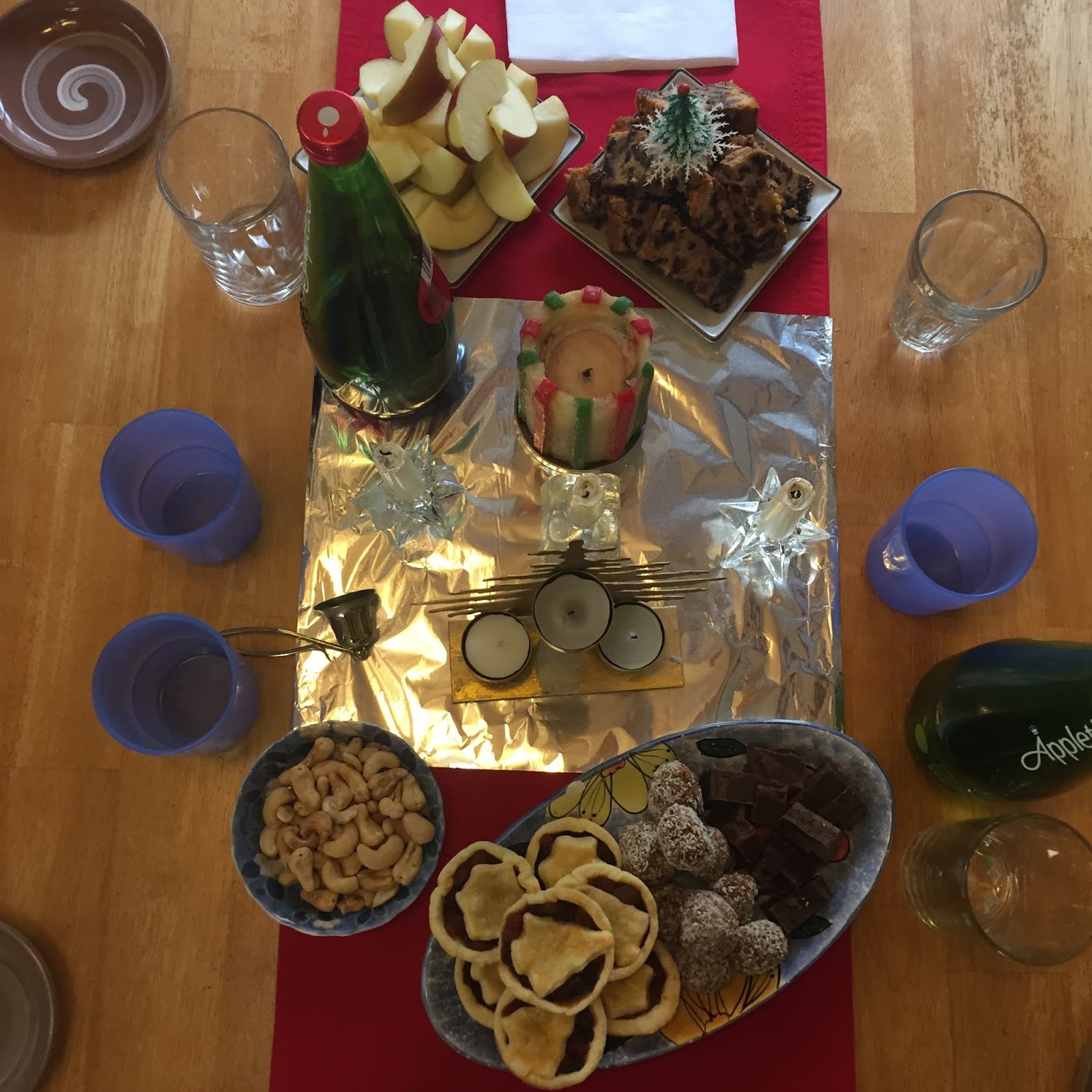
A Christmas morning tea in a past year.
Needless to say, we're all looking forward to next week. We're going away for a seven-day break, back to the house we stayed at in July. Loaded up with books, movies, games, and food, we'll apply ourselves again to intense relaxation.

This pre-Christmas holiday week is one of the few traditions that we've managed to maintain as a family. At least "big" traditions. This year it will be a bit strange as we get used to doing it as a family of four, rather than five.

I'm looking forward to time away from the relentless-ness of my work. My never-ending pile of editing, email, and social media responsibilities will be put on hold for a week. And no WiFi will certainly help! I'm also glad this Christmas that we are not looking down the barrel of lots of travel: though seeing family in Australia is always good, for us it means hours and hours of driving. Last Christmas we also were in the midst of transition as we packed up our lives in Australia and shifted focus back to Japan. Not starting 2020 like that will be a huge bonus! But now I'm moving onto an end-of-year post that I can write after Christmas.

I hope the lead up to your Christmas is not too fraught. At Christmas there can often be a lot of pressure to be perfect and to have it all sorted. We see ads and social media posts with happy families that have it all together, with piles of presents or food, and with intricately decorated homes. No one is arguing, or hiding in their room. We don't see the struggles people have with finding time or money or even enthusiasm. We don't see the loneliness that often comes with such a season. We don't see the families that are torn apart with divorce, and the parents who can't see their kids on Christmas day.

If any of the above describes you, please don't despair. The ads and the social media only show a sliver of the truth, not the whole truth. No family is perfect, many out there are hurting. You aren't alone. If you need help, please reach out. To a friend, to a local social service, to a trusted pastor. If any of my personal friends need an ear, know that I'm around on Messenger, or via email if you need me.


We ourselves aren't doing badly. We have friends here, tomorrow night we are celebrating with a few of them. Christmas Day will be quiet, with just the four of us, but we typically connect with family back in Australia via video calls as well! After a busy year we won't be disappointed in a quiet Christmas. It is our first Christmas without our eldest son with us, but then both of us did that to our families when we were in our early 20s, so it's not such a strange thing that he's growing up and doing his own thing.

Well, this has turned out to be a rambling blog post. I hope it gives you some insight into our "on the edge of ordinary" life at the moment. A friend just sent me this video, I thought you might enjoy it too.