Showing posts with label Higashikurume city. Show all posts

01 February, 2019

A grumble and a joy

I'm frustrated and discouraged this afternoon. Being a mum is a hard slog. Being a mum of teenagers is not for the fainthearted. 

I've been trying to help one boy sort out what he's thinking, help him make a decision, but feel like I've failed this afternoon and now he's not talking to me at all. 

For several days another boy has been struggling with time management both before and after school, so I feel like each of the last few days have been on repeat: do the same stupid stuff and get the same bad result. But nothing I've done so far has made much difference, except resulted in conflict. So there hasn't been much joy with them.

I'm glad that I've got other stuff on my plate, so that I can feel like I'm competant at something! Mind you, they still like my cooking, so at least I can feel that I'm getting that right.


Sorry for downloading my complaints on you. 

I'll move on now!

This afternoon I ran into a Japanese colleague who welcomed me "home" with a hug. It was both unexpected and joyful. I do feel "home" and greetings like that only reinforce it.

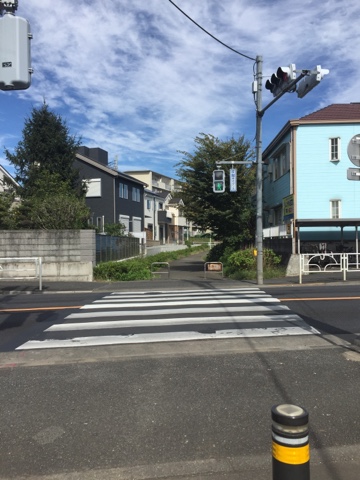
Did you know that the place we've called home in Japan, Higashikurume city, is home to one of the top 100 views of Japan? I was there at a bad time of day this afternoon, with a little phone camera, but there are some spectacular views that can be seen from just outside our local train station, especially at sunset in winter.
Can you spy Mt Fuji at the end of this corridor of
 buildings in central Higashikurume?

28 June, 2018

Home or not

Notes that two different friends gave us yesterday. Both from people
we didn't know when we came back three years ago.
Where is home? 

That's a good question and one that keeps coming back at people like us.

The best I can say is that we have two homes. We have, now, roots in two places. Different roots, but roots nonetheless.

Consider what I've done this week:

1. I went to the doctor and got asthma medication that will probably last me through the whole of our six months away. Yes, I could get this medication in Australia. But probably it is more expensive there, so I decided to get it here and avoid the hassle of going to the doctor there for that. Our doctor here is about a kilometer from our house and an easy five minute ride. The errand was done in just over an hour, including travel. Our doctor in Australia is more than 20 minutes drive (including an expressway) from where we'll be living.

2. I got a haircut. Again, something I could do in Australia, but I did it here because again it's convenient and what I know. Also cheap (under AU$20). 

Our free "shop".
3. Yesterday we had a see-you-later party. It doubled as a way to get rid of a bunch of food stuffs that we'd not managed to use up. No one who came, came primarily for the giveaways, though, they came to see us. We had 14 adults, 9 kids, and 2 babies come over the course of the afternoon. They all wanted to see us! But most took our food with them too. All of them are expats like us and have been where we are multiple times. There is community in that shared experience.

4. I put roughly 2/5 of my wardrobe into a suitcase this morning. Not all of it.

5. I rode home along our city's rivers this afternoon (after my haircut). Saying goodbye in my heart all the way.

Our corner of Tokyo is particularly beautiful. I ride along our rivers as often as I can
while going about my life. This afternoon I rode here, probably for the last time
for six months. Just gorgeous. Those trees lining the side of the river are Cherry Blossoms
with their summer clothes on.
Considering the above, does it sound like Australia is totally home for us? I don't think so. We definitely have a home here.

But Australia is also home. Consider the things on our to do list (no particular order):

1. Have as many BBQs as possible.
2. See as many good friends as we can reasonably do so.
3. Spend time with family.
4. Spend time at our home church.
5. See a live cricket match.
6. Go to a Sons of Korah concert.
7. Have a hot Christmas.

And even (for me):

  • Eat mangoes.
  • Buy new underwear (yep, haven't managed to integrate into Japan that much yet, sorry for the TMI).

I'm sure there are many others.

Yep, Australia is home to us too. Part of the ever present tension in our lives is that we can never be in both places at the same time. We always have to be absent from one (and all the people who go with that place). So our hearts aren't just full of anticipation at going to Australia, they have corners of sadness at leaving our home here too.
This is where the two rivers that slice through our city (Higashikurume), join together—just down the road from us.
David and I often ride over that bridge on our way home from church.
Two more sleeps and we will farewell this home-corner of Tokyo. One more sleep after that and we will farewell Japan, but just temporarily.

17 October, 2017

Tokyo's unexpected green tinge

In this huge metropolis that's one and half times the population of my home country, it amazes me how much green there is. There seems to be a compulsion to grow stuff in the smallest of places. Tiny garden beds seem to be regularly included on the side of houses or built into property walls these days (not so much in the older buildings like our house). 

Here's a house we've driven past quite a lot on the way back from cross-country meets these last few weeks. They've got a tree growing in that tiny garden! Plus something that looks like it could be a bonsai plant on the other side of the front door.

Of course not everyone has a green thumb (for example, yours truly, who mostly only grows geraniums because they are really hard to kill). Some of the garden beds seem to be wishful thinking: put in at entrances that are on the northern side of a building, and hence get almost no sun except in mid-summer. One building near us must have had pine trees planted there when it was built, on the north side of the building. We've watched them gradually die and finally, fall over into the street.

I passed this house on the way to Costco a couple of weeks ago. No one's grabbed the opportunity of that garden bed, but at least it's not overflowing with weeds.

I found this small ornamental chilli bush in full "bloom" on my way to the doctor last month. I passed it again yesterday and it wasn't looking so healthy. But I want to include the photo as an example of the little bits of nature that lie all around us here. This bush is in a long raised garden bed in, essentially, the central business area of our suburb. In the background you can see another one (which had mostly weeds at the time). These public areas are generally looked after by local citizen groups, who often have work days where they get out and tidy up, often planting annuals.

It's not what fits my mind's eye with what a big city will look like. 


04 May, 2017

Contrast within Tokyo

I've told you in previous blog posts that we live out of the main centre of Tokyo. It's a 30 to 45 min train ride to the nearest "big smoke" or big city centre in Tokyo. Yes, our address is still Tokyo, but we're definitely not inner city, in fact our little corner of Tokyo is really quiet. We have no major roads nearby and we don't live close enough to the train line to get that noise nor to major shopping centres. Because I work from home most of the time it's easy to forget that we live in the midst of a huge metropolis. But every now and then I'm reminded.

Yesterday I had meetings at two major (and famous) centres in Tokyo: Akihabara (electric city fame) and Shibuya (mega intersection crossing and Hachiko-the-faithful-dog statue).

I got lost in both places. 

At Akihabara I was to have a Japan Harvest meeting with a writer and my boss. I walked up and down a couple of flights of stairs before taking the wrong exit and ended up walking half-way around the shopping district that surrounds the busy station before I found the coffee shop where our meeting was scheduled to be held. And it was right next to an exit! The station wasn't super busy, by Tokyo standards, because I was there right before shops opened at 10am. But there still were plenty of people.

A small glimpse of the road crossing. Here are some better photos.
Not, however, as many as I encountered a couple of hours later at Shibuya. Here I was to meet a couple of ladies for lunch and to learn a Bible story together. One of them suggested we meet at the "Hachiko exit". It completely missed me that this is where the famous dog's statue is. However it seems that no one else had. As the Japanese phrase goes: "even cats and rice ladles" were there on this public holiday. Apparently visiting this place is one of the top 10 things to do in Tokyo! I've lived here nearly 10 years and never done it.

I didn't take a photo of the statue, I would have had to battle with the four-deep crowd that was already doing so. Located at that same exit is the famous Shibuya crossing that you often see depicting downtown Tokyo. There were lots of tourists around walking across with their phones held high to record the experience. Plus I think I saw at least three or four film crews there. Check out this 90 second video:

Here's a 9-minute documentary called "24 hours at Shibuya's Hachiko Scramble (I think the stat is wrong about how many people cross in one 45 sec crossing, though).

Yes, I crossed twice, as we searched for a place to have lunch where we could linger and not have to wait to get in. There were people standing in the middle of the crossing waiting for friends to take a photo of them. Generally being someone who avoids crowds, it wasn't great fun. There is a reason we haven't gone to view this spectacle of crowded city living.

Coming back home was a relief. Here's a main road I crossed on my way home from our local station.


19 January, 2017

Photos of our city #6


Wow, it's been more than a month since I wrote one of these. This post isn't so much about our city of Higashi Kurume, although most of the photos are from there, what is true about our city is true about much of Japan: there are lots of walls.

In Australia properties generally have fences, often quite minimal fences. Many have nothing at all at the front of the property. It is different in Japan. I'm not sure on the "why" of that, though one could guess that because properties are so small and buildings so jammed together, that people need to "mark their territory", though possibly for privacy too?

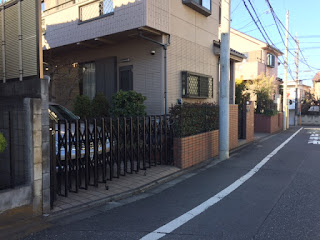
Most properties seem to have walls, usually concrete, or as you can see in the first picture here, concrete covered by tiles. Often a wall on the bottom half and a wire or metal portion on the top half.

Here are some samples from around here.


This is our back wall/fence and our neighbours'.
This is only about 100m from our house. Both sides are fields, one with a hedge the other with nothing. Those
concrete brick walls are very common on older properties.
More walls.
A neat little road that we walk down to go to the station and ride down to get to church. I love the built-in flower gardens!
Not sure why the sudden narrowing of the road here, this is just 30m from our house (our house is around the corner at the red stop sign in the "distance").
Apartment block.
Yes, and vending machines are periodically set into walls. As are community rubbish "stations".
This is a newly built house, with a minimal wall, but I think privacy one reason they've opted for this type of fence. A six-foot fence would cut off any view from the windows and light would be minimised too.
More modern houses, like this one, have no front fence. That is primarily for ease of parking the car.  This one has a covered place for parking bikes too (on the left)!

07 December, 2016

Photos of our city #5

As I wrote in my first post of this series:
Wikipedia says: "Higashikurume is a city located in the western portion of Tokyo Metropolis, in the central Kantō region of Japan. As of 1 February 2016, the city had an estimated population of 116,896 and a population density of 9,070 persons per km."
That would mean most people live in apartments and high rise, right? After all that population density is higher than the densities for places like Singapore (7,987 people per square kilometre) and Hong Kong (6,442) that definitely have lots of high density accommodation.

Well actually, no. That's one thing that surprised us and continues to surprise people we talk to in Australia when we're there. We live in a house and so do many other Tokyo-ites.

Here are some photos of accommodation in our city:

A new house built just this year down the road from us with an
old house next to it.
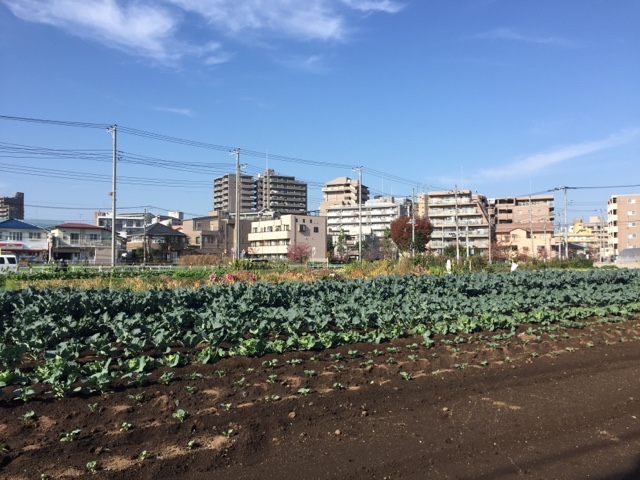
This is across the road from the previous photo. Agricultural land that has rarely been cultivated in the last five years that we've lived here, with houses closely behind it.
Rotating to the left from the previous photo and you can see the high rise buildings
surrounding our train station.
These are older than the previous buildings and not so close to the train station.
This is also just down the road from our house. Lower standard accommodation than those close to the station. They come with car parks, which is a bonus!
The best view of the sun setting that I could get the other day from our upstairs balcony.


So yes, we do live in a high density city, however it doesn't feel that bad, especially with the two rivers running through it and agricultural land sprinkled through too. It doesn't feel "inner city" as you might imagine a CBD to feel. It's very quiet at nights, definitely a bit out of the big city life. Inner-city Tokyo (the 23 wards) has 9,375,104 people living in it with a population density of 15,146 people per square kilometre. Those places "feel" inner city! Especially for David and I who grew up in Australian country towns.


18 November, 2016

Photos of our city #4

Our city has one train line running through it called the Seibu Ikebukuro line. It is owned by a private company, Sebu Railway, and originates at Ikebukuro station, a large railway junction and city centre on the west of the metropolitan Tokyo area. As of 2013 Ikebukuro station has more than 910 million passengers go through there every year or about 2 ½ million a day, making it the third busiest station in the world (the other two busier ones are just down the line at Shinjuku and Shibuya), see this article. It is huge and I remember those early days: it took me a while to feel comfortable going through there on my own.
This is a photo of our city centre, where the train station is. It was taken as I walked home from school today. You can see again, the mixture of urban and rural.
The main Seibu Ikebukuro line extends westward from Ikebukuro through and beyond our city. It also has three branch lines (Toshima line, Seibu Yūrachō line, and Seibu Sayama line). Below is a diagram of the Seibu Ikebukuro line. Thankfully at all the stations in Japan the names of stations are written in English letters as well as Japanese, making it a lot easier for us foreigners.

People from this city rely quite heavily on the train line. From here, on trains, you can go east into Tokyo city to connect up with other lines or west a couple of stations to where there is a line running north and south. The other option is to catch a bus south to catch a train from a parallel line five kilometres south (Seibu Shinjuku line, owned by the same company) or seven kilometres south (Chuo "central" line which runs all the way to Tokyo station).

Here's a photo of the actual station. It was redeveloped a few years ago and the station precinct includes a number of shops including a favourite place of mine to meet people: Tullys coffee shop.

Here's a view of the station area from the west side as I rode home along one of our rivers the other day. We live on the east side of the station.


Catching a train in Tokyo isn't as simple as finding the right platform and hopping on the first train. Trains provide different services. Some stop at every station: locals. The rest have varying numbers of stops. The list is long: semi-express, commuter semi-express, rapid, commuter express, express, rapid express, and limited express. I know now that if I hop on an Express train at Ikebukuro to come back home, I need to change trains at the stop just before our city because expresses don't stop at Higashi Kurume. Often there is another train waiting (usually a local) for the express, so you just walk across the platform for your final life home. So convenient! This photo is of just that scenario on Monday: I'd hopped off the express (blue train) and was about to jump on the waiting local (yellow).


Here are a couple of diagram of the wider train network that I found. The first are the lines owned by the Seibu company.

The second, as you can see in its title, are the railway lines in Tokyo. Can you find our line here? Tokyo's train system is amazing, but also can be thoroughly confusing and quite intimidating at first.


27 October, 2016

Photos of our city #3

Our street during a flash flood in August.
You might have been concerned after reading my last post about our city. We live very close to a river, actually two rivers run through the city of Higashi Kurume. Tokyo itself is on a flood plain and more than 100 km square of the plain are under sea level. Are we at a flood risk? 

The answer is pretty much no. We get flash floods on our street when rain dumps on us more than 50mm per hour, but they don't last much longer than the extra heavy rain itself and haven't come close to getting into our house.
The water came up over the gutter and into the carport, but not
up the three stairs that lead into the house.
Tokyo has built an incredible underground system of flood control and one of the major pieces of infrastructure is right here in our city. Check out this ABC video (12.37min) for some great footage plus explanations.

In the video at the 7 minute mark it shows a huge "surge tank". We have one of these in our city. But you hardly know it's there, except that there has been construction going on for some years now. We know it's there because we have friends who live just across the river from the entrance to this place and when they'd finished doing the underground construction they invited the locals to go and have a look.


This is all we can see of the underground flood mitigation  infrastructure. But from the photos we've seen (and the video) it sure is much more impressive down there than this photo might suggest. You can see bunches of dead plant material caught at the bottom of the grills, that was from a rain event during the summer when the river got up that high. In the background of the photo is the gym that I go to regularly to work out. This is only about 850m from our house.


14 October, 2016

Photos of our city #2

Here is where the two main rivers of our city join, less than 1km from
our house.
Continuing my posts about our city and trying not to get carried away with detail (I can drown in stuff like this). Today I'm writing just a little on the geography.

Higashi kurume city is mostly flat, which makes cycling a very easy way to get around. I discovered today that it's located on a large tableland called the Musashino Plateau. I knew it was part of the larger area that Tokyo's situated on, the Kanto Plain, but the existence of this Plateau is news to me. 

Apparently the Plateau "consists of an alluvial fan formed by the ancient River Tama with a layer of volcanic ash, many metres deep" (https://en.wikipedia.org/wiki/Musashino_Terrace) which would explain why is it such a fertile place for growing. You'll see I've included another photo of urban and primary industry side-by-side down below.

We also have two main rivers, the Kurome and the Ochiai rivers. Their banks are both well reinforced on the sides and have walk/run/cycle paths on one or two sides. I love riding along these and often use them even if it is the longer way to my destination. They're a definite joy to living here. The Ochiai river is less than 200m from our house.
Can you see the two rivers? The top one is Kurome and the bottom one Ochiai, they're both flowing towards the Arakawa, a very large river that flows into Tokyo Bay.
The city has a rather odd shape. It is bordered by several other cities and a prefecture (Saitama). The other cities are Kodaira, Higashimurayama, Kiyose, and Nishitokyo.
I ride past this local fire station and field at least twice a week doing my grocery run.
I love the lush green carrot crop at present.
Looking down into one of the rivers in our city from the bike path.


10 October, 2016

Photos of our city #1

I've been toying with the idea of blogging about our city, especially using photos. There's so much I don't know about where we live, but let's see if together we can learn a bit more.  

When we're talking to people who haven't been to Tokyo or Japan we often find a lot of misconceptions about what this actually looks like. It's not a place I ever aspired to live in and if you'd told me back in my early 20s that I'd end up living more than a decade here, I wouldn't have believed you.
Everything in this except for the green is a part of Tokyo prefecture. The purple
section is a special part called the 23 wards of Tokyo and is probably what
most people think of when they think of Tokyo. They are the central core
and have the highest population density. Two island chains are also lumped
into the prefecture. It's our hope to visit some of these, maybe as campers
at some distant time when the boys are no longer living with us.

We live in Tokyo, but Tokyo is technically a prefecture/state made up of cities, even though it is routinely referred to as a city. Strange, isn't it? The capital of a country being a prefecture not a city! A great current example of this is the 2020 Olympics which will be held where? Tokyo. Olympics are hosted by cities not prefectures/states!

Wikipedia says: "Tokyo is often referred to as a city, but is officially known and governed as a "metropolitan prefecture", which differs from and combines elements of a city and a prefecture, a characteristic unique to Tokyo."
Our address is in the city of Higashi Kurume. 

Wikipedia says: "Higashikurume is a city located in the western portion of Tokyo Metropolis, in the central Kantō region of Japan. As of 1 February 2016, the city had an estimated population of 116,896 and a population density of 9,070 persons per km." You can see it above in red/dark pink.

So here's my first photo. This is the front of the Christian Academy in Japan. You can immediately see that it doesn't fit the "inner city" model that you might think. That's true for the whole of the city, urban residential and agriculture are intertwined in a way that I've never seen in Australia.