Showing posts with label maps. Show all posts

06 April, 2021

Spring 2021 camping trip

It's about time that I got to this post, it's been nearly a week since we got back from our camping trip! We went to another prefecture (Ibaraki) we've never been to before, that makes 21 prefectures out of 47 that we've stayed at least one night in over the last 20 years (we've camped in 16, see my post from last year about our big goal).

This campsite was a complete contrast to last time, in that in October we camped in the middle of the mountains north-west of Tokyo. It was like camping in the middle of a complicated origami piece. This time we camped next to a large lake and not far from the ocean. We had a lot of horizon and almost no mountains. It was our first time in Ibaraki and we were surprised at how flat it was, at least the southern bit that we travelled through. We were also surprised at how easy it was to get there. Just over two hours from our house, most of that distance on expressways. Our campsite in October was closer, as the crow flies, but took about the same time due to weaving in-between mountains. We're far more used to camping on mountains in Japan (after all around 80% of Japan is mountains).

The Japanese tradition at this time of year is to have picnics under sakura (cherry blossom trees) when they are blooming. We went one better: we camped for three nights under one!

Campsites in Japan vary with how structured they are. Many have set spaces that you have to fit within, this one was nicely free of that and it felt like we were in a park. It also meant we could spread out. With ten of us camping, we had three tents and our usual tarp for a living area. We had four adults, and five teens and a pre-teen. This stage of camping with friends of our kids is different and really fun!


We've camped beside several lakes in the last ten years, but never as close as this. I could have thrown a tennis ball from my airbed into the lake (and I don't have a long throw).

Weather makes a big difference to any camping trip. We had quite a variety. After rain most of the first night, the next morning looked like this:


This is a clam fisherman. It was intriguing to watch him work, though he didn't seem to get much for his efforts. This lake, Lake Hinuma, is brackish. Our campsite was only 10km from the sea and the lake is somewhat tidal. Apparently it is a special environment where there are plants and wildlife that aren't so common in other parts of Japan, these clams included.

There were a couple of fearless swans that seemed to be very local. While we were cooking dinner on the second night, our friends got some lovely sunset photos with these swans around the other side of the campsite.

What a great looking kitchen! Cooking dinner: traditional yakisoba (stir-fried pork and noodles). Unfortunately one of these slipped and fell into the dirt just before serving, so we didn't get to eat it all and had to make do with filling up on dessert instead (marshmallows and chocolate banana boats).

We might have missed the sunset (the next day was too cloudy), but we did get a nice moon-rise:

Below are some pretty blossoms next to the tents. There was room to play frisbee and other sports, but this campsite lacked a little in the area of "things to do". We made our own fun, with lots of reading, walking, and riding (two campers brought bikes).

Flowering plum:
Spring starflower:

Daffodil:

Camellia tree just coming to the end of its best season.

Breakfast on the last morning was essentially leftovers. But we didn't do badly at all (we and our camping friends) have a long history of feeding teens, so we weren't found lacking.

The campsite had three main negatives:

1. Camping close to water is beautiful, but can backfire. The wind blew strongly off the lake almost all of our second day. It was like a giant air conditioner, but not in a nice way, because it wasn't warm enough for an air conditioner. Many of us got a lot of reading done in our tents this day. I started and finished a long novel on this trip, I think that's a first (for a short trip like this).

The "rubber ducky" onsen. Literally
dozens of rubber duckies decorated
the common areas of this bath.
2. No shower. Showers seem to be a hard thing to find in reasonably priced campsites close to built-up areas in Japan. The compensation was a trip to a local onsen (hot springs) on the second night. The kids loved it so much they begged to go back on the third night. Three of the adults didn't go again (it was an hour round-trip).

3. Though we'd been told it was okay to camp where we did, a local photographer came before sunrise each morning and set up close to one of our tents, waking some of our campers. Not nice.


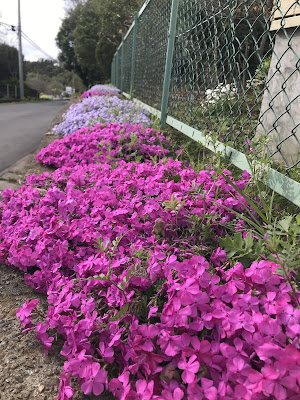
One good thing about camping with teens is not having to supervise the kids all the time. On the first full day the four adults went for a walk to a local park. Alas the one who suggested the walk (me) didn't checked if the park was open. It's not uncommon to find attractions shut on a Monday in Japan and this park certainly wasn't open. Not the most scenic of walks, but it was good to stretch our legs. This little roadside garden bed was worth capturing, though.
And a teenager, who will not be named, was climbing in this tree on the first afternoon when a rather large branch broken and deposited him on the ground, about six feet below. Thankfully he'd been imitating a sloth by hanging below the branch, so landed flat on his back, rather than in a more awkward position. Still, it was rather nasty to watch him try to recover his breath. Over a week later he's still suffering some generalised pain, though, so he'll probably see a doctor tomorrow.

The first three months of this year have been very stressful for me—you've probably picked that up if you've read between the lines of my few blog posts. I was frustrated by the wind on our second day at camp, but it did force me to "stay still" and rest, which is probably exactly what I needed. As it turns out,  this is also something of a metaphor for our current situation. David and I have been limited in many ways at the moment (by the pandemic and other personal matters), and in many respects just have to be still and live one day at a time. So I am very grateful for this short getaway, it was a very necessary break in the stress that we've been facing.

We've also decided that three-night camps are a more efficient use of time. It means that we get two whole days of "chilling". We certainly came home from this trip feeling relaxed. I had to get back to work at my desk the day after we returned home (while everyone else in the house was still on holidays), and I can't say that that was very easy, or that I did a good job of it!

So now Spring Break is over for CAJ and we've got only nine weeks left of the school year. We're not sure what camping adventures we'll get up to this summer. We've got ideas . . . but no firm plans. So stay tuned (to get to any new prefectures we'll have to drive a fair bit further, so that might not be on the cards until all our boys have left home).

18 September, 2020

Big camping goal

We started camping back in 2011 because we wanted to see more of Japan (on a missionary's budget). Back in 2017 I wrote a post that showed, using a jigsaw puzzle, how many prefectures we've visited (either driven through, or stayed a night) And just to clarify: a prefecture is like a state, and—aside from Hokkaido, which is bigger tham Tasmania—they're a lot smaller than Australian states! So it's been an informal goal for some time, but recently I've found myself saying, "We want to camp in every prefecture before we retire." Someone asked me this week how many prefectures we've already camped in, and I wasn't sure. 

So I took some time to figure it out. I think it's 14, so we've got a fair way to go to get all 47 in before we retire (granted, we've theoretically got more than 15 years left). Given we camped in five of these in a single two-week trip, we can probably manage to knock a few off fairly quickly in a summer "camping tour". For example, one trip to Shikoku Island (the smallest of Japan's four main islands, which is roughly one quarter of the size of Tasmania) and we'd be able to visit the four prefectures on the island fairly quickly. Japan doesn't seem so large when you realise that we come from a country that is about 20 times larger and hence the prefectures are a lot smaller than our states.

These are the prefectures we've camped in, some of them multiple times: Hokkaido, Akita, Niigata, Ishikawa, Tochigi, Nagano, Saitama, Tokyo, Chiba, Kanagawa, Yamanashi, Aichi, Shiga, and Wakayama. (Pictured below)

These are the prefectures we've camped in (we've stayed in several others, but not in tents).

One hard aspect about this year has been how difficult it's been to plan. I had a conversation about this just yesterday. I'm supposed to be helping run a two-week onsite workshop in January. But it's really hard to know if that's going to be able to go ahead in its usual format. How much do you plan, and risk wasting a lot of time? When do you make the call?

Starting school this last month is another example. Usually we would be able to count on certain events happening: like inter-school competitions, camps, bazaars, etc. But this year we simply haven't. A week or so ago I realised that we've got a four-day weekend next month (teachers have good holidays, but there's not much choice about when you take them). October is a beautiful time to camp in this part of the world, so we're working on a plan for that. We're aiming to visit a prefecture that we've missed up till now, but really isn't that far away: Gunma. Nothing set in concrete yet, but you'll hear about it! 

Red arrow is where we live. Purple arrow points to Gunma Prefecture. Not quite
sure how we've missed camping there!

Camping, and planning for camping, are good ways for David and I to stay mentally and emotionally healthy. I'm so excited that there's one more chance before winter clamps its bone-chilling hand on the remainder of our year.

28 February, 2018

Learning prefectures

I'm still on a quest to learn more about Japanese geography. Last year I bought a puzzle at Thrift Shop that is made up of all the prefectures of Japan (see it here). It's a bit awkward to have out all the time, so when I saw this poster on sale at our local 100 yen shop, I snaffled it up. Yes, it's all in Japanese, but the simple "alphabet" kind, so it isn't hard to read. Maybe one day I'll progress to reading the more complex "Chinese characters" that go with these places.

I've found that knowing your geography really helps when meeting people. "Where do you work?" was a question asked on Monday afternoon/evening as I interacted with people. It was great when I knew where Nagoya was, and that I've been there (camping), but awkward when I didn't know where Tottori was!

I did know approximately where New Jersey was (the place a visiting mission leader was flying back to the next day). And indeed my American geography has improved a lot since moving to Japan! We often pull out our atlas or Google maps to figure out where people come from.

Yesterday we had some little guests for the evening. They came after school and stayed till bedtime when I took them home and waited for their mum to return from a work dinner. We played with the puzzle I mentioned above. They didn't really have an understanding of prefectures, but commented on how small Tokyo was compared to all the rest of these places. Indeed! It is. All the more reason to explore other parts of Japan.

Alas no more camping trips for us for some time now. This Japan-summer is consumed with our move to Australia. Maybe next summer (though our "next summer" will really be over Christmas in Australia), really, "next summer holidays in Japan" which will be middle of next year. 

Confused? Yep, me too! Sitting in church on Sunday I had to think about what season we were actually in the middle of, literally work it through. Yes, Easter is coming up. I tell you, changing hemispheres, I didn't get jet lag, but it did exacerbate my usual "seasonal confusion". I still haven't completely adjusted back to Tokyo's winter temps, but thankfully some "warmer" days are in the pipeline (i.e. in the teens, rather than single digits).


07 January, 2018

A precious shared memory

This morning, out of the blue, a friend asked, "Are you going to the JEMA prayer meeting?"
"Yes," I said. "Where is it this year?"
"Higashi Tokorozawa, I think...," she replied.
"Ah, better than going to Mitaka in the snow on buses..." I said. And we laughed.
Tokyo streets generally aren't cleared by
the government when it snows. Local
citizens or the weather (i.e. it warms up)
do the job.


Strange conversation? Actually no. As you might imagine, there's a story behind this (that I'll get to in a minute).


One of the things you miss when you live a life full of transition are people who've known you a long time. "History" in a friendship has a lot of value. This short exchange this morning reminded me of this.

When you first arrive in a new place, you have no history. If you can't speak the language you have an even greater barrier to overcome. No one knows you. All your conversations are of the "getting to know you" or "how do you do such and such" variety. Or they are very much based in the present.

There are no fun memories, no shared history, no nuanced conversations like the above.

It is only after you've "done some time" with others that you start to build up the sort of history that you can take for granted in long-term relationships.

But in our type of transitional community the challenges don't end here. Those people who you build new history with will probably not be around in your life for all that long and when they go, they take the memories and history with them. You can tell the stories to the new folk who take their place, but they don't have the same joy and the new people might not even be interested in your stories. You have to start from scratch—build new history with new people.

That's challenging enough for a married person like myself, but much worse for a single person. At least I have a husband who I've done all my major transitions with, and a nuclear family with whom I have a lot of history. I suspect families like ours are a lot "tighter" because of the shared memories that we hold as a unit and because we don't share them all with anyone else, not even close. Our shared memories are scattered all over the globe.

But this morning I had a short time with a shared memory and it was precious.

A few years back I had been offered a lift in someone's van to an annual winter prayer meeting with other missionary women. But the day before the prayer meeting it snowed . . . and snowed and snowed! Our lift cancelled and most of those who had been going in the van couldn't because school was cancelled also. 

That left me and this friend I talked with this morning. We weren't sure what the best alternative way was to get there: by bus or train. There were a lot of back and forth texts, and we finally decided to go by bus, thinking they were most likely to be reliable (Tokyo train lines are a bit fickle with adverse weather conditions).

The next morning I dressed appropriately and managed to get to the arranged meeting point. The snow had already melted a bit and then frozen and so there was lots of scary ice around, it wasn't fun walking. We hopped on a bus, a bus route we were both unfamiliar with, and off we went. It was a veritable tour of the nearby cities! Traffic was slow and lots of people were on the buses.

But we finally arrived at the place we had to get off. Little did we know that the most difficult part of our journey had not yet began.

We walked, and walked, and consulted Google maps, and walked. Eventually we conceded that we'd probably walked too far and we really didn't know either where we were or where we should go next. So we rang the one person we knew who should be able to help: the lady running the prayer meeting who happened to know the local area well because it was her mission's headquarters who were hosting the prayer meeting. 

Our angst at this point was amplified by the fact that I was supposed to be playing the piano for the worship times of the meeting and we were already an hour late!

It was surprisingly hard to establish where we were and, it turned out, the "pin" we had on Google maps for our destination was incorrect. We eventually found a convenience store and asked for directions to the convenience store near our destination, by which time the leader of the meeting had walked out to see if she could find us. (This was 2013, I just found part of the story on my blog here.) We arrived two hours late. 

But just like the snow camp memories that our family holds and periodically take out to enjoy, this friend and I have this shared memory of the time we got lost in the snow looking for a prayer meeting in Tokyo.

Precious!

21 November, 2017

Interesting map facts about Australia and Japan

I love maps and interesting statistics. This article has some fascinating statistics that relate to
our lives as Aussies in Japan. Here are the ones that catch my eye most:
  • Japan's a pretty green place, especially in comparison to Australia. Japan has 68.6% of its land forested, that's 17th highest in the world.
  • Japan has many more roads than Australia (1.21 million km vs 823,000 km), despite Australia being 20 times bigger than Japan. I guess it makes sense in some ways, because Japan has more than five and a half times Australia's population.
  • We've moved from one of the least crowded nations to one of the most crowded (well, we pretty much knew this already!).
  • Australian drink more alcohol than Japanese, in fact more than most countries do. I don't know if I'm surprised at this. I do know that alcohol is readily available in my local grocery store in Japan, though.
  • Japan is one of the highest risk nations for a natural disaster. Yep, pretty sure I knew this. That's why we have an emergency kit in our cupboard.
  • Australia and Japan are both listed on the high end of urbanisation. Difference is that there's a lot of places where no one lives in Australia. Driving through Japanese and Australian countryside is quite a different experience. The cities and towns are much further apart in Australia.
  • One of the hundreds of tunnels in Japan, this one is on
    the northern island on Hokkaido.
  • The two countries are similar in ranking for rail network, but I'm sure that that is totally skewed by the long distances trains have to cover to get to Perth and Darwin. Rail is the primary mode of transport in Tokyo. 40 million passengers use the trains each day! More than Australia's whole population. Tokyo alone has 882 stations and nearly 5,000 km of track!
Our house (blue roof) and road.
Go and have a peek at the maps, you might learn something about your country you don't know!

22 May, 2017

What are you doing this summer?

"What are you doing this summer?" is the question that usually dominates this time of year, but I've not heard it much. Maybe because the dominant questions have revolved around our eldest son's plans after graduation.

We're not leaving the country, but we do have some summer plans.

On the way to explaining, I bring my new "toy". The prefecture of Japan puzzle. Here it is complete.

This next one shows the prefectures that we have at least driven through, perhaps stopped briefly in on our way through. You'll see that we've been through almost every prefecture east of, and including, the orange area (roughly called the Kansai region). A lot of the yellow and orange was "added" last year in our sixteen-day camping trip.

The next map is of places that at least one of us has spent at least one night. Most of them we've been all together, though.

Here's a closer view. There's one that's not shown: we've actually spent three separate nights on a ferry between Sendai and Hokkaido in the ocean off the "green" area.

So, we've got more work to do to cover all Japan. I don't think it is a formalised goal of ours, but certainly our camping endeavours have been a strategy to see more of this beautiful land. 

This summer, in July, we're going to Niigata (most northerly yellow) for a couple of nights with friends who live on the Japan sea coast, then three nights camping further north in one of those "dark green" prefectures that are currently missing from our map. Then we will spend a week or so in a cabin owned by OMF near the beach on the Pacific Ocean. David and I would happily do another long camping tour, but it's been vetoed by one of our boys. So this is our compromise. It seems we'll have to wait until he leaves home in order to do another big camping trip.

I'm looking forward to seeing another small part of this island nation, and, of course, getting away for a while. Seven weeks till holidays!