17 June, 2023

Finally the day has come…

Yesterday was the day we've been working towards: it's the day we decided months ago that we would finish our work (i.e. magazine editing, social media managing, and—for David—teaching). It seemed impossible at times, but alas (or much to my amazement) we actually managed it! The only portion of all that that I will retain is an overall management of the magazine team and general "hard question" consultant.

I'm thankful that I was running ahead of schedule last week. That relieved some stress as yesterday didn't go at all as expected—a simple get-medication medical appointment at a hospital (usually takes under an hour) turned into a four-hour ordeal. 

Being ahead of schedule also meant that I could volunteer several extra hours to help the admin team for the magazine with the manual labour of packing, and this month's mail-out had a wrinkle that's extended the time it's taking to packing all the magazines up several fold!

This week has held other unplanned things: 

  • Doing my first ever audio recording of a conversation with a colleague which will go with six articles I've written about home assignment preparation (looks like that recording and the articles will be published over the next couple of months, so I'll be sure to share them).
  • Doing some serious culling of files on my computer so that I can transition to my new work computer (yep, my computer lied about how much it held, and we ordered a new computer that was too small). Why this week?
  • Starting to hand off my plants to others! Just like with my work, I'm splitting my plants up between several people to care for while we're away. I’d planned to do it, but not as soon as this week!
  • A pile of mending has suddenly appeared! Really?
  • And various appointments that aren't related to us leaving: mostly medical, and dental, but I do need to remember to make a hair appointment.
  • I don't remember when I found out, but not long before Monday I discovered that I was invited to a staff-family dinner that night. First time since COVID (for me). And it was followed by square dancing, which is very closely related to the Australian bush dancing we did as kids and was super fun (even if I was very tired).
And expected things:
  • I'm starting to struggle with sleep: nightmares about clerical errors, waking up early with my brain whirring, etc.
  • Finishing work today, of course!
  • My last work meeting (aside from next week, which is basically a whole five days of meetings at our OMF conference).
After my long wait at the hospital on Thursday I was feeling quite off balance yesterday. I'm really glad that I planned ahead and handed things off early, it's really helped that that hard work of thinking things through to be done before this week!

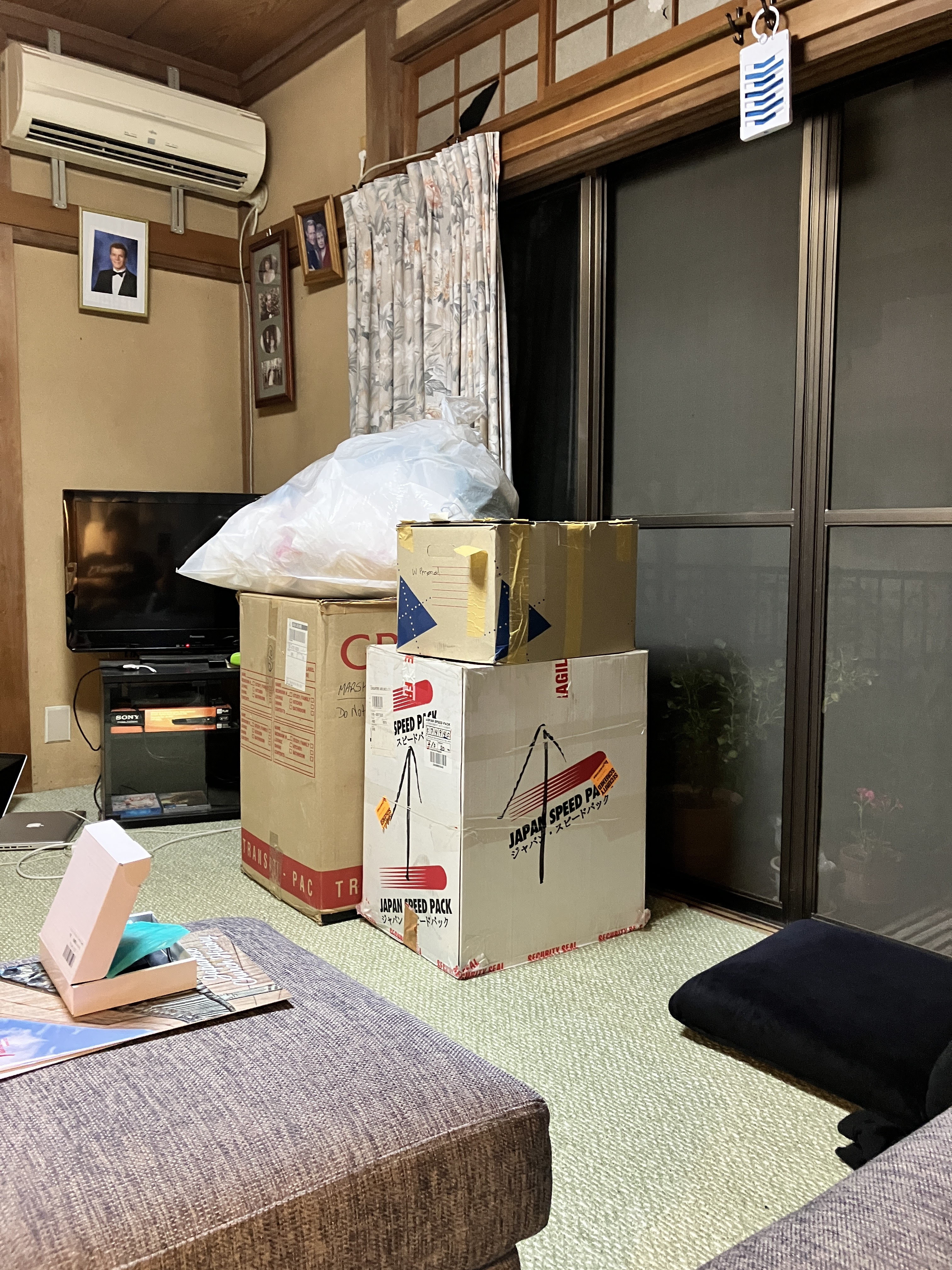
David also finished work yesterday, and last night he pulled out a whole lot of boxes that we haven’t used in 13 years. They’ve been living in our attic. Now our house looks like we’re moving, even if we haven’t actually put much into the boxes yet. But I’m feeling pretty restless about it all. Probably the best way to deal with that is to get off my chair (and this blog) and actually do some sorting myself. Here’s my secret: I leave the actual box-packing to David who is a magician when it comes to 3D puzzles like this.

Boxes full of packing material


On Monday we leave early to catch a couple of trains to catch a plane to Hokkaido for a five-day conference with OMF Japan. So we’ve also got to pack for that…and so, I’d better get going.

09 June, 2023

Transition reflections

We are inching closer and closer to home assignment. It's less than five weeks till we fly out of Japan and while I know there is a lot yet to be done, I'm also getting impatient for it all to be over! I feel a bit overwhelmed by all the anticipation! 

This week I've been slowed up considerably by the miserable cold I mentioned last post, complicated as usual by my chronic asthma. I've gotten a lot less done than I'd expected, but nonetheless, I don't appear to be terribly behind, which is a great relief.

Yesterday morning I had my last "handover" planning meeting. Gradually the puzzle that I've been working on is being solved. The question that's been heavily on my mind for months now was how I was going to take leave from my various roles in Japan for 12 months without having those ministries collapse (not because I'm indispensable, but because I have been a key leader of both my main ministry teams). 

The goal I've been working towards is officially finishing most of my roles next Friday. After that we have our OMF field conference for a week in Hokkaido and then three and a half weeks to pack up our house, pack our bags, move, go to final medical appointments, say farewells, dispose of stuff, and hop on an aeroplane.

Forgive my unbelief

One of the stresses of moves like this one are all the unknowns compounded by many, many decisions. Most of the unknowns for us now are problems to be solved in Australia: like where we're going to live and how we're going to get around. 

We sent out our June prayer letter this week and in that we made an appeal to borrow furniture. We don't know where we'll live, but chances are that it will be unfurnished. We have only a very small amount stored in Australia and almost none of that is furniture, so each time we've got back for home assignment, we've asked our network to help us out. They've never failed in 20 years and I can't remember ever having to buy any larger (or even medium) household goods. God's provided in the past. But I still succumb to anxiety, which, I realise, is basically rooted in not believing that God will supply our needs (despite what I say with my words). In the case of the furniture, only an hour or two after I sent out that prayer letter, a good friend messaged me with news that she can supply most of those needs! Wow. Thank you Lord, but please forgive my unbelief! And help me to apply that faith to the other needs we have!

Quietly rebelling

What most people don't realise is that we really do like what we do in Japan. The essence of home assignment is that we have to give up what we really like doing here to become public speakers in Australia. And neither of us really enjoys public speaking.

I find myself quietly wanting to rebel against what we’re required to do over the next twelve months. Most of what we do in Japan is usually in the background. Neither of us feel comfortable being in the limelight. But home assignment puts us firmly there. We morph into speakers, workshop leaders, and Japan experts. My quiet rebellion is because I don't really want to be considered an extraordinary human being, one that needs to be pointed out as something special, someone who we invite to speak about their amazing experiences. That sub-text is contrary to what I want to communicate: that we are just ordinary humans, doing pretty ordinary stuff (just in an extraordinary place). We appear "special" because not many people do this, but it's not because we are inherently special. All we have and are is from God. It's because we serve an extraordinary God that we can do this, and keep doing it.

Translators?

I'm reading a book at the moment called Uncommon Ground, a collection of essays brought together by Tim Keller and John Inazu with perspectives from people thinking deeply and working daily to live with these times. What I didn't expect was to gain some perspective on what our role is during home assignment.One of the authors, John Inazu, calls himself a translator, though he is a lawyer and teacher. He says each of us is called to the task of translation: making words and ideas accessible to audiences unfamiliar with them. He describes his role as translating for and to each of the two worlds he occupies: the church and the university (he teaches law). "My vocation of translation means translating the university to some of my church friends and translating the church to some of my university friends." (p. 115)

In the case of a missionary on home assignment, we have to "translate" overseas mission and Japan to Australians. In general people we encounter there don't clearly understand what we do or where we do it. If you've followed my blog for a long time, you'll know that our work in Australia is composed of answering a lot of questions.

Much patience and diligence is required in translation. Much attention to detail as well as sensitivity to the wider picture. My work as an editor is also translation to some degree. I have to ensure that the writer's intent is accurately and appealingly translated into words that the audience will understand and not stumble over. And of course, as a writer who writes about cross-cultural life, I am translating my experience, life in Japan, and missionary life, into words so that others can understand. Pretty similar, in a way, to what we do on HA, except that as a writer and editor, I can hide behind my screen, rather than have to engage people face to face, or stand up in front of an audience with no time to edit my answers.

This is an interesting, helpful new thought for me. The author's thoughts on how we all need more humility, patience, and tolerance, are challenging, but helpful as we head into a different season of translation.

06 June, 2023

Culminating events

Before we came to the Christian Academy in Japan in 2005 I'm pretty certain I'd never heard the phrase "culminating events". I'm not even sure if we had a phrase when I was growing up that collectively described the various events that happen at the end of a school year.

In any case, last week we were in the middle of culminating events at school, and, of our last son graduating from high school. The week looked like:

Monday—last day of classes

Tuesday—final assessment in the form of a formal presentation about his year-long project about mental health and exercise in adolescents. The audience was a panel of two teachers, plus around 10 middle and high school students. We, his parents, were also invited.

Wednesday—parent-organised banquet for seniors and their parents (plus siblings in some cases).

Thursday—graduation rehearsal and farewell parade through the school in graduation gowns and caps.

Friday—graduation before a gathering of about 400 people in the school gym. 

Tuesday was full of emotion as we watched our youngest child finish his last assessment. It was all over by 9.30 a.m. and I came home, not quite ready to start work, so I made a cake. Emotional cooking? It was very satisfying to do, and we've all enjoyed the fruits of it.

Photo by Megumi Nakazawa
Wednesday night was the school's traditional banquet, organised by a small group of mums. We got dressed up and took the trains downtown to a Brazilian BBQ restaurant. The meal was spectacular: all-you-can-eat meat cooked in a rotisserie, plus an amazing salad and dessert buffet, plus soft drinks and juice. Of note for some were the whole pineapples, also cooked in the rotisserie. It was a late night, however. We travelled home on crowded trains between 10 and 11 (yes, Tokyo trains at that hour, mid-week, is a sight to be seen). I only got five hours sleep that night.

Thursday was quiet for parents, but the students spent the afternoon at school, rehearsing for graduation and doing a final walk-through of the school (dressed in graduation gowns and hats). Parents were left to their own devices, which for me meant making final decisions on the Summer issue of the magazine before it went to the printer, as well as editing work on the next one, the Autumn issue, plus work on social media posts for the upcoming weeks.

Friday was an emotional day. I tried to fill in the morning with tasks that needed doing but didn't need too much brain. We had significant rain all day and through the night, maybe as much as 200mm, so there were no lovely photo opportunities in the school's lovely courtyard. Also, because there is only a small car park, we walked to school (as usual). I'd already thrown away my rain boots, so I wore sneakers and socks, changing into my black flats when I got there. It was an emotional afternoon as we watched our last child walk across the stage, finishing high school.

The emotions are mixed, mostly happy, but also sad as our son says goodbye to good friends and a place that's been like a home-away-from-home all his life. 

I also think back to the last time we did this, two years ago. The differences are stark: last time was in the middle of the pandemic, so we were masked and sitting in little "islands" apart from one another, and the only people there were the graduating students and their parents, staff who didn't have a specific job stayed home. It had also been many many months since I'd been in a room with that many people, so it felt very odd. This time anyone could come (though the weather held back many, we suspect), so all the staff were there, as well as a number of other students and parents and community members. Though I felt there is another subtle difference that's resulted from the pandemic: there weren't actually many people I knew. I think that's a hole that's partly come from not having community events for a couple of years.

The other difference is much more personal and harder to write about in a public place like this. Our sons are very different in personalities and their journey through high school has been markedly different. Some of that is related to mental health and neurodivergence. Last time significant social anxiety was a very big unseen presence that came along to graduation with us and made just getting through the ceremony a big deal, and one that didn't garner any medals or plaques.

But now we're all quite tired, socially and emotionally. I've come down with a miserable cold and am struggling to get through the brain fog to continue working on my to-do list for this week.

26 May, 2023

Remembering God's compassion and grace

Early in the year, I wrote about focusing my thoughts on Psalm 103, particularly as we work our way through this crazy year. But almost immediately after I wrote that we galloped into three big wrestling tournaments over a period of just 18 days and the madness had begun. Now we're nearly into June, the sixth month of the year! 


This week a close friend reminded me of Psalm 103, so I want to lean into it today, just before we head deeper into the end-of-high-school-and-life-as-parents-of-school-aged-kids craziness that next week holds (and yes, I know that's a ridiculous phrase).

I have frequently felt frail in the last five months. Last week was a rough week for me physically and it took longer than a weekend to recover from it, and I'm still struggling with energy as we head into another weekend. It's been a comfort to remember that God doesn't expect me to be strong.

As a father has compassion on his children,
    so the Lord has compassion on those who fear him;
14 for he knows how we are formed,
    he remembers that we are dust.
15 The life of mortals is like grass,
    they flourish like a flower of the field;
16 the wind blows over it and it is gone,
    and its place remembers it no more. (Ps. 103:13–16, NIV)

This psalm is actually full of praise for God's compassion. It talks about his justice, forgiveness, healing, and redemption, that he's slow to anger and gracious. That he satisfies us and renews us. And most of all that he is "abounding in love." It's hard for us to grasp how much he loves us, so the psalmist writes "as high as the heavens are above the earth, so great is his love" for us. In Ephesians, Paul prays that we might have the power "to grasp how wide and long and high and deep is the love of Christ." That’s a lot of love! Taking Paul's lead, I often pray this for people I know.

I was recently reminded of how quickly we humans jump to judgement, anger, and revenge. I was reminded of my tendency to be a law-keeper and how quickly I judge myself very harshly when I break rules (or get caught breaking rules), or even when I make mistakes that hurt others or don't measure up to my high standards. And how that grace-less attitude flows over into judging others. But God reminded me of Psalm 130, in particular vs. 3 and 4:

If you, Lord, kept a record of sins,
Lord, who could stand?
But with you there is forgiveness,
so that we can, with reverence, serve you.

Psalm 103 also reflects God's gracious heart. God:

  • forgives all your sins (v. 3)
  • is slow to anger (v. 8)
  • will not always accuse (v. 9)
  • will not harbour his anger forever (v. 9)
  • does not treat us as our sins deserve or repay us according to our iniquities (v. 10) 
  • has removed our transgressions from us, as far as the east is from the west (v. 12)

How comforting it is to know that I have a heavenly Father who is completely able to meet our needs and forgive our sins. Unlike an earthly king, the Lord God is all-powerful, all-knowing, and without limits in the love he has for me and all who he calls his.

As we move ever closer to leaving for our fifth home assignment my sleep is gradually getting more erratic. I find myself awake at random hours, with worry running through my head. My subconscious provides entertainment in the depths of the night: problems that need to be solved (but perhaps not by me and certainly not in bed at 2 a.m.) and even totally fictional problems that my subconscious has made up (like that exam I forgot to prepare for, or the plane that I nearly missed). This, in turn, is making my energy during the day more erratic. I hate this. But I can't escape who I am. All I can do is repeatedly turn my eyes to Jesus and remember his great compassion and love.

One night in the last week a problem that arose at work plagued my thoughts at an ugly hour, I couldn't let go of the circular thoughts running through my head. I just had to say to God: you need to solve this one, I can't do it now, I probably can't do it later either. In the days that followed that middle-of-the-night cry for help, the problem was solved. To God be the glory!

The other thing that can plague me at times of transition is seeking security in things that aren't really secure: like the promise of accommodation or a car to use in Australia. We've just given notice to our landlord on our house in Japan, after nearly 13 years! But we don't know where we'll next truly unpack our suitcases, nor what car we will drive. There are a lot of unknowns in the coming 12 months. But no amount of worry is going to solve those problems. Yesterday afternoon an email in my inbox from ThriveConnection.com reminded me of how easy it is at times of transition to put my hope in things that only provide a false sense of security. When I do that I forget the only true security is in God, who cannot be shaken.

And . . . I’m back to the lesson God’s been teaching me over these last few years: trust him. No matter what the present or future looks like, trust him.

This song grabbed my attention this morning, and drove me to tears. Maybe it’ll be a comfort to you today too: Desert Road by Casting Crowns

19 May, 2023

Change is in the air

The dominant theme in my week has been transition planning at work. Yes, I know, I've been thinking about this for months, and rightly so, it's more than one complicated problem that I've been trying to solve. But this week I feel like I made it past a tipping point in the planning and was able to get some plans rolling. Each day I've been juggling my usual work with communicating with people (via email or video call) about jobs I'm going to hand off to them, or how their particular job will change with me stepping back. 

It's exhausting and has come a bit to dominate my thinking over the last months. And, while I'm happy to be making visible progress, I think I'll also be happy to make it past the planning stage into the execution stage and see a visible reduction in my workload on this side of the ocean, to make room for new things.

End-of-senior-year pressure cooker

I'm very happy this is my last time as mum of a senior at high school. It's a lot of pressure and life is moving like a rocket for these kids at the moment. There is so much going on in these final weeks of school (graduation is two weeks from today), that it's hard for us parents to keep up. 

I'll be very glad for these two weeks to be over, but there's a bitter-sweet note too, as these friends with whom they have forged something very special, will be scattered around the earth, literally. Kids growing up outside their passport culture find "home" amongst other people like them, so at an international school the bonds are often stronger than you'd usually find in a school. During times we've spent in Australia it's their school and friends from CAJ that they have missed the most, even more than Japan itself. This is a much more "permanent" goodbye to that relatively safe place. Our youngest has been at this school since kindergarten, barring three home assignments, totalling 2 ½ years. During his life he's said goodbye to a lot of good friends, but usually one at a time, this time it's much bigger. So grief hovers below the surface of the craziness that abounds at present.

My experience of orchestral concerts has 
always been people dressing fairly formally.
It wasn't so on Saturday, but we had fun
nonetheless!

Something different

David and I did something totally unusual on Saturday night. We went to a symphony orchestra concert downtown. It was a suggestion I gave him for my birthday present. This is something really enjoyed doing when I was much younger: I have fond memories of my mum taking me to concerts as a young teenager. It's not something David has done much of, in fact, we have only once before done this as a couple, way back when we only had two kids, nearly 20 years ago! 

The concert was held in NHK Hall, which has a
capacity of 3,400! It was about ¼ or ⅓ full. NHK
is the national broadcaster in Japan, and the 
concert was recorded for TV and radio. Not sure
when they'll broadcast it. And yes, we were 
towards the back (there was a tier above us).
It proved to be a great experience, one that is very accessible in Tokyo. We can see concert-going in our future. We're definitely thinking about how life will be different as a couple and pondering how we can make that a rich and full experience, rather than the rather negative "empty nest" tag that it's often given.

Surprised by a book

I'm currently reading a book as research for writing an editorial for Japan Harvest on a topic I know little about: singleness. The book is called Sacred Siblings. Two people recommended that we publish a review for it in the upcoming magazine, but no one volunteered, so I decided to use it to help me write an article that I feel incredibly ill-equipped to write.

The book is not what I expected. It is very applicable to all people in ministry, but especially overseas ministry (their stated audience). I've been surprised to find that my experience as a married mother has come up many times in it. Married women with young children and single women have very different stories on the mission field, and not always in ways that you might imagine if you've not lived as each. It's interesting to have that written out in black and white, I'm not sure I've ever seen it acknowledged in print. 

I was struck by a story shared by one of the authors about two teams she was part of: one had a majority of married couples and the other had a majority of singles. She noted how the majority (no matter the makeup of that group) had a lot of difficulty seeing and accommodating the minority.

I'm nearly halfway through the book, but am already glad I've picked it up and hope that by writing about the book in the magazine it is picked up by others in the missions community too, especially the majority in leadership (largely married men with children).

My role is about to change in this area too with the remainder of my children leaving home, I'll soon be a married woman without children in Japan. I guess we've been living in the middle-ground for nearly six years now: with one of our sons living in Australia. I expect that this change to just the two of us here will give me a different perspective from that which I've had up till now—I've never been in Japan without children at home.


And such are the thoughts that are rushing around in my head at the end of this week. I'm also keeping an eye on the weather. I usually do a grocery run on my bike on Fridays and we have a rain front approaching us, so if I want to do it and stay relatively dry, I need to hop on my bike very soon! In fact . . . it's already raining, which is not what the forecast said . . . so do I don rain gear, or wait a little, or take the car?

12 May, 2023

Neurodivergence and missionary families

Here's one definition of this term that has become popular in the last few years:

Neurodivergence refers to any difference in the way our brain works, processes information, and interacts with the world around us. This umbrella term includes autism spectrum disorder (ASD), attention deficit hyperactivity disorder (ADHD), dyslexia, learning disabilities, Asperger's syndrome, and more (from here).
Image by Gordon Johnson from Pixabay

I was proud to learn that the term was coined by an Australian sociologist. And only four years ago! So it's a very new word and one that I like a lot because it's so helpful and positive.

Our family has been influenced by neurodivergence from quite early on, and the particular brand we've been dealing with is ASD, of the "Asperger" type.

Recently a colleague, who also has parented a neurodivergent child through to adulthood, was asked to address the topic with a group of missionary leaders who help our mission take care of the kids and families in our organisation. She asked about our experience and for any recommendations we'd have for resources. We ended up talking about some of our experiences and, with the benefit of hindsight, I wanted to share with you something of what it is like as a missionary family dealing with kids who don't fit into the neurotypical box.

It's hard on many fronts.

Diagnosis

It's not always clear what's going on when you're raising a child who doesn't fit the "norm." It can be even harder when you aren't in your home country, because it isn't always clear what the "norm" is. For example, if your child is in a local school overseas, every day they are dealing with more than one language and culture. Moving from your home to school and back again represents crossing cultures each time. It might not be clear exactly what the trouble is: it could be linguistic or not understanding the culture of the kids they are with or even a lack of friends. Or it could be that the teachers have never dealt with a child who isn't a local, and don't know what to do, or how to communicate with you or your child. Schools in different countries are very different. Or, your child could be in a small international school with few resources, or you could be homeschooling them an have no training in recognising neurodivergence.

The other challenge with getting a diagnosis is finding someone to do that. In Japan neurodivergence isn't well understood, not to mention doing an assessment in Japanese wouldn't have worked so well for our boys who haven't become fluent in the language. So, getting a diagnosis was easier when we were in Australia. We're fortunate to be in a big city in Japan where we've had access to an American-trained psychologist, but that isn't often the case for missionaries. And even then, at one point we had to have a reassessment done in Australia because a diagnosis by a paediatrician is required in our home country.

Resources and services

Missionaries often have limited access to the sorts of resources and services that their peers in their home countries might take for granted. Although from what I've heard, even in home countries, parents of neurodivergent kids often have to advocate hard to get services for their kids, especially kids who are higher functioning. Missionaries are even more on their own. Thankfully more resources are available online these days, so it is pretty easy to access support groups and tonnes of information, even if you can't access person-to-person services for your kids.

Schooling

Education choices are more limited when you're serving overseas; they are also more complicated. And that's for neurotypical kids. If your kids don't fit into that box, then it's even more difficult. We know colleagues who have ended up homeschooling and numerous others who've had to return to their home countries permanently.

And then there's home assignment. It involves changing schools (and churches, homes, friends, food, and general environment), not to mention changing cultures. No one finds this easy. It involves a lot of transition, which is something kids on the Autistic spectrum don't deal with well, but I suspect other kids who are neurodivergent also do it tough.

Behaviour

Somehow missionary kids are expected to be well behaved, just like pastor's kids. Even though we all know that children are flawed individuals, we (adults in general) still have these expectations. Missionaries often feel like we live in a bit of a glass house. 

We write regular newsletters. Parents of neurodivergent kids carefully select the bits they're comfortable sharing and that they think will be favourably received. But I think this is true of missionaries in general. Of course wisdom is always needed in what you share with anyone— too much isn't good, but neither is being too selective. And prayer letters are public communications: we never know who will read them. Most missionaries have received unhelpful advice from people who think they understand our situation and our kids, but don't really. We generally share more details with a smaller group of close friends. But we need to share something with the wider audience so that they can pray and also so that we have some accountability, because this is where much of our income is coming from. But as you can imagine, these communication decisions aren't easy to make.

And then we go on home assignment, when we're even more on display as a family. When our children are younger we "drag" them around to various speaking appointments, and at each place, there are unspoken expectations. The worst are, unfortunately, usually Sunday morning church services, where kids are expected to sit quietly in a strange-to-them building brushing shoulders with strangers, and then afterwards be pleasant to anyone who chooses to talk to them. As a parent in that situation, we feel the pressure to be advocates for our kids, on top of all the other responsibilities that come with being the "visiting missionary". It's exhausting.

We've got many sad memories of the difficulty of getting our kids seated in a crowded church, of awkward whispered conversations with people who assumed our kids would join the Sunday School, or even a child who refused to get out of the car and come into church at all. And then the difficulties of staying in other people's homes: relatives, friends, and strangers. So many unspoken expectations surround situations like that, including conversation, politeness, and even that two children will share a room willingly. And all the while, feeling like our kids and observations of our parenting are somehow part of a report card on our fitness as missionaries. That's a lot of uncomfortable pressure.

So, this all sounds rather negative. I do need to tell you, though, that we've made it through. We've spent the last 22 ½ years raising our boys (mostly) in Japan, and we've gotten them all through to officially being adults. And each of them has finished (or is about to) high school. We know that that's not the end of our involvement in their lives, and that each of them has much more growing to do as people, but by God's amazing grace, we've made it this far, and we look forward to seeing where they go and what they do in the future.

Have there been times when we thought it would be better to be doing this in Australia? Yes. The big challenge of parenting is that not only do you not know how things are going to turn out, you don't get any "redos" or "practice runs". You have to make decisions based on the information you currently have to hand and the wise people you have surrounding you. As Christians you also take your hard situations to God in prayer and ask for his wisdom, trusting that he will guide you.

God's power for the weak

I was encouraged this week by a reminder of God's great power for his children. The same power that he used to raise Christ from the dead. 

It's mentioned in Philippians 3: 10–11 and in Ephesians 1:19–20: "His incomparably great power for us who believe. That power is the same as the mighty strength he exerted when he raised Christ from the dead and seated him at his right hand in the heavenly realms" (NIV).

And Paul, the writer of both those passages also says, "But one thing I do: Forgetting what is behind and straining toward what is ahead, I press on toward the goal to win the prize for which God has called me heavenward in Christ Jesus" (Phil. 3:13–14 NIV).

I can't finish a blog post about parenting without telling you the "parenting" verse that's helped me persevere through the years:

"Let us not become weary in doing good, for at the proper time we will reap a harvest if we do not give up" (Gal. 6:9 NIV).
06 May, 2023

Endings

Funerals seem to be a bit of a theme running through this week. No, no one close to me has died, but we know about three separate people who have died in the last couple of weeks in three different countries. They are all parents of friends or colleagues.

But the other "funereal" theme that's creeping into our lives is something I've referred to in the past as a "living funeral". Something we've been the subject of every time we've made an international move in the last 22 ½ years (which is ten times now, by my calculations). Here are a couple of quotes from a blog post I wrote in 2015:

It happens when you're leaving. Everyone talks to you about leaving. It can be like a living funeral. The collective effect of all these conversations is sadness. Friends also stop talking to you in quite the same way, they don't want to talk about future events that you won't be a part of, so you are gradually eased to the edge of the community.

I guess it helps everyone cope with the emotions associated with parting with friends, but it isn't nice. 

And—

On Thursday afternoon in the space of a couple of hours I had multiple conversations about us leaving. It just left me feeling empty and sad.

This week I was part of a two-hour meeting, a committee that helps to oversee the social media work I do for our mission. If I had a dollar for each time something like the phrase "when Wendy goes on home assignment", I'd be able to shout a couple of friends coffee (the Australian phrase for "pay for other's food/drink"). They were doing some planning for the future and I felt a bit powerless, knowing I wouldn't be around to help them do what they want to do, and that I'm not sure how they're going to manage it. 

I'm encouraged, however, by what an older friend said to me on Tuesday, that sometimes we need to put a "ball" down and see who/how/if it gets picked up again. I'm about to put a lot of balls down, and it's not easy, but it needs to be done.

The other funereal thing has been downsizing: disposing of some of our worldly goods. Though in general that's making me happy, not sad! There are things leaving our house almost daily (or being earmarked to leave with a certain person). This is one thing that seems far more common in the missionary community than in other communities: the tradition of giving away your stuff (with or without money changing hands).

We’re giving away this beautiful  5 L Corning Ware
casserole dish, one of many things that has been
culled from our household goods.

So, back to funerals. At least our withdrawal is a planned one, an expected one (this home assignment date has been in the schedule for more than five years, maybe as many as eight). We do get to say goodbye and we hope that for many it’s a “see you later” farewell. I need to keep reminding myself, I should be thankful for that!

And when thinking about endings, this song is a good one to refocus us on what’s important and who is eternal and wise:  https://youtu.be/ara0P_pUMO4