Showing posts with label speaking. Show all posts

11 June, 2026

Pondering our uncommon "walking around life"

Before we went on home assignment in 2023 I was reading a book called Uncommon Ground, a collection of essays brought together by Tim Keller and John Inazu with perspectives from people thinking deeply and working daily to live with these times. Here are some of my reflections on that in light of our upcoming time in Australia:
Home assignment means meeting
up with people for various reasons.
On Saturday we met up with a 
member of our church in Tokyo,
someone we'd never met before.
We got to walk for the first time on
this cool bridge across the Brisbane
river.

In the case of a missionary on home assignment, we have to "translate" overseas mission and Japan to Australians. In general people we encounter there don't clearly understand what we do or where we do it. If you've followed my blog for a long time, you'll know that our work in Australia is composed of answering a lot of questions.

Much patience and diligence is required in translation. Much attention to detail as well as sensitivity to the wider picture. My work as an editor is also translation to some degree. I have to ensure that the writer's intent is accurately and appealingly translated into words that the audience will understand and not stumble over. And of course, as a writer who writes about cross-cultural life, I am translating my experience, life in Japan, and missionary life, into words so that others can understand. Pretty similar, in a way, to what we do on HA, except that as a writer and editor, I can hide behind my screen, rather than have to engage people face to face, or stand up in front of an audience with no time to edit my answers. (from here)

In the midst of another home assignment, one that is far more fast paced, the thoughts about still resonates with me. I'd definitely rather be working behind the scenes, but alas, God has given us this thing to do and we're getting on with doing it.

These last few weeks, when I have some free time and energy, I've been gradually making my way through A Long Obedience in the Same Direction by Eugene H. Peterson, the author of the Bible paraphrase: The Message. A Long Obedience. It is a book that I heard about early in our time in Japan but have only now gotten my hands on a copy. I didn't realise that it was a book on discipleship based on the Songs of Ascent, Psalms 120–134. It's a good read!

The chapter I read on Tuesday was based on Psalm 123 and in it Peterson connects it with Romans 12:1–2:

So here’s what I want you to do, God helping you: Take your everyday, ordinary life—your sleeping, eating, going-to-work, and walking-around life—and place it before God as an offering. Embracing what God does for you is the best thing you can do for him. Don’t become so well-adjusted to your culture that you fit into it without even thinking. Instead, fix your attention on God. You’ll be changed from the inside out. Readily recognize what he wants from you, and quickly respond to it. Unlike the culture around you, always dragging you down to its level of immaturity, God brings the best out of you, develops well-formed maturity in you. (The Message)

Below is how I more commonly recognise this passage: 

Therefore, I urge you, brothers and sisters, in view of God’s mercy, to offer your bodies as a living sacrifice, holy and pleasing to God – this is your true and proper worship. Do not conform to the pattern of this world, but be transformed by the renewing of your mind. Then you will be able to test and approve what God’s will is – his good, pleasing and perfect will. (Romans 12:1-2 NIV).

The Message version of the passage stands out to me because the intro that I'm giving to our formal presentations includes a series of statements about what our ordinary lives in Japan looks like. Our "walking around life". We tend to think of service to God as the extraordinary stuff, not the stuff of ordinary life. As we talk from the front of churches and other gatherings I'm deliberately framing our stories as being from the place where God has set us down. (From the quote that Alistair Begg uses from his mentor Eric Alexander: "There's no ideal place to serve God, except the place he sets you down.")

And of course the other thing that stands out is the observation about culture. As we move between our two "home" cultures, we see things that people who are immersed in them don't necessarily see so clearly. It doesn't make us experts in either culture, but it does give us a unique perspective. Perhaps not fitting so well into either culture is an advantage, helping us to focus our attention on God as Paul instructs us to do?

I'll continue to ponder this and other thoughts in this book while I go about my "walking around life", which, this afternoon includes the joy of hanging out in an Australian library :-) and even borrowing some physical books!

13 April, 2026

Ordinary obedience is overlooked

I've continued thinking about the same topic I wrote about ten days ago: what to share during our home assignment. Some friends have been encouraging me to talk about ordinary life-stuff. One of them wrote: 
"...real impact often grows out of ordinary obedience, lived out over time." Just read this sentence in Martyn Iles' intro to his latest "At the Crux" podcast episode....referencing Daniel whose "faithfulness, integrity, and consistency were already visible" from the beginning (not just in the lion's den incident).

It's thought provoking, but also encouraging—that if we are faithfully seeking God and seeking to serve him in the everyday, it will shine through to others, even when we're not specifically speaking about our faith.

Here's an "ordinary" meal we had one 
night. I did make the bun from
scratch, though.
Therefore, I need to ponder: is it meaningful, as a missionary reporting back to supporters, if we talk about the ordinary things we do? Do we actually need extraordinary stories, or is reporting back about our daily life and work actually more meaningful and more encouraging? I'm thinking it might even be more relatable to those we speak to. After all, we're doing work that is more like what the majority of Christians do: working as a teacher and administrator, an editor and team leader, not church planters or evangelists. And on Sunday we're just a part of a church, much like most Christians are on a Sunday.

A couple of weeks ago I wrote this in our monthly news/prayer letter:

Here are some small ways we served others in March:

Wendy drove a car full of people to a women’s retreat. During the retreat she helped her roomie who was sick and held a colleague’s baby while she went to the toilet. She listened to a friend talk about her concerns about her boyfriend. The nights before and after the ladies retreat we hosted a young Australian lady who rode to the retreat with Wendy.

David drove a bus full of students to an athletics meet, hung around all day and into the night, before driving them home again.

We attended our church’s Wednesday prayer meetings, listened to and prayed for various church members.

David led worship on March 22nd and Wendy played. Later in the week one of the other pianists told us that the song “Meekness and Majesty” had been playing through her head all week (it was new to her and most in the church).

We spent several hours with a colleague in OMF leadership, enjoying fellowship and sharing one another’s burdens over food and games.

Wendy baked for our monthly church morning tea (David washed up).

David helped missionaries access the storage facility OMF rents not far from us to help meet the furnishing needs of various missionaries who were moving.

Wendy listened to a lady at church whose husband has recently had significant surgery and another lady who is seeking God’s leading in her career and personal life.

Most of this doesn’t seem all that significant. We’re not bragging about these things and definitely aren’t looking for applause. You have probably done similar things this month. It is good to remember that Paul told us to “Carry each other’s burdens, and in this way you will fulfil the law of Christ” (Gal. 6:2 NIV). John Stott’s commentary on that verse is, “To love one another as Christ loved us may lead us not to some heroic, spectacular deed of self-sacrifice, but to the much more mundane and unspectacular ministry of burden bearing.” Let’s continue to love another in the small things. 

 Most people can relate to the above fairly ordinary activities. It's not all we did in March and I haven't listed the things that fall under our usual job responsibilities. But these aren't extraordinary and it's almost embarrassing to list them out like this.

What do you think? I'm sure that most of us don't realise how much of Christ is shining through to others and in many ways it's probably good that we don't, otherwise we might think it's because we're pretty special and get big heads! 

But it begs the question: are we metaphorically putting some actions on a pedestal and hiding others away in a drawer? That kind of dichotomy is unhelpful, I think. It encourages us have a dualistic system in our head: going to church and talking to someone about my faith is more important than faithfully serving my friends and family in practical ways. 

And it probably also means that we think of some jobs are more important than others: that a pastor is more important than an electrician, that a worship leader is more important than the church cleaner. And thus "missionaries" are elevated unhelpfully...ah, but now I'm heading into my own hobby horse territory, a topic that I'm writing about in my (possible future) book.

And so, we continue to ponder what we're going to share during our 11 weeks in Australia, when we take on the temporary role of "missionary speaker."

01 April, 2026

Home assignment prep: help needed

These last couple of weeks have been much more pedestrian than our Spring Break adventure. It's been time to start facing up to the reality that we leave for home assignment in just seven weeks!

This short home assignment is much easier to execute, for that I'm really thankful. Most of the "easy" stuff has been organised:

I need to keep finding ways to share the
gorgeous spring blossoms that surround us :D
This riverside plum tree was visible from
our lounge room a couple of weeks ago.

✓ Get permission from relevant line managers.

✓ Buy plane tickets.

✓ Organise accommodation and transport in Australia.

✓ Set up meeting times.

✓ Organise some holiday time and time with family.

✓ Get people to look after our plants and our apartment while we're gone.

But these tasks remain:

☐ Write talks for the 16+ public speaking engagements we've got organised.

☐ Organise our stories under a cohesive theme that we can present together.

Many of our stories can be used multiple times, but in at least three churches we'll have two opportunities to speak that will potentially include overlaps in people hearing us speak...so a bit of variety is desirable.

I have to admit to feeling a little bit dull about it all. This is the sixth time we've done this and there is little new under the sun that we can say. Our jobs haven't changed significantly. And we're in support ministries, which are hard to talk about. We don't have many (any?) dramatic stories. What on earth are we going to say that isn't going to bore people to tears?

I've come up with a couple of things today. But I'm interested in any ideas from you. What would you like to hear if we were visiting your church or small group?


22 October, 2025

Opportunity to tell about a lifetime of learning to trust God

I "gave my testimony" at church a couple of weeks ago. That phrase is generally associated with telling how you came to Christ. But for some people like me, that is not an especially enthralling story because we came to Christ as a young child with no drama. I can't even remember a time I didn't believe in God, so there really isn't much to tell.

These are the gorgeous flowers
that stood in front of the lectern are
a type of protea, native to South 
Africa. But they are a close relative
to the Australian native plants:
banksias, grevilleas, and macadamias.

 But "testimony" also means "an open acknowledgment" or "a public profession of religious experience" according to the Merriam-Webster dictionary. So, I called it "A lifetime of learning to trust God" and told a bigger story about my life. I said a bit about my childhood, a bit about how I came to meet David and came to Japan, a bit about how I came to be an editor and writer. The last third of my story was about struggling to trust God as I walked alongside our kids, as they finished high school and moved into adult life. Much of this is stuff I've written about here at various times, though it was a challenge to squeeze the details out so that I could present it in under 15 minutes.

I have stood up in front of churches and other gatherings many times to tell stories about life and ministry in Japan, it's part of our job when we're on home assignment (which we've done for a total of 4 ½ years during the last 25 years). I can't remember having an opportunity like this before. I did have to give my testimony in Japanese at language school, but doing that in (my poor) Japanese was a very different experience to speaking in my heart language.

This one turned out to be a pretty teary experience, even bits that were from a very long time ago! I know that public speaking makes me nervous, which in turn makes me more likely to be emotional when I speak, so I had tissues with me, but I didn't expect be this tearful! 

But I was very encouraged by the opportunity to be heard by the whole church. An experience like that often means an emotional connection with the audience and I've had numerous conversations since then confirming that. I pray that it was helpful for some to hear that this very ordinary person, who happens to have the label "missionary", struggles in her faith, just like they do.

26 October, 2023

An emotional speaker

I spent last weekend at a non-denominational Christian women's conference (retreat or convention or even “camp”...depending on your background). In many ways it was very similar to the annual retreats I go to in Japan, except more than three times the size and much less international. Also, the average age was probably a fair bit higher. The one in Japan is mostly made up of expats who are in ministry, which generally means under 70 years of age. This event I went to had a significant number of women over 70.

The convention was held at a place 
that I’ve been to many times since
I left school: Mt Tamborine Convention
Centre. A place where many Christian
gatherings happen every year. The
very place where we began seriously
applying to serve with OMF overseas.

Another difference was that they had a focus on missionaries. They’ve traditionally invited missionaries to come and give short presentations. I was one of four invited to speak for six minutes this year. 

I thought that I’d gotten past the “very nervous” stage of speaking this year. August and September were full of speaking opportunities and I’d been relaxing quite a bit. But apparently not so much as I thought. I was struck with considerable nervousness about standing up in front of this large group (over 200 people). This would have been okay, except that the main story I’d planned to share was my most emotional one, the one I was most likely to cry during. Nerves + emotional story made for a very challenging period as I started telling this story.

A few weeks earlier I’d had to choose what I would say so that I could give the organisers my PowerPoint slides. I was feeling pretty cynical about the value of a one-off appearance at an event where I would probably not be able to form many longer lasting partnerships. When I voiced this to two close friends (who’ve both been to this event before and one helped organise it this year) and they encouraged me to use my “is it worth it all” story, so I did. I blamed my friends for egging my on, but really it was me who chose to do it, I wanted to tell the audience something honest that they probably didn’t know about missionaries. Missionaries tend to tell “success” or “good” stories, they often don’t talk about hard personal things in public. As someone who strongly values honesty and authenticity, and telling things how they are, this was definitely in line with my values, even if I hadn’t intended to get so emotional in the delivery of it!

Emotion is a strong way to connect with audiences, but breaking down on stage with a microphone in your hand isn’t a comfortable experience. However, I ended up with many conversations (and hugs) afterwards—many ladies told me they had been touched by my tears and pain. Some even found they could identify in a small way with the pain I’d admitted, which is a definite “win”. There were plenty others who didn’t have anything to say to me, but for the rest of the weekend I saw plenty of ladies walk past who I could tell recognized me as the one who’d lost it on the stage! 

It’s a lot easier to write these things at home on my computer, than say them out-loud to a group of strangers. If you’d like a glimpse of the sort of thing I was talking about, you can see something else I’ve written about grief and goodbyes here. Ultimately, I don’t feel called to be a speaker! Working behind the scenes with the written word is much more my gifting.

It was good to sit at the “feet” of two gifted speakers who preached though the book of Colossians. We were reminded that we are complete in Christ. That nothing we do can either make God love us less or more. God made me, he knows my weaknesses and my strengths, and he loves me anyway. My personal encouragement was that I don’t need to strive to be busy right through this home assignment time, that taking time to rest is okay too.

Overall it was a great weekend. Tiring but wonderful. Another taste of heaven, really. We had great Bible teaching and rich times of singing. Also lots of fun. It was wonderful to share the weekend with two close friends and get to know a few more people that they know.

29 September, 2023

Resident missionaries at a high school camp

A few day ago we came home from another camp. We spent four days in Samford Valley, just north-west of Brisbane. This one was a high school camp comprising mostly of youth groups from Presbyterian churches in north Brisbane. There were more than 70 campers. It was a fun camp where we were the official missionaries-in-residence. 

We got to run three 1.5 hour sessions over three days. The first one was for everyone, the other two were electives. 

We got to do our classic: divide the group into four and rotate between four different activities. My job during the rotations was to teach them how to fold an origami balloon: which was pretty challenging when you realise I had just 10 minutes and over 20 people in each group. David taught groups the Japanese words to go with Rock, Paper, Scissors game and one of the four groups learned how to play the "Jan-Ken-Poi train game". We had another missionary who came along to help, ran a chopsticks relay, and they were on their own with instructions on how to run a Japanese slipper relay.

With such generous amounts of time, we got to share quite a lot of stories, especially the story of how we came to be missionaries in the first place, one that originates back in the late 70s. And we spent time on our central theme: missionaries work in teams (at least those in our organisation do). We don't all spend all our time doing church and evangelistic ministry, but we help one another with lots of practical tasks that people don't often think about that are necessary for ministry overseas.

The hidden value of a camp is that you get to talk to people at all sorts of other times too. For example, over a bowl of cornflakes I got to answer the question: So what's helped you stay in Japan for so long? While eating sticky date pudding and ice cream I got cornered by a bunch of older teenage boys who wanted to know about street evangelism in Japan. So many questions: What food do you miss when you're in Japan, and when you're in Australia? How did you meet? Do you enjoy being a missionary? What's your favourite ice cream in Japan? Which convenience store has the best fried chicken (obviously from someone who's spent time there)?

But all this interaction is exhausting. I didn't get to join in all the fun activities because I was so tired, especially at the start of camp (strangely...I think partly due to sleeping badly the first night). We left after dinner on Wednesday night, the day before the camp ended. Yesterday I was fairly blotto. David came and helped me do grocery shopping (on his birthday). Today I'm feeling better, but I'm thankful we have a quiet weekend in front of us, and several days before we're speaking again (next Thursday).

Bush!
The other fascinating aspect of camp for me was that, while we didn't know many people, we had common connections with quite a few. Though we are no longer members of the Presbyterian Church of Queensland (the denomination running the camp), during the first 21 years of my life I went to two of the biggest Presbyterian churches in Queensland. There were a number of other common connections as well, mostly from our university and young adult years.

This camp was not under canvas, but rather we were in cabins. It was in a part of Queensland that we've never been before, a gorgeous large scout-owned site! I'm so glad we went. Most people start to consider mission as something they can get involved in when they are young. Having the opportunity to talk seriously to high schoolers about mission was an incredibly valuable opportunity. Surely more valuable than them just seeing us speak one-time for less than 10 minutes at the front of their church. Only God knows what the long-term effects of our time with these campers and adults will be. 


Campfires every night, with marshmallows on sticks. No s'mores.

This was a fairly central quiet corner of camp: the verandah on the side of 
the main meeting area. I retreated here a couple of times when my voice
and ears were tired!

In case you've never seen one: a paper origami balloon. At least one person 
began this activity saying, "No way, that doesn't even seem possible."

I didn't get the timing right for a full-on sunset, but this was close on the first night.

12 September, 2023

Western Australia work trip

It's over a week since we arrived in Western Australia and a lot has happened. In addition to speaking at five formal meetings in the last week, we've met a handful of people over coffee/meals, as well as enjoying fellowship with our hosts. On top of that I've had three Zoom meetings with people in Japan (and other places).

Anyone who's been following us on social media will know we've been enjoying getting out and seeing some sights in this region too. We spent a few hours in Kings Park, time in Fremantle, and a day out on Rottnest Is, as well as several walks around our local area in western Perth/eastern Fremantle. We spent several hours at the Western Australia Maritime Museum too. Check out some photos at the end of this post!

To be guests has been a welcome break from being the ones in charge of the household and meals. This is the longest trip away from our kids that we've ever had in 24 years, and it's been quite enjoyable so far. When we left Queensland we were wondering if we had been wise in planning this trip. It hasn't quite looked like we'd imagined, but have had to trust God that he's had things planned that we couldn't see or imagine.

This coming week includes six more formal meetings, a couple of informal meetings, as well as being guest missionaries at a church camp before we fly back to Brisbane on Monday. I'm guessing I'll be pretty exhausted on Monday and Tuesday, and maybe even Wednesday next week!

Enjoy the following photos from this remote part of the world. I checked out that by finding some statistics. We're 4,328km from our home in Ipswich, Queensland. That would take us around 46 hours to drive, according to Google. It's around 110 miles less than the distance from Los Angeles to New York, but that trip would take around 41 hours (same source). For a European comparison, the distance is from approximately the top of Scotland to Athens, Greece. Perth is closer to Singapore and Jakarta than it is to the east coast of Australia.

One of these days, we're hoping to see more than just a tiny part of this giant state, just not this time. But a good rule to remember is to leave wanting to come back again some other time!

Perth: old and new, like many cities.


View of the Swan River from King's Park.

Another angle of the park with the river in the background.

This young magpie wasn't bothered by me or the reversing car on our driveway.

Black swans on a local lake.

Our national flower: the Golden Wattle.
This one had particularly large, vibrant flowers.
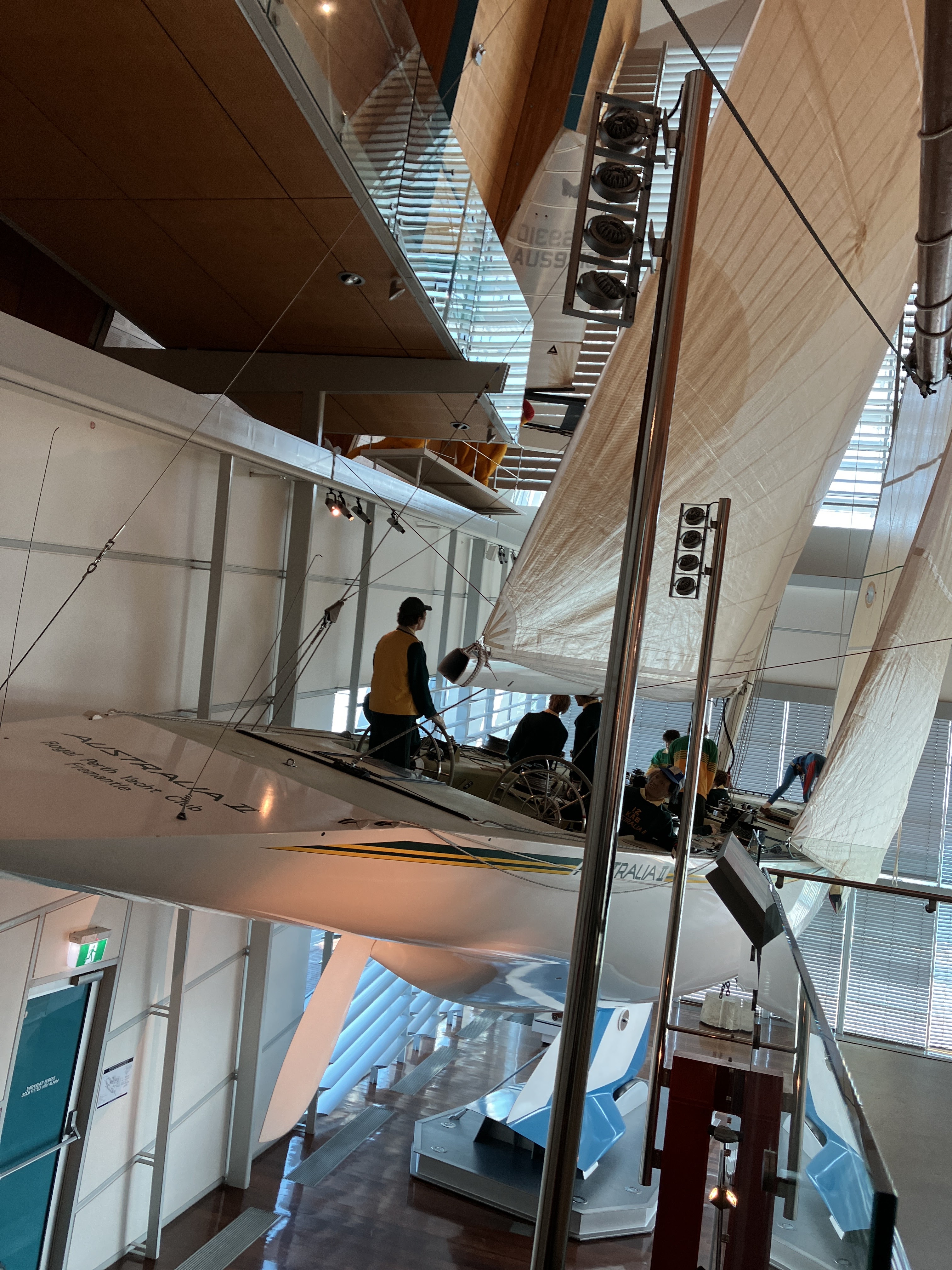
Australia 2,  the boat which famously won the America's Cup in 1983.
Located in the Western Australia Maritime Museum.

After wandering around Fremantle for a few hours we had a decadent afternoon tea.
This cake is called Death by Chocolate, and despite sharing it, we couldn't finish it.

Out on Rottnest Is. The colour of the sea was spectacular
all the way around the island. I used to associate colours
like this with tropical islands, but that's not true of Rottnest.

We had lunch with this view (180 degrees, actually), with almost
no one else around.

No private vehicles are allowed on the island, so if you're able,
bikes are the perfect way to see the sights. It seemed like every five minutes or so 
we were hopping off our bikes to check out a new scene. Stunning!

Quokkas are native to the island. The ones in the populated part of the island 
were quite bold, but we did see three in another part that were more timid.

Working: this group of around 50 people from two or three churches
 gathered on Friday night to hear about OMF and mission work in Japan.
They provided a yummy dinner too! It was a great evening, but I
came home exhausted!

Cliffs at Point Walter Reserve on the Swan River.

Cute shaded beach on the river. With my pale skin
a rare beach with shade is worthy of attention!


02 September, 2023

Different ways of working

For the last three weeks, I’ve had Tuesday morning free to go to our local library and write. This last week was different. We spoke at a growth group from a supporting church (the same church we spent Sunday at, teaching in the Sunday school, being interviewed up front by the pastor, and talking to people before and after the service). It’s a more immersive approach to reporting back to a church that we’re thoroughly enjoying. And it’s made possible by having no school-pickups or needing childcare.

That same evening we went to another growth group from the same church, the first time we’ve worked in the evening like this for a long time. We’re far more used to working during the day and relaxing at night, and neither of us are night owls. It took a long time for me to chill out enough to sleep Tuesday night, and a while to get moving on Wednesday. 

In fact on Wednesday, an admin and preparation day, it was really hard to concentrate and check things off the list of things we had to do. Neither of us are used to working in pairs for planning and executing plans. Both of us usually work on our own for the “thinking” parts of our jobs. It’s not that we mind working together, and in fact we complement each other quite well, but it’s another adjustment, quite a large one.

We had another big day on Thursday: several hours of talking with people at a theological college in the morning, time spent with a couple of different professionals in the afternoon dealing with family matters, plus over three hours of city driving. It was tiring. And then when we got home we had

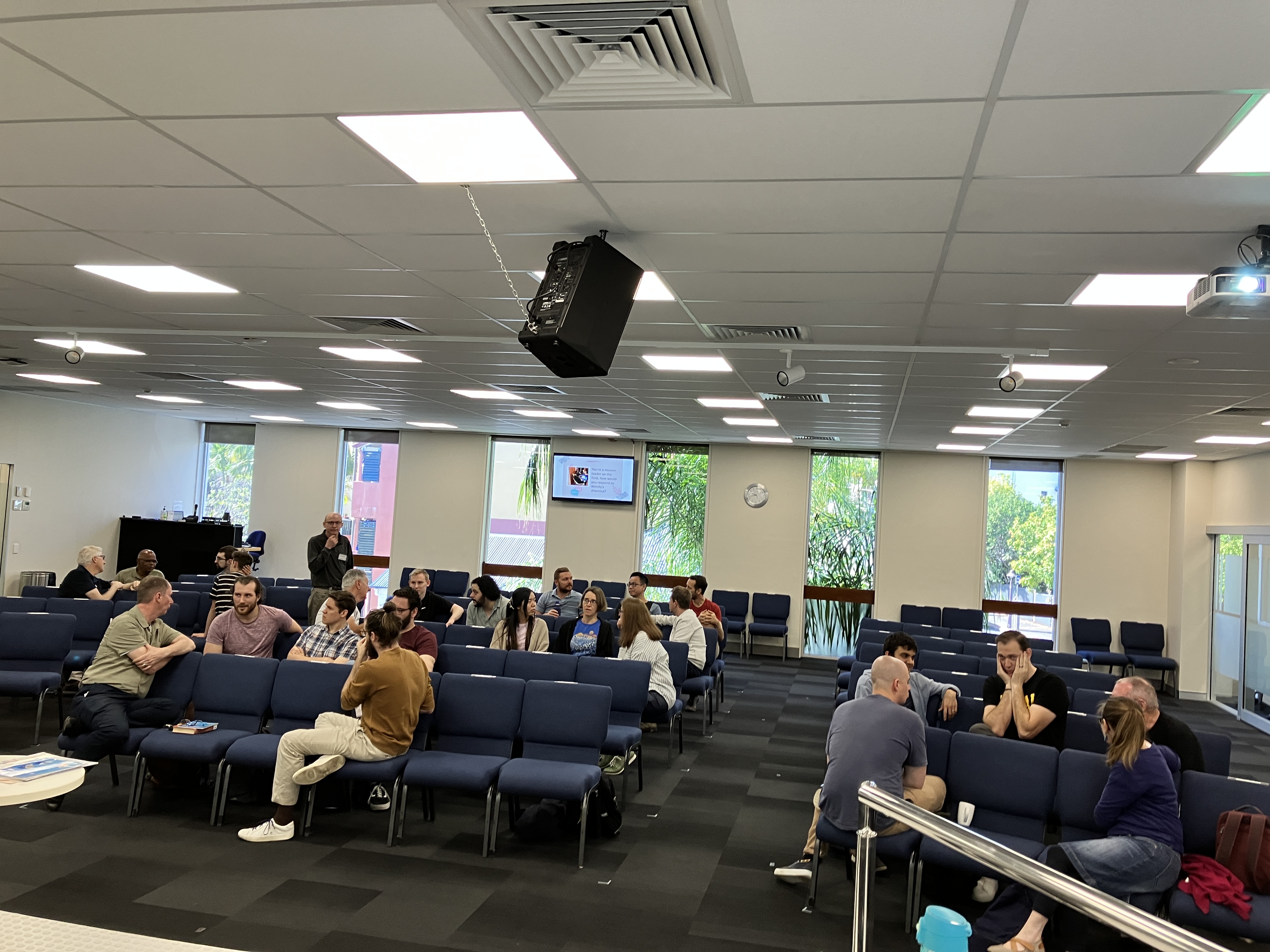
We got the crowd at the theology college
discussing tricky questions.

to finish packing for our 18-day ministry trip to Perth (west coast).

On Friday we dragged ourselves out of bed with the sun and made it to the airport with time to spare, but not really on top of our game. The flight was good—on time and fairly smooth—but we happened to have seats amidst a group of very verbose older folk. Two of the ladies rarely stopped talking during the six-hour flight. It was wearing.

Now we’ve got mild jet lag, Ironic, really, that we can get that here, with a domestic flight, but not really when flying to Japan (one hour difference between Qld and Japan, two hours difference between Qld and Western Australia). I was awake before 5 am this morning, despite my fatigue. But, it’s mild and will resolve quickly. I can’t fathom what many of my international friends cope with, flying across multiple time zones!

The plan for our time in Perth is to visit supporting churches, individual supporters, and also to connect with the OMF network over here. It’s looking different to what we expected it might, but in a few ways that’s really good—when our expectations are foiled, we have to depend on God more, and seek what his plans are.

This is our first multiple-day ministry trip away from home without children. And the first time we’ve ever been away from our guys for more than five days. It’s different for us all, and will require some time to adjust to.

In addition to meetings, we’re planning some relaxing time. This is a beautiful part of the world that not so many people are privileged to see (many Australians never get over to the west coast), it’s always a special treat to be able to come here. One day we’ll plan it that we can get out of this small built-up part of the state and see some other parts of this massive state (the second largest in the world, Texas is only 26th on that list).

We’re missing our usual jobs and ways of working. Gracious, I’m even missing my newly formed Tuesday morning writing habit! But for now we need to be patient with ourselves and each other as we learn new rhythms of life and work for this season.

18 September, 2018

Japan family fun night

On Saturday night we ran a Japan-themed family fun night at our home church. Of all the various up-front things we do, it's one of our favourites. Alas not many churches take us up on the offer to do it. Over the years we've done them in about six different churches.

The principle is simple: introduce people to Japan and mission in a fun way, with lots of interaction and activity.

On Saturday, we knew that people would probably wouldn't all arrive at 5pm when it began. So during the first hour we had a variety of individual activities for people to get into the theme: from origami to Japanese-themed colouring-in and worksheets to dress-up in Japanese clothes. The kids really got into the origami, but there were quite a few takers at the photo booth too.

Then we had a bring-and-share dinner, to which we contributed rice balls (onigiri) and coffee jelly.

After dinner the main programme began.

We divided the group into teams by playing "happy families" where people were given a card with a Japanese surname on it and they had to find the rest of their family.

Then we ran a slipper-chopsticks relay (pictured). They had to change out of their shoes into Japanese slippers, run up to the bowls and move five sultanas from one bowl to the next with chopsticks and then reverse the journey back to tag the next team member.

Chopsticks proved harder than the slippers, though David did advise them not to run in the slippers!

The next activity we started moving towards our theme for the evening: support. Each team got a bag with 45 plastic blocks and had to create a tower that would support this "Japanese missionary" (aka wooden doll). They did really well at this!

The main element of the evening is pictured below. One volunteer (a young girl) was our "missionary" who was first given a box representing "ministry". She was then given a lot of other boxes representing other things missionaries have to do, or need in order to function healthily, eg. visa help, language and culture learning, education of their kids, spiritual growth. Needless to say, she looked rather overwhelmed after being loaded with all that.

So we got more volunteers to take some of the load off her (I've blanked out faces for privacy reasons). It was quite a powerful demonstration of how missionaries involved on the "coal face" of evangelism and church planting, can be mightily helped by having others around them to help. It was pretty obvious that without all those other tasks, the missionary would have a lot more time to do ministry.

The analogy was continued when David asked everyone else to form a circle around the kids. We represented those who remain in the sending country and we support the missionaries by praying, giving, etc.

It was a fairly small group but we were hopeful that those who did come would not forget what they learned there. As our home church, it hopefully helped them to understand why we're doing what we're doing as support workers.

Speaking at churches when you're a support worker in mission isn't the easiest thing. People like to hear conversion stories, news about people being baptised. Teaching science and editing a magazine doesn't have quite the same impact. So we've been trying our best to raise awareness of how important what we do is to those who are evangelists and church planters. That what we do will help those who do those things stay longer and be more effective.

We have one other opportunity to present this to a church group this home assignment. Though if you're reading this and would like us to do this in your church (and you are in SE Qld), then do get in contact with us as we've still got some Fri/Sat nights free (or even mid-week nights).

07 September, 2018

Different presentations every time

So, one of our most obvious jobs these six-months is the up-front speaking. We spoke at two churches in July, and three Sunday morning church services plus one mid-week church meeting and three other groups in August. September is not too much different.


For our sanity we're using the same basic presentation every time. One that we mostly prepared before we came to Australia. However, it also gets tweaked every time according to what we've been asked to provide, the audience, the time we've been given. We add bits in, or take them out, and now, ⅓ of the way through our time here, getting quite adept at this. Tweaking also means altering the power point presentation as needed. 

For example, here are some of the requirements we've been asked to meet:

Church A: 
1.     Share during the service for 5-10 minutes with maybe a summary of what’s been happening in your family and in Japan
2.     After morning tea, to do a 45 minute more detailed summary/presentation of your ministry and OMF’s ministry in Japan (and able to take questions at the end)

Church B:
He (pastor) concurs and you have all the time from 10.00am to present your story and finishing with David preaching. We will need to finish at 10.45

Church C:
Would you be interested in attending a church breakfast? You would have the floor after we had all eaten.

Meeting at a theological college:
[Speaking] from 0930-1020 followed by morning tea 1020-1050 where there is time to chat with the students in a more relaxed setting. . . it will be great for them to hear directly from you of your own experiences, positive and negative, your learned priorities and how you have changed or had to adapt during your time away from Australia. Plus whatever else you deem appropriate. 

Church D:
MLT will try and organise you to visit Bible study groups between those dates and speak at the Mission spot on the Sunday. The Mission spot is 10 mins long and if you have any visuals if you please contact this person...

Mid-week church meeting:
We would like to invite you to one of our Wednesday mission nights to share with us. You have been once before and always appreciated.  I remember you had an activity on sorting garbage in Japan. We start at 7pm and finish at 9pm, with a coffee break at 7.40pm.

Another mid-week church meeting:
Our group can be anything from 12 – 26 people, and yes seniors. All able to drive them selves to the church. We don’t know anything about you or your mission. The group loves hearing from those working in Gods field and you would be warmly welcomed.
We start at 9.30am with morning tea, followed by a devotion – I can get someone from our group to do it or you can do it – about 15 minutes. Then our guest speaker for about 30 minutes with a question time if possible. We can provide a computer and screen if you want to show photos etc.

As you can see our "brief" varies significantly between groups. Sometimes this is written clearly in an email, sometimes it is nutted out over a number of emails or instant messages, or even on the phone (shock! Yes, it still does happen!)

It keeps us on our toes. We enjoy the more formal, small group times where we can interact with our listeners more, but understand the value of getting some precious minutes in front of the captive audience on a Sunday morning.

Our theme of Support and Mobilisation is helping to keep our presentations focused. We're telling people how important it is to have support personnel in mission and putting faces on what that looks like.

Of course this whole thing comes unravelled if we ever have to face the same audience twice, but thankfully that doesn't happen very often.

Ah, but now I need to get back to actually doing that: editing work for the magazine. Thankfully our two meetings for Sunday are pretty well organised, thanks to our method above, plus a little bit of experience under our belts (more than four years experience over the last 20 years) and I can spend time doing other things!

07 August, 2018

A day off

It's been a crazy-busy week. Or should I say month or year? 

When people ask what we've been doing recently, they usually wonder if we're getting any rest. We've been working hard to get ourselves all set-up for ministry and life here, that always takes a lot more time and emotional energy than you expect. And last week I really didn't get much of a break, and it was followed by a weekend away at my parents and speaking at a church in their city—a very people-filled weekend. Then yesterday I had a five-hour Skype meeting with my magazine team in Japan. All good, important stuff, but tiring.

This morning I woke up feeling blurry.

The range of emotions I've been experiencing also include: inadequate, out of control, and off balance. Some of that is related to the busyness, some is related to parenting, and some is just trying (and at times failing) to find new rhythms that work for these six months. It's not really surprising that this extrovert-with-a-strong-introvert shadow, who's had little "me" time (or reflection time) recently is feeling this way.

Today there was nothing on the schedule, and with no designated ministry opportunities for nearly two weeks, we've got a small breathing space. 

So today, I stopped. 

I stopped answering email—though that in itself is a stress, knowing that there are emails to answer, people who are waiting to hear from me. 

I stopped doing Japanese study—yes, I'm still working on that and it is a definite stressor as it doesn't end. I can have no reviews left when I go to bed and find 100 waiting for me when I get up. I'm also still catching up from the break I took for a month while we relocated.

I stopped. And lay on my bed for the morning, reading and playing addictive phone games. As it was a school day I didn't get to sleep-in, but I did get that on Saturday.

This afternoon I got up again and "went". We went to a local gym. Getting some kind of exercise routine going for our family, especially for our home-schooling 15 year old, has been a stressor that we've despaired at solving. It was good to get him out and good for David and I to work out too. Maybe this is the light at the end of that tunnel! We went to the library too, so hopefully I'm fuelled up with some more reality-escaping fiction to relax with at nights.
I like coming back to this convenient kitchen
appliance. In Japan I use a hand-held mixer,
it is fun to have this here to use when we're back.

When we got home I baked. I'm continuing a challenge I gave myself in our last home assignment: that is, to bake my way through a small Australian recipe book I picked up in 2014. It's theme is chocolate and most recipes use at least one ingredient that is hard to get in Japan, so it's fun to do this here. So I baked a Hazelnut Mud Cake. 

I also baked an old favourite: Honey Biscuits (aka Stamp Biscuits), as one boy was complaining about the snacks he'd been receiving in his lunchbox and hankering after some good-old home cooking by mum. Baking takes energy, but is also relaxation for me, so it was good to have the time and energy to do it.

Now I'm writing, processing it all.

All that adds up to a pretty good day off. I'm definitely feeling better than I have for a few days.

Here's hoping that, for a few months at least, I'll be able to balance my weeks a bit better!

25 July, 2018

Adjusting to new rhythms

Sundays are work days for us for these six months in Australia. I know many missionaries work on Sundays routinely, but not us. Our work in Japan is mostly done during the week and during office hours. So when we change countries, we change jobs and change major life rhythms too. It takes a lot of adjusting to.

The weekend just past looked like this:

Saturday
Part of our new neighbourhood. Very different to where we live in Tokyo!
We spent a lot of the day preparing for our visit to a supporting church the next day. That
 included what we would say up the front (about 10 minutes), the powerpoint presentation we would use, the other visual aid we'd prepared, as well as the table display we'd prepared (books, leaflets, magazines, and a display board).


We didn't spend all day Saturday working, we took some time after
lunch to go wandering in nearby scrub. This isn't far from our house.
Sunday
We left at 8.15, drove an hour, then spent 30 minutes getting set-up and settled, spoke during the service, spent an hour or so afterwards talking to people, then packing up, and driving home. 

It doesn't sound like a lot, but it was exhausting. 

In those short 30 minutes of set-up time we stumbled into another church who were meeting on the same premises (it's a Seventh Day Adventist church that has several halls that it rents out on Sundays to churches/sects without their own church building). Thankfully that error was quickly spotted by a leader who checked that we were in the right place. I guess we looked a bit odd, sporting a suitcase, a large display board (still in its carry case), and a long poster-cylinder.

We didn't just drive straight home, we grabbed some fast food for lunch and then half-way home stopped off to pick up our eldest son, who drove us the rest of the way, getting 50 more minutes of driving practise in (he needs 100 hours to go for a test). 

Soon after we arrived home some family who are holidaying in the area dropped in for a few hours to visit.

I was exhausted by the end of the day. I had to lie down straight after dinner as I felt a bit ill.

Monday
I hadn't factored this in. The fact that the weekend wasn't a restful time and that I needed mid-week (preferably early in the week) time off. I'd booked myself in for an optometrist's appointment for Monday morning, along with needing to do groceries after the weekend, and then without much break, take a boy to the doctor (the latter couldn't be scheduled later, he had an infection that needed attention). So by the end of Monday I sported a headache and wasn't in great shape.

Glad to be back in Australia?
People keep asking if we're glad to be back in Australia (some say "back home", which is another whole topic). I can't answer that question with a 100% positive "YES", because making any big change takes a lot of energy and has negatives attached to it. Making a big change as a family is even more gigantic than just doing it as a single or couple. Yes, there are many good things about being in Australia, but there are things about it that aren't so good, like adjusting to lots of change all at once.

As I said at the start of this post, one big change is our change in jobs. We're now spending weekends and other times talking about what we do in Japan. That's considerably different to writing and editing at my desk in Tokyo from Monday to Friday between 8.30 and 5. It's also different to teaching at a school and overseeing professional development and curriculum. The rhythm is different, the stressors are different. We need to be gentle on ourselves as we adjust to the changes.